Decoding the Language of Your Marriage: What Love & Respect Teaches About Breaking the Cycle of Conflict
I want you to think about the last truly exhausting argument you had with your partner.
You know the one. It probably started over something trivial—the tone of a text message, a forgotten chore, a misunderstood comment about the weekend plans. But within ten minutes, the dishwasher was forgotten, and suddenly you were litigating the last five years of your relationship. You were both speaking, both raising your voices, both armed with flawless logic and historical grievances. Yet neither of you was being heard.
If you have ever walked away from a fight like that feeling entirely depleted, wondering, “Why do we keep having the exact same argument?”, I want to offer you a perspective that has helped countless couples step off the battlefield.
The problem is rarely the surface issue. The problem is a profound translation error. You are broadcasting on one frequency, and your partner is listening on another.
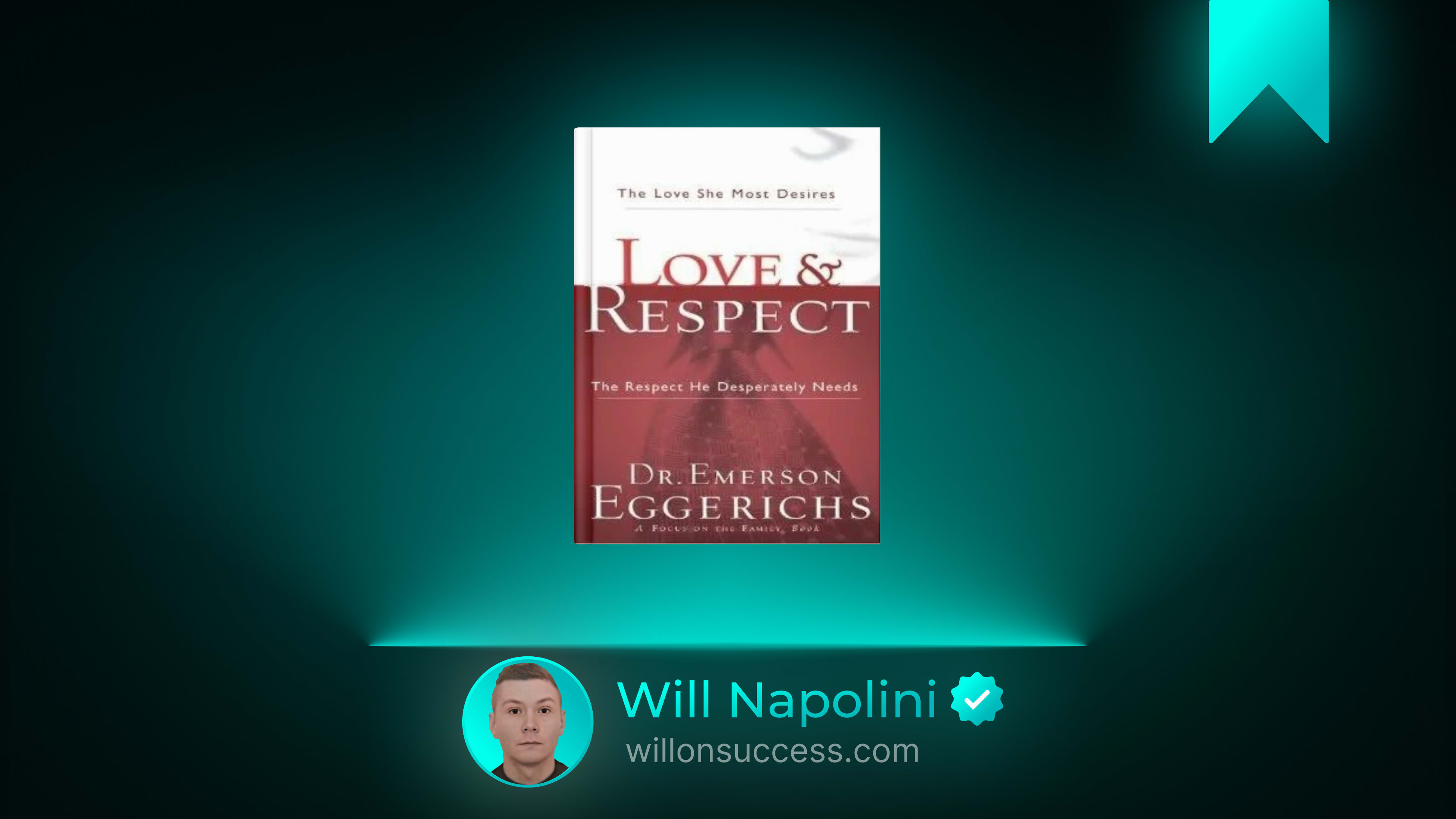
Emerson Eggerichs addresses this exact gridlock in his book Love & Respect. Based on decades of counseling and a specific interpretation of Ephesians 5:33, the book proposes a deceptively simple central thesis: A wife’s primary emotional need is to feel loved, and a husband’s primary emotional need is to feel respected.
When these two distinct needs collide and are misunderstood, couples fall into a destructive feedback loop. But when you learn to speak your partner’s native emotional language, the entire architecture of the marriage changes.
This matters because you cannot build a lasting, peaceful home using the tools of a courtroom. You cannot logic your partner into feeling cherished, and you cannot argue your way into being admired. Understanding the mechanics of love and respect is not about keeping score; it is about finally giving your partner the specific type of support they actually need to thrive.
The Anatomy of the Crazy Cycle
Eggerichs illustrates the core conflict in most marriages through a concept he calls the “Crazy Cycle.” The mechanism is brutal in its simplicity:
Without love, she reacts without respect. Without respect, he reacts without love.
Imagine a wife who feels emotionally disconnected. She feels her husband is distant, preoccupied, or dismissive. Because her primary need is love, this deficit feels like a threat to her security. Her reaction, often born of hurt and a desperate desire to be heard, comes out as criticism, sarcasm, or contempt.
Her husband, whose primary need is respect, hears her criticism not as a plea for connection, but as an attack on his competence and character. Feeling disrespected, his instinct is to defend, withdraw, or counterattack. His withdrawal or anger feels profoundly unloving to her.
And so the wheel turns. She feels more unloved, so she becomes more disrespectful. He feels more disrespected, so he becomes more unloving.
I have sat with couples who have been spinning on this wheel for decades. They are not bad people. They are not out of love. They are simply trapped in a psychological trap where their natural, instinctive reactions to pain are precisely what trigger their partner’s deepest insecurities.
You cannot demand in a tone of voice what you are asking for in your words. If you scream for love, you sound disrespectful. If you coldly demand respect, you sound unloving. The Crazy Cycle ensures that the harder you try to get your needs met using your own native language, the more you starve your partner of theirs.
The Translation Error: Pink and Blue Lenses
To help couples visualize this, Eggerichs uses the metaphor of colored lenses. He suggests that women generally view the world through “pink” sunglasses and hear through “pink” hearing aids—everything is filtered through the need for love, closeness, and emotional security. Men generally view and hear through “blue” lenses—filtered through the need for respect, trust, and competence.
When a husband comes home from a stressful day at work and immediately retreats to his garage or his computer, he is wearing his blue lenses. He is seeking decompression. He is not trying to be hurtful. But his wife, looking through her pink lenses, interprets his withdrawal as rejection. He doesn’t want to be with me. I am not important to him.
When she expresses her hurt by saying, “You never care about what happens in my day,” she intends to communicate a need for love (pink). But he hears it through his blue lenses as: You are failing as a husband. You are inadequate.
What I discovered in studying this dynamic is that most marital resentment is just un-translated love. You are both trying to care for the relationship, but you are handing each other the wrong tools. You are handing a thirsty person a sandwich, and then getting angry when they don’t eat it.
This framework is a generalization, and it is important to acknowledge that individuals vary. Some men deeply crave verbal affection, and some women deeply crave professional or intellectual respect. But as a diagnostic tool for the specific, repetitive gridlock that plagues millions of heterosexual marriages, the Love/Respect dynamic is startlingly accurate. It provides a vocabulary for the invisible wounds you have been inflicting on each other without realizing it.
Stopping the Wheel: The Courage to Move First
Understanding the Crazy Cycle is intellectually interesting, but it changes nothing until someone decides to stop spinning the wheel.
This is where the book transitions from observation to profound personal responsibility. Eggerichs introduces the “Energizing Cycle”: His love motivates her respect; her respect motivates his love.
But here is the difficult truth, the one that requires genuine character to implement: You cannot wait for your partner to change their language before you learn to speak theirs.
If you are the husband, you must choose to show love even when your wife is acting disrespectfully. You must look past her sharp tone and see the frightened, disconnected woman underneath who is just begging to know she matters to you.
If you are the wife, you must choose to show respect even when your husband is acting unlovingly. You must look past his emotional withdrawal and see the man who feels he is failing, who needs to know you still believe in him.
This is not about keeping a ledger. It is not about saying, “I will only be loving if you are respectful.” That is a transaction, not a marriage. This is about taking radical responsibility for your half of the dynamic. It is the principle of action before intention. You do not wait to feel the warm emotion of grace; you extend the grace, and the emotion often follows.
I know this sounds unfair in the moment. When you are hurt, the last thing you want to do is speak your partner’s love language. But acting on principle rather than reacting to pain is the hallmark of emotional maturity. You are choosing to be the thermostat that sets the temperature of the room, rather than the thermometer that merely reflects it.
What Respect Actually Looks Like (And What It Doesn’t)
I need to pause here and address a vital nuance. In some circles, the concept of “wifely respect” has been weaponized to demand blind obedience, silence, or the toleration of poor behavior. That is a gross distortion of Eggerichs’ work and of healthy relationship dynamics.
Respect, in the context of a healthy marriage, does not mean agreeing with everything your partner says. It does not mean abandoning your boundaries, your voice, or your dignity. It does not mean staying in an abusive situation. (If you are experiencing abuse, the principles of this book do not apply to you; your primary job is to seek safety and professional help).
In a healthy marriage, respect means honoring your partner’s humanity, his intentions, and his efforts. It means assuming the best of him. It means speaking to him, especially in front of others and especially your children, with dignity. It means acknowledging his hard work, even if the execution wasn’t perfect.
For men, showing love does not mean just providing financially or fixing the car. Love, for a woman, is often spelled C-H-A-I-R-S: Closeness, Honesty, Appreciation, Inclusion, Responsibility, and Security. It means holding her hand without it leading to sex. It means listening to her problems without immediately trying to “fix” them, because to her, the listening is the fixing. It means making her feel that she is the most important person in your world, not just the manager of your household.
A marriage is not a courtroom where you prove your innocence; it is a garden where you tend to what the other person needs to grow.
Why This Matters on an Ordinary Tuesday
It is easy to read about emotional frameworks and think they are only for grand moments of crisis. But the true test of your marriage happens on an ordinary Tuesday evening when you are both tired, the kids are loud, and the dinner is burning.
When he forgets to take out the trash, her pink lenses see: He doesn’t care about my time or my stress. Her reaction is a heavy sigh and a sharp comment.
His blue lenses hear: I am a failure. Nothing I do is ever enough. His reaction is to shut down and stare at his phone.
If you apply the Love & Respect framework, the Tuesday evening changes. She feels the frustration rising, but she catches it. She translates her need. Instead of a sharp comment, she says, “I’m feeling really overwhelmed with the house tonight. Could you help me by taking the trash out? I’d really appreciate it.” She speaks to his need to be respected and helpful.
He hears the request. He feels the respect in her tone. He takes out the trash. When he comes back inside, instead of retreating to his phone, he walks over, puts a hand on her shoulder, and says, “You’re working really hard today. Let me handle the kids’ baths.” He speaks to her need for love and closeness.
The dishes are still dirty. The kids are still loud. But the connection is intact. The cycle is broken.
Who Should Read This Book
Love & Respect has helped millions of couples, but it is a specific tool for a specific type of gridlock.
You will benefit deeply from this book if you:
- Find yourselves having the exact same argument, just with different details, over and over again.
- Feel like you are giving your partner everything you have, but they still complain that they aren’t getting what they need.
- Are willing to take responsibility for your own reactions, rather than just demanding your partner change.
- Are open to a framework that is rooted in Christian principles (Eggerichs writes from a biblical worldview, though the psychological mechanics are widely applicable).
You may find this book less useful, or potentially harmful, if you:
- Are in a relationship characterized by emotional, physical, or verbal abuse. (Respect cannot be demanded by an abuser, and this framework should never be used to trap a victim).
- Are looking for a strictly secular, clinical psychology text devoid of religious language.
- Have a partner who completely refuses to acknowledge their side of the dynamic (you can change your own steps in the dance, but you cannot force a willing partner to dance).
One Small Step You Can Take Today
You do not need to overhaul your entire communication style by tomorrow morning. Consistency will always outperform intensity. You just need to interrupt the Crazy Cycle once, today.
Send a text message right now that speaks your partner’s native language.
If you are the husband, send her a message that communicates closeness and love, with no logistical questions attached. Do not ask what is for dinner. Text her: “I was just thinking about how much you do for our family, and I just wanted to say I love you and I appreciate you.”
If you are the wife, send him a message that communicates respect and belief in his competence. Text him: “I know you’ve been working incredibly hard lately to provide for us and manage everything. I just wanted to say I see it, I respect how hard you work, and I’m proud of you.”
Do not send it expecting a perfect, immediate, effusive response. Send it simply to deposit the correct currency into their emotional bank account.
You do not break the cycle by waiting for your partner to change their language. You break it by becoming fluent in theirs.