The Long Walk Is Not Over: What Mandela's Autobiography Teaches About Patience, Purpose, and Freedom
Twenty-seven years.
I want you to sit with that number for a moment. Not as an abstraction. Not as a statistic in a history lesson. Twenty-seven years in a cell. Waking every morning to the same stone walls, the same routines, the same small patch of sky. Watching your children grow up in photographs. Learning, piece by piece, that the world outside is moving forward without you, and that you may never be part of it again.
Most of us cannot imagine a week of genuine constraint without feeling our identity begin to fray. Nelson Mandela endured twenty-seven years of it. And when he walked out of Victor Verster Prison on February 11, 1990, he did not walk out broken. He did not walk out consumed by vengeance. He walked out with his mind intact, his purpose clarified, and a decision already made that would alter the course of a nation: he would pursue reconciliation rather than retribution.
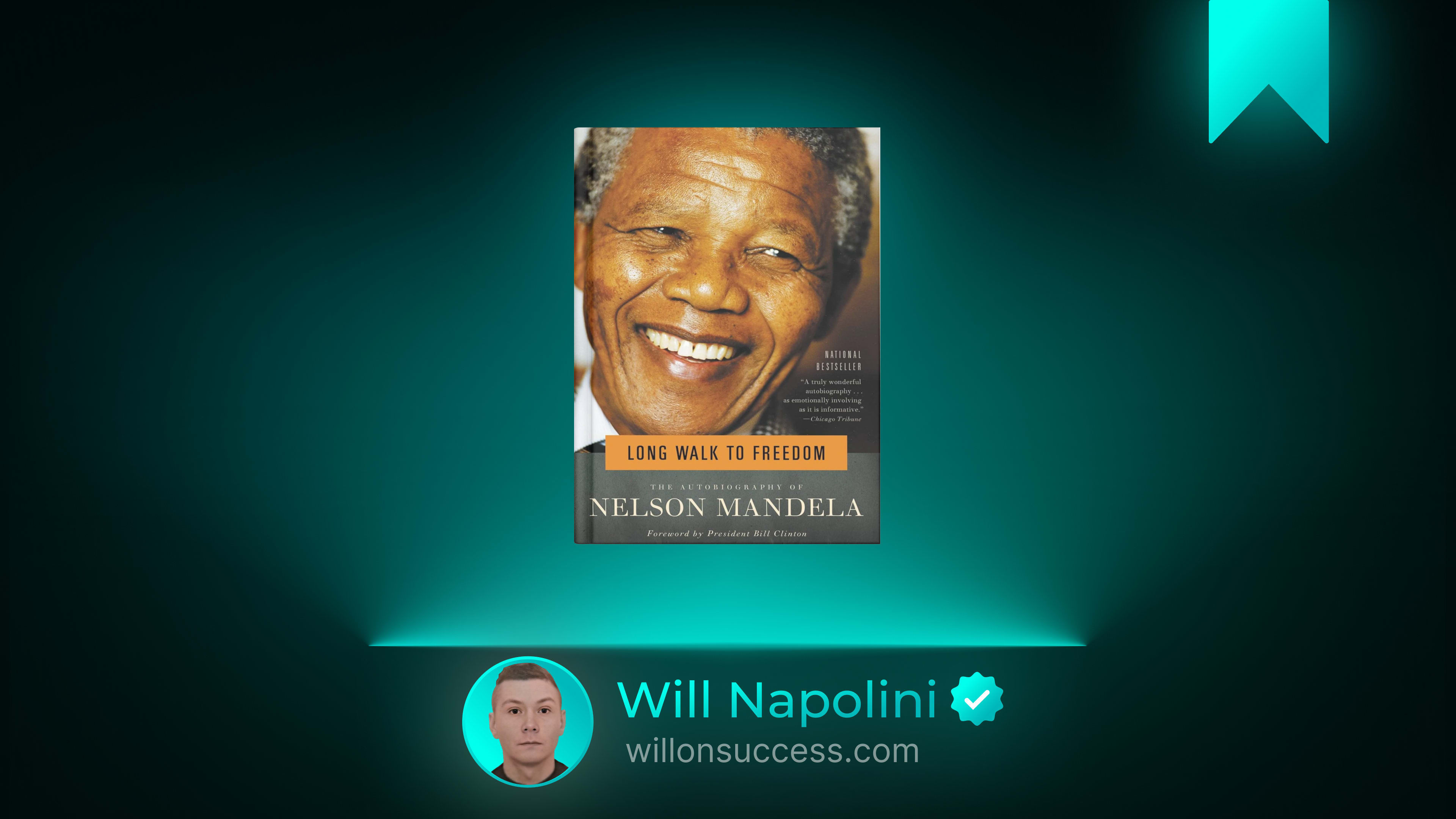
Long Walk to Freedom, published in 1994, is the story of how a person becomes capable of making that choice. It is not a book about a saint. It is a book about a man who was angry, who was sometimes reckless, who missed his children’s childhoods, who failed in marriage, who authorized armed resistance, and who spent nearly three decades in prison learning, slowly, painfully, what it actually means to be free.
The central idea of the book is contained in its title. Freedom is not a destination you arrive at. It is not a single election, a single signature on a document, a single moment of release. It is a long walk. It is a daily practice. And the walk does not end when the chains come off. In many ways, it only begins.
The Boy Who Was Given a Name That Meant “Troublemaker”
Mandela was born Rolihlahla Mandela in 1918 in the Eastern Cape, a name his father gave him that translates roughly as “pulling the branch of a tree,” or more colloquially, “troublemaker.” He was Thembu royalty, raised in the village of Qunu, shaped by the stories of elders who spoke of a time before colonial dispossession.
What struck me most in the early chapters is not the drama of later events but the quiet formation of a moral imagination. Young Mandela watched the regent of his tribe conduct meetings by listening to everyone before speaking last. He absorbed the principle that leadership is not domination but stewardship. He learned that dignity is not granted by circumstance; it is maintained by conduct.
This matters because we tend to assume that extraordinary people are born extraordinary. They are not. They are shaped by small, repeated exposures to principle long before they are tested by crisis. The seed is planted in childhood. The harvest comes decades later, in a prison cell, when you must decide whether to let bitterness eat you alive or to keep tending the small garden of your own character.
You are being shaped right now, in the small rooms of your life, by what you watch, what you tolerate, what you practice when no one is looking. The person you will need to be in your hardest moment is being built in your ordinary ones.
From Anger to Strategy: The Education of a Fighter
Mandela did not begin as the serene reconciler the world eventually met. In his twenties and thirties, he was fiery, impatient, sometimes arrogant. He co-founded the ANC Youth League because he believed the older generation was too cautious. He helped organize the Defiance Campaign. He watched the Sharpeville Massacre in 1960, where police opened fire on peaceful protesters, killing sixty-nine people. He saw the state answer nonviolence with slaughter.
And he changed his mind. This is crucial. Mandela, along with others, concluded that nonviolent resistance alone could not dismantle apartheid. He helped form Umkhonto we Sizwe, the armed wing of the ANC. He went underground. He was arrested. At the Rivonia Trial in 1964, he stood in the dock and delivered a speech that remains one of the most extraordinary statements of moral conviction in the twentieth century. He said he had cherished the ideal of a free and democratic society, that he hoped to live for it, but that if needs be, it was an ideal for which he was prepared to die.
I tell you this because I do not want to flatten Mandela into a comfortable symbol. He was not a gentle man who stumbled into sainthood. He was a strategist who weighed terrible options and chose what he believed necessary. He was a person who evolved. And that evolution is the most important lesson in the book.
You are permitted to change your mind. You are permitted to outgrow your own anger. You are permitted to discover that the strategy which served you at twenty-five is not the strategy that will serve you at fifty-five.
Mandela’s life is not a straight line. It is a spiral. He circles back to the same questions—What is justice? What is the cost? What is possible?—but from a higher vantage point each time. The young man who wanted to fight the system becomes the older man who must negotiate with it. The prisoner who could have demanded release on condition of renouncing armed struggle chooses instead to remain in his cell rather than compromise the movement. The old man who walks free chooses to invite his former jailers to his inauguration.
Each of these decisions required a different kind of courage. And none of them was inevitable.
The Forge: What Prison Teaches When You Let It
Robben Island was designed to break people. Hard labor in a limestone quarry. A tiny cell. Limited contact with the outside world. Guards who wanted to reduce you to a number.
Mandela spent eighteen years there.
What he describes is not a story of triumphant endurance. It is a story of grinding, daily, unglamorous persistence. He and his fellow prisoners established routines. They studied. They debated. They tended a small garden. They argued with each other. They grieved. They aged.
I have learned, through my own smaller seasons of constraint, that the most important thing a person can build in a time of powerlessness is routine. Not because routine is exciting. Because routine is the skeleton that holds you upright when everything else has been stripped away. You wake. You work. You study. You rest. You repeat. You do not wait for inspiration. You do not wait for rescue. You build a structure inside the absence of freedom, and that structure becomes the proof that you have not been erased.
Mandela wrote about the importance of maintaining his mind in prison—reading, writing letters, studying Afrikaans so he could understand the language of his oppressors. This was not mere self-improvement. It was an act of war against despair. It was a declaration that his inner life belonged to him, regardless of what they did to his body or his circumstances.
You cannot always control what is done to you. You can always protect the small sovereign territory of your own attention.
And there was the garden. Mandela grew tomatoes and onions in a small patch of earth on Robben Island. He wrote about the satisfaction of planting a seed, tending it, watching it emerge. I think this is one of the most important metaphors in the entire book. In a place designed to produce nothing, to crush all growth, to reduce men to labor and silence, he grew tomatoes. He chose to participate in creation rather than only endure destruction.
You may be in a season of constraint right now. You may feel imprisoned by illness, by poverty, by a job that grinds you down, by a grief that will not release you. I cannot promise you that the cell door will open soon. But I can tell you this: you can grow something. A practice. A skill. A relationship. A small daily act of creation that says, I am not only surviving. I am still building.
The Choice That Changed Everything
In 1990, after twenty-seven years, Mandela was released. The world watched. And the question that hung over South Africa was simple and terrible: What now?
The country was a powder keg. Decades of apartheid had produced rage, trauma, and a deeply entrenched system of white minority rule. The expectation, in many quarters, was retribution. Blood. Settling of scores.
Mandela chose differently. He chose negotiation. He chose to learn Afrikaans in prison so he could speak to his captors in their own language. He chose to invite the Springboks—the rugby team that had been a symbol of white supremacy—to represent a unified nation. He chose the Truth and Reconciliation Commission over Nuremberg-style tribunals. He chose to govern with his former oppressors rather than to exclude them.
This was not weakness. I want to be very clear about that. Forgiveness, in Mandela’s hands, was not the absence of justice. It was a different architecture of justice. It said: I will not become what was done to me. I will not build the future out of the same material as the past.
He wrote in the book that hatred is learned, and therefore love can be taught. He wrote that no one is born hating another person because of the color of their skin. This is not naive optimism. This is a man who looked into the eyes of the system that stole three decades of his life and decided that the cycle would stop with him.
I have seen this principle operate in smaller rooms. I have watched people choose, after betrayal, after loss, after years of being diminished, to set down the weight of resentment—not because the other person deserved forgiveness, but because they themselves deserved peace. The choice to release bitterness is never a gift to the person who harmed you. It is a gift to the person you are trying to become.
Resentment is a cage you build around yourself and call justice.
The Long Walk Continues
The book’s title is not triumphant. It is not The Walk to Freedom, completed, achieved, finished. It is the Long Walk. Ongoing. Unfinished. Mandela ends not with victory but with the recognition that the work is not done. That freedom, once achieved politically, must still be achieved economically, socially, personally. That every generation inherits the walk and must take its own steps.
This is the deepest lesson I take from the book, and the one I return to most often in my own life: the goal is not to arrive. The goal is to walk well.
You may be in the middle of your own long walk. A career that is not yet what you hoped. A relationship that requires years of patient rebuilding. A creative project that has not yet found its audience. A healing that is slower than you want, messier than you expected, further from completion than you can bear.
Mandela’s life says this: the length of the walk does not invalidate it. The years in the cell were not wasted. They were the forge. They were the education. They were the slow, invisible work that made the final steps possible.
You start small. You stay steady. You let time do what only time can do.
And you do not mistake the current chapter for the entire book.
Who Should Read This Book
Long Walk to Freedom is a long book. It is detailed, sometimes slow in its early chapters, and unflinching in its depiction of political struggle. It is not a quick inspirational read. It is a life, fully told.
It will transform you if you:
- Are in a season of waiting and need proof that patience is not passivity
- Are wrestling with bitterness and need to see what choosing release actually looks like in practice
- Are interested in leadership, moral courage, and the mechanics of social change
- Need to understand that a person can evolve radically over decades, and that your current self is not your final self
- Are facing a decision between revenge and reconciliation, in any area of your life
It may be less suited if you:
- Are looking for a short, distilled motivational text (the book is over 600 pages and moves deliberately)
- Want a purely uplifting narrative without confronting the genuine brutality of apartheid
- Are unfamiliar with South African political history and want a textbook rather than a memoir (though the book teaches the history through lived experience)
Read it slowly. Let it take time. The pacing of the book mirrors the pacing of the life it describes. You are meant to feel the length.
One Small Step You Can Take Today
You do not need to spend twenty-seven years in prison to apply what Mandela learned. You only need to identify one place in your life where you have been waiting for permission, for rescue, for the perfect moment, and choose instead to begin the small daily practice of building.
Tonight, before you sleep, write down one thing you have been enduring that you wish to transform.
It might be a resentment. A stalled project. A relationship that has gone cold. A version of yourself you have outgrown but haven’t released.
Then write one small action—something you can do in the next twenty-four hours—that tends that situation the way Mandela tended his garden. Not to fix it. Not to solve it. Just to put one seed in the ground.
Send the message. Open the document. Make the phone call. Apologize for the small thing you’ve been avoiding. Sit in silence for ten minutes and let the bitterness speak, and then let it leave.
You do not have to see the end of the walk. You only have to take the next step with your eyes open and your hands willing.
The cell door you are waiting for someone else to open may already be unlocked. The long walk is not the punishment. The long walk is the becoming. And you are already on it.