The Most Dangerous Beautiful Lie: What Lolita Actually Teaches About Seeing Clearly
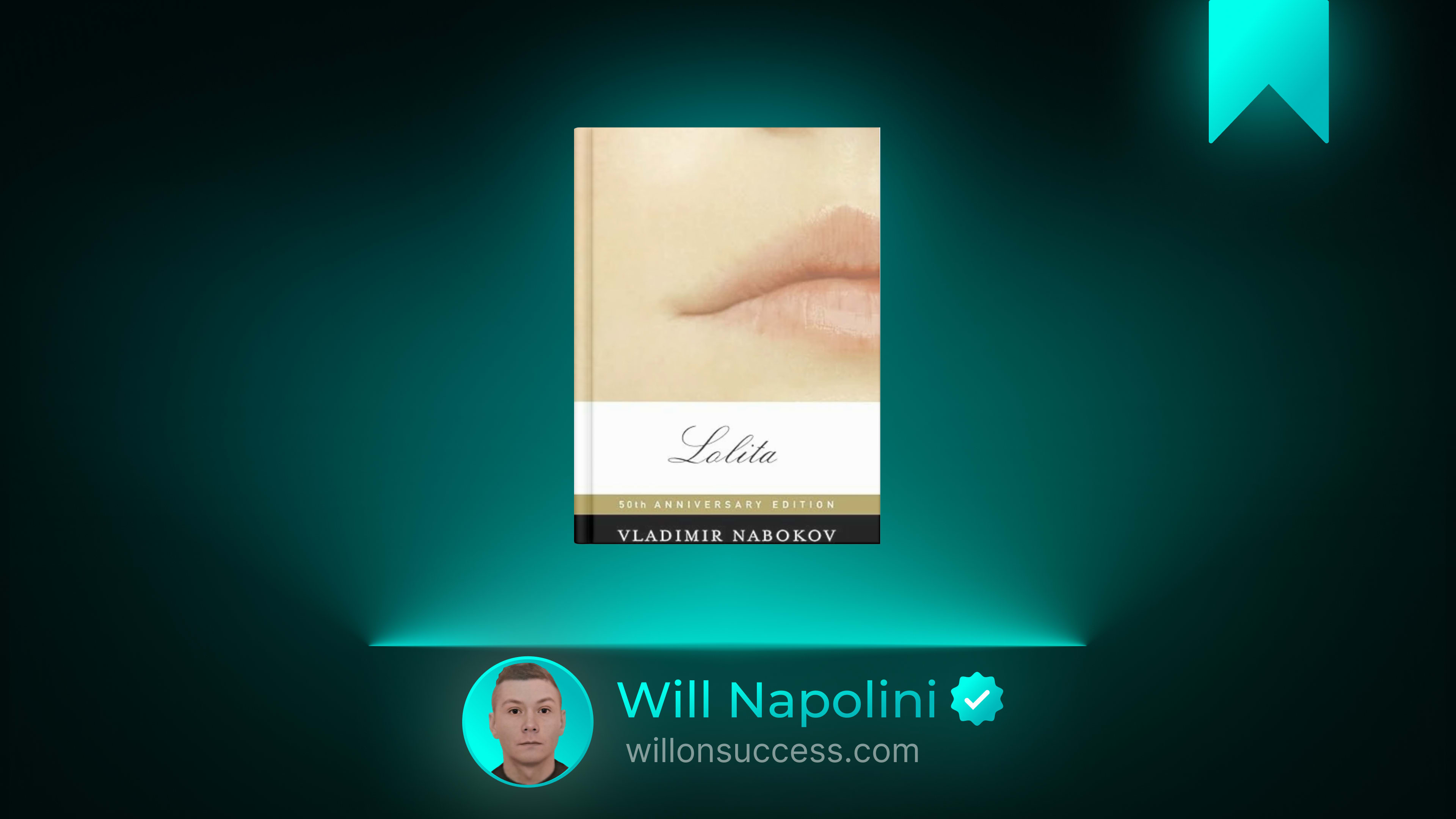
I need to be honest with you before we begin.
This is not a comfortable summary. The book I am about to discuss is not a guide to productivity, or a framework for better habits, or a gentle meditation on gratitude. It is a novel about a man who sexually destroys a twelve-year-old child, and it is written in some of the most exquisite prose ever committed to the English language. That tension—the unbearable collision of beauty and atrocity in the same sentence—is the entire point.
I will not pretend this is easy reading. I will not soften what happens. And I want to say clearly, at the top, before we go further: if you are a survivor of abuse, you do not owe this book your time. You do not owe anyone a confrontation with this material for the sake of literary education. Close this article if you need to. Your peace matters more than any book.
But if you stay, I want to show you something I have come to believe is one of the most important moral lessons any novel has ever taught. Not about desire. Not about romance. About the terrifying architecture of self-deception, and how easily the most beautiful language in the world can be used to make you complicit in the destruction of a child.
What This Book Is Not
Let me begin by clearing away the fog that popular culture has draped over this title.
Lolita is not a love story. It is not a tragedy about forbidden passion. It is not, in any honest reading, sympathetic to its narrator. The name “Lolita” has been absorbed into the culture as a shorthand for a seductive young girl, but this is a grotesque inversion of what the novel actually contains. Dolores Haze—the real girl beneath the nickname Humbert invents for her—is not a seductress. She is a child. She plays with dolls. She likes comic books. She cries for her mother. And she is systematically destroyed by an adult man who has decided that his fantasy matters more than her existence.
Vladimir Nabokov published the novel in 1955. He spent years struggling to find a publisher willing to touch it. In his afterword, he stated plainly that the book carried no moral in the traditional fable sense, but he also made clear that Humbert Humbert was “a vain and cruel wretch who managed to appear pathetic.” The word that matters there is managed. Humbert’s pathos is a performance. It is a strategy. It is designed to manipulate you, the reader, into feeling sorry for a monster while the monster narrates the annihilation of a child.
The central idea of Lolita is not about love. It is about what happens when one person’s inner narrative becomes so absolute, so beautifully constructed, so rhetorically perfect, that it swallows another person’s reality whole. It is about solipsism dressed as devotion. And it is about you—the reader—and how easily you can be charmed into looking away.
The Narrator’s Architecture: How Humbert Controls What You See
The novel is structured as Humbert’s written confession, composed in prison after Dolores is gone. He is addressing a jury. He knows you are reading. And from the very first line—the famous, hypnotic incantation of “Lolita, light of my life, fire of my loins”—he is seducing you.
This is not accidental. This is the novel’s mechanism.
Humbert is intelligent, cultured, witty, and devastatingly eloquent. He quotes poetry. He mocks his own pretensions with self-aware humor. He constructs elaborate metaphors that make his obsession sound like a sacred quest. He tells you, in effect, that what happened was a grand tragedy of fate and beauty, rather than what it was: a grown man harming a child he was supposed to protect.
And here is what I have learned from sitting with this book over many years: it works. The prose is so beautiful, the voice so charming, the wordplay so delightful, that readers frequently finish the novel feeling sorry for Humbert. They feel he was trapped by passion. They feel Dolores was somehow part of the equation, somehow complicit, somehow responsible.
That response is not a bug in the novel. It is the novel’s subject. Nabokov is demonstrating, in real time, on your own nervous system, how aesthetic beauty can override moral judgment. He is showing you that if a voice is sufficiently lovely, sufficiently clever, sufficiently confident, you will follow it into atrocity and call it art.
I have seen this principle operate far beyond fiction. I have watched people in boardrooms, in relationships, in families, use eloquence and charm to reframe their harm as someone else’s failing. The abuser who speaks in poetry. The leader whose vision is so stirring you forget to ask who is being crushed beneath it. The partner whose explanations are so elaborate you lose track of the simple fact that they hurt you.
Beautiful language does not make a true statement. It makes a persuasive one. These are not the same thing.
The Erasure of Dolores: What Happens When Someone Becomes Your Projection
Here is the detail that has stayed with me longest, the one I return to when I need to remember what the novel is actually about.
Dolores Haze does not narrate. She does not get a chapter. She does not get an interior monologue. Everything we know about her is filtered through Humbert’s possessive, fantasizing gaze. He renames her “Lolita”—she did not choose that name. He constructs her as a “nymphet,” a mythological creature of his own invention, because the reality of a twelve-year-old girl does not fit the narrative he needs to justify himself.
But Nabokov leaves cracks. Dolores cries at night. Dolores begs to leave. Dolores is ordinary, awkward, adolescent, human. She likes movies and soda and tennis. She is not a mythological creature. She is a child who has lost her mother and is now trapped with a man who will not let her be real.
The novel’s deepest horror is not any single act. It is the total erasure of Dolores’s subjectivity. Humbert does not see her. He sees a screen onto which he projects his fantasy. And because he controls the language—because he is the narrator, the writer, the voice—the reader is forced to see her through his distortion unless they actively resist.
This is the principle I want you to carry forward: Every time you reduce another person to a function of your own narrative, you are performing a small version of what Humbert performs.
You do it when you decide your colleague is “the difficult one” and stop listening to their actual words. You do it when you cast your ex-partner as the villain in the story you tell your friends, flattening their complexity into a role that lets you remain innocent. You do it when you look at a stranger and see only a category, a stereotype, a background character in the movie of your life.
The antidote is not complicated, but it is not easy. The antidote is to ask, persistently: What is this person’s experience of me? What do they need that has nothing to do with my story? Am I seeing them, or am I seeing my projection of them?
The Reader’s Complicity: Why You Are Part of the Story
Nabokov does not let you off the hook. That is what makes the novel genuinely dangerous rather than merely transgressive.
If you finish Lolita and feel sympathy for Humbert, the novel has done something to you. It has shown you that your moral compass can be overridden by style. It has demonstrated that you can be made to admire the man destroying the child, simply because he describes the destruction in gorgeous sentences.
I have learned, through years of mentoring people through difficult self-examination, that the hardest truth to accept is this: you are not immune to manipulation by beauty. You are not so rational, so grounded, so morally certain that a sufficiently charming voice cannot lead you into ethical failure. The fact that you are reading a summary of Lolita and feeling the pull of its famous opening line means the mechanism is already working on you. That is not a condemnation. It is information.
The question the novel asks is not “What kind of monster is Humbert?” The question is: “What beautiful lies are you currently believing because they were told to you in a voice you find attractive?”
Maybe it is a leader whose rhetoric makes you feel chosen while they consolidate power. Maybe it is a relationship in which someone’s explanations are so poetic you never quite land on the simple fact that your boundaries are being crossed. Maybe it is a story you tell yourself about your own behavior—I had no choice, I was passionate, I was driven, it was complicated—that uses complexity to obscure a simple harm.
Nabokov wrote the novel to make you feel that seduction in your own body, so that next time, in real life, you might recognize the mechanism before it completes its work.
The Architecture of Self-Justification
Humbert does not say, “I am going to harm a child.” He says, “Fate decreed.” He says, “She was already damaged.” He says, “I was enchanted, possessed, helpless before the power of beauty.” He constructs an elaborate mythology around his actions so that he never has to use the plain word for what he is doing.
I have seen this architecture built in smaller, quieter ways in every area of life. The manager who calls exploitation “opportunity.” The friend who calls control “concern.” The person who calls their avoidance “respecting your space.” The stories we build around our worst impulses are always more elaborate than the impulses themselves. The lie requires architecture. The truth is usually simple and small and painful.
The more ornate the justification, the more likely it is concealing something the speaker cannot face.
This does not mean complexity is always deception. Life is genuinely complex. But there is a difference between complexity that illuminates and complexity that obscures. Humbert’s language is the second kind. It is designed to make you unable to see the simple, terrible fact at the center of the story: a man hurt a child, and the child did not recover.
What Nabokov Asks of You
Nabokov was not interested in writing a moral fable. He was interested in something more unsettling: he was interested in whether you could remain morally awake inside a work of art that was trying to lull you to sleep.
The novel asks you to do two things simultaneously: to appreciate the prose, and to resist the narrator. To feel the beauty of the language while refusing to let that beauty override your judgment. To hold two truths at once: this is magnificent writing and the narrator is a monster who destroyed a child.
This capacity—to hold complexity without collapsing into easy narrative, to feel without being governed by feeling, to appreciate craft without surrendering moral clarity—is not merely a literary skill. It is a life skill. It is the skill that allows you to love someone without excusing their harm. To admire a leader without surrendering your judgment. To grieve a loss without constructing a mythology that prevents you from healing.
Who Should Read This Book (And Who Should Not)
I will be direct.
Lolita is a masterpiece of English prose. Its sentences are among the finest ever written. Its psychological precision is extraordinary. As an object of literary study, it is unsurpassed.
But it is a novel about the sexual abuse of a child, narrated in the first person by the abuser, in language designed to make you sympathize with him.
You should read this book if:
- You are prepared to confront disturbing material without romanticizing it
- You are interested in the psychology of manipulation, self-deception, and narrative control
- You are a student of literature, ethics, or the power of language
- You can hold the discomfort of being charmed by a voice that describes atrocity
- You have the emotional distance to engage analytically with the material
You should not read this book if:
- You are a survivor of sexual abuse and this material would reopen wounds (this is not a failure; it is self-knowledge)
- You are in a fragile emotional state and cannot tolerate sustained discomfort
- You are seeking a “love story” or a sympathetic portrait of forbidden romance (this book is the opposite of that)
- You are not prepared to sit with the fact that the novel will try to make you feel sorry for a predator, and that feeling is part of the lesson, not the point
Be honest with yourself about which category you are in. There is no moral failure in choosing not to read a book.
One Small Step You Can Take Today
You will not become a different person because you read a summary of Lolita. But you can take one small principle from it and test it in your life today.
Identify one story you are currently telling yourself that makes you feel justified.
It might be about a conflict with someone you love. It might be about a decision you postponed. It might be about why you spoke harshly to someone, or why you withdrew, or why you chose the comfortable option over the right one.
Write that story down. Then ask yourself a single question: If the other person in this story were writing their version, in plain, unadorned language, with no metaphors and no justifications—what would they say I did to them?
You do not have to accept their version. You do not have to condemn yourself. You only have to look. You only have to resist the temptation to make your own narrative so beautiful, so elaborate, so rhetorically perfect, that it swallows their reality.
See them. See them as they are, not as your story requires them to be.
That act of seeing—clear, unadorned, resistant to the seduction of your own eloquence—is the smallest and most important thing you can do. It is the opposite of what Humbert did. It is the beginning of every ethical life.
The most dangerous lie is never the ugly one. It is the beautiful one that makes you forget someone else is real.