Unlocking Your Exceptional Life: A Mentor’s Guide to Jim Kwik’s Limitless
I want to ask you a question that usually only surfaces in moments of quiet frustration.
Have you ever stared at a screen, a book, or a sprawling to-do list and felt a sinking certainty that your brain simply isn’t built for the demands of your life? Have you ever walked out of a meeting having forgotten the most important point, or struggled to recall the name of someone you just met, and whispered to yourself, “I’m just not sharp enough anymore”?
If you have felt this way, I need you to hear me clearly: You do not have a broken brain. You do not have a fixed capacity. You simply have an untrained one.
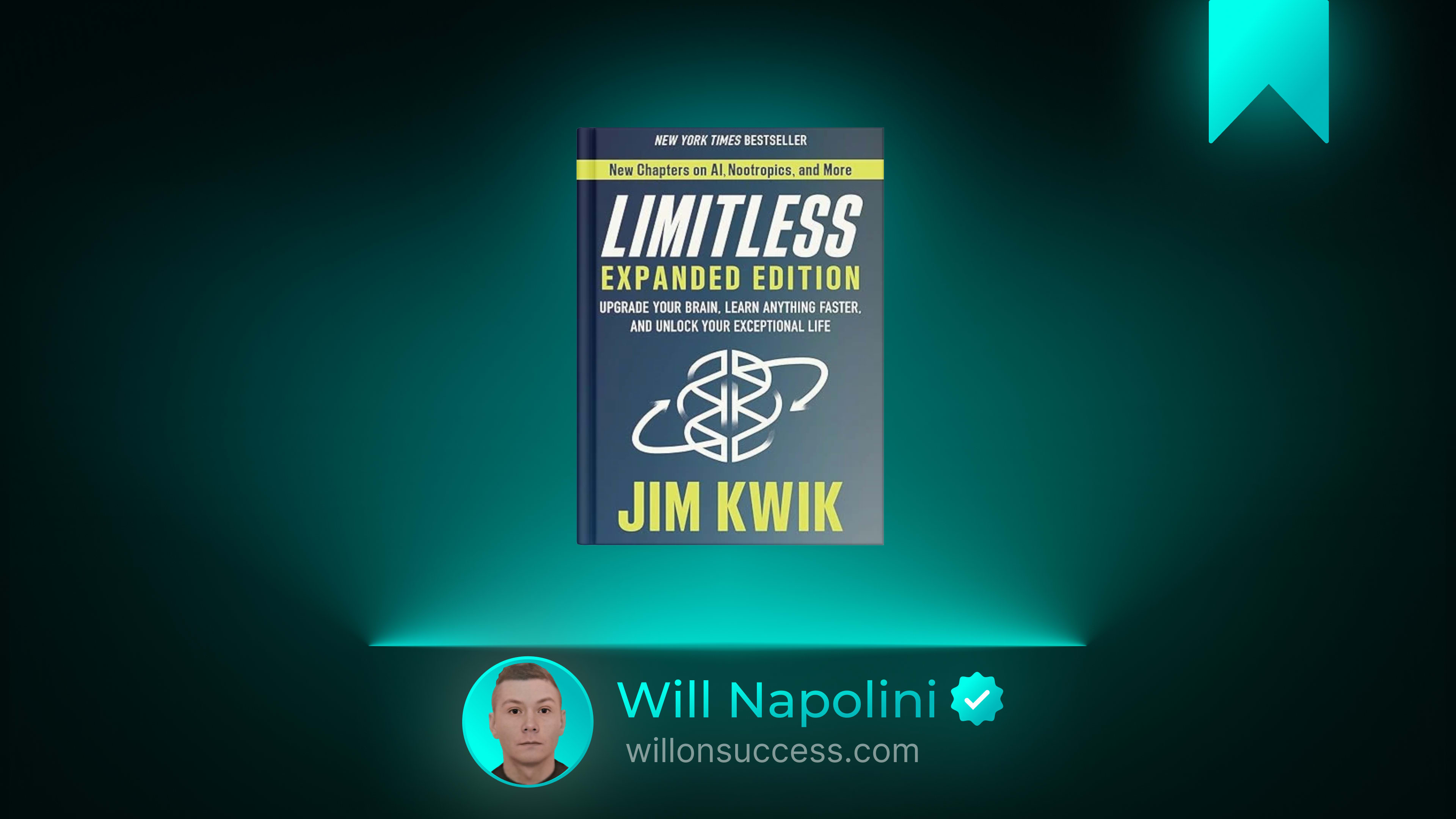
For most of my life, I believed that intelligence and memory were like eye color or height—traits you were handed at birth and forced to live with. I watched people who seemed to absorb information effortlessly and assumed they possessed some genetic magic that I lacked. It wasn’t until I studied the mechanics of human cognition, and specifically the work of brain coach Jim Kwik in his book Limitless, that I realized how profoundly wrong I was.
Limitless is not about taking a magical pill to unlock 100% of your brain, like in the movies. It is a deeply practical, rigorously tested manual for upgrading the operating system of your mind. Kwik’s central thesis is both liberating and demanding: There is no such thing as a “bad” memory or a “slow” learner. There are only unoptimized strategies and unmanaged environments.
The core idea rests on a framework Kwik calls the “3 M’s”: Mindset, Motivation, and Methods. When these three circles intersect, you become limitless. When even one is missing, you stall.
This matters because we are living in an era of unprecedented cognitive friction. We are drowning in information but starving for wisdom. We are constantly distracted, yet expected to perform at elite levels. If you want to thrive in this environment, you cannot rely on the learning habits you picked up in grade school. You need a new architecture for your attention.
The Boy with the Broken Brain
To understand the power of this book, you have to understand the pain that forged it.
Jim Kwik did not start as a memory champion or a high-performance coach. In kindergarten, he suffered a severe head injury. The trauma scrambled his ability to focus and learn. While his peers moved forward, he fell behind. He was held back, subjected to special education, and deeply ashamed of his inability to keep up.
One day, a teacher pointed at him in front of the class and said, “Jimmy is the boy with the broken brain.”
That moment could have been a life sentence. Instead, it became a catalyst. Kwik realized that if the traditional educational system couldn’t teach him, he would have to figure out how to teach himself. He began studying how the brain actually works, experimenting with nutrition, focus techniques, and memory strategies. He didn’t just heal his cognitive function; he optimized it to a level that eventually led him to teach memory and speed-reading to everyone from Hollywood actors to Fortune 500 CEOs.
I share his story not to suggest you need a childhood trauma to improve your mind, but to highlight a universal truth: Your current limitations are often just unexamined injuries.
You may not have a physical brain injury, but Kwik argues that most modern adults suffer from “digital brain injuries.” We endure digital deluge (too much information), digital distraction (constant interruptions), and digital dementia (outsourcing our memory to our phones). We blame our aging or our genetics, when the real culprit is the environment we’ve allowed to hijack our neurology.
Recognizing this is the first step toward taking responsibility for your own mind.
The Three-Legged Stool of Human Potential
Kwik structures his philosophy around a Venn diagram of three overlapping circles. Think of it like a three-legged stool. If one leg is shorter than the others, the stool falls over. You cannot compensate for a missing leg by polishing the other two.
Mindset: Evicting the Tenants of Doubt
Mindset is your belief system. It is what you believe about yourself, what you believe is possible, and what you believe you deserve.
I have sat across from brilliant, capable people who were entirely paralyzed by a single, unexamined belief: “I am just not good with names,” or “I’m too old to learn new technology.”
Kwik calls these limiting beliefs ANTs—Automatic Negative Thoughts. They are the uninvited tenants of your mind, eating your mental energy and paying no rent. The problem with a limiting belief is not that it is true; the problem is that it acts as a self-fulfilling prophecy. If you believe you have a bad memory, you will not pay attention when someone introduces themselves. Because you didn’t pay attention, you forget their name. You then use that forgotten name as “proof” that you have a bad memory.
The Principle: A belief is just a thought you have thought so many times it has hardened into a wall.
To change your mindset, you do not need to stand in front of a mirror and chant empty affirmations. You need to interrogate your doubts. When you catch yourself saying, “I can’t learn this,” you must practice the discipline of adding a single word to the end of the sentence: “I can’t learn this… yet.” That single word creates a bridge between your current frustration and your future capability.
Motivation: The Myth of Willpower
Most people treat motivation like the weather. They wait for a sunny day of inspiration to strike before they tackle a difficult book or start a new project. When the feeling doesn’t arrive, they label themselves lazy.
What I discovered, and what Kwik emphasizes brilliantly, is that motivation is not a feeling you wait for; it is a mechanical process you build. Kwik provides a formula that forever changed how I approach difficult work:
Motivation = Purpose × Energy × Small Simple Steps (S3)
- Purpose: Why are you doing this? If your reason is purely external (e.g., “My boss told me to read this report”), your motivation will be fragile. You must connect the task to a deeper personal value.
- Energy: You cannot run high-performance cognitive software on low battery. Brain health—sleep, hydration, nutrition, and stress management—is not a luxury; it is the physical foundation of motivation.
- Small Simple Steps (S3): This is where most people fail. They look at the mountain and get overwhelmed. Procrastination is rarely a time-management problem; it is an emotion-management problem. We avoid tasks because they trigger anxiety. By shrinking the first step until it is ridiculously easy (e.g., “I will just open the document and read one paragraph”), you bypass the brain’s fear response.
The Principle: You do not need more discipline to start. You need a first step so small that your brain cannot find a reason to resist it.
Methods: The Architecture of Attention and Memory
This is where Limitless transitions from philosophy to tactical execution. If Mindset is the “what” and Motivation is the “why,” Methods are the “how.”
Many people feel guilty for using “hacks” or techniques, believing that true intelligence means just “trying harder.” This is a tragic misunderstanding of human biology. The brain did not evolve to memorize abstract strings of text or numbers. It evolved to remember spatial environments, vivid images, and emotional threats.
When you try to memorize a list of facts by repeating them over and over (rote memorization), you are fighting your brain’s natural architecture. Kwik teaches methods that align with how the brain actually works.
For example, to remember a list of items or a sequence of ideas, Kwik introduces the Loci Method (often called a Memory Palace). You associate the things you want to remember with specific physical locations in a place you know well, like your home. Because your brain’s spatial memory is nearly limitless, you anchor abstract data to concrete geography.
Similarly, when it comes to reading, Kwik addresses the habit of subvocalization—the voice in your head that reads every word aloud. This habit limits your reading speed to your speaking speed (about 200 words per minute). By using a visual pacer (simply guiding your eyes with your finger or a pen), you can eliminate regression (eyes darting back) and significantly increase your reading speed without losing comprehension.
The Principle: Effort without technique is just exhaustion. When you learn the mechanics of your mind, hard work transforms into flow.
Why This Matters on an Ordinary Tuesday
It is easy to read about memory palaces and brain health and think, “That’s great for a memory champion, but I just need to get through my workday.”
But consider what an untrained mind costs you in daily life.
It costs you the embarrassment of forgetting a client’s name in the middle of a pitch. It costs you the two hours of “flow state” you lose every time you check a notification and have to rebuild your concentration. It costs you the joy of reading a profound book, only to realize a week later that you cannot recall a single chapter. It costs you the patience to sit with your children at the end of the day because your cognitive bandwidth has been entirely depleted by digital friction.
When you apply the Limitless model, you are not just trying to pass a test. You are reclaiming your agency.
Imagine sitting down to work and knowing exactly how to enter a state of deep focus. Imagine listening to a mentor and being able to mentally file their advice so you can retrieve it exactly when you need it. Imagine ending your workday with enough mental energy left over to be fully present with the people you love.
This is not about becoming a robot. It is about becoming fully human, unburdened by the cognitive clutter that keeps us stressed and reactive.
Who Should Read This Book (And Who Might Struggle)
Limitless is a profoundly useful book, but it is not for everyone in every season of life.
You will benefit immensely from this book if you:
- Are a student, professional, or entrepreneur who feels overwhelmed by the sheer volume of information you must process.
- Frequently experience “brain fog” or feel that your memory is declining.
- Want to learn a new language, skill, or instrument but feel intimidated by the learning curve.
- Are ready to take radical responsibility for your digital environment and daily habits.
You may find this book less useful if you:
- Are looking for deep, philosophical musings on the nature of consciousness. This is a tactical, applied manual, not a theoretical treatise.
- Suffer from severe, unmanaged clinical trauma or neurological disorders without the support of a medical professional (while Kwik’s advice is generally safe, it is not a substitute for medical treatment).
- Are unwilling to practice. Kwik provides the blueprints, but you must swing the hammer. If you want a magic pill, you will be disappointed by the requirement for daily drills.
Practical Application: Building Your Limitless System
Understanding the 3 M’s is valuable, but understanding without action changes nothing. Here is how you can begin integrating these principles into your life today.
1. Audit Your ANTs (Mindset) Take out a piece of paper. Draw a line down the middle. On the left side, write down the limiting beliefs you hold about your own intelligence or capabilities (e.g., “I’m bad at math,” “I can’t focus,” “I’m not creative”). On the right side, rewrite them as temporary states or challenges (e.g., “I haven’t found the right method for math yet,” “My focus is currently compromised by my environment,” “I need to practice creative exercises”). Burn the left side. Keep the right.
2. Design Your S3 (Motivation) Think of a project you have been procrastinating on. The thought of it makes your chest tight. Now, shrink it. What is a Small Simple Step you can take in the next five minutes that requires almost zero willpower? Don’t write “Clean the garage.” Write “Move three boxes to the curb.” Don’t write “Write the report.” Write “Open a blank document and write the title.” Action precedes motivation, not the other way around.
3. Use a Visual Pacer (Methods) The next time you read a physical book or a long report, use your index finger or a pen to trace underneath the line you are reading. Move your finger slightly faster than is comfortable, and force your eyes to keep up. Do not stop to re-read words you missed. This simple physical anchor reduces eye fatigue, stops subvocalization, and immediately increases your reading velocity.
One Small Step You Can Take Today
If I could sit across the table from you right now, I would ask you to stop trying to fix your entire life by tomorrow morning. Consistency will always outperform intensity.
Here is your one small step for today: Protect your first 30 minutes.
For the next 24 hours, do not let a screen dictate your mindset before you have dictated it yourself. When you wake up, do not touch your phone. Do not check email. Do not scroll through the news. Your brain is highly suggestible in the first half-hour of the day. If you feed it the world’s urgency, you will spend the rest of the day reacting.
Instead, spend those first 30 minutes hydrating, stretching, or reading something that aligns with the person you want to become. Build a fortress around your morning mind.
You have spent years believing the lie that your potential is capped by your past. But the brain is not a hard drive with a fixed capacity; it is a muscle that grows with resistance, and a garden that flourishes with intentional cultivation.
The boundaries of your life are not set by the brain you were born with, but by the methods you choose to practice. The door is unlocked. You just have to turn the handle.