The Thing You Chase Is Not the Thing You Need: What Gone with the Wind Teaches About Self-Deception
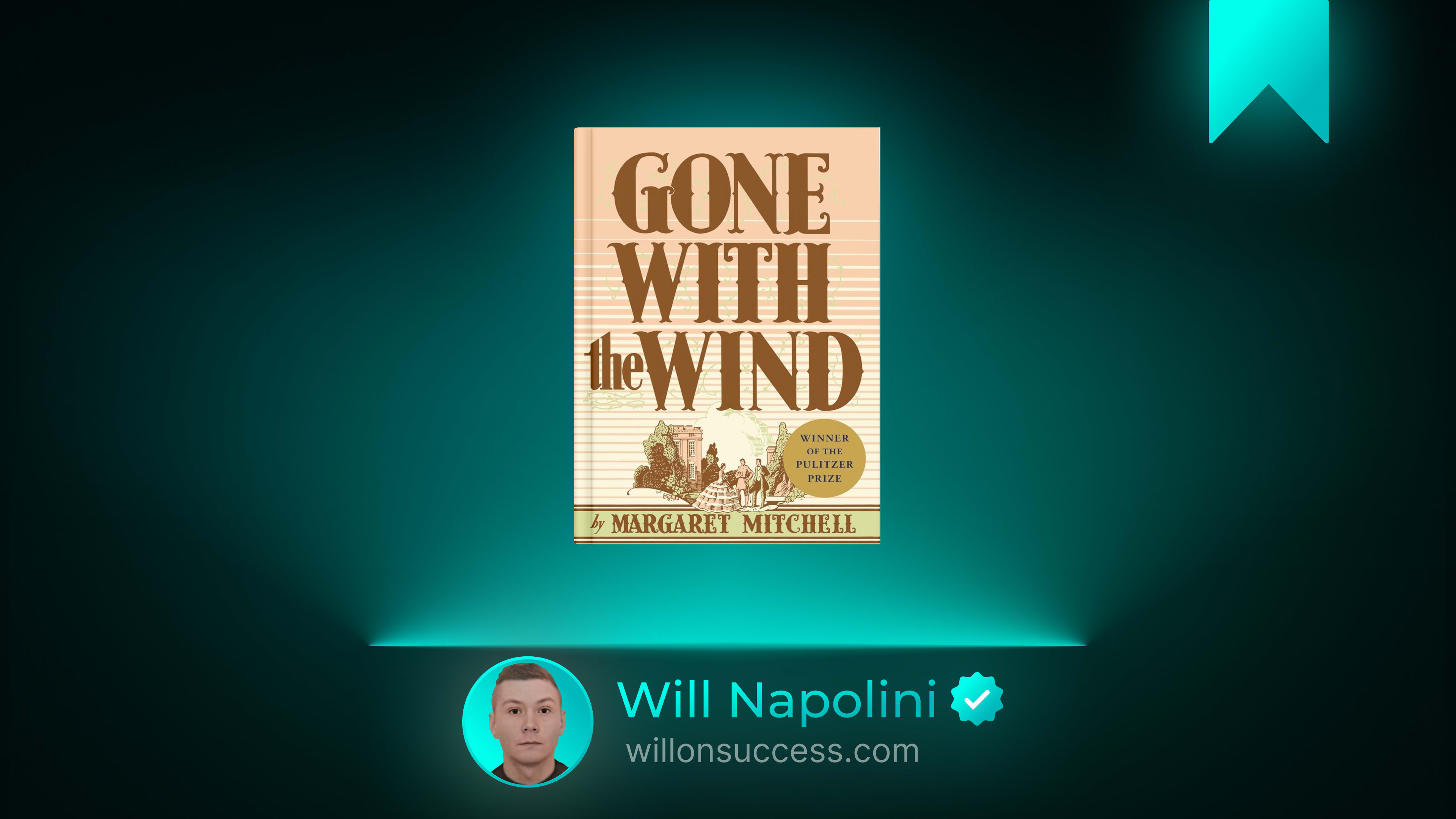
There is a particular kind of heartbreak that does not come from losing what you wanted. It comes from finally getting what you wanted and discovering, too late, that it was never the right thing.
I have watched people spend twenty years climbing toward a version of success they imagined when they were nineteen, only to stand at the top and feel nothing. I have watched people pour their devotion into a relationship because of what the other person symbolized to them, rather than who the person actually was. And I have watched them realize the truth only after the real thing—the messy, imperfect, living thing that was standing right beside them all along—has quietly walked out the door.
Margaret Mitchell understood this tragedy so completely that she built an entire epic around it. Gone with the Wind, published in 1936, is a novel of staggering scope: over a thousand pages, a civil war, the destruction of a civilization, a woman’s ruthless fight to survive. But at its center is one of the simplest and most devastating emotional truths in all of literature.
Scarlett O’Hara spends the entire novel reaching for the wrong man. And by the time she understands the difference between the dream and the real, the real is gone.
I want to talk about what that means. Not just for Scarlett. For you. For the thing you might be chasing right now that is not actually what you need.
The Big Idea
Gone with the Wind is set in the American South during the Civil War and the years of Reconstruction that followed. It follows Scarlett O’Hara, the daughter of an Irish immigrant who owns Tara, a cotton plantation in Georgia. Scarlett is beautiful, vain, ferociously determined, and convinced from her earliest years that she loves Ashley Wilkes, the son of a neighboring plantation family. Ashley is gentle, cultivated, poetic—a gentleman of the old aristocratic order.
But Ashley is engaged to his cousin, Melanie Hamilton. And when the novel opens, on the eve of the war, Ashley gently tells Scarlett he cannot marry her. Scarlett is devastated. In her fury and pride, she marries another man on impulse. And then the war comes, and the world she knew is dismantled, burned, and scattered.
What follows is Scarlett’s long, brutal, extraordinary struggle to survive. She loses her first husband to illness. She returns to a Tara that has been stripped bare by war. Her mother is dead. Her father’s mind is broken. The fields are ruined. And Scarlett, who was raised to be a lady of leisure, discovers that she will do absolutely anything to keep Tara alive and keep herself from starving. She works the fields with her hands. She lies, manipulates, steals, and marries for money. She becomes ruthless in a world that has no use for gentleness.
And through all of it, through the fire and the hunger and the reinvention, she tells herself the same story: When this is over, I will have Ashley. Ashley is what I am fighting for. Ashley is the reward at the end of the suffering.
Meanwhile, Rhett Butler—a rogue, a realist, a man who sees through every pretense and calls things exactly what they—is in her life. He sees her clearly. He loves her, in his sardonic, wounded, deeply hidden way. He offers her honesty, partnership, a mirror. And Scarlett cannot see him. Cannot really see him. Because he does not fit the story she has been telling herself since she was fifteen.
That is the big idea. The novel is a thousand-page argument that the thing you are chasing is often not a person or a goal. It is a symbol. A stand-in for a world you want to believe in. And while you are reaching for the symbol, the actual life—the one that could feed you, challenge you, love you back—is waiting patiently, and then it stops waiting.
The Ashley Problem
I want to be careful here, because I do not want to reduce Ashley Wilkes to a villain. He is not one. He is a decent man trapped inside a world that no longer exists. He is kind, cultured, and genuinely unable to adapt to the brutality of the post-war economy. He represents the antebellum South’s ideal of the cultivated gentleman, and when that South is destroyed, he is destroyed with it. He survives physically, but he cannot build anything new. He is a man haunting a house that has already been torn down.
Scarlett does not love Ashley. What she loves is what Ashley represents: elegance, permanence, the world of Tara as it was before the war, the certainty of a social order where she was the belle and everything was arranged and beautiful. Ashley is a doorway to a fantasy of safety. And Scarlett, who survived the war by becoming harder than anyone expected her to be, needs that fantasy desperately. She needs to believe that somewhere, the soft world still exists, and that Ashley is its keeper.
But Ashley cannot give her what she needs. He is passive. He is drowning in his own nostalgia. He needs Melanie’s quiet, steady goodness to keep him upright, and he knows it. He tells Scarlett as much, gently, at the very beginning. She does not hear him. She hears only the rejection, not the truth inside it.
And this is where the novel becomes a lesson for all of us. I have seen people pursue a career because it represents the identity they wanted at twenty-two, long after the career has stopped feeding them. I have seen people stay in relationships because the other person represents a version of themselves they are afraid to lose. I have seen people build entire lives around a goal that made perfect sense in one season and became a hollow symbol three seasons later, and they keep pursuing it because admitting it is hollow would mean admitting they spent years running in the wrong direction.
The Ashley in your life might not be a person. It might be a title. A city. A number in a bank account. A relationship status. A version of yourself you constructed in a moment of youth and never updated. The question is not whether you want it. The question is whether it is real, or whether it is a symbol you are using to avoid facing what you actually need.
The Ground Beneath Your Feet
There is one thing in this novel that is not an illusion. And it is not a person. It is a place.
Tara. The red earth. The cotton fields. The house that Gerald O’Hara built with his own hands and his own stubbornness. When everything else in Scarlett’s life is stripped away—husbands, wealth, social position, the entire civilization she grew up in—Tara remains. And Scarlett discovers that her love for that land is the one honest thing in her. It is not a performance. It is not a symbol she is using to avoid something else. It is the ground beneath her feet, and when she presses her hands into the red clay, she remembers who she is.
Mitchell gives Scarlett this anchor deliberately, because Scarlett needs it. Without Tara, she would have nothing real. Every relationship in her life is tangled in self-deception, manipulation, or fantasy. But the land does not lie. The land does not perform. The land asks only that you show up and work it, and it gives back what you put in.
I think this is one of the most transferable ideas in the novel. When the stories collapse, when the personas fall away, when you can no longer maintain the performance you have been giving for the people around you, what is your ground? What is the thing that holds you when everything else is gone?
For some people, it is a craft. A practice. Something they make with their hands or their mind that does not depend on anyone’s approval. For others, it is a place. A routine. A small community of people who knew them before the performance started. For others, it is a discipline—physical, spiritual, intellectual—that they return to every morning regardless of how the previous day went.
You need a Tara. Not a fantasy. Not a symbol. Something real, something that asks nothing of you but your presence and your work, and gives back the simple, unglamorous truth that you exist, and that the day has something in it for you if you show up.
The Cost of Becoming Unbreakable
Scarlett survives. That is the undeniable, even triumfact fact of the novel. She survives hunger, war, loss, heartbreak, and a world that has been dismantled around her. She survives by becoming harder, more pragmatic, more willing to do what others will not. She looks at the ruin of Tara and says, in effect, that she will never be hungry again, and she means it with every cell of her body.
And I admire her for that. I do. There is something genuinely inspiring about a person who refuses to be destroyed by circumstance, who looks at the wreckage and decides to rebuild with bare hands if necessary. Consistency before intensity. Action before intention. Scarlett does not wait for rescue. She does not wait for permission. She acts.
But Mitchell is honest about the cost. And this is where the novel earns its depth, because it does not let Scarlett’s strength exist without showing what it takes from her. Scarlett’s ruthlessness isolates her. Her willingness to use people—to marry for money, to manipulate, to discard—leaves a trail of damage. She is so focused on survival, on winning, on getting what she has decided she wants, that she becomes increasingly blind to the people around her. She cannot see Melanie’s fierce, quiet loyalty. She cannot see Rhett’s love because she has decided he is not part of her story. She cannot see that her strength, wielded without tenderness, becomes a kind of violence.
There is a lesson here that I think applies to anyone who has had to fight hard to build a life. Survival mode is necessary in a crisis. But if you stay in survival mode after the crisis is over—if you keep treating every relationship as a transaction, every vulnerability as a weakness, every softness as a threat—you will survive, yes. You will even prosper, by certain measures. But you will be alone inside your prosperity, and the people who tried to reach you will have stopped knocking.
Scarlett’s tragedy is not that she was too weak. It is that she became so strong, so armored, so certain of what she wanted, that she lost the capacity to receive what was being offered.
The Quiet Strength That Holds Everything Together
I cannot talk about this novel without talking about Melanie Wilkes. Because if Ashley is the illusion and Scarlett is the storm, Melanie is the thing I wish more of us recognized in time.
Melanie is gentle. She is kind. She does not announce her strength. She does not demand recognition. She does not perform. She simply shows up, again and again, with steady loyalty and clear-eyed compassion. When Scarlett is at her worst—selfish, manipulative, cruel—Melanie still sees the good in her. Not because Melanie is naive. But because Melanie has chosen, deliberately, to believe in people, and that belief is not weakness. It is the hardest, most courageous thing in the novel.
Melanie is the one who holds the community together. She is the one Rhett respects most deeply. She is the one Ashley cannot survive without. And when she dies, near the end of the novel, the entire world of the book collapses, because she was the load-bearing wall that no one noticed until she was gone.
I have known people like Melanie. They are not the loudest in the room. They do not build empires or win arguments or dominate conversations. But they are the ones who make it possible for everyone else to function. They listen. They forgive. They show up on the days that matter. And they are often the last people we thank, the last people we see clearly, because their strength is so quiet that we mistake it for background.
If there is a Melanie in your life, do not wait until the end of the novel to realize what they meant. Say it now. While they are still in the room.
The Door That Closes
Near the end of Gone with the Wind, Scarlett finally understands the truth she has been avoiding for fifteen years. Ashley was never real to her. He was a dream, a symbol, a placeholder for a world that no longer exists. And Rhett—difficult, sardonic, honest Rhett—was the one who actually saw her, loved her, challenged her, and stayed.
But by the time she understands this, Rhett is done. He has spent years loving a woman who could not see him, who used him, who kept turning back toward a ghost. And something in him has broken. Not dramatically. Not with a shout. Just a quiet, exhausted closing of a door that had been open for a very long time.
He leaves. And Scarlett stands in the empty house and realizes that the thing she spent the entire novel reaching for was never Ashley. It was Rhett. It was the honest, complicated, unglamorous love that did not fit the fantasy she had built at fifteen. And it is gone.
The novel’s final line looks forward. Scarlett tells herself that tomorrow is another day, that she will find a way to bring him back, that Tara will give her strength. And there is something brave in that refusal to surrender. But there is also something heartbreaking about it. Because the reader knows what Scarlett is only beginning to understand: some doors, once closed, do not open again. Some people, once lost to your blindness, are not waiting for you to finally see them.
What you repeat in private eventually becomes visible in your life. And what you neglect in private eventually becomes absent from your life.
An Honest Word About This Book
I would be failing you if I discussed Gone with the Wind without addressing what it gets deeply, dangerously wrong.
Mitchell’s novel romanticizes the antebellum plantation system. It presents slavery through a lens of paternalistic nostalgia. Its Black characters are drawn in stereotypes that reflect the racial assumptions of its author and her era. Its treatment of Reconstruction is filtered through a perspective that views Black political participation as illegitimate and the restoration of white dominance as natural and just.
These are not minor flaws to be noted in a footnote and moved past. They are woven into the fabric of the novel’s worldview. The “Old South” that Scarlett mourns and Ashley embodies was built on the labor and suffering of enslaved people, and the novel’s nostalgia for that world is inseparable from its failure to reckon honestly with what that world was.
You can learn from this novel’s insights about self-deception, resilience, and the cost of loving an illusion, while also recognizing that its vision of history is deeply distorted. Read it with your eyes open. Read it alongside voices that tell the stories Mitchell could not or would not tell. Do not let the beauty of the prose or the power of Scarlett’s survival make you forget what was on the other side of the cotton fields.
A book can teach you something true about the human heart and something false about the world it is set in. Both things can be real at the same time. Hold both.
Who Should Read This Book
Gone with the Wind is for readers who want an epic. If you are drawn to novels that sweep you through years of a life, that place individual struggle against the backdrop of historical upheaval, that give you characters you will argue about long after the last page, this is your book. Scarlett is one of the most complex, frustrating, compelling protagonists in American literature. You will admire her. You will be exasperated by her. You will recognize yourself in her.
It is also for anyone who wants to understand the power of self-deception in love, in ambition, and in identity. The novel is a master class in how we construct narratives about what we want and then spend years pursuing the narrative instead of the need beneath it.
It is not for readers who need their fiction to be morally tidy. Scarlett is not redeemed in any conventional sense. The ending is unresolved. The novel’s racial politics will and should trouble you. And at over a thousand pages, it demands patience and commitment. This is not a quick read. It is a long walk through a world that Mitchell built with obsessive, granular detail.
But if you are willing to walk it, the novel will stay with you. Not because it is comfortable. Because it is true about the things that are hardest to admit.
Practical Application
I want to ask you a question, and I want you to answer it honestly, even if the answer makes you uncomfortable.
What is your Ashley?
Not who. What. What is the thing you are pursuing that is actually a symbol? The goal you set years ago that made perfect sense then but has become a hollow destination? The person you are fixated on because they represent a version of life you want to believe in, rather than because they actually nourish you? The identity you are performing because it was assigned to you in a season that has long since passed?
Write it down. Name it. Get it out of the fog of vague longing and into the clarity of a sentence on a page.
Then write down a second sentence. This one is harder. If I stopped chasing this thing tomorrow, what would I actually want? Not what would look good. Not what would make the story of my life make sense. What would I want, if no one were watching and no narrative had to be preserved?
You do not have to act on the answer today. You do not have to blow up your life. But you have to look. Because Scarlett spent fifteen years looking in the wrong direction, and the cost was everything that mattered. You do not have to give it fifteen years. You can look now.
One Small Step
Tomorrow, I want you to do one thing.
Find one person in your life who has been steady, loyal, quietly present. The person who shows up without being asked. The person who forgives your bad moods, who remembers the small details, who does not need you to perform in order to stay. Your Melanie. Your Rhett. The person who sees you without the armor.
And I want you to tell them you see them. Not in a grand speech. Not in a dramatic revelation. Just a sentence. I know you have been there, and I want you to know I notice. Say it to their face, or write it in a letter, or send it in a message. But say it.
Because the deepest lesson of this novel is not about the Civil War, or the Old South, or the red clay of Georgia. It is about the people who are standing in front of you right now, loving you in ways you are too busy to notice, while you stare past them at a horizon that was never going to give you what you need.
Tomorrow is another day. That is true. But the people who are here today will not be here forever. See them while you can.