The Stranger Across the Pillow: What Gone Girl Reveals About the Stories We Tell in Love
Here is a question I want you to sit with before we go any further.
How well do you actually know the person you love most?
Not the person you think they are. Not the version you have constructed in your mind over years of shared breakfasts and half-finished conversations and quiet evenings on the same couch. The actual person. The one behind the face you have memorized. The one whose inner monologue you will never fully hear.
If you are honest—and I mean the kind of honest that makes your stomach tighten—there is a gap. There has always been a gap. You fill it with assumptions, with stories, with the comfortable fiction that proximity equals understanding. And most of the time, that fiction holds. The marriage works. The friendship endures. The family gathers at Thanksgiving and no one notices the cracks.
But Gillian Flynn is not interested in most of the time. She is interested in what happens when the fiction collapses. When the person you built your life around turns out to be a stranger wearing a familiar face. When the story you told yourself about your own life is revealed to be a story someone else wrote for you.
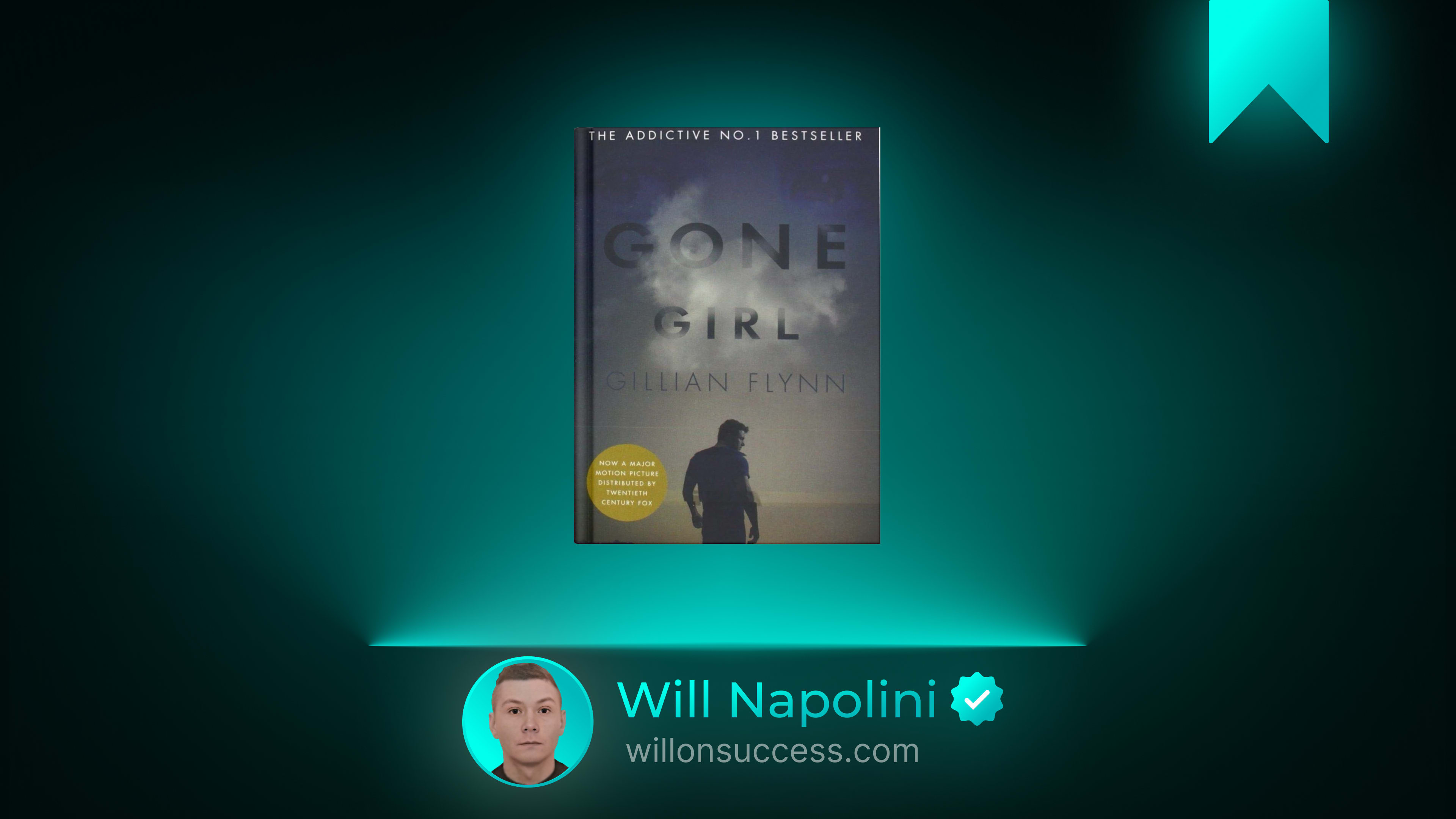
Gone Girl, published in 2012, is a thriller on its surface. Beneath that surface, it is one of the most unsettling examinations of performance, resentment, and narrative control that I have encountered in modern fiction. And I want to be clear before we go further: I will be discussing the novel’s central revelations. If you have not read the book and want to experience its twists unspoiled, stop here. Read it first. It is worth your time. Then come back, and we will talk about what it means for the way you show up in your own relationships.
If you have read it, or if you are willing to have the architecture of the story revealed so we can examine what it teaches, then stay. Because what Flynn built inside this novel is not just a mystery. It is a mirror. And it is aimed directly at the performances you and I give every day in the name of love.
The Big Idea
Gone Girl is set in North Carthage, Missouri, against the grey backdrop of the Great Recession. Nick Dunne and Amy Elliott Dunne are a married couple who have moved from New York to Nick’s hometown after both lose their writing jobs and his mother falls ill. On their fifth wedding anniversary, Amy vanishes. The house shows signs of a struggle. And almost immediately, every piece of evidence begins pointing at Nick.
The novel is structured in alternating perspectives. We get Nick’s present-tense account of the investigation, the media circus, and the slow tightening of suspicion around him. And we get Amy’s diary entries, which trace the arc of their marriage from glamorous New York courtship to the slow decay of resentment in a small Missouri town. The diary paints Nick as increasingly cold, controlling, and frightening.
And then, at the novel’s midpoint, Flynn pulls the floor out from under you.
Amy is not dead. Amy is not a victim. Amy is alive, hiding, and she has orchestrated the entire disappearance as an act of revenge. She discovered Nick’s affair with one of his students, and she responded not with grief, not with confrontation, but with an elaborate, meticulous, almost artistic campaign to frame her husband for her own murder. Every diary entry was fabricated. Every clue was planted. Every detail was designed to construct a narrative in which Nick Dunne is a monster, and Amy Elliott Dunne is his final victim.
This is the big idea, and it is not merely a plot twist. It is the novel’s thesis. The story you have been reading—the diary, the evidence, the public narrative—was constructed by one person to control another person’s reality. And you, the reader, believed it. You believed it because it was well-told. You believed it because it fit the shape of a story you already knew how to interpret. Flynn implicates you. She makes you feel what it is like to have your understanding of another person revealed as a fiction you were willing to accept because it was convenient.
That is what this novel is really about. Not murder. Not a missing woman. But the stories we build around the people closest to us, and the terrifying possibility that those stories might be entirely wrong.
The Performance We Call Love
There is a passage in Amy’s voice, roughly midway through the novel, that I think is one of the sharpest pieces of writing about gender and identity in contemporary fiction. Amy describes what she calls the “Cool Girl”—the woman who reshapes herself around a man’s preferences, who pretends to like what he likes, who never complains, never demands, never shows the messy, complicated, inconvenient parts of herself. She performs an idealized version of femininity that requires no maintenance, no emotional labor, no friction. And she does it so convincingly that the man falls in love with the performance, not the person beneath it.
I will not reproduce the passage here, but I want you to understand what Flynn is doing with it. She is not writing a polemic. She is identifying a mechanism. The mechanism is this: in the early stages of love, we edit ourselves. We show the best angles. We suppress the parts we fear will be rejected. And the other person does the same. Two edited versions of two complicated humans fall in love with each other’s highlights, and they call it intimacy.
Then the years pass. The editing becomes exhausting. The suppressed parts start leaking through. And the person across from you begins to notice that the character they fell in love with does not match the human being standing in the kitchen at eleven p.m., tired, irritable, and quietly furious about something they cannot name.
Nick and Amy are not unusual in this. They are extreme, yes. What Amy eventually does is monstrous, and I do not want to soften that. But the seed of their disaster is something I have seen in quieter forms in almost every long relationship I have witnessed. Two people fall in love with projections. They marry the projections. And then they spend years resenting each other for failing to remain characters in a script that was never fully real.
The question the novel presses against your chest is this: how much of your own relationship is built on a performance you are exhausted by maintaining? And how much resentment is quietly accumulating in the space between who you actually are and who you have agreed to pretend to be?
Resentment Is a Slow Poison
Nick and Amy did not become strangers overnight. Flynn is careful to show the erosion. The small disappointments. The compromises that felt like surrenders. The conversations that were postponed until postponing them became the pattern. The sex that thinned. The silences that thickened.
Amy’s revenge, when it comes, is spectacular and terrible. But the novel makes clear that it did not begin with the affair. It began years earlier, in the quiet accumulation of grievances neither person voiced. Nick stopped trying. Amy stopped saying what she needed. Both of them started keeping score in a ledger the other person could not see.
This is what I want you to hear, because it is the most practical lesson inside this dark book. Resentment does not arrive like a storm. It arrives like mold. You do not notice it on day one. You do not notice it on day ten. But if the room stays damp and no one opens a window, eventually the walls are black with it, and the structure is compromised, and you cannot fix it by painting over the surface.
Every unspoken frustration is a drop of water. Every swallowed complaint. Every “it’s fine” that is not fine. Every time you perform contentment instead of risking an honest conversation. The drop falls. The mold spreads. And one day the person across from you does something that is not actually the final cause of your rage, but it is the drop that breaks the dam, and what comes out of you is disproportionate, and ugly, and possibly unforgivable.
Amy’s response to her marriage is a horror story. But the mechanism that produced it—the long, silent accumulation of unmet needs and unexpressed anger—is not foreign to most relationships. It is just that most of us express our resentment in smaller ways. A cold shoulder. A cutting remark disguised as a joke. A slow withdrawal of affection that the other person feels but cannot explain. A quiet decision to stop trying, dressed up as acceptance.
If there is something you have been swallowing in your closest relationship, I am not telling you to stage a dramatic confrontation. I am telling you that the swallowing is not neutral. It is building something. And what it is building will not stay contained forever.
The Story You Tell Becomes Your Prison
One of the most disturbing elements of Gone Girl is its ending. I will not describe it in full detail, but I will say this: Nick and Amy do not get a clean resolution. There is no neat justice. There is no satisfying separation. They are bound together by circumstance, by a child, by the public narrative that has been constructed around them, and by the terrible mutual knowledge of what they are.
Amy has built a story so elaborate, so public, and so irreversible that she cannot escape it. Nick has been cast in a role he cannot shed without destroying himself. They are trapped inside the narrative they co-authored, and the only way forward is to keep performing it. Together.
This is where the novel moves from thriller into something closer to tragedy. Because I think this trap is more common than we want to admit, even in relationships that involve no crime, no deception on Amy’s scale.
How many people stay in marriages, in careers, in friendships, in communities, not because they want to, but because the story they have told about themselves makes leaving feel impossible? I am the person who stuck it out. I am the person who makes this work. I am the person who doesn’t quit. The narrative hardens. The identity calcifies. And the living person inside the story slowly suffocates, but no one notices because the performance is so convincing.
You do not have to fake your own disappearance to be trapped by a fiction you built. You just have to keep telling a story about yourself that is no longer true, and keep living inside it because the cost of revision feels higher than the cost of suffocation.
Why This Matters Beyond the Page
You may be thinking, This is a novel about a sociopath and a marriage that turns into a hostage situation. What does this have to do with my ordinary Tuesday?
More than you might expect.
Think about social media. Think about how we curate versions of ourselves for public consumption. The vacation photo. The milestone announcement. The carefully framed opinion. We are all, in small ways, writing diary entries for an audience. Constructing a narrative of a life that is tidier, happier, and more coherent than the actual experience. And we do it so consistently that we start to mistake the curated version for the real one. We start performing our own lives for ourselves.
Think about the stories you tell about the people in your life. The colleague you have decided is difficult. The friend you have decided is selfish. The parent you have decided is impossible. How much of that story is based on what they actually are, and how much is a narrative you built from a handful of data points and then stopped questioning? How much of your frustration with them is really frustration with the character you wrote for them, a character they never agreed to play?
Think about the stories you tell about yourself. I am not the kind of person who does that. I have always been this way. It is too late for me to change. These are diary entries you wrote about yourself years ago, and you keep reading them back as though they are still accurate, as though you have not changed, as though the person holding the pen is the same person who wrote the first line.
Flynn’s novel asks you to interrogate every one of those narratives. To hold them up to the light and ask: is this true? Or is this a story I am telling because it is easier than facing what is actually there?
Who Should Read This Book
Gone Girl is for readers who want their comfort disturbed. If you are drawn to psychological depth, to unreliable narration, to stories that make you question your own assumptions about truth and perception, this novel will grip you. Gillian Flynn’s prose is sharp, propulsive, and darkly funny. She writes with a precision that makes even the most unpleasant revelations feel earned.
It is also for anyone who has ever felt a quiet unease in a long relationship—a sense that something is not quite what it appears, that the person across from you is performing, or that you are performing, and that the performance is starting to cost more than the honesty would.
I will be honest about what this book is not. It is not cozy. It is not restorative. There is no moral neatness here, no villain punished and hero rewarded. The ending is uncomfortable, unresolved, and deliberately unsatisfying in the way that real life is unsatisfying. If you need your fiction to reassure you that goodness triumphs and justice is served, this will frustrate you. The novel is also dark in its treatment of manipulation, violence, and psychological cruelty. It does not flinch, and it does not apologize.
But if you are willing to sit in that discomfort, the novel will give you something rare: a story that refuses to let you look away from the mechanisms of self-deception that operate in your own life.
Practical Application
I am not going to tell you to interrogate your marriage as though your spouse might be framing you for murder. That is not the point. But I am going to ask you to do something smaller, and in its own way, just as brave.
Tonight, or tomorrow morning, I want you to identify one story you have been telling about someone you love. It could be a partner, a parent, a close friend. The story might be: They never listen to me. They always prioritize work. They don’t care about the things that matter to me. They are the way they are and they will never change.
Write that story down. Look at it on the page, outside of your head, where you can see its shape.
Now ask yourself three questions. First: is this story based on a pattern I have observed over years, or on a handful of moments I have generalized into a verdict? Second: have I told this person the story I am telling about them, or am I narrating their life without their knowledge? Third: if I stopped telling myself this story tomorrow, what would I have to face?
You do not have to act on the answers tonight. You do not have to fix anything. But you have to look. Because the stories you refuse to examine are the ones that quietly build the walls around you, and one day you wake up and the room is very small, and the person across from you is a stranger, and you cannot remember when the editing replaced the honesty.
One Small Step
Here is the smallest, most immediate thing you can do.
Think of one small truth you have been keeping from someone close to you. Not a secret that would shatter their world. Something smaller. A preference you have been suppressing. A frustration you have been smoothing over. A need you have been performing your way around because asking directly feels too risky.
Say it. Not in anger. Not as an accusation. Just say it. I need you to know that I feel… or I have been pretending to be fine about this, but I’m not. One sentence. One honest line spoken into the space between you instead of swallowed.
Amy and Nick Dunne built a marriage on performances, and it ate them alive. You do not have to go where they went. But the only alternative is the thing they refused to do. The small, unglamorous, slightly terrifying act of being real with the person in the room.
The story you are performing is not your life. Your life is what happens in the silence after you put the script down.