The Holes We Keep Digging: What God's Little Acre Teaches About Obsession
There is a kind of work that feels like purpose but is really just avoidance dressed up in overalls.
I have seen it in my own life, and I suspect you have seen it in yours. The project you keep polishing instead of launching. The research you keep doing instead of making the decision. The plan you keep refining instead of stepping into the uncertain, imperfect reality that is actually waiting for you. You call it diligence. You call it preparation. But somewhere beneath the surface, you know it is something else. You are digging a hole, and you are calling it a calling.
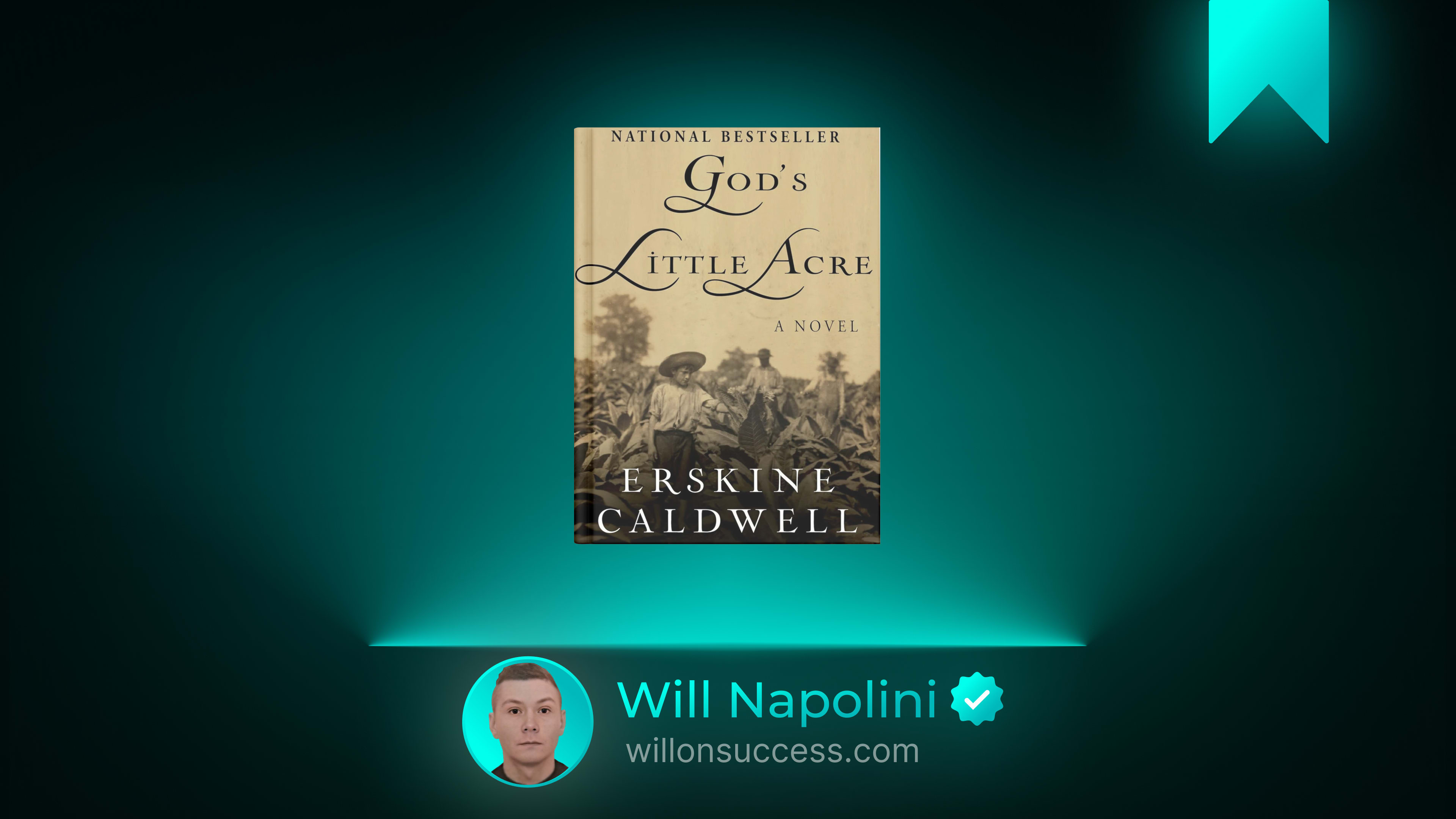
Erskine Caldwell understood this self-deception better than almost any novelist of the twentieth century. In God’s Little Acre, published in 1933, he gave us one of literature’s most unforgettable portraits of a man who has mistaken his obsession for his vocation—and who is destroying everything around him because of it.
This is not a gentle book. It is not a comfortable book. But it is a true one. And sometimes the truest mirrors are the ones we would rather not look into.
The Big Idea
God’s Little Acre is set in rural Georgia during the Great Depression, in a landscape of red clay, failing farms, and desperate people. At its center is Ty Ty Walden, a farmer who has stopped farming. Instead of planting crops, feeding his family, or tending the land that could sustain them, Ty Ty spends his days digging holes in his fields. He is searching for gold. His grandfather, he believes, buried a fortune somewhere on the property, and Ty Ty is certain that the next shovelful will uncover it.
He has made a promise to God. If he finds the gold, he will dedicate a small portion of his land—”God’s Little Acre”—to the church. But here is the quiet, devastating detail: whenever Ty Ty suspects the gold might be in the spot he has designated for God, he quietly moves God’s Little Acre to a different part of the property. He never actually gives anything up. He keeps his promise alive in language while hollowing it out in practice.
Meanwhile, his family is falling apart. His sons and daughters are tangled in hunger, lust, and aimlessness. The house is crumbling. The fields are barren. The people who depend on Ty Ty are slowly being consumed by his refusal to face the life in front of him.
What Caldwell is showing us is not just one man’s foolishness. He is showing us what happens when a person substitutes a fantasy of future rescue for the demanding, unglamorous work of the present. Ty Ty is not lazy. He digs all day. He sweats. He exhausts himself. But his labor is pointed at a mirage, and because of that, nothing around him grows.
That is the central idea of this novel, and it is one worth sitting with: effort without direction is not virtue. It is just a slower way to starve.
The World of the Novel
I want to introduce you to the world Caldwell builds, because understanding the texture of this story is essential to understanding its lessons.
The Walden farm is a place of scarcity. Food is scarce. Money is scarce. Dignity is scarce. And in that scarcity, the characters are driven by appetites they can barely name or control. Caldwell writes about hunger—physical hunger, sexual hunger, hunger for meaning—with a frankness that shocked readers in 1933. The novel was, in fact, the subject of obscenity proceedings in New York, a fact that tells you something about how uncomfortable Caldwell made people by refusing to look away from the raw realities of poverty.
Around Ty Ty, the family orbits like planets pulled by a dying star. His sons navigate their own frustrations and desires. His daughters seek connection in a world that offers them very little tenderness. Griselda, Ty Ty’s wife, endures the slow erosion of a life that was supposed to be sustained by the land but is instead being consumed by her husband’s fixation.
Into this world comes Will Thompson, a mill worker who carries a different kind of obsession. A textile mill in the area has been shut down, and the workers have lost their livelihoods. Will is consumed with the desire to reopen it, to restore work and purpose to his community. His subplot runs alongside Ty Ty’s gold-hunting, and the contrast is deliberate. Ty Ty digs for something buried in the past. Will reaches for something that could sustain the living.
And then there is Pluto Swint, a political figure campaigning for sheriff, who represents yet another form of empty promise. He talks of leadership and service, but his ambitions are self-serving, his methods corrupt. In Caldwell’s Georgia, the institutions that are supposed to hold a community together—church, government, industry—are either absent, broken, or being exploited.
What I want you to notice is that Caldwell is not writing a novel about villains. He is writing a novel about people who have been worn down, confused, or seduced by false hopes. And that makes the story far more unsettling, because these are not distant characters. They are recognizable.
The Promise You Keep Moving
There is a principle buried in Ty Ty’s shifting “God’s Little Acre” that I think applies to all of us, whether we realize it or not.
Ty Ty makes a vow. He tells God he will give something back. But every time the giving might cost him—every time the promised acre might overlap with the spot where the gold could be—he relocates the promise. He keeps the language of devotion while quietly protecting his obsession.
I have seen this pattern play out in quieter, more modern forms. You tell yourself you will start the business once you have saved a certain amount. You tell yourself you will repair the relationship once the timing is better. You tell yourself you will begin the creative project, take the class, have the difficult conversation—just not yet. Just not here. Just not in the place where it might actually cost you something.
The promise stays alive in your mind. You repeat it to yourself often enough that it feels like integrity. But the acre keeps moving. The giving never happens. The commitment remains theoretical, safely stored in a future that never arrives.
Caldwell shows us the cost of this. Ty Ty is not a monster. He is a man who has convinced himself that his digging is righteous, that the gold will solve everything, that the promise he made is still valid even though he has rearranged it a hundred times. And while he digs, his children go hungry. His land dies. His family fractures.
What you postpone indefinitely does not stay neutral. It rots. It spreads. It takes something from the people around you who are waiting for the version of you that keeps making promises but never keeps them.
Hunger Strips Away the Masks
One of the most difficult truths Caldwell writes about is what scarcity does to human character. In God’s Little Acre, poverty is not a backdrop. It is a force. It changes how people think, how they treat each other, how they see themselves.
When people are hungry—truly hungry, not just inconvenienced—they stop performing. The social masks come off. Desire becomes blunt. Pride becomes fragile. People do things they would never do in comfort, not because they are bad, but because desperation narrows the field of vision until only the most immediate need is visible.
I do not think you need to be in the kind of poverty Caldwell describes to recognize this in your own life. There are seasons when any of us feel depleted—emotionally, financially, spiritually—and in those seasons, our patience thins, our generosity shrinks, and our relationships bear the weight of a scarcity that was never their fault.
Caldwell does not judge his characters for this. He shows them with a kind of rough compassion that I find deeply moving. He understands that people are not their worst moments. But he also refuses to pretend that those moments do not matter. Hunger, in all its forms, reveals what we have not yet resolved about ourselves. And until we face that revelation honestly, we will keep making excuses for the damage we do.
The Dignity of Real Work
Against Ty Ty’s futile digging, Caldwell places Will Thompson and the closed mill. And this contrast is where the novel’s deepest wisdom lives.
Will Thompson understands something Ty Ty does not: the value of work is not found in what you hope to uncover. It is found in what you produce for the living. The mill made cloth. The mill employed people. The mill gave a community a reason to gather, a structure for the day, a sense of shared purpose. When it closes, something more than income is lost. Identity is lost. Belonging is lost.
Will’s determination to reopen the mill is not glamorous. It is not a treasure hunt. There is no buried fortune, no ancestral legend, no romantic mystery. There is only the stubborn belief that people deserve work, that labor has meaning, that a community is held together not by dreams of gold but by the daily act of showing up and making something useful.
Will Thompson does not survive the novel. I will not soften that. Caldwell was not writing a fairy tale. But the fact that Will’s commitment is to the living, to the present, to the tangible needs of real people, gives his story a weight that Ty Ty’s gold-hunting never achieves. One man digs for a ghost. The other fights for a future. And Caldwell wants you to feel the difference in your bones.
What you repeat in private eventually becomes visible in your life. Ty Ty repeats a fantasy. Will repeats a commitment. The novel asks you which repetition you recognize in yourself.
Why This Book Still Matters
You might be wondering why a gritty Depression-era novel about a Georgia farmer matters to you, sitting where you are right now, living a life that looks nothing like Ty Ty Walden’s.
It matters because the architecture of self-deception has not changed. The costumes are different. The technology is different. But the human tendency to build an elaborate, exhausting routine around a thing that will never feed you—that is as common now as it was in 1933.
Think about where this shows up in modern work. How many people spend years preparing for a career shift that never happens? They take another course, update another résumé draft, research another industry, and call it progress. But the actual step—the application, the conversation, the leap—never comes. They are digging for gold in a field that will never yield, while the skills they already have go untended and the relationships around them grow strained by their absence.
Think about where this shows up in relationships. How many people wait for the perfect moment to be vulnerable, to forgive, to say the thing that has been sitting in their chest for years? They keep moving God’s Little Acre. They keep relocating the promise. And the person across from them keeps waiting, growing hungrier, growing colder, growing more certain that they will never be chosen.
Think about where this shows up in creative life. The novel you keep outlining but never write. The song you keep tweaking but never record. The painting you keep planning but never begin. The digging feels like work. It even looks like work. But nothing is being harvested.
Caldwell’s novel holds up a mirror to all of this and says, gently but firmly: look at what you are actually doing. Not what you intend to do. Not what you hope will happen someday. Look at the holes in the ground. Look at the empty table. Look at the faces of the people who are waiting for you to show up.
Who Should Read This Book
God’s Little Acre is for readers who are not afraid of discomfort. If you want fiction that challenges your assumptions about productivity, purpose, and the stories we tell ourselves to avoid the work in front of us, this novel will reward you. If you are drawn to Southern literature, to the tradition of writers who look at the hardscrabble realities of ordinary life without flinching, Caldwell belongs on your shelf.
It is also for anyone who has ever suspected that their busiest activity might actually be their most elaborate form of avoidance. The novel will not tell you what to do about that suspicion. But it will make the suspicion impossible to ignore.
I will be honest about what this book is not. It is not gentle. It is not uplifting in any conventional sense. Caldwell’s prose is plain, direct, and sometimes brutal. The sexual content, frank even by later standards, was genuinely shocking in its time. The poverty is unflinching. The ending offers no easy redemption. If you are looking for a novel that wraps its darkness in sentimentality or resolves its tensions with a tidy moral, this is not that book.
But if you want a story that respects you enough to tell you the truth about how people actually behave under pressure—about what hunger does, what obsession costs, and what dignity looks like when it has been stripped to the bone—then God’s Little Acre is worth your time.
Practical Application
Caldwell wrote fiction, not a self-help manual. He would not have sat you down and given you a five-point plan. But the questions his novel raises are deeply practical, and I want to help you use them.
I want you to try an exercise. It is simple, but I do not mean it is easy.
Take a sheet of paper. Write down the three activities that consume the most hours in your average week. Not the activities that produce the most money or the most visible results. The activities that take the most time. The ones you reach for first, the ones you return to when you are tired or anxious or avoiding something.
Now look at those three activities and ask yourself, honestly: am I harvesting, or am I digging?
Harvesting means the work produces something. A finished project. A repaired relationship. A skill that grows. A body that gets stronger. A conversation that actually happens. The effort converts into something real, something you can hold or see or share.
Digging means the effort circles. You prepare but never arrive. You research but never decide. You plan but never commit. You talk about the thing but never do the thing. The hole gets deeper. The gold never appears. And the people around you get hungrier.
You do not have to judge yourself harshly. Ty Ty Walden is not a villain. He is a man who got lost inside a story he told himself. The point is not to condemn your digging. The point is to see it clearly. Because you cannot change what you will not look at.
If you discover that one of your three activities is a hole you have been digging for years, I want you to do one thing. Just one. Identify the smallest, most concrete step that would move you from digging to harvesting. Not a grand plan. Not a total life overhaul. One step. One phone call. One draft. One honest conversation. One small act of production instead of preparation.
And then do it before the week is out. Not tomorrow. Not when the timing is better. Not when the acre has been safely relocated to a less threatening part of the field. Now.
One Small Step
If I could sit across the table from you right now, I would not hand you a motivational speech. I would hand you a pen.
I would say: think of one promise you have been keeping alive in language while quietly moving it further away from action. One thing you have told yourself you will do “someday” while ensuring that someday never comes. One hole you have been digging and calling it a vocation.
Write it down. Not the fantasy version. Not the version where everything works out perfectly. Write down the actual next step. The physical, unglamorous, slightly terrifying next step that would turn your digging into planting.
Ty Ty Walden spent his life moving God’s Little Acre so he would never have to give anything up. He died still digging. The gold was never there.
You do not have to make his mistake. You can put down the shovel. You can look at the field you actually have, in the season you are actually in, and plant something real.
The soil does not care about your promises. It only responds to what you put into it.