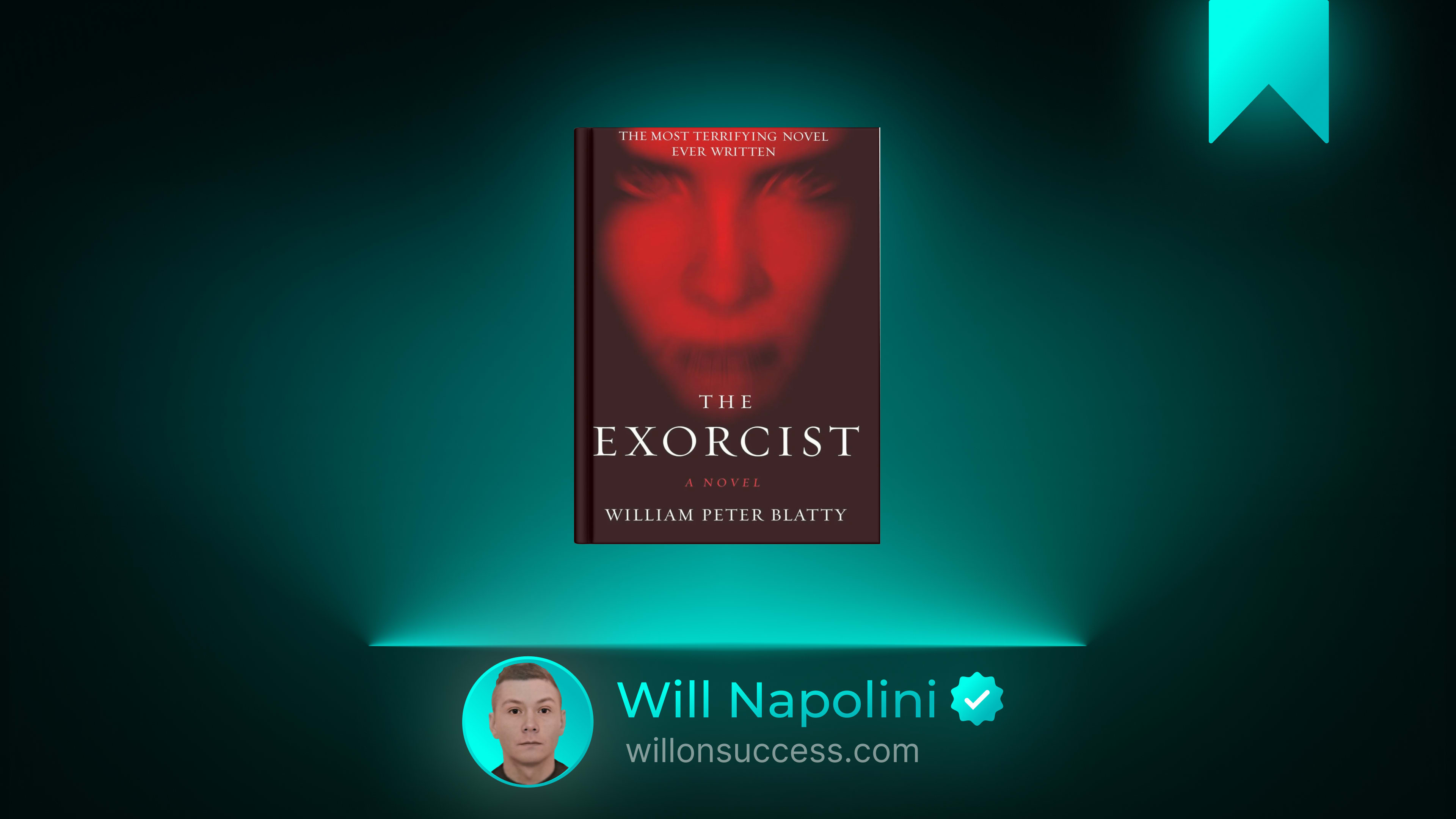
The Exorcist by William Peter Blatty: What a Horror Novel Reveals About Faith, Doubt, and the Courage to Stay
What do you do when every explanation you trust fails you?
Not a small failure. Not a missed deadline or a plan that needs adjusting. I mean the moment when the doctors shrug, when the experts contradict each other, when the framework you built your understanding on simply cannot account for what is happening in front of your eyes. The moment when you realize that the world is stranger, darker, and less manageable than you believed.
Most of us will face that moment. Maybe you are facing a version of it right now—a relationship that has become unrecognizable, a loss that makes no sense, a season of life where the ground beneath you has shifted and no amount of planning can make it solid again.
William Peter Blatty wrote a novel about exactly this moment. You probably know it by its title, and you probably think you know what it is about. A possessed girl. A terrified mother. Two priests. A ritual. Horror.
But I have read The Exorcist, and I want to tell you something: beneath the dread, beneath the scenes that made audiences faint in 1973, Blatty buried one of the most honest explorations of doubt, faith, and human courage I have encountered in any novel. This is not a book about monsters. It is a book about what people do when they stand at the edge of what they cannot explain, and whether they choose to turn away or step forward.
And that question belongs to all of us.
The Story at the Center
Let me give you the shape of it, because the power here lives in the narrative before it lives in the ideas.
Chris MacNeil is an actress renting a house in Georgetown with her twelve-year-old daughter, Regan. Life is ordinary. Then Regan begins to change. Small things at first. A voice that does not sound like hers. A bed that shakes. Behavior that no parenting book prepared Chris for. She does what any rational, loving parent would do. She takes her daughter to doctors. Neurologists. Psychiatrists. Specialists. They run tests. They disagree. They offer tentative diagnoses that explain nothing.
The deterioration accelerates. Regan becomes someone Chris does not recognize. Violent. Cruel. Speaking in a voice that seems to come from somewhere beneath language itself. Every medical avenue closes. And Chris, exhausted and desperate, is driven to a request she never imagined making. She asks the Church for help.
This brings her to Father Damien Karras. He is a Jesuit priest and a trained psychiatrist—a man who lives in two worlds, the world of the soul and the world of the mind. And he is hollowed out. His mother has recently died. His faith, once reliable, has gone silent. He says the prayers. He performs the duties. But inside, there is a quiet, terrible emptiness. He is a man going through the motions of belief while wondering whether belief is still there.
Alongside him stands Father Lankester Merrin, an elderly priest who has faced this kind of darkness before and recognizes its shape. Together, they enter the room where Regan is held. What follows is not a battle of special effects. It is a long, grinding, exhausting confrontation in which two men must decide, hour after hour, whether they will remain present in a situation that is destroying them.
Blatty drew the novel’s foundation from a documented 1949 case involving an alleged exorcism that he first encountered as a student at Georgetown University. He spent years researching, consulting priests and psychiatrists, building the world of the story with care. The novel was published in 1971 and became a cultural phenomenon. But Blatty himself insisted, in various interviews over the years, that the book was fundamentally a story about faith. The horror was the vehicle. The question underneath was always spiritual.
Doubt Does Not Disqualify You From the Work
Here is what moves me most about Father Karras, and here is what I think Blatty is truly writing about beneath the supernatural events.
Karras does not believe easily. He does not stride into that room armored in certainty. He questions. He looks at Regan and wonders whether this is psychosis, whether this is some undiscovered neurological condition, whether he is a fool for being here. His faith is not a fortress. It is a small, flickering thing, and he is cupping his hands around it against the wind, trying to keep it alive.
And yet he stays.
I think many of us carry a misunderstanding about faith, about conviction, about the inner steadiness we believe we need before we can act. We imagine that the person who shows up must first feel certain. That you must have resolved your doubts before you can do the work. That if you are uncertain, you are somehow unqualified.
Karras shows us the opposite. His doubt does not disqualify him. His doubt is part of what makes his choice to stay meaningful. If he were certain, his presence would cost him nothing. But he is not certain. He is afraid. He is grieving. He is unsure whether any of this is real. And he walks into that room anyway.
You do not need to feel ready. You do not need to have resolved every question before you move. What you need is the willingness to stay in the room while you are still figuring it out.
The Limits of Explanation, and What Comes After
One of the most quietly powerful structures in the novel is the long sequence of medical consultations Chris endures. Blatty writes these scenes with patience. Doctor after doctor. Test after test. Each specialist confident, then uncertain, then defensive. The machinery of rational explanation is given every opportunity to solve the problem.
And it cannot.
Now, I am not suggesting that medicine or science are insufficient in general. Blatty is not writing an argument against psychiatry. What he is doing is dramatizing something every person eventually encounters: the boundary of your framework. The point where the categories you rely on simply do not contain what is happening.
You will hit this boundary. Perhaps in grief, where no amount of understanding makes the absence smaller. Perhaps in a relationship, where you have read every book and tried every communication technique and the distance remains. Perhaps in your career, where you have done everything correctly and the door still will not open.
When you reach that boundary, the question is not “What new explanation can I find?” The question is “Who will I be in the presence of what I cannot fix?”
Chris MacNeil answers that question by refusing to leave. She does not understand what is happening to her daughter. She cannot fix it. She cannot even fully believe what she is witnessing. But she stays. She keeps showing up. She keeps saying, in every way she knows how, You are still my child, and I am not going anywhere.
That kind of stubborn, exhausted, unglamorous presence is one of the bravest things a human being can offer another.
Sacrifice Is Where Purpose Becomes Real
I will not describe the novel’s final scenes in detail, because they deserve to be experienced. But I will tell you this: the story ends with a choice. A deliberate, costly, irreversible choice made by a man who has spent the entire novel questioning whether his life has meaning.
Karras begins the story hollow. Grieving. Wondering if his vocation is a performance. Wondering if his mother’s death was meaningless. Wondering if he matters.
And by the end, he discovers the answer. Not through argument. Not through intellectual resolution. Through action. Through a decision that costs him everything and gives him everything at the same time.
Blatty is showing us something important about purpose. You do not find it by thinking your way into clarity. You find it by discovering what you are willing to give yourself to. Purpose is not a conclusion you reach. It is a price you choose to pay. And the willingness to pay it transforms the person paying.
You start uncertain. You act anyway. And in the acting, you discover who you are.
No One Faces the Darkest Room Alone
There is another thread in the novel that I think gets overlooked because the horror elements are so vivid. It is the thread of community. Of people showing up for each other in situations none of them are equipped to handle.
Chris does not face this alone. Karras does not face it alone. Merrin comes from a great distance to stand beside a younger man. Even Detective Kinderman, investigating the deaths tangled around the case, represents a kind of stubborn, skeptical loyalty to the truth.
The novel quietly insists that the worst things in life are not meant to be carried by one person. You were not built to carry them alone. And asking for help—bringing another person into the room where you are struggling—is not weakness. It is strategy. It is survival. It is the way the work gets done.
If you are in a season right now where you are trying to handle everything by yourself, where you are white-knuckling your way through a problem you cannot solve, I would gently ask you: who have you not called? Who is waiting for you to let them in?
You do not have to explain everything. You do not have to have the language for what is wrong. You can simply say, I need someone beside me.
That sentence is not a failure. It is a beginning.
What This Looks Like on an Ordinary Tuesday
Let me bring this down from the level of supernatural drama to the level of your actual life. Because the principles in this novel are not only for exorcisms. They are for Tuesdays.
You are at work, and a project has collapsed in a way you did not foresee. Your careful plan is in pieces. You do not know how to rebuild it. The old framework has failed. You can either pretend everything is fine, or you can say to a colleague, “I am stuck, and I need help.” Karras would recognize the second choice. Chris would recognize the second choice.
You are in a relationship, and someone you love is going through something you cannot fix. You cannot solve it. You cannot optimize it away. You can only be present. You can only sit in the room and say, “I am here. I do not understand this. But I am here.” That is what Chris does. That is the whole novel in one gesture.
You are in a season of doubt. About your career. About your direction. About whether the life you are building means anything. You are going through the motions and wondering if the motions are enough. Karras would sit across from you and say, “Yes. I know that feeling. Stay anyway. The doubt is not the verdict. It is the weather. And weather changes.”
You do not need a demon to test your faith in something. Life provides smaller, quieter tests every week. The question is always the same: will you stay in the room?
Who Should Read This Book
I want to be honest with you. The Exorcist is a horror novel. It contains scenes of genuine psychological intensity, violence, and disturbing imagery. If you are sensitive to those elements, or if you are in a fragile place emotionally, this may not be the right season for it. There is no shame in that.
But if you can handle the horror elements, what you will find is a novel of surprising moral seriousness. It will reward you most if you are:
- Wrestling with doubt and wondering whether doubt makes you unworthy of your commitments
- Caring for someone through a crisis you cannot fix
- Feeling that your life lacks purpose and wondering whether purpose must be found or built
- Interested in the intersection of psychology, spirituality, and human endurance
It will reward you less if you are looking for a light read, or if you want the horror to be purely sensational. Blatty’s horror always serves a deeper argument. If you skip past the dread to find the argument, you will find something genuinely moving.
What makes the book worth reading, beyond its cultural importance, is that it takes seriously the question of what people owe each other in extremity. It does not answer that question easily. But it answers it honestly.
One Small Step You Can Take Today
You do not need to perform an exorcism. You do not need to confront a supernatural force. But you can do the thing Karras does, the thing Chris does, in a small and ordinary way.
Think of one situation in your life right now where you have been avoiding staying present. A conversation you keep postponing. A person you have been keeping at a distance because their pain makes you uncomfortable. A question about your own direction that you keep pushing away because you are afraid of what you might find.
Today, spend five minutes with it. Not solving it. Not fixing it. Just sitting with it. Write down what you are afraid of. Call the person you have been avoiding and simply ask how they are. Open the document you have not looked at. Light a candle if that helps you mark the moment.
Stay in the room for five minutes. That is all.
You do not need certainty. You do not need a plan. You only need the willingness to be present with what is real, instead of turning away from it.
Because here is what Blatty understood, and what I have learned in my own stumbling way: the darkness does not ask you to defeat it in a single night. It only asks whether you will show up. Whether you will remain. Whether you will let the doubt and the fear and the exhaustion be there, and choose to stay anyway.
You do not need to be unafraid. You only need to be unwilling to leave.
And that small, stubborn, unglamorous decision to remain—that is where faith begins. Not in the absence of darkness, but in the quiet choice to stand inside it and say, I am still here.
The door is open. Walk through it.