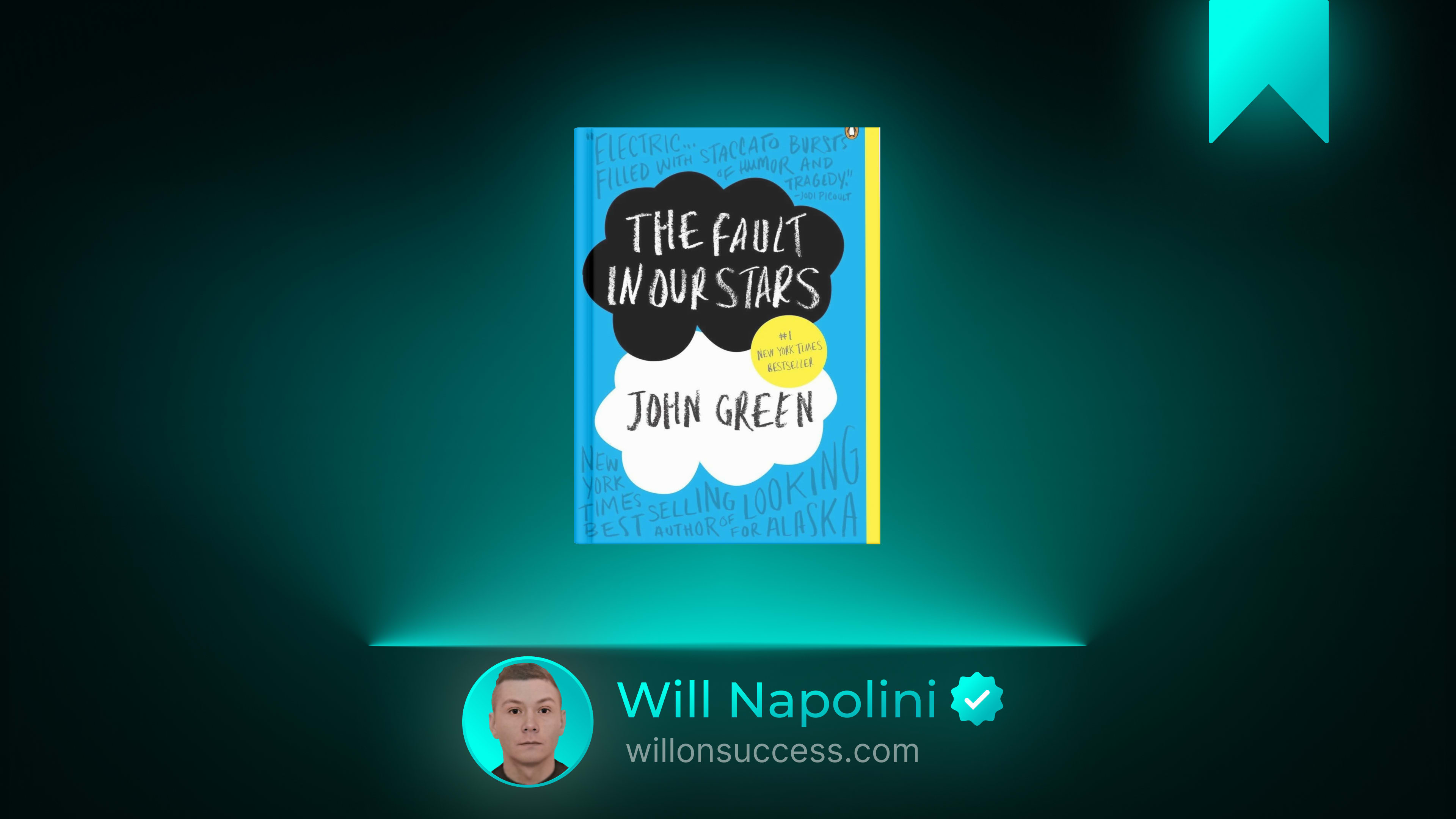
The Fault in Our Stars by John Green: What Two Dying Teenagers Teach Us About Living Fully
What if the life you are trying to build does not need to be long in order to be complete?
I know how that question sounds. I know that in a culture obsessed with legacy, with building something that outlasts you, with leaving a mark so deep that strangers will remember your name a century from now, the idea that a short life can be whole feels almost offensive. It feels like a consolation prize. A gentle lie we tell to make unbearable things bearable.
But I have sat with this question for a long time. And I have come to believe it is not a consolation. I have come to believe it is one of the most liberating truths a person can encounter. And I first encountered it not in a philosophy text or a sermon, but in a novel about two teenagers with cancer who fall in love in a church basement support group.
John Green published The Fault in Our Stars in 2012. Millions of people read it. Millions of people cried. And then many of them put it on a shelf and moved on, remembering it as a beautiful, devastating love story. And it is that. But underneath the love story, Green constructed a careful, tender argument about what it means to be alive when you know you are running out of time. And that argument, I think, belongs to every one of us. Because every one of us is running out of time. We simply do not all know the deadline.
The Story You Need to Hear
Hazel Grace Lancaster is sixteen. She has thyroid cancer that has spread to her lungs. She carries an oxygen tank beside her like a small, humming companion. She is sharp, funny, stubbornly honest, and she has decided something about herself that shapes everything she does: she is a grenade.
This is her word for it. She believes that when she dies, she will explode, and the shrapnel will wound everyone who loved her. So her strategy, the one she has built her young life around, is to minimize the blast radius. Keep people at a distance. Do not let them get too close. Protect them from the inevitable detonation.
Then she meets Augustus Waters at a cancer support group held in the literal heart of a church. Augustus is seventeen. He had osteosarcoma. He lost a leg to it. He is in remission, though the fear of recurrence lives in him like a low hum he cannot turn off. He is charming. He is a little too pleased with his own metaphors. And he has a conviction that Hazel does not share: he wants his life to mean something large. He wants to be remembered. He wants to leave a mark on the world.
They bond over a book. A novel called An Imperial Affliction, written by a reclusive author named Peter Van Houten. The book ends mid-sentence. No resolution. No closure. It simply stops, as if the character’s life continued past the last page and the author refused to follow. Hazel is obsessed with what happens to the characters after the ending. She needs to know. It is the one question she cannot answer for herself.
Together, they travel to Amsterdam to find Van Houten and demand answers. What they find instead is a bitter, drunk, cruel man who offers them nothing. The answers will not come from outside. They never do.
And then the story reverses. Augustus, who seemed to be the one with time, reveals that his cancer has returned. It is everywhere. It is terminal. The boy who wanted to be immortal has learned that he will not be. And the girl who tried to protect everyone from her death must now watch someone else die, and discover that she cannot protect herself from loving him.
The title comes from Shakespeare. In Julius Caesar, Cassius says the fault is not in the stars but in ourselves. Green borrows the phrase and quietly inverts it. His characters are not flawed because of their choices. The fault is in their stars. In their cells. In the blind, indifferent machinery of a body turning against itself. And the question the novel asks is: given that the fault is not of your making, what will you do with the time that remains?
You Cannot Protect Anyone by Disappearing
Hazel’s grenade metaphor is one of the most honest descriptions of how we handle our own suffering I have encountered in fiction. And I do not think it applies only to terminal illness.
How many of you are pulling away from the people who love you because you are struggling? How many of you are keeping a cheerful mask in place, not because you are fine, but because you are afraid that if you let someone see the real weight you are carrying, you will become a burden? How many of you have decided, quietly, that the kindest thing you can do is to make yourself smaller so that your pain takes up less room in other people’s lives?
I understand the logic. It feels like generosity. It feels like protection.
But Hazel learns, slowly and painfully, that it is not protection. It is a different kind of harm. When you withdraw, when you minimize yourself, when you refuse to let people love you in your mess and your grief and your fear, you rob them of the chance to be present. You make the decision for them. You decide what they can handle. And that decision, made in the name of kindness, often isolates you in exactly the moment you most need connection.
Augustus does not let Hazel be a grenade. He does not stand at a safe distance. He walks toward her. And in doing so, he teaches her something she could not teach herself: that being loved in your suffering is not the same as being a burden. That the people who choose to stay are making their own choice, and that choice is theirs to make.
You do not owe anyone your disappearance. You owe them the truth, and the chance to decide for themselves whether they will stay.
The Obsession With Legacy, and Its Quiet Antidote
Augustus wants to be remembered. He says so plainly, in the way teenagers say things plainly, without the layers of irony adults wrap around their desires. He wants his life to add up to something. He wants a story that outlasts him. He wants a mark.
And Green does not mock him for this. He takes the desire seriously. Because it is a real desire, and it lives in most of us. You have felt it. The late-night thought: Will any of this matter? Will anyone remember? Did I build something, or did I just pass through?
But the novel gently dismantles the assumption behind the desire. It does so through a single, luminous idea that Hazel and Augustus return to: some infinities are larger than other infinities. The mathematician’s language applied to a human life. You can have an infinite number of days between zero and one, and an infinite number between zero and two. Both are infinite. One is larger. But neither is incomplete.
A life of sixteen years, lived with attention, with love, with the full weight of feeling, is not a truncated version of a longer life. It is not a draft. It is not a fragment. It is whole. The infinity it contains is real. The moments of laughter, of argument, of tenderness, of terrible honesty—those moments do not need to be witnessed by millions in order to be complete. They are complete in the living.
This does not mean ambition is wrong. It does not mean building something, contributing something, leaving a trace is foolish. But it means that the value of your life is not contingent on its duration or its audience. You do not need to be remembered by strangers in order to have lived fully. The Tuesday afternoon you spent truly listening to someone. The meal you cooked with care. The hard conversation you did not run from. These are not small things. They are the infinity between zero and one. And that infinity is enough.
Life Will Not Give You a Clean Ending
Remember the book within the book. An Imperial Affliction, the novel Hazel loves, ends mid-sentence. The characters are in the middle of a moment, and the text simply stops. Hazel is tormented by this. She needs to know what happens next. She flies across an ocean to ask the author.
And the author tells her nothing. He is cruel. He is broken. He has no answers.
Green is making a point, and it is a point I think every person must eventually reckon with. Life does not resolve. There is no clean third act. There is no moment where all the threads tie together and the meaning becomes obvious and the music swells. People leave mid-conversation. Stories end in the middle of a sentence. You will carry questions that never get answered. You will love people and lose them before the narrative feels finished.
And you must make peace with that. Not because it is fair. Not because it is satisfying. But because the alternative—refusing to live fully until you are guaranteed a resolution—means you will never live fully at all.
Hazel wanted the author to tell her what happened to the characters after the last page. But the characters’ lives, like hers, like yours, do not require an author’s explanation to be real. The mid-sentence ending is not a failure of the story. It is the shape of the story. You are living in the middle of a sentence right now. You do not know how it ends. That does not make the words you are speaking today less true.
Choosing to Love When Loss Is Guaranteed
This is the hardest idea in the book, and the most important.
Hazel knows Augustus will die. Or rather, she learns it. And the knowledge does not make her pull away. It makes her move closer. She chooses to love him fully, in the time they have, knowing exactly what the cost will be. She does not bargain. She does not hedge. She does not say, “I will love him a little less so that it hurts a little less when he is gone.”
She loves him the whole way.
And Augustus, in the final stretch of his life, asks Hazel for something that I find unbearably beautiful. He asks her to write a eulogy for him. Not for a funeral. For a pre-funeral. A small gathering, just the people who love him, where they say the words while he can still hear them. He wants to know what his life meant to the people in it. He wants to hear it spoken aloud while he is still in the room.
This is not morbid. This is the most honest thing a person can ask for. To know, while there is still breath in you, that you mattered. That you were seen. That the specific texture of your presence in someone’s life was noticed and cherished.
You do not have to be dying to do this. You can tell someone today what they mean to you. You can say the words while the person can still hear them. You can write the letter. Make the call. Sit across from them and say, plainly, without occasion, “You matter to me. Here is how. Here is specifically what you have done that I have carried with me.”
We postpone these words as if time is guaranteed. As if there will always be a later. There is not. And the novel’s deepest argument is that the awareness of this is not a reason to despair. It is a reason to speak now. To love now. To be present now, with the full weight of your attention, before the sentence ends.
What This Means for Your Ordinary Week
You are not, I suspect, carrying an oxygen tank. You are not, I hope, facing the specific, brutal urgency that Hazel and Augustus face. And I do not want to equate your struggles with theirs. That would be dishonest.
But the principles in this novel scale down to the size of a normal life.
The grenade instinct lives in you when you cancel plans because you are depressed and do not want anyone to see you struggling. The legacy anxiety lives in you when you cannot enjoy an evening because you are calculating whether your work will be remembered. The need for a clean ending lives in you when you cannot grieve a relationship because it ended without closure, without explanation, without a final conversation that made sense of everything.
And the choice to love despite loss lives in you every time you let someone close, knowing that all closeness carries the seed of future grief. Every friendship. Every love. Every child. Every parent. To love is to accept that you will one day grieve, or be grieved. And to love anyway.
That is not a small decision. That is the decision. The one underneath all the others.
Who Should Read This Book
If you have the emotional space for it, this novel will reward you. It is written for young adults, but it is not a young book. Green’s prose is sharp, funny, and philosophically serious. The teenagers in it speak like precocious teenagers, which is both the book’s charm and, occasionally, its limitation. Some readers may find the dialogue a shade too polished, too metaphor-rich. That is a fair criticism. Green writes teenagers who are a little more eloquent than most teenagers are at four in the morning in a hospital room.
But if you are someone who is wrestling with questions of meaning, of legacy, of how to love in a world that guarantees loss, this book will meet you where you are. It will not preach. It will not promise you that everything works out. It will simply sit beside you and say, “Yes. It is this hard. And it is still worth it.”
Read it if you need permission to grieve. Read it if you need permission to love without guarantees. Read it if you have been making yourself small to protect others, and you need a story that tells you to stop.
Do not read it if you are in the acute center of a fresh loss and you are not yet steady enough for this particular weight. Give yourself time. The book will be here when you are ready.
One Small Step
Here is what I would ask you to do today. Not tomorrow. Today.
Think of one person in your life who has mattered to you. A friend. A parent. A partner. A mentor. Someone whose presence has shaped who you are, even in small ways.
And tell them. Not in a grand speech. Not in a five-page letter. Just a few sentences, spoken or written. “I was thinking about you today, and I wanted you to know that you matter to me. Specifically, I remember when you—” and then name one moment. One Tuesday. One conversation. One small act of kindness that you carried forward.
Say it while they can hear it. Say it while you are both in the room.
Because the sentence you are living in right now is not guaranteed to continue. And the words you leave unspoken are the only true loss. Not death. Not time. Not the fault in the stars. The words you held back because you thought there would be another day.
There may be. There may not be.
Speak while the sentence is still being written. The middle is where the life is. And the middle is all any of us are promised.
You are not too late. Not yet. Pick up the phone. Write the note. Say the thing.
The infinity between zero and one is large enough to hold it. And you are still in it.