The Courage to Be Seen: A Mentor’s Guide to Brené Brown’s The Gifts of Imperfection
We spend the first half of our lives building a flawless armor, convinced that if we can just look perfect, do perfect, and have perfect, no one will be able to hurt us. Then we spend the second half of our lives exhausted, wondering why the armor is so heavy and why we still feel entirely alone inside it.
When was the last time you allowed yourself to be seen without immediately trying to edit yourself?
Most of us have forgotten how. We have been taught that worthiness is a reward for flawless performance. We believe that if we can just optimize our routines, curate our images, and anticipate every possible failure, we will finally earn the right to be loved, respected, and at peace. But this is a dangerous illusion. A life lived in pursuit of an unattainable standard is not a life lived; it is a life managed.
There is a profound difference between striving to be your best and striving to prove you are enough. The former builds character. The latter builds a cage.
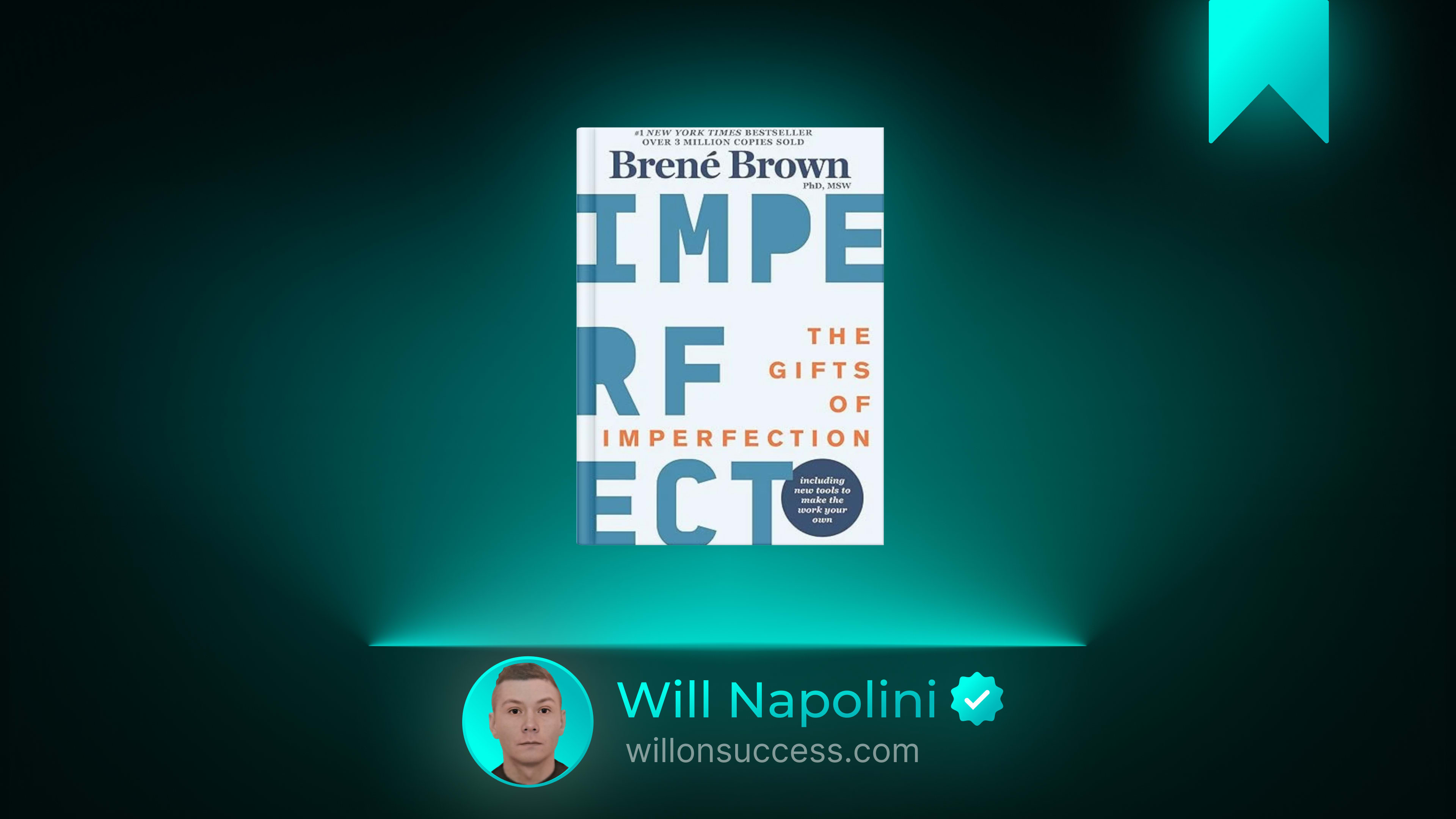
If you are tired of the exhausting performance of trying to be flawless, there is a body of work that will fundamentally shift how you view your own value. That work is The Gifts of Imperfection by Brené Brown.
While Brown is widely known as a research professor who studies courage and vulnerability, this specific book is not an academic textbook. It is a deeply practical, ten-step guide to what she calls “wholehearted living.” It is a manual for letting go of who you think you are supposed to be, and embracing who you actually are.
Here is what this book can teach you about dropping the armor and stepping into your own life.
The Big Idea: Worthiness Is Not an Achievement; It Is a Baseline
The central thesis of The Gifts of Imperfection is that wholehearted living is not a personality trait reserved for the naturally confident. It is a daily practice rooted in a single, foundational belief: the belief that you are enough.
We often treat worthiness as a variable. We think it fluctuates based on our productivity, our bank accounts, our physical appearance, or the approval of our peers. When we succeed, we feel worthy. When we fail, we feel defective.
Brown’s research dismantles this entirely. She discovered that people who experience a strong sense of love and belonging do not have fewer struggles, fewer flaws, or fewer failures than anyone else. The only distinguishing factor is that they believe they are worthy of love and belonging, regardless of their circumstances.
True growth requires you to stop treating worthiness as a finish line you cross when you finally get your life together, and start treating it as the ground you stand on while you figure things out.
The Story: The Data That Broke the Researcher
To understand the power of this idea, we have to look at how Brown arrived at it. She is a qualitative researcher. Her job is to look at messy human experiences, break them down into data, and find the underlying patterns.
Years ago, she was studying connection and shame. She stumbled upon a subset of people who had a strong sense of love and belonging. Intrigued, she dug into the data to find out what these people had in common. She looked at their demographics, their habits, their psychological profiles.
What she found was a variable she could not easily quantify.
These individuals simply believed they were worthy of love. They did not have a special gene. They had not suffered less. They had not achieved more. They just possessed a core belief in their own worthiness.
As Brown has documented in her talks and writings, this realization essentially broke her brain. It forced her to abandon her clinical detachment and confront her own struggles with worthiness and vulnerability. It led her to realize that to study courage, you have to practice it. To study vulnerability, you have to be willing to be seen.
This is the mechanism of the book: it asks you to move from analyzing your life to actually living it, with all the messiness that entails.
The Major Principles
Perfectionism Is Not a Virtue, It Is a Shield
We often confuse perfectionism with healthy striving. We put it on resumes and praise it in our children. But Brown draws a sharp, necessary line between the two.
Healthy striving is self-focused. It asks: How can I improve? Perfectionism is other-focused. It asks: What will they think?
Perfectionism is not the pursuit of excellence. It is the belief that if you look perfect, live perfectly, and act perfectly, you can avoid the pain of blame, judgment, and shame. It is a defensive strategy.
Think of it like the architecture of a building. A structure built to withstand a massive earthquake must have a flexible frame. It needs to sway. Rigid structures do not survive the shaking; they shatter.
When you operate from perfectionism, you are building a rigid structure. You are so terrified of the shaking that you make yourself brittle. When a mistake happens—and it always happens—you do not bend. You break.
Letting go of perfectionism does not mean lowering your standards. It means changing your motivation. It means doing excellent work because you care about the work, not because you are terrified of being exposed as a fraud.
Belonging Requires the Courage to Stand Alone
We live in a culture obsessed with fitting in. We are taught from a young age that to be part of a group, we must assimilate. We must read the room, mirror the opinions of the majority, and hide the parts of ourselves that might cause friction.
But Brown makes a critical distinction that changes everything: fitting in and belonging are not the same thing. In fact, they are opposites.
Fitting in is assessing a situation and changing yourself to be accepted. It is a form of camouflage. Belonging is presenting your authentic self and being accepted for it.
The paradox of belonging is that you cannot truly belong to any group, community, or relationship until you first belong to yourself. If you have to alter your shape to fit into a space, you do not belong there. You are just hiding there.
This principle demands a high degree of personal responsibility. It requires you to stop outsourcing your identity to the crowd. It means accepting that the price of true belonging is the willingness to be misunderstood by those who only want you to fit in.
Joy Is Actually More Terrifying Than Vulnerability
This is perhaps the most counterintuitive insight in the book. We tend to think that sadness, fear, and grief are the hardest emotions to face. But Brown’s research reveals that joy is often the most terrifying.
She calls this “foreboding joy.” When we experience a moment of pure joy—watching our children sleep, achieving a massive goal, sitting across from someone we love—our immediate instinct is to brace for impact. We imagine everything that could go wrong. We envision the tragedy that might follow. We numb the joy because we are afraid of being blindsided by disappointment.
We do this because vulnerability feels dangerous, and joy makes us incredibly vulnerable. When you love something deeply, you have everything to lose.
The antidote to foreboding joy is not to lower your expectations. The antidote is gratitude. Brown found that the people who experience the most joy are those who actively practice gratitude. They do not take the good moments for granted. When joy arrives, they name it. They say, I am so grateful for this.
Gratitude anchors you in the present moment. It prevents you from numbing the good stuff out of fear of the bad stuff.
Why It Matters: Your Ordinary Tuesday
You might be wondering how these high-level concepts apply to the mundane reality of your daily life.
Imagine your ordinary Tuesday.
You are drafting an email to a colleague. You have written the core message, but you spend twenty minutes softening the tone, adding unnecessary apologies, and re-reading it to ensure you do not sound “too aggressive.” That is perfectionism acting as a shield.
You are at a dinner party. Someone brings up a topic you have a strong, unpopular opinion on. You nod along with the group instead of sharing your actual perspective because you do not want to disrupt the harmony. That is choosing fitting in over belonging.
You are playing with your kids on the floor, and you feel a sudden, overwhelming surge of love. Immediately, your brain whispers, But what if they get sick? What if you fail as a parent? You push the feeling away and check your phone. That is foreboding joy.
These micro-moments are where your life is actually happening. When you apply the principles of wholehearted living, you stop sleepwalking through these moments. You start making conscious choices. You send the clear, direct email. You share your honest opinion with kindness. You put the phone away and soak in the joy of the moment.
The shift is subtle, but over time, it is transformative. You stop living in a state of low-grade anxiety and start living in a state of active engagement.
Practical Application: Turning Insight into Behavior
Understanding these concepts is only the beginning. The goal is not merely to read about wholeheartedness, but to practice it. Here are three concrete ways to integrate these principles into your life this week.
1. The “Good Enough” Audit Identify one area of your life where you are over-functioning out of perfectionism. It might be your morning routine, the way you organize your workspace, or how you parent. Ask yourself: Am I doing this to make the work better, or am I doing this to avoid being judged? Choose one task this week to do “just well enough.” Send the email without the third proofread. Leave the dishes in the sink overnight. Observe the physical sensation of letting it be imperfect. Notice that the world does not end.
2. Practice Micro-Belonging You do not need to reveal your deepest secrets to practice authenticity. Start small. In one conversation this week, resist the urge to agree with the group just to keep the peace. Say something like, I actually see it a little differently, or I’m not sure I agree, but I’m listening. Keep your tone warm and curious, but do not camouflage your actual thoughts. Build the muscle of standing by your own perspective in low-stakes environments.
3. The Gratitude Anchor When you experience a moment of genuine joy, or even just deep relief, stop what you are doing. Do not let your brain immediately jump to the next worry. Physically pause. Take a breath. Say out loud or write down: I am grateful for this exact moment. Name the joy. Claim it. Refuse to let the fear of the future rob you of the present.
Who Should Read This Book
The Gifts of Imperfection is a modern classic for a reason, but it is not a light read. It requires emotional labor.
You will benefit most from this book if:
- You are exhausted by the pressure to have it all together and are ready to give yourself permission to be human.
- You struggle with people-pleasing, chronic self-doubt, or the belief that your worth is tied to your productivity.
- You want to build deeper, more authentic connections in your relationships but are afraid of being truly seen.
You may find it less useful if:
- You are looking for a quick, tactical fix for a specific problem. This book is about foundational identity work, not life hacks.
- You are deeply resistant to examining your own emotional patterns. The book asks you to look closely at your shame and your defenses, which can be uncomfortable.
Brown writes with the rigor of a scientist and the warmth of a trusted friend. She does not offer cheap platitudes. She offers a researched, proven path back to yourself.
One Small Step
We often think that changing our lives requires a massive, sweeping overhaul. We wait for the day we finally feel confident enough to drop the armor.
But courage is not the absence of fear. Courage is acting in spite of it. And it starts incredibly small.
Here is what I want you to do today.
The next time you make a minor mistake—a typo in a text, a slightly burnt dinner, a clumsy comment in conversation—catch your immediate instinct to criticize yourself.
Instead of spiraling into self-correction, simply pause and say to yourself: I am learning.
Do not try to fix it immediately. Do not beat yourself up. Just acknowledge the imperfection and grant yourself the grace to be a work in progress.
You do not have to earn your right to take up space. The armor is heavy, and you have carried it long enough. Set it down. The world does not need a flawless version of you; it just needs the real one.