Trusting Your Gut: Why the Gift of Fear Is Your Greatest Protector
There is a specific, quiet moment I want you to remember.
It is the moment you felt a sudden, unexplained chill in a conversation. It is the strange hesitation you felt before getting into a car, or the subtle, creeping wrongness when a stranger offered you help. And then, it is the moment you smiled, nodded, and pushed that feeling down because you did not want to be rude.
We have all been there. We feel the alarm bell ring in our chest, and instead of pulling the alarm, we apologize for the noise.
If I could sit across the table from you right now, I would tell you that this is not a character flaw. You are not overly sensitive, and you are not imagining things. What you are experiencing is a highly evolved, deeply intelligent survival mechanism trying to do its job. The problem is not that your intuition is broken. The problem is that you have been trained to ignore it.
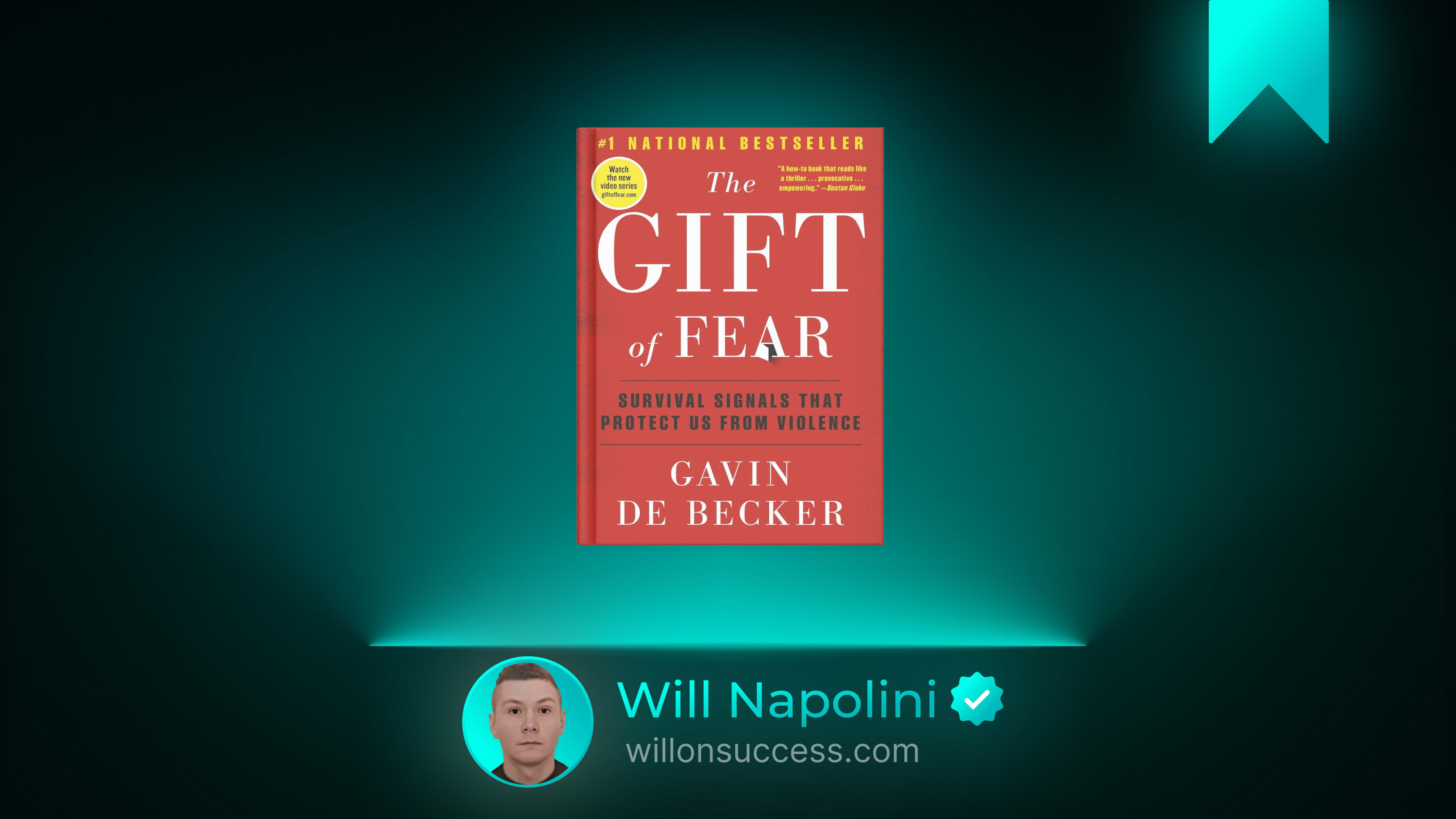
In his groundbreaking book, The Gift of Fear: Survival Signals That Protect Us from Violence, Gavin de Becker explores the mechanics of human intuition. While the book is rooted in the study of violent crime and personal safety, its core message reaches far beyond physical danger. It is a profound masterclass in self-trust, boundary-setting, and recognizing the subtle ways our social conditioning compromises our well-being.
What I discovered when I first engaged with de Becker’s work was a fundamental shift in how I view my own hesitation. I realized that my gut was not a source of irrational anxiety; it was a compass. And for years, I had been deliberately walking in the wrong direction just to avoid offending the people around me.
Here is what I want to show you about the central idea of this book, why it matters for your daily life, and how you can begin to reclaim the most powerful tool you already possess.
The Big Idea: Intuition Is Not Magic, It Is Intelligence
We often treat intuition as a mystical sixth sense. We call it a “gut feeling” or a “hunch,” and because we cannot explain it logically, we dismiss it. We tell ourselves to stop overthinking and just look at the facts.
De Becker dismantles this misconception entirely. He explains that intuition is not magic. It is the brain’s ability to process thousands of micro-signals—body language, tone of voice, micro-expressions, environmental context, and historical patterns—faster than the conscious mind can articulate them.
When you walk into a room and instantly feel that something is wrong, your conscious mind might not be able to point to the exact threat. But your subconscious mind has already analyzed the data, recognized a pattern of danger, and sent a physical signal to your body. That signal is fear.
Society has taught us to view fear as a weakness, an emotion to be conquered or suppressed. De Becker flips this paradigm. He argues that true fear is not a weakness; it is a gift. It is a positive, life-saving signal that tells you a present danger exists.
When you ignore that signal, you are not being brave. You are simply disconnecting your alarm system.
The Mechanism of Survival: Why We Ignore the Alarm
If intuition is so reliable, why do we so frequently override it? Why do we stay in the uncomfortable conversation? Why do we accept the help we do not need? Why do we ignore the creeping sense of dread?
The answer lies in our socialization.
From the time we are children, we are taught to be polite. We are taught to give people the benefit of the doubt, to not judge a book by its cover, and to prioritize the comfort of others over our own unease. For many people, especially women, this social conditioning is deeply ingrained. We are taught that being “nice” is a moral imperative.
Predators and manipulators know this. They do not attack our physical defenses first; they attack our social conditioning. They use our politeness as a wedge to bypass our boundaries.
When your intuition says, This person is dangerous, and your social conditioning says, But they are being so nice, you would be rude to leave, you experience cognitive dissonance. To resolve the discomfort, you usually side with your social conditioning. You suppress the fear. You stay.
This is the central tragedy of ignored intuition. We sacrifice our own safety and peace of mind on the altar of politeness.
The Major Principles of Recognizing Manipulation
To protect yourself, you must understand how manipulation operates before it crosses the line into overt aggression. De Becker identifies several “survival signals”—specific communication strategies used by manipulators to gain control. Understanding these will change the way you interact with the world.
Politeness Is a Predator’s Best Tool
We tend to associate danger with obvious hostility. We look for anger, aggression, or threats. But true danger often wears a mask of charm.
A manipulator will often go out of their way to be exceptionally nice. They will offer unsolicited help, give you a compliment, or make you laugh. This is not necessarily because they are a good person; it is a strategic disarming tactic. They are building a social debt. By being “nice,” they make it socially unacceptable for you to reject them.
If you find yourself feeling obligated to someone you just met because they did you a small favor, recognize that feeling. It is not gratitude; it is a manufactured obligation. You do not owe anyone your time, your attention, or your safety, regardless of how pleasantly they delivered their request.
The Strategy of Forced Teaming
One of the most subtle and effective survival signals is “forced teaming.” This is when a person uses the word “we” to create a false sense of shared purpose or shared situation.
Imagine you are trying to leave a conversation, and the other person says, “We’re both just trying to get through this long day, right?” or “We can figure this out together.”
Notice what they are doing. They are deciding that you are a team without your consent. They are using language to break down your boundary and pull you into their orbit. When someone forces a “we” upon you, your intuition should immediately recognize it as a boundary violation. You are not a team. You are two separate individuals, and you have the right to walk away.
The Unsolicited Promise
When someone is being entirely honest, they do not need to promise you things you have not asked for. If you ask a colleague if they will finish a report, and they say, “Yes, I will have it done by five,” that is a normal response.
But if you ask a simple question and the person replies, “I promise I’m not going to lie to you, I will have it done by five,” pay attention. They have introduced a promise you did not request.
Manipulators use unsolicited promises to soothe your skepticism. They are trying to convince you of their honesty because they know their honesty is in question. When someone promises you something you did not ask them to promise, trust the hesitation in your gut, not the words in their mouth.
Ignoring the Word “No”
This is the most critical survival signal of all.
De Becker makes it unequivocally clear: when you say “no” to someone, and they do not accept it, they are showing you exactly who they are.
If you decline an invitation and they push back, if you say you cannot help and they guilt-trip you, if you set a boundary and they try to negotiate it, they are not showing you persistence. They are showing you disrespect.
A healthy, safe person will respect a “no” immediately. A manipulator will view a “no” as an obstacle to be maneuvered around. If someone cannot accept a small “no,” they will not accept a large one.
Why It Matters: Beyond Physical Safety
You might be reading this and thinking, This is great for avoiding danger in dark alleys, but how does it apply to my everyday life?
The principles of The Gift of Fear apply to every area where human boundaries intersect. The same psychological mechanisms that allow a predator to bypass physical boundaries allow a toxic partner to bypass emotional boundaries. They allow a manipulative boss to bypass your professional limits. They allow an emotional vampire to drain your energy.
How often do you stay in a job that is destroying your health because the boss is “charming” and you do not want to seem ungrateful?
How often do you stay in a relationship that diminishes you because your partner uses “forced teaming” (“We’re in this together, you can’t leave me now”) and you feel trapped by the illusion of shared destiny?
How often do you say “yes” to commitments you do not have the time or energy for, simply because you were too polite to say “no”?
Your gut is not just protecting your physical body. It is protecting your peace, your time, your energy, and your future. When you ignore the gift of fear in your daily life, you slowly erode your own foundation. You teach the world that your boundaries are negotiable. You teach yourself that your intuition is unreliable.
Reclaiming your intuition is not just about physical safety. It is about personal sovereignty. It is about deciding that your internal compass is more important than the external expectation of politeness.
Distinguishing True Fear from Anxiety
Before you begin trusting your gut, you must learn to distinguish between true fear and false fear. This is a crucial distinction that de Becker emphasizes.
False fear is anxiety. It is worry about the future. It is the manufactured dread of what might happen. False fear is often paralyzing. It keeps you awake at night, it makes you second-guess your decisions, and it is usually driven by insecurity or past trauma rather than present reality. False fear is not a survival signal; it is noise.
True fear, on the other hand, is a response to a present, immediate signal. It is clear, sharp, and grounded in the current moment. True fear does not paralyze you; it prepares you. It heightens your senses, focuses your mind, and gives you the energy to act.
When you feel true fear, your body is telling you that the data it has processed indicates a present threat.
If you are lying in bed at 2:00 AM worrying about an email you sent three days ago, that is false fear. Ignore it. If you are sitting across from a stranger who is smiling, but your chest is tight, your breathing is shallow, and every cell in your body is telling you to leave the room, that is true fear. Obey it.
Practical Application: Retraining Your Intuition
Understanding these concepts is only the first step. The goal is not merely to know how manipulation works; the goal is to change how you respond to it. Here is how you can begin to apply this wisdom immediately.
Conduct a Politeness Audit
For the next three days, pay close attention to the moments you say “yes” when your body wants to say “no.” Notice the physical sensations. Does your chest tighten? Does your stomach drop? Do you feel a sudden urge to look away?
When you notice this, pause. You do not have to change your behavior immediately if you are not ready, but you must acknowledge the signal. Say to yourself, My intuition is telling me something right now. Stop treating your physical reactions as inconveniences. Start treating them as data.
Practice the “Micro-No”
If you struggle with boundaries, do not start by setting massive, life-altering boundaries. Start small. Practice the “micro-no” in low-stakes environments.
When a cashier asks if you want to round up for charity, say, “No, thank you.” When a colleague asks if you can take on a minor task that is not your responsibility, say, “I don’t have the bandwidth for that right now.”
Observe their reaction. If they smile and accept it, you are dealing with a healthy person. If they push back, sigh heavily, or try to guilt you, you have just identified a survival signal. You are learning to read the room without putting yourself in actual danger.
Separate Intellect from Intuition
One of the most difficult habits to break is allowing your intellect to argue with your intuition.
Intuition is fast. It says, Leave this situation. Intellect is slow. It says, Wait, let me gather more data. Maybe they have a good explanation. Maybe I am being unfair.
When your intuition gives you a clear signal of danger or deep discomfort, do not let your intellect talk you out of it. Intuition is the compass; intellect is the map. If the compass is pointing toward danger, do not ignore it just because the map looks pretty.
Trust your intuition first. Get yourself to safety. You can let your intellect analyze the situation later, when you are no longer in the presence of the threat.
Who Should Read This Book
The Gift of Fear is a vital read for anyone who struggles with people-pleasing, boundary-setting, or self-trust. If you have a history of staying in bad situations too long, or if you frequently feel “off” about people but dismiss it to avoid being judgmental, this book will fundamentally change how you navigate the world.
It is also essential reading for parents. De Becker includes profound insights on how to teach children to trust their own intuition, rather than forcing them to be polite to adults at the expense of their own comfort.
However, this book may not be for everyone. It deals heavily with the realities of violent crime, stalking, and abuse. The examples are sometimes graphic and deeply unsettling. If you are currently in a highly triggered state regarding trauma, approach the book with care, perhaps reading it in small increments. It is not a light, breezy self-help book; it is a serious, urgent examination of human darkness and how to navigate it.
One Small Step You Can Take Today
I want to leave you with a single, actionable step.
Think of one person in your life, or one recurring situation, where you routinely override your intuition to keep the peace. It might be a family member who makes backhanded comments, a friend who always cancels plans at the last minute, or a professional contact who makes you feel subtly uneasy.
Today, I want you to stop overriding the signal.
You do not need to confront them. You do not need to make a dramatic exit. Simply acknowledge the truth. Say to yourself, I do not feel safe around this person, and I am allowed to protect my energy.
Then, take one small action to honor that feeling. Delay your response to their text. Decline their next invitation. Keep the interaction strictly professional and brief.
You do not need to explain yourself. You do not need to apologize. You just need to listen to the quiet voice that has been trying to protect you all along.
The Door Opens Forward
We spend so much of our lives looking outward for validation, trying to read the minds of others, trying to be exactly what the world expects us to be. We look for signs in the eyes of strangers, in the tone of our bosses, in the approval of our peers.
But the most important signs are not out there. They are in here.
Your intuition is not a flaw in your programming. It is the masterpiece. It is the culmination of millions of years of human evolution, designed to keep you alive, keep you safe, and keep you moving forward.
When your gut speaks, it is not whispering. It is the only thing in the room telling the truth.
Politeness is a social lubricant, but it should never be a padlock on your intuition. The next time you feel that sudden, unexplained chill, do not smile and push it down. Do not apologize for the noise.
Pull the alarm. Trust the gift. And walk confidently in the direction of your own truth.