The Gospel According to Peanuts by Robert Short: What a Comic Strip Taught Me About Faith, Failure, and Getting Up One More Time
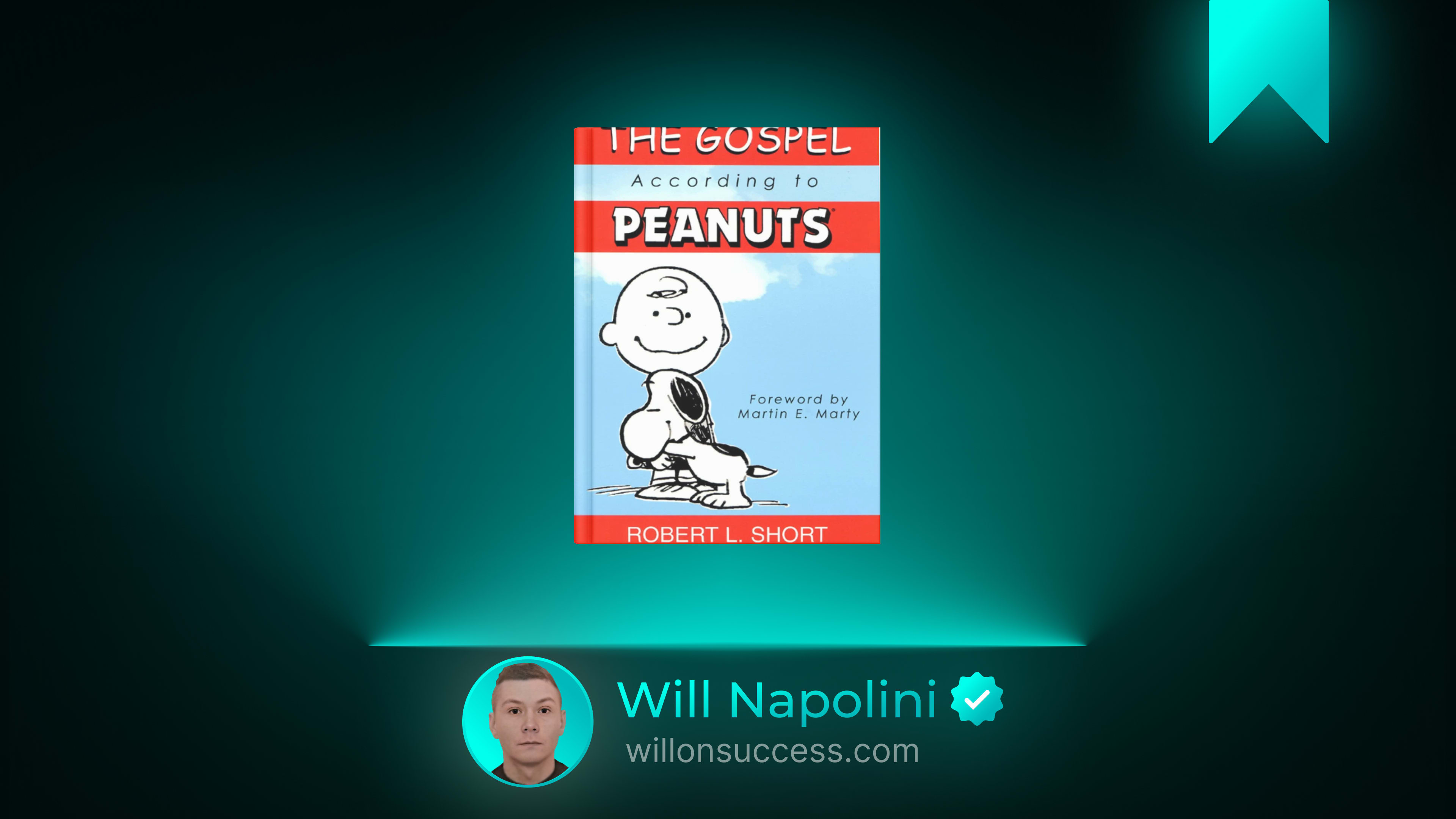
I want you to picture something. A boy runs toward a football. A girl holds it steady on the ground. He plants his foot, swings his leg, commits his whole small body to the kick—and she yanks the ball away. He lands flat on his back. The sky stares down at him. He says, “Good grief.”
Now picture it again. And again. And again. Hundreds of times, over decades. The same setup. The same hope. The same fall.
And here is the part that undid me when I first really thought about it: he keeps running toward the football.
Not because he is stupid. Not because he has forgotten what happened last time. He remembers. He always remembers. Lucy reminds him. Everyone reminds him. He knows, with full clarity, that the ball will probably be pulled away. And he runs toward it anyway.
Robert Short looked at that image—a child falling on his back in a comic strip—and saw something that most theologians miss. He saw faith. Not the triumphant, certainty-soaked faith of stained glass and soaring hymns. The other kind. The kind that looks foolish. The kind that gets you knocked down. The kind that says, I will try again, even though I have every reason to expect the same result.
His book, The Gospel According to Peanuts, published in 1965, made the case that Charles Schulz’s little comic strip was quietly doing the work that churches often struggle to do: telling the truth about what it feels like to be a fragile, hopeful, confused, persistent human being in a world that does not owe you an explanation.
I think this book has something to say to you, whether or not you grew up in a pew. Whether or not the word “gospel” means anything specific in your life right now. Because the questions it asks are not denominational. They are human. They belong to anyone who has ever tried something, failed, and faced the morning with the question: Do I get up? Do I try again? Is it foolish to hope?
The Big Idea: Sacred Truth Hides in Ordinary Places
Short’s central argument is simple and, I think, quietly revolutionary: you do not need to look for spiritual truth only in scripture, in sermons, in the formal language of theology. Sometimes the deepest questions about suffering, grace, love, doubt, and meaning are being worked out in a four-panel comic strip that millions of people glance at over morning coffee.
This is not a gimmick. Short was not trying to be clever by finding religion in popular culture. He was making a point about where truth actually lives. And his point was this: it lives in the ordinary. In the small, repeated, unglamorous moments. In the child who cannot kick the football. In the boy who carries a blanket and quotes scripture to a skeptical girl. In the dog who dances on top of his doghouse because the sheer fact of being alive is worth celebrating.
If you have been waiting for a sign, for a burning bush, for some dramatic confirmation that your life matters and your struggles have meaning—this book gently suggests that the sign might already be in front of you, in the small texture of your Tuesday, in the thing you keep doing even though it is hard, in the person you keep loving even though they disappoint you.
The sacred is not somewhere else. It is here, in the getting up.
The Characters as Mirrors: What Each One Carries
One of the things Short does beautifully is read the Peanuts characters not as cartoons but as facets of a single human soul. Each one carries a different response to the fundamental problem of being alive in a world you did not choose, with people you did not select, under conditions you cannot fully control.
Charlie Brown is the one who keeps showing up. He loses. He loses the baseball games. He cannot fly the kite. He cannot talk to the little red-haired girl. He is anxious, uncertain, and perpetually hopeful in a way that embarrasses him. And yet he does not become bitter. He does not harden. He is sad, yes. “Good grief” is his constant refrain. But sadness and bitterness are not the same thing, and Charlie Brown never crosses that line. He remains soft. He remains open. He remains willing.
Lucy is the voice that says the world will not cooperate with your hope. She pulls the football. She runs the psychiatric booth where she dispenses blunt, unsentimental advice for five cents. She represents the part of every person that has been hurt and has decided the safest response is control. She will not be vulnerable. She will not be surprised. She will pull the ball away because being the one who disappoints is safer than being the one who is disappointed.
Linus is the theologian. The philosopher. The child who carries a blanket everywhere because it gives him something to hold onto in a world that will not hold still. He quotes scripture. He waits for the Great Pumpkin with absolute sincerity. He is mocked for his blanket, for his faith, for his need. And he carries on anyway. His blanket is not stupidity. It is the small, tangible thing that keeps him tethered while he works out the enormous questions.
Snoopy is joy. Pure, unapologetic, imaginative joy. He dances on his doghouse. He writes novels no one will read. He pretends to be a World War I flying ace. He is not interested in whether the performance is dignified. He is interested in whether it is alive. And the answer is always yes.
Schroeder sits at his piano, lost in Beethoven, devoted to something beautiful that requires nothing from him except his full attention. He represents the life given over to a single love, a single craft, a single source of meaning.
Short reads these characters with tenderness and without condescension. He does not reduce them to illustrations of a thesis. He lets them breathe. And in doing so, he lets the reader breathe, too. You can find yourself in one of them. Or in several. You can be Charlie Brown on Monday and Lucy on Thursday and Linus on Sunday, clutching your blanket and wondering whether the thing you believe in is real or whether you are just afraid to let go.
That is allowed. That is, in fact, the point.
Persistence Is Not the Same as Naivety
I want to linger on Charlie Brown, because I think he is the heart of this book, and because I think he is the heart of something most of us need to hear.
We live in a culture that is deeply suspicious of repeated failure. If you have tried something five times and it has not worked, the sensible advice is to stop. To pivot. To cut your losses. To be realistic. And often that advice is wise. Sometimes quitting is the bravest thing you can do.
But there is another kind of persistence that is not about strategy. It is about identity. It is about the refusal to let your failures write the final sentence of your story. Charlie Brown does not run toward the football because he has calculated a high probability of success. He runs toward it because he is the kind of person who runs toward the football. Because the alternative—deciding, once and for all, that the ball will always be pulled away, that hope is a sucker’s game, that vulnerability is a luxury he cannot afford—would cost him something he is not willing to lose.
It would cost him his openness. His willingness. His softness.
And I have seen what happens when people lose that. I have watched people get knocked down enough times that they decide the ground is safer than the sky. They stop trying. They stop asking. They stop running toward anything because the falling is too familiar, too predictable, too exhausting to bear one more time.
I understand that decision. I have felt the pull of it. And I do not judge anyone who makes it.
But I also know this: the person who gets up one more time than they fall is not foolish. They are practicing something. Something slow and unglamorous and essential. They are practicing the belief that the next attempt is not identical to the last one. That the world is not a fixed mechanism. That showing up, even when showing up has hurt you before, is a form of faith in the future.
You do not need to call it faith. You can call it stubbornness. You can call it hope. You can call it the quiet refusal to let the worst outcome be the only story you tell yourself. The name matters less than the practice.
Doubt and Belief Are Not Opponents
One of the gentlest arguments in Short’s book is that doubt is not the enemy of faith. Linus believes. He believes sincerely, earnestly, with his whole small heart. And he is also uncertain. He also needs his blanket. He also gets mocked. He also wonders, in the quiet moments, whether the Great Pumpkin is real, whether the things he holds onto are true or simply comforting.
And the book treats that uncertainty not as a failure of belief but as an honest part of it.
I think this matters enormously, because so many people I have known—people who are thoughtful, sincere, searching—have been told, implicitly or explicitly, that doubt means they are doing it wrong. That if they truly believed, the questions would stop. That certainty is the goal and uncertainty is a flaw to be corrected.
But that is not what Short sees in Peanuts. What he sees is a child who holds his blanket and asks hard questions and waits for something he cannot prove is coming. And the book says: that is enough. That is the shape of a real, lived, honest faith. You do not have to resolve every question before you are allowed to believe. You do not have to be certain before you are allowed to hope.
If you are someone who carries questions alongside your convictions, who feels the tension between what you want to trust and what you cannot quite verify—you are not broken. You are in good company. You are Linus, sitting in the pumpkin patch, blanket in hand, watching the sky, waiting.
And the waiting is not wasted. The waiting is the practice.
Joy Is Not a Reward for Suffering. It Is a Companion to It.
Snoopy dances. That is his whole theology, if you can call it that. He does not wait until the war is over, until the novel is published, until the doghouse is renovated. He dances now. On top of the doghouse. In the middle of everything.
Short treats Snoopy’s joy not as escapism but as a necessary counterweight to the heaviness that Charlie Brown carries. And I think this is one of the book’s most practical insights, even though it sounds simple.
You are allowed to be joyful in the middle of a hard season. You are allowed to laugh while you are still grieving. You are allowed to play, to be silly, to waste an afternoon doing something that produces nothing of measurable value, simply because it makes you feel alive. Joy does not require that you have earned it through sufficient suffering. It is not a reward at the end of the difficulty. It is available in the middle.
I have learned this the slow way. I spent years believing that I had to finish the hard part before I was permitted to enjoy anything. That rest was a reward for completion. That play was something you did after the work was done. And the work was never done. So the joy kept getting postponed, year after year, until I realized I had built a life with no room in it for the thing that made the life worth living.
You do not have to finish before you dance. You can dance on the doghouse while the novel is still unfinished. While the kite is still stuck in the tree. While the football is still on the ground, waiting for the next run.
Especially then.
Who Should Read This Book
The Gospel According to Peanuts is for you if you are drawn to the intersection of spirituality and everyday life. If you grew up reading Schulz’s strip and have always sensed there was something deeper underneath the humor. If you are looking for a book that takes faith seriously without taking itself too seriously. If you want theology that smells like autumn leaves and baseball diamonds and the particular loneliness of a child sitting on a curb.
It is especially resonant if you are in a season of doubt, of repeated failure, of wondering whether persistence is wisdom or foolishness. If you need permission to be uncertain and faithful at the same time.
It may be less useful if you are looking for systematic theology, for rigorous biblical exegesis, or for a book that engages deeply with the academic history of religious thought. Short writes as a thoughtful, warm interpreter, not as a scholar. The book is accessible, gentle, and sometimes brief in its treatment of complex ideas.
It is also a product of its time—1965, mid-century American Christianity—and some of its cultural assumptions will feel dated. That is worth knowing going in. But the core insights, the readings of the characters, the fundamental questions about faith and failure and grace—those have not aged. They are as alive now as they were sixty years ago, because the human condition has not changed. The football still gets pulled away. We still fall. We still have to decide whether to get up.
One Small Step
Here is what I would ask you to do today. Just one thing.
Think about the football in your life. The thing you keep running toward even though it has hurt you before. The conversation you keep trying to have. The creative work you keep returning to. The relationship you keep trying to mend. The habit you keep trying to build. The prayer you keep trying to pray, even though the sky feels quiet.
Name it. Say it out loud if you can. This is my football. This is the thing I keep running toward.
And then ask yourself one question, gently, without judgment: Am I running toward it because I still believe it matters? Or am I running toward it out of habit, out of fear of stopping, out of a sense that I should?
If it is the first—if there is still a living hope underneath the repetition—then tomorrow, run toward it again. Not with the expectation that this time will be different. Just with the quiet, stubborn decision that you are not finished. That your story is not the story of the fall. It is the story of the getting up.
And if it is the second—if you realize you have been running toward something that no longer serves you, that you are holding onto out of guilt or momentum—then you have just been given something valuable. Permission to set it down. To walk away. To find a different football, or no football at all. To sit on the curb for a while and let the afternoon be the afternoon.
Either way, you are not a failure. You are a person, figuring it out, one panel at a time.
And that is enough. That has always been enough.
The sky is wide. The grass is soft. And tomorrow, the ball will be on the ground again, waiting.
You do not have to kick it. You just have to decide, honestly, whether you want to run.
And whatever you choose—run or rest, kick or walk away, believe or wonder—choose it gently. Choose it as yourself. Not as the person you think you should be. As the person you are, right now, in this ordinary, unrepeatable moment.
Good grief, you are doing better than you think.