The Grapes of Wrath by John Steinbeck: How to Keep Your Soul When the Ground Beneath You Gives Way
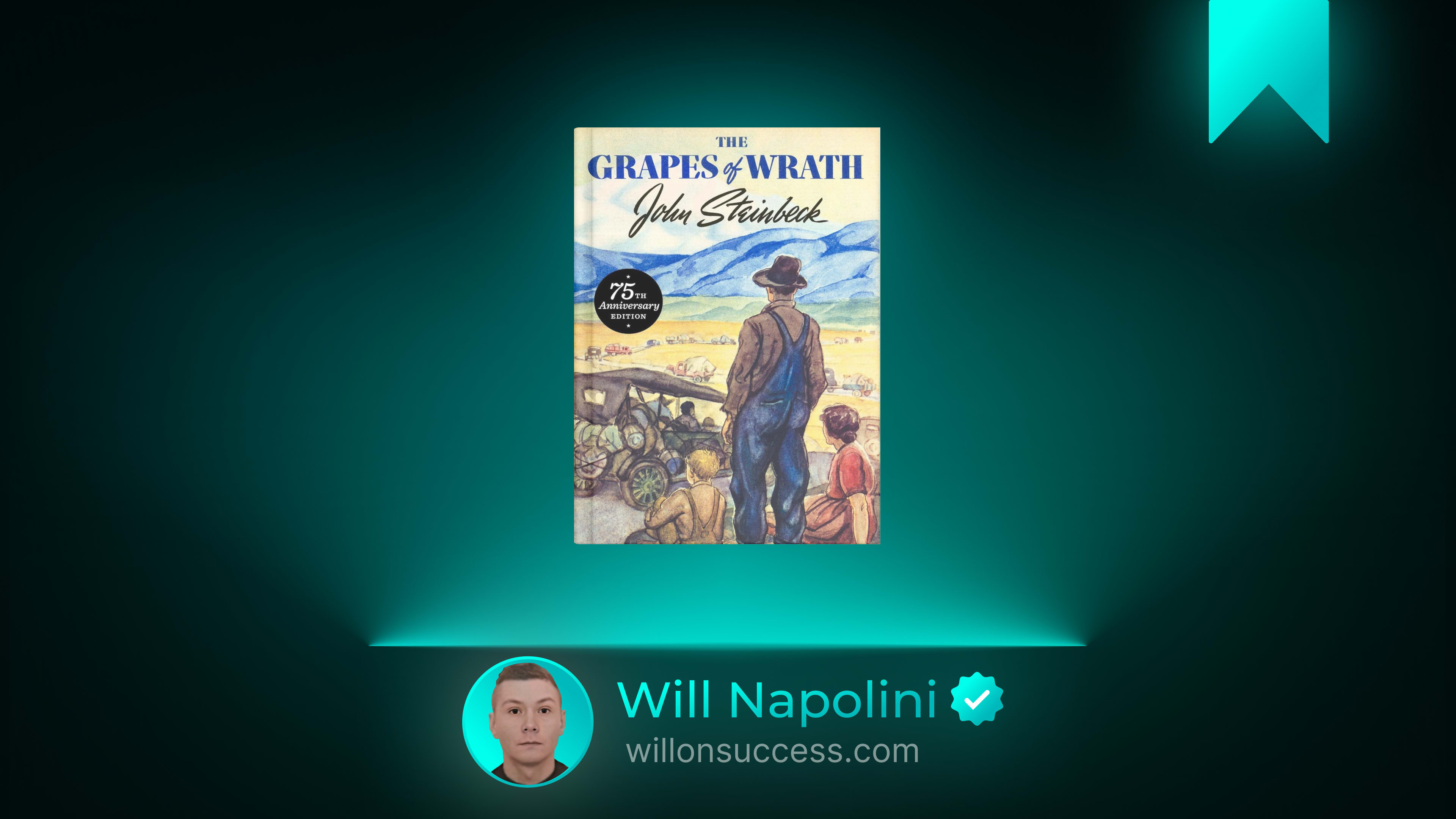
I have watched people lose the ground beneath them.
Not in dust storms, but in sudden layoffs that erased a twenty-year career. In medical diagnoses that rewrote a family’s future in an afternoon. In economic shifts that rendered a lifetime of careful planning obsolete before the ink on the mortgage was dry.
When the thing you trusted to hold you up simply vanishes, you are faced with a terrifying, quiet question: Who am I when I am no longer what I do?
John Steinbeck asked this question in 1939, and he embedded the answer inside one of the most sweeping, heartbreaking, and ultimately triumphant novels in the English language. The Grapes of Wrath is ostensibly about the Joad family, Oklahoma tenant farmers driven off their land by the Dust Bowl and bank foreclosures, who pack their lives into a dilapidated truck and drive Route 66 toward the promised land of California.
But if you read it only as a historical document about the Great Depression, you will miss its most vital lesson.
Beneath the dust and the hunger, Steinbeck wrote a masterclass on human resilience. He mapped the exact psychological and spiritual journey a person must take when the external structures of their life collapse. He showed us what breaks under pressure, what survives, and what actually grows stronger.
If you have ever felt like the rules of the game changed without your permission, or if you have ever watched a system treat you like a disposable line item, this book is holding a mirror up to your life. And the reflection it offers is not one of defeat. It is one of fierce, unbreakable dignity.
The Big Idea: True Resilience Requires the Shift from “I” to “We”
The central thesis of The Grapes of Wrath is that survival in a hostile world cannot be an individual project.
When the novel begins, the characters are largely driven by the “I.” Pa Joad’s identity is tied to his specific plot of land and his role as the patriarch. Tom Joad, freshly paroled, is focused on his own individual freedom and his own immediate family. The landowners and the banks are driven by a hyper-individualized pursuit of profit, viewing the farmers not as humans but as obstacles to efficiency.
But as the journey progresses and the suffering deepens, Steinbeck argues that the “I” is a fragile vessel. It cracks under pressure. The only structure strong enough to endure profound systemic failure is the “We.”
This is not a sentimental plea for charity. It is a practical, unsentimental observation about human mechanics. When the world strips you of your resources, your title, and your status, the only wealth you have left is your connection to other people. The book’s deepest argument is that your capacity to survive a crisis is directly proportional to your willingness to expand your definition of family.
The Story: A Crucible on Route 66
The plot follows the Joads as they join a massive migration of displaced “Okies” heading west. They are lured by handbills promising work in the orchards of California, only to arrive and find a landscape saturated with desperate labor, guarded by hostile locals, and manipulated by corporate growers who use the oversupply of workers to drive wages to starvation levels.
Along the way, the family is whittled down. Grandpa and Grandma die on the journey. Noah, the eldest son, wanders away. Connie, the husband of the pregnant Rose of Sharon, abandons her. The family’s resources dwindle to nothing. They live in squalid, flooded ditch-bank camps. They are hunted, starved, and beaten.
Yet, within this crucible, a profound transformation occurs. The characters who cling rigidly to their old identities break. The characters who adapt, who soften their boundaries, and who recognize their shared humanity with the strangers around them, become the bedrock of the new world.
Steinbeck does not offer a neat, happy ending. The final pages of the novel are stark, ambiguous, and deeply challenging. But they leave the reader with an undeniable truth: systems can crush the body, but they cannot confiscate the soul unless you hand it over.
When the Ground Shifts, You Must Change What You Stand On
One of the most heartbreaking and instructive character arcs in the book belongs to Pa Joad.
Pa’s entire sense of self is built on a specific foundation: he is a farmer, he owns his land, and he provides for his family. When the bank sends the tractor to bulldoze his house, and when the drought kills his crops, Pa does not just lose his income. He loses his architecture of self. Because he cannot adapt his identity to the new reality, he slowly collapses inward. He becomes silent, passive, and ultimately unable to lead.
Ma Joad, by contrast, undergoes a magnificent evolution. At the start of the journey, she operates within the traditional boundaries of her role. But as Pa fades, Ma steps into the vacuum. She does not do this by trying to be Pa. She does it by redefining what holds the family together.
There is a moment when Pa laments that the family is breaking apart, that the old ways are gone. Ma looks at him and says, “We’re the people that live. Can’t nobody wipe us out. Can’t nobody lick us. We’ll go on forever, Pa, ‘cause we’re the people.”
Ma understands a principle that I have seen save countless modern careers and marriages: If your identity is built on what you own or what you produce, a single storm can bankrupt you. If your identity is built on your capacity to adapt, to love, and to endure, you are stormproof.
You may be facing a season where the ground is shifting. The industry you mastered is being automated. The business you built is failing. The physical health you relied on is declining.
If you tie your worth to the thing that is disappearing, you will disappear with it. The work of resilience is to gently, bravely detach your core identity from the external circumstance. You are not your job title. You are not your bank account. You are the person who navigates the loss. You are the person who keeps the family calm. You are the person who figures out the next right step.
When the land blows away, you must become the land.
Dignity Is an Inside Job, Even in the Deepest Poverty
The migrant camps in California are designed to strip the workers of their humanity. The growers want them to feel like animals, because animals are easier to exploit and cheaper to replace. The conditions are degrading, filthy, and deliberately humiliating.
And yet, in the midst of this, Steinbeck shows us characters who fiercely guard their dignity.
When the Joads have almost no food, they still share what they have with a starving family they meet on the road. When they are treated like dirt by the camp managers, they maintain their manners, their speech, and their mutual respect. They refuse to let the external degradation dictate their internal character.
I want to pause here, because this is where personal development often gets confused with toxic positivity. Steinbeck is not saying, “Just smile and the poverty will go away!” He is documenting the brutal reality of exploitation. But he is also making a profound point about agency.
Circumstances will always try to negotiate with your character.
When you are treated poorly, the temptation is to become poor in your behavior. When a company acts unethically, the temptation is to justify your own ethical shortcuts. When the world is cruel, the temptation is to become cruel to protect yourself.
The Joads refuse the negotiation. They understand that dignity is not something granted to you by your environment. It is a boundary you draw inside yourself.
You have probably been in a workplace that was toxic, or a negotiation that was hostile, or a situation where you were treated as less than. The most powerful thing you can do in those moments is to refuse to lower your own standards to match the room. You speak clearly. You keep your promises. You treat the receptionist with the exact same respect as the CEO.
You do not do this because it will magically fix the corrupt system. You do it because it is the only way to walk out of that room with your soul intact. What you repeat in private, and what you hold onto in public, eventually becomes the person you are. Do not let a bad environment write your character.
The Former Preacher and the Discovery of the “Oversoul”
One of the most important voices in the novel belongs to Jim Casy, a former preacher who has lost his traditional faith. Casy realizes that the old religion, which focused on individual salvation and personal piety, is inadequate for the suffering he sees around him.
He spends the journey thinking, listening, and observing. And he arrives at a radical conclusion. He tells Tom Joad, “Maybe all men got one big soul ever’body’s a part of.”
Casy realizes that holiness is not found in isolation. It is found in the collective. It is found in the shared struggle. When he finally sacrifices his own freedom to protect Tom and the other striking workers, he does it not for a reward in the afterlife, but because he recognizes that his life is inextricably woven into the lives of the people beside him.
This is the philosophical heart of the book. In a culture that constantly tells you to optimize your personal brand, to curate your individual success, and to view others as competitors for scarce resources, Steinbeck offers a counter-narrative: Hyper-individualism is a fragile strategy for a hard world.
When you view yourself as entirely separate from the people around you, every setback is a personal failure, and every success is a lonely summit. But when you begin to see yourself as part of a larger whole—as a thread in a wider fabric—your suffering becomes shared, and your resilience becomes collective.
You do not need to adopt Casy’s specific theology to practice his principle. You practice it when you mentor a junior colleague instead of viewing them as a threat. You practice it when you advocate for a policy that helps people you will never meet. You practice it when you realize that your neighbor’s struggle is, in some fundamental way, your struggle.
The “I” can be broken. The “We” can endure.
Why This Matters on an Ordinary Tuesday
You might be thinking, This is a beautiful analysis of a 1930s novel, but I am not driving a Hudson Super Six across the desert.
But the mechanics of the Joads’ journey are playing out in your life right now, just in different clothing.
Think about the modern gig economy, where workers are classified as independent contractors, stripped of benefits, and managed by algorithms. Think about the corporate restructuring where loyal employees are dismissed via a pre-recorded Zoom call. Think about the way social media encourages us to view our peers as audiences to be monetized rather than neighbors to be known.
The systems we navigate today are vastly more comfortable than the ditch-banks of California, but they are often just as indifferent to our humanity. They are designed to extract our labor, our attention, and our data, and they are not designed to care if we break in the process.
The Grapes of Wrath matters because it teaches you how to navigate an indifferent system without becoming indifferent yourself.
It teaches you that when the company lays you off, they are taking your salary, but they are not taking your capacity to work, to learn, and to connect. It teaches you that when the economy shifts, your greatest asset is not your stock portfolio, but the depth of your relationships and your willingness to help someone else carry their load.
It reminds you that you are not a machine to be optimized. You are a human being, capable of profound adaptation, fierce loyalty, and radical generosity. And those are qualities that no algorithm can replicate and no market crash can foreclose upon.
Who Should Read This Book
The Grapes of Wrath is for you if you want to understand the deep, historical roots of economic inequality and labor struggles in America. It is for you if you are a leader, a manager, or an entrepreneur who needs a visceral reminder of the human cost of purely profit-driven decisions.
It is profoundly resonant if you are currently navigating a massive life transition—a career change, a relocation, a loss of status—and you need a story that validates the grief of that loss while pointing toward a resilient future.
It may be less suited for readers who are looking for a light, fast-paced escape. The book is dense. Steinbeck’s intercalary chapters—short, poetic essays that zoom out to look at the macro-economic forces of the Depression—can slow the narrative momentum. The language is deeply rooted in the specific dialect and landscape of the 1930s.
And I must be honest about the ending. It is not a Hollywood resolution. It does not tie up the systemic injustices with a neat bow. It is raw, it is shocking, and it demands that the reader sit with the uncomfortable reality of human suffering. If you need your fiction to reassure you that the good guys always win and the system always corrects itself, this book will frustrate you.
But if you are willing to look at the world as it actually is, and find the courage to act within it anyway, this novel will change the way you see your fellow human beings.
One Small Step
Here is what I would invite you to do today. It is a small act, but it is the seed of the “We.”
Look at your immediate environment—your workplace, your neighborhood, your apartment building. Identify one person who is doing the invisible labor that makes your life possible, but who is rarely acknowledged. The person who cleans the office after hours. The delivery driver who drops off your packages in the rain. The cashier who scans your groceries at the end of a long shift.
Today, stop treating them as a function. Treat them as a person.
Look them in the eye. Learn their name if you do not already know it. Ask them a genuine question about their day, and actually wait for the answer. Thank them, not with a rushed nod, but with a pause that communicates, I see you. I recognize your effort. You matter.
It takes ten seconds. It will not fix the systemic issues of wage inequality or labor exploitation. But it will do something equally important: it will interrupt the machinery of indifference. It will remind them of their dignity, and it will remind you of your shared humanity.
You start small. You refuse to let the system make you cold. You expand the circle of who you consider “your people.”
The ground beneath us will always shift. The seasons will turn, the markets will rise and fall, and the plans we make will sometimes blow away in the wind.
But if your roots are tangled up with the roots of the people beside you, you will not be swept away. You will hold the earth together. And when the rain finally comes, you will be ready to grow.