The Great Gatsby: What Fitzgerald Teaches Us About the Lives We Build and the Pasts We Chase
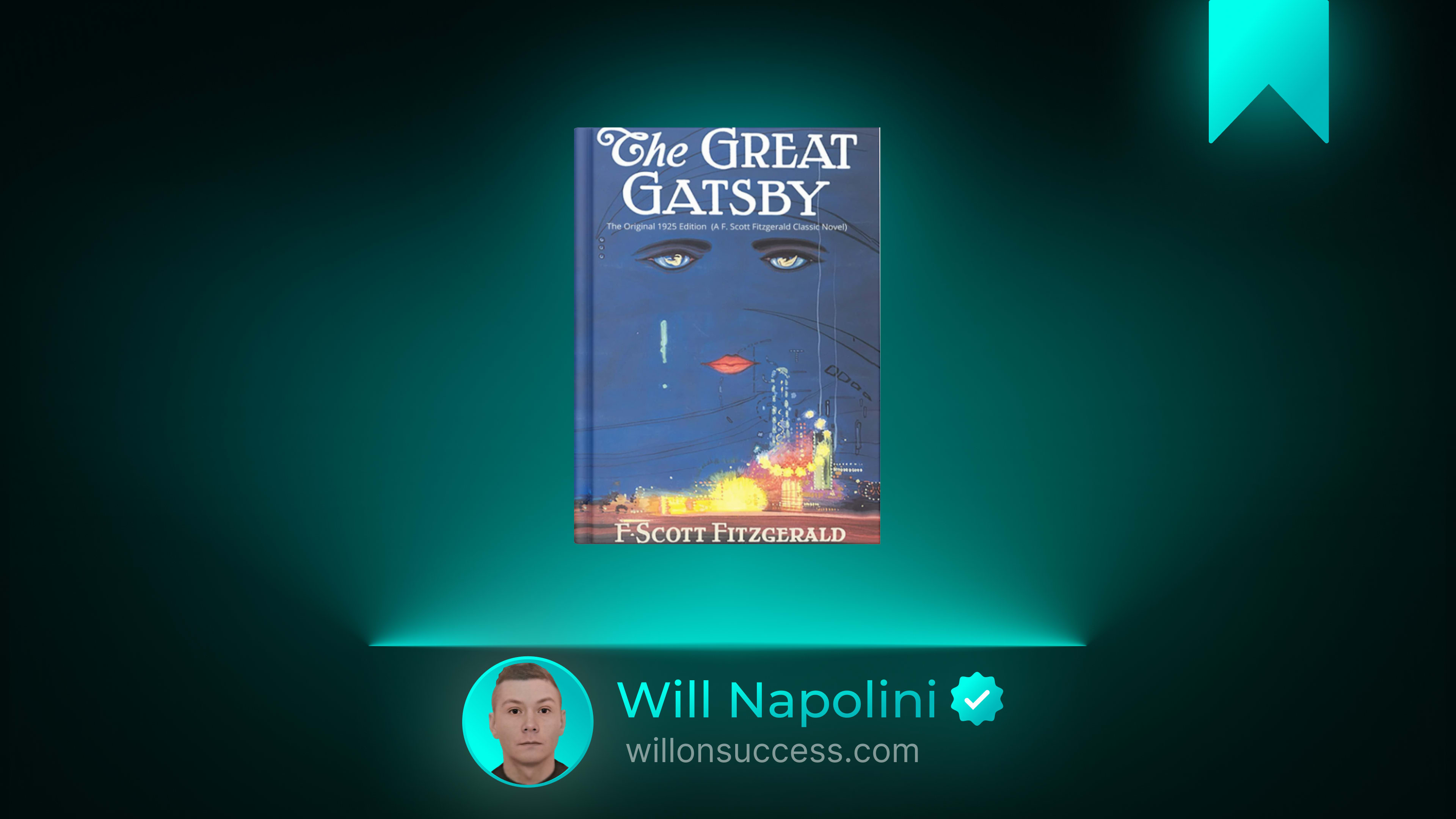
There is a moment near the middle of The Great Gatsby when Nick Carraway warns his friend, gently, that you cannot repeat the past. And Gatsby—standing in his mansion, surrounded by the evidence of everything he has built—looks at him with genuine astonishment and says, “Can’t repeat the past? Why of course you can!”
I have thought about that exchange more times than I can count. Because I recognize it. Not in a millionaire throwing parties in 1922, but in myself. In you, maybe. In every person who has ever looked at a version of life they once knew—or once imagined—and decided, That is the only future I will accept.
Fitzgerald wrote a novel about a man who reinvented himself from nothing. And in doing so, he wrote one of the most honest books ever composed about the difference between building a life and performing one. About the gap between who we are becoming and who we are pretending to be. About what it costs to anchor your entire identity to a single moment, a single person, a single version of a dream that time has already carried past you.
If you have ever rebuilt yourself around an old wound, an old love, an old vision of how things were supposed to go—this book is speaking directly to you.
The Central Idea: Reinvention Without a Foundation Becomes a Beautiful Ruin
Jay Gatsby was not born Jay Gatsby. He was born James Gatz, the son of poor farmers in North Dakota. At seventeen, he met a wealthy man named Dan Cody on the shores of Lake Superior, and in that encounter, he saw a life he wanted. He decided, in that moment, that James Gatz would cease to exist. He created Jay Gatsby. He built the name, the bearing, the ambition. Fitzgerald writes that Gatsby sprang from his own “Platonic conception of himself.”
That part is extraordinary. Self-creation is real. You are not trapped in the story you were handed. Fitzgerald understood that.
But here is where the novel turns its lens on something harder to look at. Gatsby did not reinvent himself toward an open future. He reinvented himself toward a closed one. Every dollar, every shirt in that famous closet, every party with hundreds of strangers flooding his lawn—all of it was in service of one frozen Tuesday afternoon in Louisville, years earlier, when a young woman named Daisy Fay looked at him and made him feel chosen.
He did not build a life. He built a stage set. And the only audience that mattered was one person who had already walked out of the theater.
The central lesson Fitzgerald leaves us is not that dreams are dangerous. It is that a dream anchored entirely to the past cannot sustain a future. You cannot build forward by reaching backward.
The Green Light and the Life You Keep Postponing
You know the image. Gatsby standing at the end of his dock in the dark, arms stretched toward a small green light across the water. That light sits at the end of Daisy’s dock. It is close enough to see. Far enough to never touch.
Fitzgerald turns that light into something universal in the novel’s final pages. He writes about the green light, about the “orgastic future that year by year recedes before us.” About how we keep believing tomorrow will bring us closer to what we want, while the current keeps pulling us back.
I want you to sit with that for a moment.
How many of us are standing at our own dock? Reaching toward a version of success, love, recognition, or peace that we have placed just far enough away to justify never fully arriving? We tell ourselves: Once I get that role. Once I earn that number. Once I fix that relationship. Once I go back and make right what went wrong five years ago. Then I will begin living.
The green light is not evil. Aspiration is not the problem. The problem is when the light becomes the whole life. When you spend twenty years furnishing a mansion for a guest who is never coming to the party. When the pursuit of the dream replaces the living of it.
Gatsby had everything. The money, the house, the fame, the hundreds of guests every weekend. And he was, beneath all of it, profoundly alone. Because none of it was his. All of it was scaffolding around an absence.
The Valley of Ashes: What We Ignore While Building Our Performance
Between the glittering mansions of West Egg and East Egg, Fitzgerald places a stretch of grey, exhausted land he calls the Valley of Ashes. It is where the industrial waste of the wealthy is dumped. Where people like George and Myrtle Wilson live and work and slowly disappear. Above it hangs a faded billboard of an optometrist—giant, bespectacled eyes that see everything and do nothing.
I think about the Valley of Ashes every time I see someone constructing an impressive external life while quietly neglecting the inner ground beneath it. The health they are not tending. The relationships they are letting erode. The honest conversation they keep postponing. The grief they paved over with busyness.
You can build the most beautiful mansion in the world. But if the foundation is ash, the first hard wind will remind you.
Fitzgerald does not preach this. He simply shows it to you. The carelessness of Tom and Daisy Buchanan—people who smash up things and creatures and then retreat into their money—stands in stark contrast to Gatsby’s earnest, doomed devotion. But even Gatsby’s devotion is misdirected. He is faithful to an image, not to a living, changing person. Daisy in his mind is not Daisy in the room. And the novel’s tragedy deepens because Gatsby never fully reckons with that gap.
You Are Allowed to Outgrow Your Own Story
Here is what I would tell you if I could sit across the table from you, with coffee going cold between us.
You do not owe your past self the future you once promised them.
That vision you had at twenty-two, at thirty, at the moment everything broke open—honoring it does not require you to freeze your life in its shape. You can carry the lessons forward without carrying the exact blueprint. You can love who you were without becoming a museum curator of who you used to be.
Gatsby’s tragedy is not that he dreamed too big. It is that he dreamed too small. He dreamed one specific dream, in one specific shape, aimed at one specific person, and he could not let the dream evolve. He could not let himself want something new. He could not let Daisy be a person instead of a symbol.
You are allowed to change your mind about what you want. You are allowed to discover that the thing you spent years chasing was a proxy for something else—belonging, safety, proof that you matter. You are allowed to set down the green light and look around at the life that is actually here.
That is not failure. That is maturity.
Carelessness Is Not Freedom
Fitzgerald writes near the end of the novel that Tom and Daisy were careless people. They smashed up things and creatures and then retreated back into their money or their vast carelessness, and let other people clean up the mess.
I have seen that pattern outside of novels. In workplaces where leaders make impulsive decisions and leave their teams to absorb the fallout. In relationships where one person treats the other’s feelings as an inconvenience. In our own lives, when we make choices in a rush of emotion and then expect time to quietly repair what we broke.
Carelessness looks like freedom, but it is not. It is the refusal to accept that your actions land somewhere, on someone. Gatsby, for all his illusions, at least felt the weight of his choices. The Buchanans never do. And Fitzgerald makes clear which of those fates is truly empty.
The principle underneath this is simple and old: character is what remains when the party ends and the guests go home. Who are you when no one is watching, when the performance is not required, when the green light is just a light?
What This Looks Like on an Ordinary Tuesday
Let me bring this down from the dock and the mansion and the green light into the texture of a regular day.
Maybe you are in a career you chose fifteen years ago because someone you loved thought it was impressive. You are good at it. You are also quietly exhausted. And every Sunday night you feel a small, persistent grief you cannot name. Gatsby would recognize that feeling. The feeling of living inside someone else’s expectation of your life.
Maybe you are holding onto a relationship—not because it nourishes you, but because ending it would mean admitting that five years went somewhere you did not intend. You keep polishing the image. You keep throwing the party. And the person across from you is not the person in your memory. They have changed. You have changed. And the honest, terrifying, liberating thing would be to see them clearly. To see yourself clearly.
Maybe you are rebuilding after a failure, and you have decided that the rebuild must look exactly like the original plan. Same city. Same role. Same timeline. Because if it looks different, it will feel like proof that you lost. But it is not proof of anything except that you are alive, and the ground has shifted, and you are allowed to build somewhere new.
You do not have to repeat the past to redeem it. You can simply learn from it and walk forward.
A Small Practice for This Week
Fitzgerald gives us Nick Carraway as a narrator for a reason. Nick is the one who watches. Who reflects. Who eventually turns away from the glitter and goes home. Who writes the story so he can make sense of it.
You do not need a novel. You need ten minutes.
Tonight, before you sleep, take a plain sheet of paper and answer one question honestly:
What am I still building my life around that is no longer alive?
It might be a relationship. A career goal. A version of success. A grudge. An image of yourself from a decade ago. A promise you made to someone who is no longer in your life.
You do not need to fix it tonight. You do not need to burn anything down. You just need to see it clearly. To name it. To stop pretending the green light is enough.
If you want to go further, write three sentences about what you would want if you were not trying to recreate or recover anything. If the past had no claim on your next chapter. What would you build? Not perform. Build.
Keep that paper somewhere you will see it. Let it sit. Let it work on you the way Nick’s final reflection works on the reader—slowly, and then all at once.
Who Should Read This Book
The Great Gatsby is short. You can read it in a single long afternoon. But it stays with you for years, rearranging things quietly.
It will speak most powerfully to anyone who is in the middle of reinventing themselves and is not sure whether they are building toward something real or performing for an audience that left long ago. It will resonate with anyone who has ever confused wanting a person with wanting the feeling that person once gave you. Anyone who has ever looked at their life from the outside and thought, This looks right, but it does not feel like mine.
It is less useful if you are looking for plot-driven entertainment or tidy moral resolutions. Fitzgerald does not tie things up. He leaves you with the current, the boats, the receding light. You have to sit in the ambiguity.
But if you are willing to sit in it, the book gives you something rare: permission to grieve the future you imagined and start building the one that is actually available to you.
One Small Step Before You Close This Page
Here is what I want you to do today. Not tomorrow. Today.
Identify one thing in your life that you are maintaining out of loyalty to an old version of yourself. It might be small. A commitment you keep because you said you would, years ago, in a version of your life that no longer exists. A habit you perform because it once made you feel like the person you wanted to be, but now only makes you feel tired.
You do not have to abandon it. But I want you to look at it honestly and ask: Am I keeping this because it still serves who I am becoming, or because I am afraid of who I would be without it?
Then write the answer down. One sentence. Keep it.
Gatsby could not do this. He could not look at the green light and say, Maybe I want something else now. And it cost him everything.
You do not have to make his mistake. You can set the light down. You can turn around. You can look at the life that is actually here, in your hands, tonight, and begin building something that belongs to you—not to your memory, not to someone else’s expectation, not to a past that will never come back in the shape you remember.
Fitzgerald ends his novel with boats against the current, borne back ceaselessly into the past. It is a beautiful, sorrowful line. But you are not a boat. You have hands. You can pick up the oar and row somewhere new.
The dock is behind you. The water is open. And the light you actually need is not across the bay.
It is in you, waiting to be used.