Things Fall Apart by Chinua Achebe: The Tragedy of a Man Who Built Himself on Fear
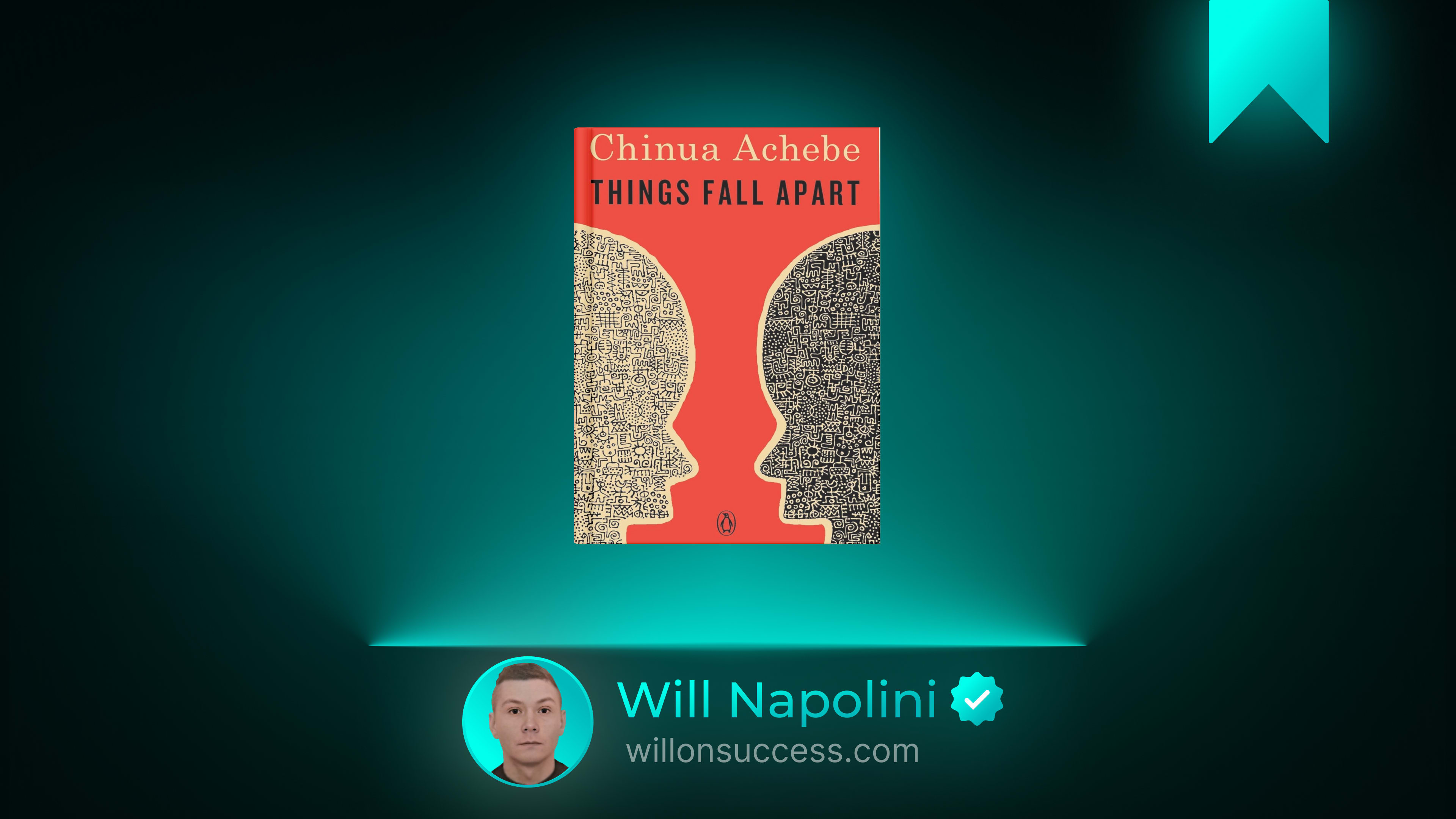
What if the very thing you built your life on—the quality you are most proud of, the trait you worked hardest to develop—is the thing that will not let you survive the next season of your life?
Not because it was wrong. Not because you were foolish to cultivate it. But because you made it the only thing. The single pillar. The whole architecture. And now the ground is shifting, and a structure with one pillar cannot sway. It can only stand rigid until it breaks.
That is the story Chinua Achebe tells in Things Fall Apart. And he tells it with such precision, such dignity, and such quiet devastation that it has stayed with readers across every continent and every decade since 1958. Not because it is a cautionary tale dressed in African clothing. But because it is the story of a man who made himself into a weapon and then discovered that a weapon cannot hold a child, cannot bend in wind, cannot change shape when the battle it was forged for is over.
The Big Idea: A Self Built Entirely Against Something Cannot Survive Change
Achebe set his novel in the Igbo villages of southeastern Nigeria in the late nineteenth century, in the years when British missionaries and colonial administrators first began to arrive. The title comes from a line in W. B. Yeats’s poem “The Second Coming”—Things fall apart; the centre cannot hold—and that phrase is the novel’s thesis compressed into five words.
But here is what I want you to understand before anything else: Achebe did not write this novel only to tell you about colonialism, though it tells you about colonialism with unmatched force. He did not write it only to depict Igbo society, though he depicts it with a richness and specificity that had been denied in European literature. He wrote it to show you a man. One man. And the particular way that man destroys himself from the inside before the outside world ever touches him.
The man is Okonkwo. And his tragedy is not that the world changes. His tragedy is that he made himself incapable of changing with it.
Okonkwo: The Man Who Decided He Would Never Be His Father
The novel opens in a village called Umuofia, and it opens on Okonkwo at the height of his powers. He is a wrestler who threw the unbeatable Amalinze the Cat. He is a farmer with barns full of yams. He has three wives, eight children, titles, respect. He is feared. He is admired. He is, by every measure his society recognizes, a great man.
And every single one of those achievements is built on one foundation: the determination never to be his father.
Unoka, Okonkwo’s father, was gentle. He loved music. He told stories. He was lazy with money, died in debt, left nothing for his son. The village considered him a failure. He died without titles. He was buried in the evil forest, the place for those who died of shameful diseases. And young Okonkwo looked at his father’s life and made a vow so deep it became his bones: I will be the opposite of everything he was.
Where Unoka was soft, Okonkwo will be hard. Where Unoka was poor, Okonkwo will be wealthy. Where Unoka was gentle, Okonkwo will be fierce. Where Unoka was laughed at, Okonkwo will be feared.
And for years, it works. The formula produces results. He rises. He prospers. The village respects him.
But Achebe shows you, with patient, unflinching clarity, the cost. Okonkwo cannot be tender with his children. He cannot praise his eldest son Nwoye without it turning to cruelty. He cannot sit in stillness without feeling he is becoming his father. He has built a self so rigid, so defined by opposition, that any softness threatens to collapse the entire structure. He is not strong because he has integrated strength into a full self. He is strong because he has amputated everything that is not strength.
And a thing with only one quality is not a self. It is a wall.
The Three Parts: Fullness, Exile, Collapse
The novel is structured in three movements, and the structure itself is the argument.
Part One gives you the fullness of Umuofia. The yam harvests. The wrestling matches. The egwugwu masquerades where ancestral spirits render justice. The proverbs that season every conversation—Achebe renders Igbo speech with a music and density that makes you understand this is a civilization with its own philosophy, its own jurisprudence, its own literature. The kola nut ceremonies. The intricate negotiations. The women’s stories told in the dark while the men drink palm wine. This is not a primitive world awaiting rescue. This is a world with its own logic, its own beauty, its own flaws, its own completeness.
And into this world comes Ikemefuna, a boy given to Umuofia as a peace offering from another village. Okonkwo’s household takes him in. The boy becomes like a son to Okonkwo—closer, in some ways, than Nwoye. And then the oracle speaks, and the village decides the boy must die. Okonkwo is told not to participate. But he does. He strikes the blow himself, because he is afraid that refusing will make him look weak. Afraid that tenderness will make him Unoka.
That moment is the crack. Not the crack in the world. The crack in the man.
Part Two takes Okonkwo into exile. At a funeral, his gun explodes and kills a young clansman. It is an accident, but the law is clear: he must leave Umuofia for seven years. He goes to his mother’s village, Mbanta. And during those seven years, the first missionaries arrive. They build a church. They speak of a new god. They welcome the outcasts, the twins, the mothers of twins—those whom the old order has marginalized. And slowly, quietly, the centre begins to loosen.
Okonkwo’s son Nwoye walks into that church. And Okonkwo, when he learns of it, feels something break in him that he cannot name. His own blood has chosen the other side. Not because Nwoye is weak. Because Nwoye heard something in those new stories that spoke to a part of him his father’s hardness had tried to kill.
Part Three brings Okonkwo home. And Umuofia is not Umuofia. The church is established. A colonial administrator sits in judgment. The clan cannot unite as it once did. Some have converted. Some are afraid. Some simply want peace. And Okonkwo, who has spent seven years sharpening his rage, finds that the world no longer has a shape his rage can cut.
In the final act of the novel, Okonkwo kills a colonial messenger. He looks around for the village to rise with him. To roar. To be Umuofia as it was.
They do not rise. They question. They hesitate. They let the other messengers go.
And Okonkwo understands, in that silence, that the world he knew is gone. And that he does not know how to live in a world that is not that world. He cannot adapt. He cannot bend. He has been one thing for so long that he cannot become another.
He hangs himself. In his own compound. The death his society considers the most shameful. The death of a man without a community to bury him.
Strength Without Flexibility Is Not Strength. It Is Rigidity Waiting to Shatter.
I have watched this pattern in many forms, in many lives, in many smaller keys than Okonkwo’s. The person who defines themselves entirely by their career and cannot survive the layoff. The parent who built their identity on being needed and cannot bear the children leaving. The partner who made themselves into the strong one, the provider, the rock, and discovers that rocks do not know how to grieve. The person who decided at twenty that they would never be vulnerable, and by fifty has built a prison so complete they cannot find the door.
Okonkwo’s tragedy is not that he is strong. His tragedy is that he is only strong. That he looked at his father’s gentleness and called it weakness, and then cut gentleness out of his own life like cutting out a disease. That he could not see that Unoka’s love of music, his stories, his softness—these were not the opposite of worth. They were a different kind of worth. And that by rejecting them entirely, Okonkwo rejected a part of what it means to be a whole person.
You do not have to be everything your father was. You do not have to repeat the patterns that hurt you. But there is a difference between choosing your own path and building your entire identity as a negative image of someone else’s. The first is freedom. The second is a different kind of cage, built with the same bars, just rearranged.
The World You Built Your Rules Around Can Change Without Asking Permission
This is the part of the novel that reaches beyond one man’s psychology into the larger tragedy of cultural destruction. Achebe shows you, in meticulous, loving detail, a world that works. A world with its own systems of justice, its own education, its own spiritual life, its own economy, its own art. And then that world is not destroyed by a single conquest. It is eroded. Slowly. By a church here. A court there. A trade route redirected. A generation of children who learn a different language, a different story of who they are.
The centre does not collapse in a day. It loosens. Thread by thread. Until one morning you look up and the pattern you knew is gone, and no one can quite say when it went.
And here is the question Achebe leaves you with, the one that is not only about colonialism but about every life lived through change: What do you do when the world you built yourself around is no longer the world that exists?
Okonkwo’s answer is to refuse. To stand in the old shape and demand that reality conform to it. And the cost of that refusal is total.
But Achebe does not present the alternative as simple surrender. Obierika, Okonkwo’s closest friend, is a man who questions, who adapts, who grieves without calcifying. He survives. Not unscathed. Not unchanged. But alive. Capable of witnessing. Capable of carrying the story forward.
Adaptation is not betrayal of what you were. It is the only way to carry what you were into what is coming.
What This Looks Like in Your Own Life
You are not in Umuofia in the 1890s. But you know what it is to build a self around one quality and feel the ground shift beneath it. The career that defined you restructures. The relationship that anchored you ends. The body that carried you begins to change. The child who needed you grows up and needs you differently. The belief that organized your world cracks open and shows you something you did not expect.
And in that moment, you have a choice that Okonkwo did not—or rather, that Okonkwo could not see. You can grieve what was, and then you can ask: Who am I now, in this new shape? What parts of me can I carry forward? What must I set down?
This is not weakness. This is not surrender. This is the deepest form of strength, because it requires you to be honest about what is real rather than insisting on what was.
Who Should Read This Book
Things Fall Apart is essential reading for anyone who wants to understand the human cost of cultural destruction from the inside. It is essential for anyone who has been told, directly or indirectly, that their heritage is less complex than it is. Achebe wrote it partly in response to European novels that depicted Africa as a dark, silent place without history or interiority. His answer was to render Igbo life with such specificity, such proverbs, such legal arguments, such tenderness and such humor, that the silence became impossible to maintain.
It is also a profound novel for anyone wrestling with the question of identity. For anyone who has built themselves on a single trait and feels the strain. For parents and sons. For anyone watching a world they knew change into something they do not recognize.
It is a short novel. You can read it in an evening. But it will stay in you for years. It is not a comfortable book. The ending is devastating. But it is not a cruel book. Achebe writes Okonkwo with compassion even as he writes him without excuse. You will grieve for this man even while you see clearly how he destroyed himself. That is the mark of a great novelist. That is the mark of a true mentor: showing you the whole truth and trusting you to bear it.
If you are looking for a light, resolving, triumphant narrative, this is not it. If you are ready to sit with a tragedy that is also a portrait of a civilization, and to ask yourself hard questions about the architecture of your own identity, this book will reward you deeply.
One Small Step You Can Take Today
I want to ask you for something small but honest.
Think about the quality you are most proud of. The thing you have worked hardest to build in yourself. Discipline. Strength. Independence. Competence. The ability to endure. The ability to provide. The refusal to complain.
Now ask yourself one question, and I want you to actually let it land, not rush past it:
Have I made this the only thing I am allowed to be?
Not whether the quality is good. It probably is. But whether it has become a wall instead of a window. Whether you have forbidden yourself every other quality in order to protect it. Whether somewhere in your life there is a softness, a question, a need, a tenderness that you have locked out because you decided, long ago, that it was weakness. That it was the thing you swore you would never be.
You do not have to resolve it today. You do not have to dismantle the structure. But you can name the locked room. You can say, Yes. That part exists. I have been keeping it out. And I am allowed to let it in.
Okonkwo could not say that. Not once. Not in the whole of his proud, terrible, magnificent life. And it cost him everything.
You do not have to pay that price. You can set the wall down. You can be strong and soft. Principled and flexible. Proud and capable of changing your mind. You can carry your father’s story without being imprisoned by its opposite.
The centre can hold. But only if you let it be more than one thing. Only if you build with enough materials to weather a season you did not plan for.
You are still here. The ground is still beneath you. And you are allowed—today, now, in this small quiet moment—to be more than the single story you told yourself about who you must be.
Let yourself be larger than your fear. That is where the life you have not yet lived is waiting.