The Gruffalo: What a Small Mouse Teaches Us About Thinking Clearly When the World Feels Too Big
I want to tell you about a mouse.
Not a metaphorical mouse. A literal, illustrated, small brown mouse in a picture book that you may have read to a child, or had read to you, or dismissed as something meant for four-year-olds and therefore beneath serious attention.
I think that dismissal is a mistake.
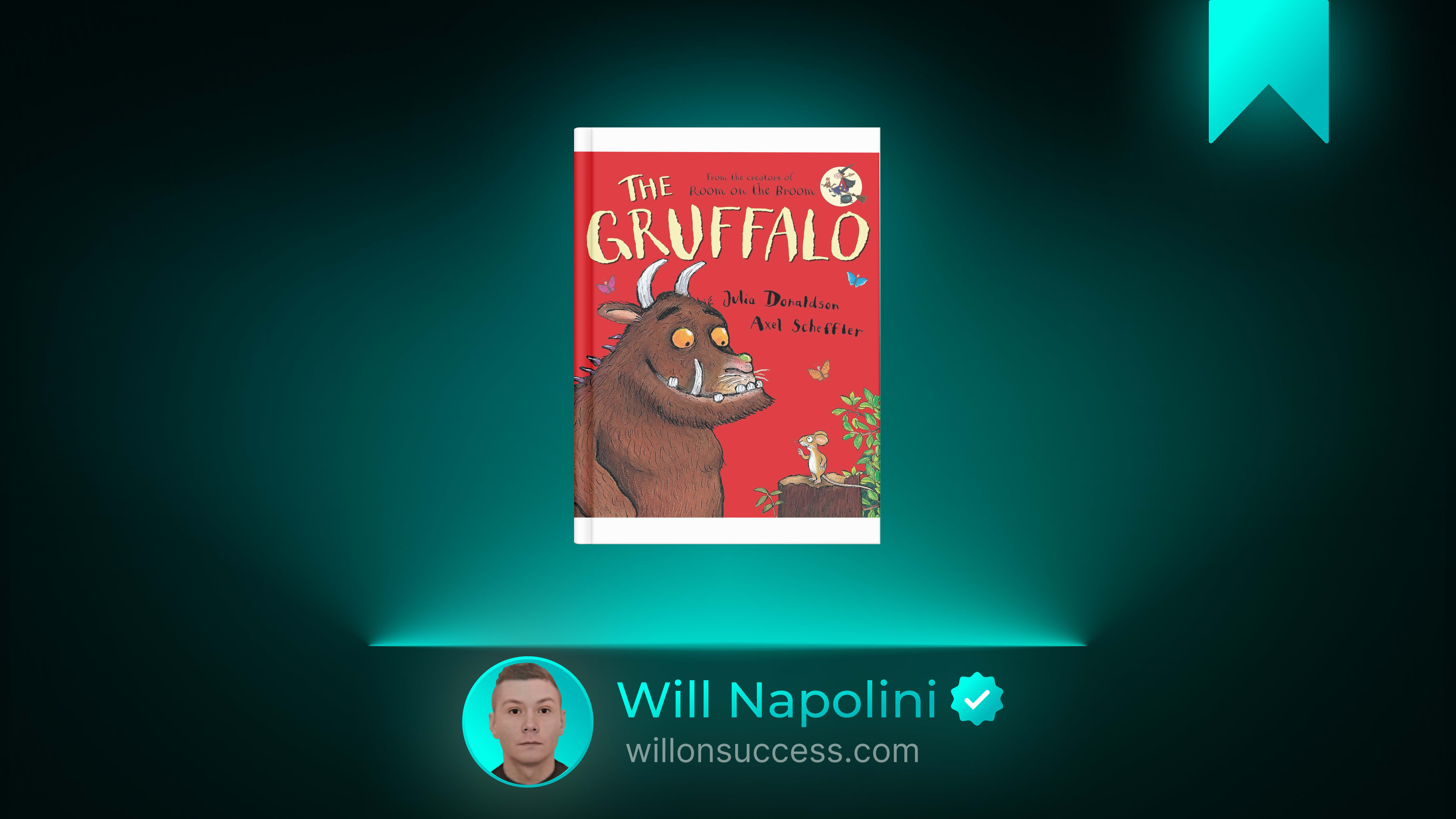
Julia Donaldson’s The Gruffalo, with Axel Scheffler’s rich, earthy illustrations, has sold millions of copies since 1999. Children love it because it is funny and rhythmic and a little bit scary in the safe way that good stories are. But underneath the rhyming couplets and the creature with knobbly knees and turned-out toes, there is one of the cleanest lessons I have ever encountered about what to do when you are small, the world is large, and everything in it seems hungry.
And I suspect you know what that feels like. Not in a forest. But in a meeting room. In a new city. In a conversation where someone bigger, louder, or more powerful has decided what you are. In any moment where the honest assessment is: I am outmatched, and I cannot fight my way through this.
The mouse cannot fight either. So he does something else. And what he does is worth your attention.
The Big Idea: You Do Not Need to Be the Largest Thing in the Room
The premise is simple. A small mouse takes a walk through a deep, dark wood. Three predators encounter him in sequence—a fox, an owl, a snake—and each one invites him to a meal that is clearly meant to end with the mouse on the plate.
The mouse does not run. He does not fight. He is too small for either to work.
Instead, he tells a story. He invents a creature—the Gruffalo—and describes it in vivid, terrifying detail. Terrible tusks, terrible claws, terrible teeth in terrible jaws. Knobbly knees. Turned-out toes. A poisonous wart at the end of his nose. He tells each predator that he is on his way to meet this creature, and that the Gruffalo’s favorite food happens to be roasted fox. Or gruffalo crumble. Or gruffalo steak, depending on who is asking.
Each predator flees. The mouse walks on.
And then—this is the turn that makes the book more than clever—the Gruffalo turns out to be real. He steps out of the trees, exactly as described, and he looks at the mouse and says, in effect, You are small. I am hungry.
Now the mouse must think again. Fast. And this time, he cannot invent a fictional monster to scare this one. He must work with what is actually in front of him.
What he does next is the heart of the book.
Composure Is a Strategy, Not Just a Feeling
When the Gruffalo appears, Donaldson writes that the mouse is frightened. She does not skip over this. The mouse’s world has just shifted from a manageable problem—three predators he can outthink—to an immediate, physical threat standing right in front of him.
But the mouse does not panic outwardly. He thinks. And in that thinking, he finds the one advantage he actually has: the Gruffalo does not know what the other animals in the wood are afraid of.
So the mouse proposes a walk. He walks ahead. The Gruffalo follows. And when they pass the fox, the owl, the snake—each one takes one look at the Gruffalo and bolts. But the mouse has arranged the scene so that the Gruffalo sees only the fleeing, not the reason for it.
The Gruffalo concludes that the animals are afraid of the mouse.
The mouse, small and calm, turns and says that his favorite food is gruffalo crumble.
And the Gruffalo runs.
Here is what I have learned from watching this small creature work: composure is not the absence of fear. It is the decision to let your mind operate while your fear is still present. The mouse is scared both times. But he does not let the fear make his decisions for him. He breathes. He looks at what is actually available. He uses it.
You will not always have the advantage of size, authority, resources, or numbers. But you almost always have the advantage of one clear thought, taken in the right direction, while the larger thing in front of you is still operating on assumption.
The Stories We Tell Reshape the Room
There is something deeper happening in this book than cleverness. The mouse is, in the most literal sense, a storyteller. He narrates a creature into existence. He describes the Gruffalo before the Gruffalo exists, and the description is so vivid, so specific—those knobbly knees, that turned-out-toe detail—that it becomes more real to the fox, the owl, and the snake than the small mouse standing in front of them.
Then, when the real Gruffalo appears, the mouse tells a second story. This one is about himself. He narrates himself into a position of power that does not match his physical reality. He walks ahead. He speaks with certainty. He lets the evidence arrange itself around his narrative.
And it works. Not because the story is true in a factual sense, but because the Gruffalo has no competing narrative. He has no reason to doubt what the mouse is showing him. The story fills the space where doubt might live.
I have seen this principle operate in rooms that contain no forests and no creatures. I have watched a junior person in a meeting change the entire direction of a decision not by shouting, not by pulling rank they did not have, but by calmly, clearly reframing the question everyone else was arguing about. I have watched someone walk into a negotiation with less money, less leverage, less history—and shift the outcome because they were the one who defined what the conversation was actually about.
The one who tells the story shapes the room. Not always. Not magically. But more often than we give credit for, especially when we assume that only the loud, the large, and the established get to define reality.
You are not powerless because you are small. You are not voiceless because you are new. You may simply need to tell the right story, in the right order, with enough calm that people believe it before they think to question it.
Adaptability Matters More Than the Original Plan
The mouse’s first strategy works beautifully—until reality surprises him. He planned for three predators. He did not plan for the invented monster to become real. And in that moment, the plan is useless.
What saves him is not a second pre-made plan. It is the willingness to look at the new situation, accept it as it is, and think freshly.
I think this is one of the hardest skills in adult life. We build a strategy. We commit to a path. We tell ourselves, This is how it will go. And when the Gruffalo steps out of the trees—when the company restructures, when the relationship shifts, when the market turns, when the thing we were counting on simply does not materialize—we freeze. Not because we lack intelligence, but because we are still trying to apply the first plan to a situation that no longer matches it.
The mouse does not stand in the clearing arguing that the Gruffalo should not be real. He does not grieve the simplicity of his earlier walk. He looks at what is here. He works with what is here.
That flexibility—the ability to let go of the strategy that got you to this point and build a new one from the materials at hand—is not a sign of weakness. It is the highest form of resourcefulness.
Smallness Is Not a Sentence
I want to speak directly to you for a moment, if you have ever felt like the smallest creature in the wood.
Maybe you are young in a field full of people with decades more experience. Maybe you are quiet in a culture that rewards volume. Maybe you are rebuilding after something fell apart, and everyone around you seems to have more stability, more confidence, more ground beneath their feet. Maybe you are simply tired, and the problems in front of you feel like they have terrible claws and terrible teeth and terrible jaws.
You are not required to become the fox. You are not required to grow tusks. You are not required to overpower the thing in front of you.
You are required only to think. To look clearly. To use what you actually have—your words, your timing, your willingness to stay calm one breath longer than panic demands.
The mouse wins not because he becomes something other than a mouse. He wins as himself. Small. Quick-minded. Walking steadily through a wood that is full of things that could eat him, and choosing, each time, to meet them with a clear head instead of a desperate scramble.
You do not need to become someone else to navigate what is in front of you. You need to become more fully yourself—calmer, clearer, more willing to trust your own thinking when the noise around you is loud.
What This Looks Like in Your Life This Week
Let me bring the wood home.
Perhaps there is a conversation you have been avoiding because the other person has more authority, more seniority, more history in the room. You have been rehearsing how to fight or flee, and neither feels right.
Try the mouse’s approach instead. Before the conversation, write down three sentences: What do I actually want from this exchange? What does the other person assume is true? What is one reframe or one question that shifts the conversation from their terms to mine?
You do not need to dominate. You need to redirect. One clear sentence, offered calmly, can change the shape of a room.
Or perhaps you are in the middle of a plan that has gone sideways. The Gruffalo is real now, and he was not supposed to be. You keep trying to apply the old strategy and feeling frustrated that it no longer fits.
Give yourself permission to stop. Set the old plan down. Look at what is actually in front of you—today, this week, in its real and unglamorous form—and ask: Given what is here, what is the next small move?
Not the grand solution. The next move. The next step through the trees.
Who Should Read This Book
If you have a child between the ages of three and seven, this book is a gift you will both enjoy. The rhythm is wonderful for reading aloud. The repetition invites little voices to join in. Scheffler’s illustrations give the wood a rich, autumnal warmth that makes it feel like a place you could walk into.
But I also recommend it to any adult who needs a reminder that cleverness, calm, and clear thinking are genuine strengths. That you do not need to be the biggest voice. That the story you tell about your own capability matters as much as the capability itself.
It is less useful if you are looking for complexity, moral ambiguity, or a long narrative arc. This is a short, clean, rhythmic story. Its power is in its simplicity. If you need a novel’s worth of nuance, this is not that. But if you need a clear, grounding reminder delivered in thirty-two pages, it is hard to do better.
One Small Step Before You Close This Page
Tonight, I want you to think of one situation in your life where you have been telling yourself, I am too small for this. I do not have enough. I am not enough.
Now write down one sentence that reframes it. Not a denial. Not a pep talk. A reframe. Something like: I do not need to overpower this problem. I need to outthink it. Or: I do not need everyone’s approval. I need one clear next step. Or: I have survived every version of this wood so far.
Say it once. Write it where you will see it tomorrow.
The mouse did not defeat the Gruffalo by becoming a Gruffalo. He walked through the wood as himself, small and steady, and trusted that his mind was enough.
It was.
Yours is too. Now walk on.