The Book Thief by Markus Zusak: What a Girl Who Stole Words Can Teach You About Choosing Light in the Darkest Seasons
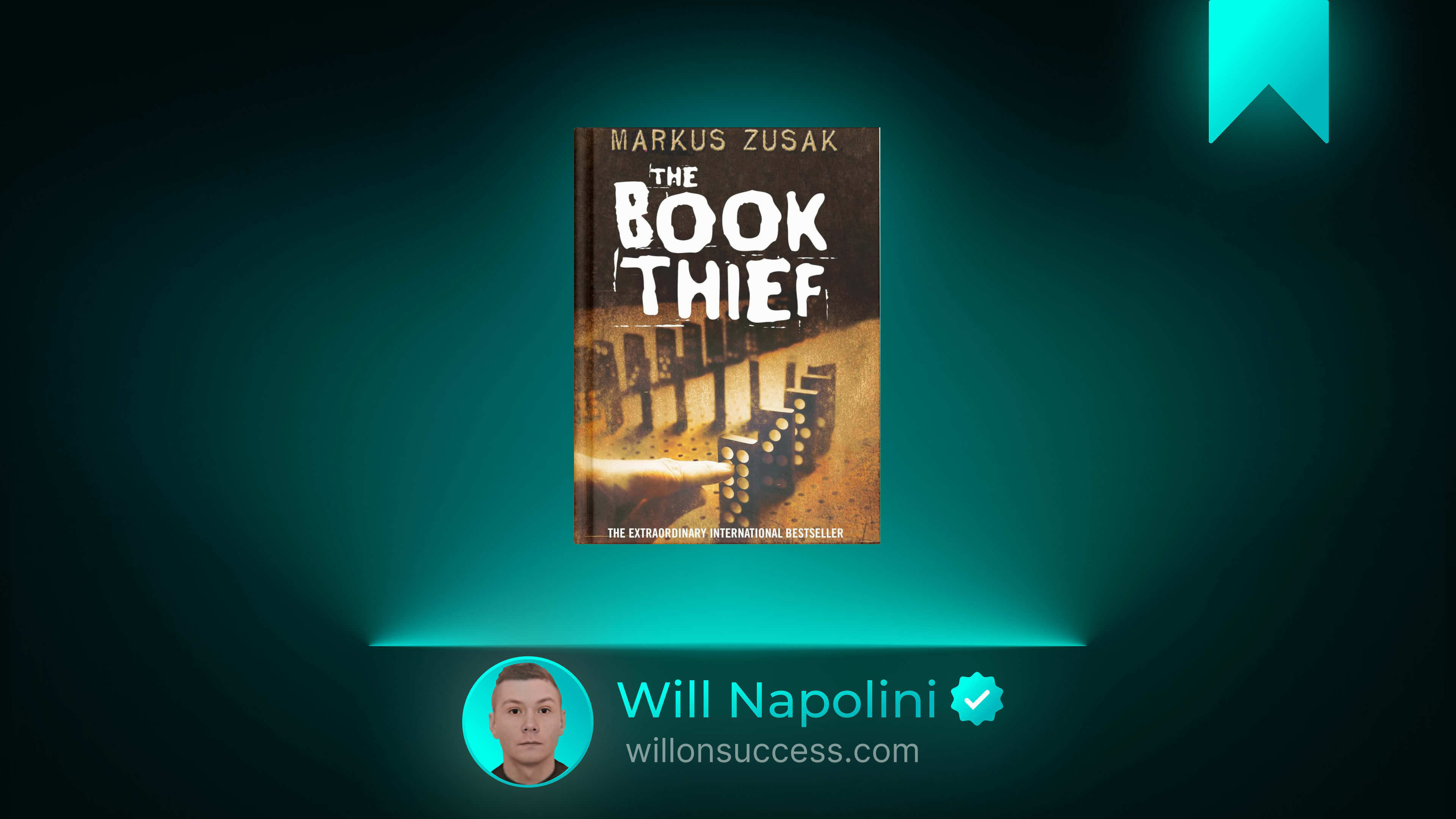
There is a novel narrated by Death. Not a grim, theatrical Death. A tired one. A Death who looks down at a small German town during the worst century humanity ever built and says, with something almost like bewilderment, I am haunted by humans.
That novel is The Book Thief by Markus Zusak. And if you let it, it will change the way you think about the words you speak, the stories you tell yourself, and the small, stubborn acts of decency that keep a person whole when everything around them is breaking apart.
I want to walk you through what this book taught me. Not as a literary critic. As someone who has needed, at various points, to be reminded that a single person’s choice to be kind, to read, to write, to hide a stranger, to share bread with a prisoner—those choices are not small. They are the entire architecture of a life.
Let’s begin.
The Big Idea: Words Are Not Neutral. They Build Worlds or Burn Them Down.
Zusak set his story in Nazi Germany for a reason. It is not merely a backdrop. It is the argument. Here is a regime that understood, with terrifying precision, that words are the first weapon. Before the camps, before the armies, there were speeches. Propaganda. Books burned in public squares while crowds cheered. A nation was reshaped one sentence at a time.
And into that world, Zusak places a nine-year-old girl named Liesel Meminger. She is fostered by a poor, kind-hearted accordion player named Hans Hubermann and his sharp-tongued but fiercely loyal wife Rosa. Liesel cannot read. She is grieving her brother. She is terrified. And on the day she attends his burial, she steals her first book—The Grave Digger’s Handbook—from the snow beside the grave.
She does not steal it for profit. She does not steal it out of malice. She steals it because it is the last physical thread connecting her to the person she lost, and because something in her understands, even at nine, that holding a book is a way of saying I exist. I matter. This story is not finished.
That is the heart of this novel. In a world where language is being used to dehumanize millions, one girl learns to read. Then she learns to write. Then she learns to give stories to others as a way of keeping them alive.
The central thesis is this: you cannot control the world’s cruelty, but you can decide what you do with the words in your mouth and the stories in your hands. And that decision, repeated quietly over years, is not small. It is everything.
The Story That Holds the Whole Book Together
I do not want to reduce this novel to a plot summary. You deserve to experience it as Zusak built it—scene by scene, season by season, with Death pausing to tell you the color of the sky before someone dies. But there is one thread I need you to understand, because it carries the book’s deepest lesson.
Liesel’s foster father, Hans, teaches her to read. Not in a school. Not with a curriculum. He paints words on the wall of their basement, letter by letter, during the long nights when she wakes from nightmares. He is patient. He is not a scholar. He is a house painter who plays the accordion and rolls cigarettes. But he sits beside a frightened child and says, in effect, You are not alone in the dark. Let me show you the shapes of the letters, and we will build a world you can walk into.
Later, the Hubermanns hide a Jewish man named Max Vandenburg in their basement. Max is starving, terrified, and slowly losing his grip on who he is. And Liesel, this child who once could not read a single sentence, begins to bring him stories. She reads to him. She describes the weather outside because he cannot see the sky. And Max, in return, paints over pages of Mein Kampf—yes, that book—and writes a story for Liesel called The Standover Man, about a boy who was always fighting, who finally finds someone worth standing beside.
Think about what Zusak is doing there. The words of a dictator, literally painted over, transformed into a gift between two people trying to survive. The instrument of hatred becomes the canvas for tenderness.
I have come back to that image many times in my own life. Not because I am hiding anyone from a regime. But because I have watched people take the ugliest material life hands them—grief, failure, humiliation, loss—and slowly, painstakingly, paint something honest and beautiful over it. Not to pretend the ugliness was not there. But to refuse to let it be the only story.
Words Shape the World You Live In
Here is what I have learned, and what Zusak dramatizes with extraordinary force: the words you repeat most often become the architecture of your inner life.
Liesel lives in a town where the radio broadcasts rage. Where neighbors report neighbors. Where a boy her age, her best friend Rudy Steiner, is being shaped by a youth organization that tells him his worth is measured by obedience and racial purity. The words surrounding these children are poison. And Zusak shows you, with quiet devastation, how poison seeps in even when you try to resist it.
But Liesel has a counter-language. Hans’s patient teaching. The books she steals from the mayor’s wife’s library. The stories she reads aloud in the bomb shelter while sirens wail and neighbors tremble. The words she writes in her own notebook in the basement at two in the morning.
She is not defeating the war. She is not toppling the regime. But she is building a small room inside herself where different words live. And that room keeps her human.
You do not live in Nazi Germany. But you live somewhere. And the words surrounding you—on your phone, in your workplace, in the conversations you replay at midnight, in the stories you tell yourself about why you are stuck or why you are not enough—those words are building a room too. The question is whether you are choosing those words deliberately, or whether you are letting them accumulate like snowdrifts against a door you no longer know how to open.
The stories you feed yourself in private become the world you walk through in public.
Small Acts of Defiance Are Not Small
Hans Hubermann gives bread to a Jewish prisoner marching through town. He is punished for it. The act changes nothing strategically. The war does not turn. The prisoner is still marched onward.
And yet.
And yet Zusak writes that moment with such care, such weight, that you understand: the act was not about changing the war. It was about Hans refusing to let the war change him. It was about one man looking at another human being and saying, I see you. You are not what they have told me you are. Here. Take this bread.
I think about that scene when I am tempted to believe that small kindnesses do not matter because they do not fix the whole problem. You hold a door. You listen to a friend without checking your phone. You write a note to someone who is grieving. You teach a child one patient lesson when it would be easier to walk away.
None of those acts will fix the world. But they fix the small radius of world you can reach. And more importantly, they fix you. They keep the part of you that believes in decency alive, so that when the moment comes that requires something larger, you have not forgotten how to reach for it.
Courage, in this book, is not a single dramatic charge. It is Hans painting letters on a basement wall at midnight. It is Liesel reading aloud in a shelter while bombs fall. It is Rosa Hubermann, who complains about everything, quietly feeding a starving man hidden under her floorboards and calling him a nuisance so he will not see her weep.
You do not need a grand stage to be brave. You need a Tuesday, and a choice, and the willingness to make it.
Storytelling as Survival
There is a moment near the end of the novel—I will not spoil it fully—where Liesel is writing her own story in the basement. The words are pouring out of her. And outside, the world is literally being destroyed.
She survives because she is in the basement, writing.
That is not a coincidence. That is Zusak’s thesis made physical. The act of shaping your experience into language—of saying this happened, and it hurt, and here is what I noticed, and here is what I still believe—is an act of survival. It does not erase the suffering. But it prevents the suffering from being the only author of your life.
I have seen this in my own experience and in the lives of people I care about. The person who journals after a loss. The friend who finally tells the story they have been carrying silently for years. The parent who sits down and writes a letter to their child explaining where they went wrong. The worker who, after a brutal year, takes one evening to write down what they learned instead of pretending it meant nothing.
They are not performing. They are not publishing. They are doing what Liesel does in that basement. They are saying: I will narrate this. I will not let it narrate me.
If you have been carrying something heavy and unspoken, I would gently encourage you: find the words. Write them down. Tell one trusted person. You do not owe anyone a polished account. You owe yourself the dignity of saying, This happened. This is what it cost. And I am still here, still making sentences, still choosing what comes next.
The Narrator Teaches You Something About Attention
One more thing about the structure of this book that I find endlessly instructive. Death narrates it. And Death is not cruel. Death is exhausted. Death notices colors. Death pauses to say, The sky was the color of Jews. The sky was the color of cats. The sky was the color of— and then stops, because even Death is overwhelmed by the amount of ending happening.
But Death also notices Liesel. Three times, Death encounters her. And each time, Death is struck by her. Not because she is extraordinary in any conventional sense. But because she is paying attention. Because she is alive to the world, to the words, to the people beside her, even while everything is falling apart.
Here is what that taught me: the opposite of despair is not happiness. The opposite of despair is attention. When you pay attention—to the person in front of you, to the work in your hands, to the particular quality of light on an ordinary afternoon—you are refusing to be swallowed whole by the vast, impersonal machinery of circumstance. You are saying, I am here. This moment is real. I will not look away.
Liesel does not save the world. But she sees it. And seeing it clearly, lovingly, honestly, is its own form of resistance.
Who Should Read This Book
If you have ever wondered whether one person’s choices matter in a world that feels vast and indifferent, read this book.
If you love language—if sentences can stop you in your tracks and make you put the book down and stare at the wall—read this book. Zusak writes prose that aches.
If you are in a season where you feel small, overlooked, or powerless, Liesel’s story will meet you where you are. She is not a hero in any traditional sense. She is a child who steals, who fights, who grieves, who reads, who writes. And that is enough.
If you prefer fast-paced thrillers or light entertainment, this may not be your book. It is slow in places. It asks you to sit with discomfort. The ending will hurt you, and Zusak does not soften it. But the hurt is honest, and honest hurt is a different thing from cruelty.
And if you have read many Holocaust narratives and feel you have encountered this territory before, Zusak’s approach—Death as narrator, the focus on language itself as the battlefield, the insistence on small domestic moments rather than sweeping historical drama—will likely offer you an angle you have not walked before.
One Small Step You Can Take Today
I am not going to tell you to go write a novel. I am not going to tell you to overhaul your life.
Here is what I would ask, if we were sitting across from each other and I could see that you have been carrying something quietly for a while.
Tonight, before you sleep, take five minutes. Write down one true sentence about something you are carrying. Not a whole essay. One sentence. I am tired because— or I have been avoiding— or The thing I have not said out loud is—
Then write a second sentence about what you want to be true next. Not a fantasy. A direction. I want to feel— or I want to try— or Tomorrow, I will—
That is all. Two sentences. A beginning.
Liesel’s first stolen book was pulled from the snow beside a grave. It was not a grand library. It was not a gift wrapped in ribbon. It was a cold, mud-streaked manual meant for someone else. And it was enough. It was the first brick.
You do not need the perfect words. You do not need the perfect moment. You need one true sentence, written in a quiet room, in a season that is yours.
The words you choose in the smallest hours are the ones that build the life you walk into tomorrow. Choose them like they matter.
Because they do.