The Boy in the Striped Pajamas by John Boyne: What Two Children on Opposite Sides of a Fence Can Teach You About the Stories You Never Question
I want to ask you something, and I want you to sit with it for a moment before you answer.
What is the last boundary you accepted without asking who built it?
Not a physical wall. Something quieter. A category you sort people into. A story you inherited about who belongs where, who deserves what, who is us and who is them. A fence you stopped noticing because you have lived beside it so long that it looks like landscape.
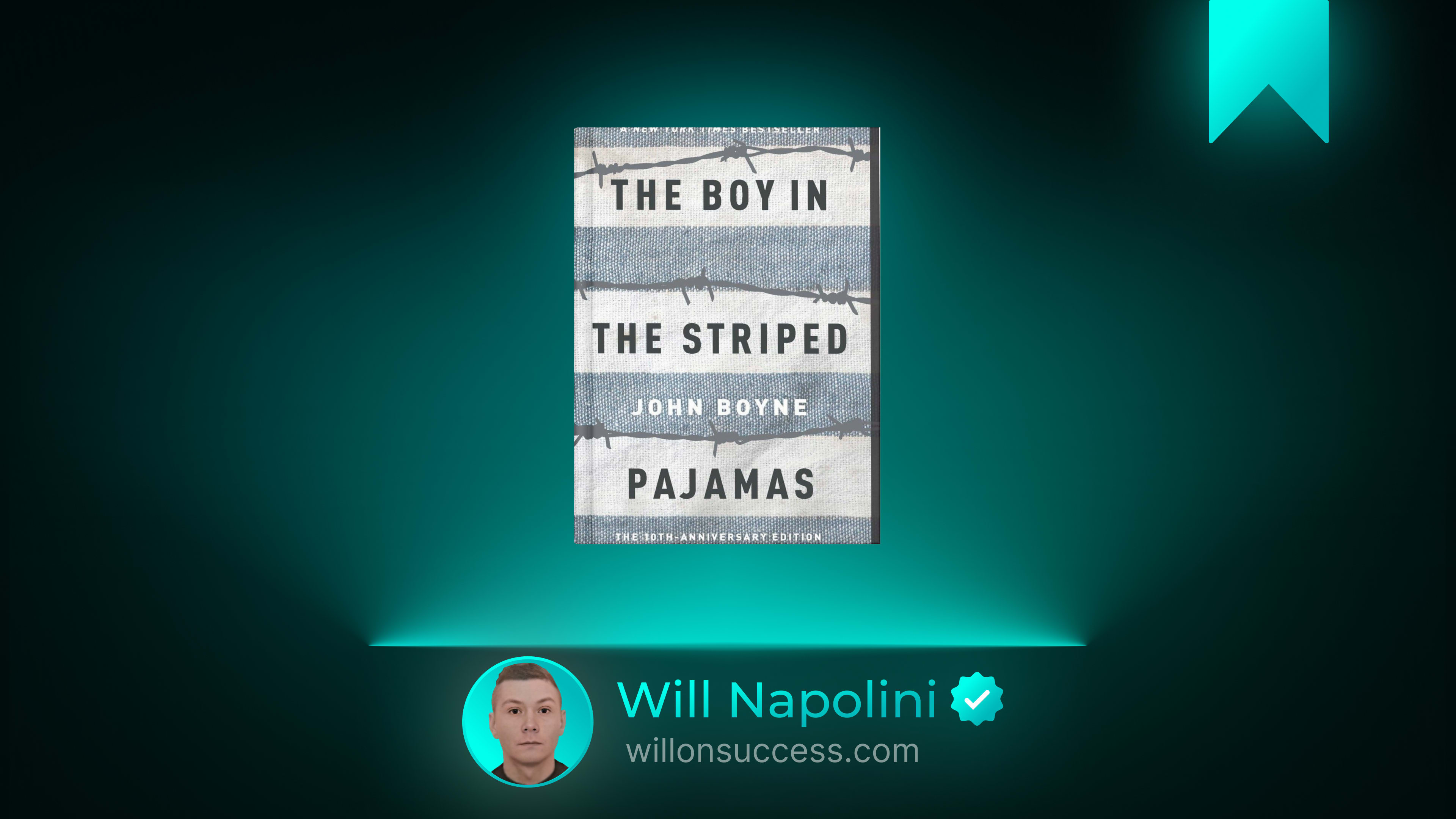
John Boyne wrote a short novel in 2006 called The Boy in the Striped Pajamas, and its entire engine is that question. It is a book that looks like a children’s story. It reads, in places, like a fable. And then it ends in a way that leaves you sitting in silence, holding the book in your lap, realizing that the fence in the story was never really about the story.
It was about you. About the fences you walk past every day. About the comfortable blindness that lets you call a camp a farm, call a uniform a pair of pajamas, and call a stranger a category instead of a name.
Let me walk you through what this book taught me. Not as a literary critic. As someone who has had to confront, more than once, the quiet ways I have chosen not to see.
The Big Idea: Ignorance Is Not Innocence. It Is the Soil Where Atrocity Grows.
Boyne’s novel is set during the Second World War. The narrator is Bruno, a nine-year-old German boy whose father, a high-ranking officer, is transferred to command a place Bruno calls “Out-With.” Bruno mishears the name. The reader understands immediately what it really is. Bruno does not.
That gap—between what Bruno sees and what the reader knows—is the entire architecture of the book. Bruno looks through a window and sees people in what he thinks are striped pajamas, working on what he assumes is a farm. He asks questions. No one answers them honestly. His mother changes the subject. His sister Gretel, three years older, has already begun arranging herself into the shape the regime wants. His father speaks in abstractions about duty and service.
And Bruno, being nine, being curious, being lonely in a strange new house with no friends, does what any child does. He goes exploring. He walks along the fence. And on the other side, he finds a boy sitting in the dirt.
The boy’s name is Shmuel. He is nine years old. He is starving. He is on the wrong side of the wire.
And Bruno sits down and talks to him.
That is the whole book, in its simplest form. Two boys. A fence. A conversation. And the slow, unbearable revelation of what the fence actually means.
The central idea Boyne is pressing into your hands is this: the people who build fences need the people on both sides to stop looking closely. The entire machinery depends on your willingness to mispronounce the name, to call the uniform pajamas, to assume the farm is a farm. And the moment one person sits down and says, Hello, what is your name? the machinery shudders. Because a name is harder to hate than a category. A face is harder to erase than a number.
The Friendship That Should Not Exist
I want to tell you about the middle of this book, because the middle is where the real lesson lives.
Bruno keeps going back to the fence. Day after day. He brings Shmuel food, sometimes. He listens. Shmuel tells him about the camp in the halting, incomplete way a traumatized child talks—not explaining the horror, just naming small, broken facts. His father has gone missing. He is hungry. There are too many people in the barracks. He does not understand why he is there.
And Bruno, in his nine-year-old way, tries to make sense of it through the only framework he has. He assumes Shmuel is playing a game. He assumes the “farm” has rules. He assumes the soldiers are there to help. He cannot integrate what he is seeing with what he has been told, so he simply does not integrate it. He files the contradictions away and keeps coming back, because Shmuel is the first person at Out-With who talks to him like a person.
What strikes me every time I return to this part of the story is how ordinary the friendship is. They do not discuss ideology. They do not make grand speeches. They play a word game. Bruno complains about his sister. Shmuel talks about his grandfather. They bicker, briefly, the way children do, and then they make up.
Boyne is showing you something essential: the most radical thing two people can do in a world that insists they are enemies is simply to sit down and have a conversation. No manifesto. No protest. Just two people, a shared stretch of ground, and the willingness to say I am here, and you are here, and I want to know what your life is like.
I think about that when I notice how easy it is to keep a distance. To sort. To assume that the person on the other side of some invisible line—political, professional, cultural, personal—has nothing to say to me. That our lives do not intersect. That the fence is natural.
It is not natural. Someone built it. And the first act of dismantling it is as small as sitting down and asking a question.
The Fence You Stop Seeing
There is a character in the novel I think about often. Pavel. He is a Jewish man who works as a servant in Bruno’s household. Before the war, he was a doctor. Now he peels potatoes and pours wine and is spoken to as though he is furniture.
Bruno notices Pavel. Bruno asks, He’s a doctor, isn’t he? And the adults in the room either dismiss the question or correct him with a cold, flat certainty that is not really an answer. Pavel is not a doctor here. Pavel is a servant. Pavel is a category. Pavel is what the fence has made him.
And Bruno, to his credit, is confused. But he does not push. He absorbs the correction. He lets the adult version overwrite what his own eyes are telling him.
I recognize that instinct in myself. The moment when I see something that does fit the story I have been told, and instead of sitting with the discomfort, I let the story win. Oh, that’s just how things are. That’s not really my concern. I’m probably misunderstanding. The quiet, efficient way we talk ourselves out of seeing what is right in front of us because seeing it would require us to change something, and changing something is exhausting, and we are already tired.
A fence becomes invisible when you stop asking who put it there and who it is keeping out.
That is true in the novel. And I will be honest with you—it is true in the small geographies of your own life. The colleague you have decided is difficult, so you stop listening. The neighborhood you drive through without looking. The conversation you avoid because you already know what the other person will say, or think you do. The story you tell yourself about why you cannot help, why it is not your responsibility, why someone else will handle it.
None of those fences may be made of wire. But they are fences. And they are maintained by the same quiet agreement not to look too closely.
What the Adults Choose Not to Say
Bruno’s mother knows. That is the reading I take from the text, and I think Boyne intends it. She knows what Out-With is. She is miserable. She drinks. She wants to take the children and go back to Berlin. She argues with her husband. But she does not sit Bruno down and say, Here is what is happening. Here is what your father is part of. Here is what those people behind the fence are suffering.
She does not say it. And because she does not say it, Bruno fills the silence with guesses. And his guesses are wrong. And his wrong guesses, compounded with his innocence, lead him toward an ending I will not describe in full but that will stay with you long after you close the book.
This is one of the hardest lessons in the novel, and it applies far beyond the historical setting. When the adults in a child’s life—or the people in a community, a workplace, a family—choose silence over difficult truth, they do not protect the child. They leave the child to build a world out of fragments and assumptions. And assumptions, uncorrected, become directions. And directions, walked long enough, become destinations.
If you are a parent, a mentor, a leader, a friend—there will be truths you need to speak that are uncomfortable. That are complicated. That you wish you could spare someone. I understand the impulse to protect. I have felt it. But there is a difference between shielding someone from cruelty and shielding them from reality. The first is love. The second, over time, becomes a kind of abandonment.
Speak the hard thing. Age-appropriately, gently, with care. But speak it. Because the silence you leave behind will be filled by something less kind.
The Ending and What It Costs
I will not spoil the final pages. If you have not read the book, you deserve to walk into them unprepared.
But I will tell you this: the ending is not a twist. It is an inevitability. Boyne constructs the entire novel so that the last scene is the only possible conclusion of every small choice, every silence, every unexamined assumption that came before it. The fence was never going to protect the people who built it. The machinery does not distinguish. It never has.
And the father—Bruno’s father, the commandant—discovers what has happened too late. Not in time to prevent it. Not in time to undo it. Only in time to grieve. Only in time to understand, fully and irrevocably, the cost of the world he helped construct.
I think that is the most honest and most devastating thing Boyne says: understanding that arrives too late is still understanding. It still lands. You still have to carry it. But it cannot save what you failed to protect while there was time.
That is not only true of historical atrocities. It is true of the friend you did not call. The apology you postponed. The person you categorized instead of met. The truth you were going to address “someday.” Someday has a way of running out while you are still making plans for it.
Who Should Read This Book, and Who Should Read It Carefully
I want to be honest here, because you deserve honesty from me.
The Boy in the Striped Pajamas is a powerful fable. It is accessible, short, and emotionally direct. For a young reader encountering the Holocaust for the first time, it can open a door into questions about humanity, cruelty, and complicity that they might not otherwise walk through.
But I would also tell you this: the book has been critiqued, thoughtfully and seriously, by historians and educators. Some argue that the premise stretches plausibility—that a nine-year-old living adjacent to a death camp would likely encounter more evidence, more explanation, more horror, than Bruno does. Some argue that centering a German child’s innocence risks softening the historical reality. Some caution that the fable-like tone can create the impression that the Holocaust was a tragic accident rather than a deliberate, industrialized act of extermination.
These are fair concerns. If you read this book, I would encourage you to read it alongside firsthand accounts, historical works, and survivor testimonies. Let Boyne’s fable be the door, not the whole room.
That said, the emotional and moral core of the book is genuine. The question it asks—What do you do when the fence is in front of you?—is not limited to 1943. It is a question every generation, every community, and every individual must answer.
Read it. But read it with your eyes fully open. And then read more.
What This Looks Like on an Ordinary Tuesday
You are not going to dismantle a regime this week. I know that. You are going to go to work, make dinner, answer emails, maybe argue with someone you love, maybe sit in traffic, maybe scroll through your phone until your eyes ache and you feel vaguely hollow.
But here is what I would invite you to notice, drawn straight from what Boyne put on the page:
Where in your life have you accepted a fence without inspecting it?
Maybe it is a belief about a group of people that you inherited and never tested against actual conversation. Maybe it is a workplace dynamic where one team is treated as disposable and everyone has agreed not to mention it. Maybe it is a relationship where you decided, years ago, that the other person is a certain way, and you stopped being curious about whether they had changed. Maybe it is a story you tell yourself—I’m not the kind of person who can do that, who belongs there, who deserves this—and you have lived beside that fence so long you think it is a mountain.
It is not a mountain. Someone built it. You can walk up to it. You can sit down beside it. You can ask it who put it there, and whether it still needs to be standing.
One Small Step
Here is what I would ask of you today. One thing. Small. Specific.
Think of one person in your life—just one—whom you have placed on the other side of a fence. A colleague you have written off. A family member you have stopped trying to understand. A neighbor you have never spoken to. A viewpoint you dismiss without engaging.
This week, have one genuine conversation with that person. Not a debate. Not a performance. A conversation. Ask them a question about their life. Listen to the answer. Do not prepare your rebuttal while they are talking. Just listen.
You do not have to agree with them. You do not have to solve anything. You just have to sit down beside the fence and say, I see you. Tell me something true.
Bruno and Shmuel had nothing but conversation. No resources, no power, no plan. Just two boys, a stretch of dirt, and the willingness to keep showing up at the same spot, day after day, to talk.
And that was enough to make the fence, for a little while, into something other than the final word.
You do not need to tear down every wall today. You need to sit beside one. You need to look through it, clearly, without flinching. And you need to say the name of the person on the other side out loud, so that you remember it is a name and not a category.
The fences in your life are only as permanent as your willingness to stop questioning them.
Ask the question. Sit down. Begin.