The Brand Gap by Marty Neumeier: How to Bridge the Distance Between What You Do and How People Feel
If I asked you to define your brand right now, you might point to your logo. You might talk about your color palette, your website, or the clever slogan you spent months perfecting. If you are building a career rather than a company, you might point to your resume, your job title, or the specific skills you have acquired.
We spend an enormous amount of time, energy, and money trying to control the narrative. We polish the presentation. We refine the pitch. We optimize the output.
And then, despite our best efforts, we watch someone with a messier presentation, a less polished pitch, and a seemingly inferior product win the room, win the client, or win the promotion.
If you have ever watched that happen and felt a quiet, frustrated confusion, I want to show you an idea that will change the way you look at your work.
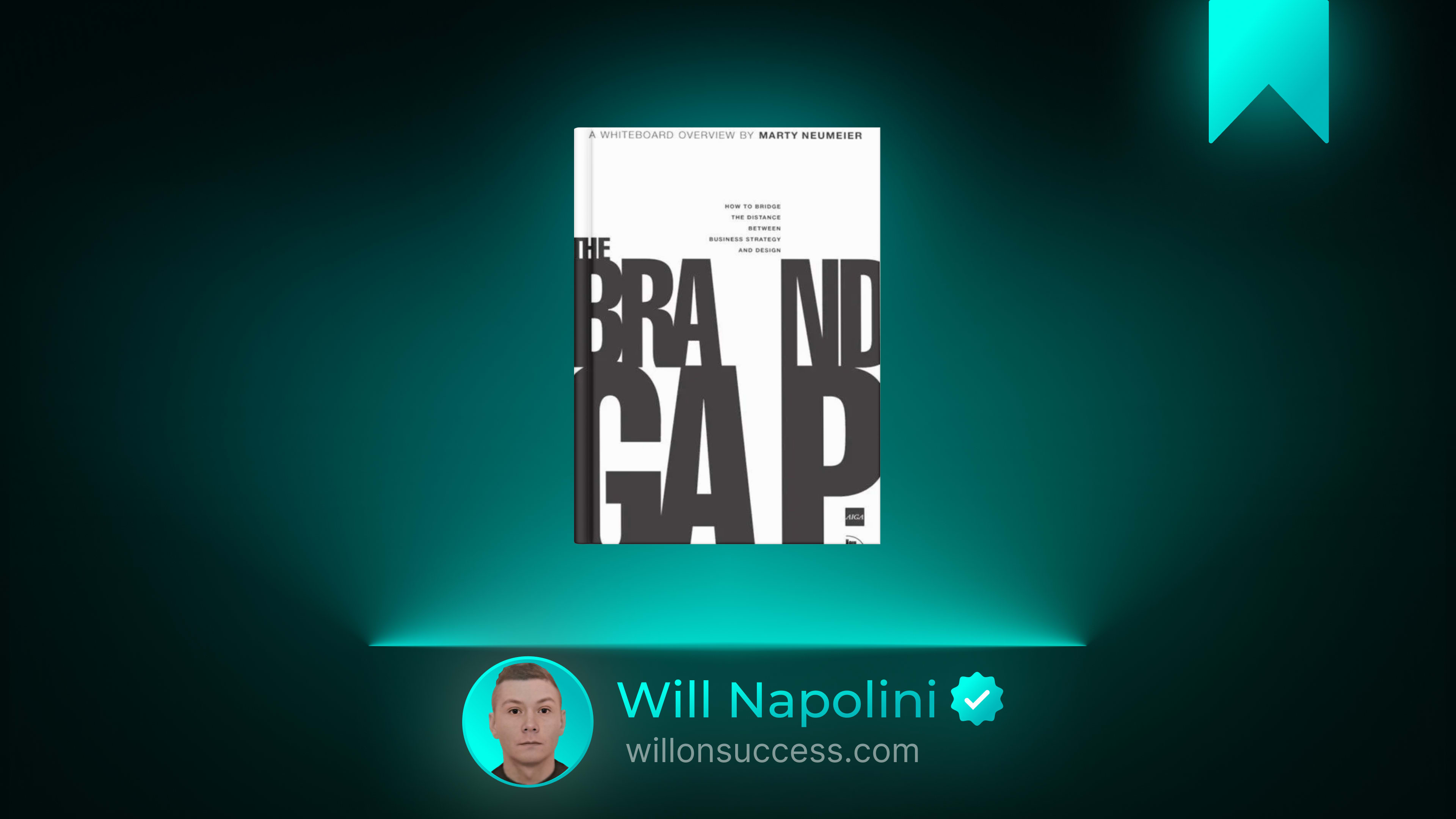
Marty Neumeier wrote a short, brilliantly visual book called The Brand Gap. It is ostensibly a book about business, design, and marketing. But beneath the corporate vocabulary, it is actually a profound meditation on human nature. It is about the distance between what we say we are, and what people actually feel when they interact with us.
Let us walk across that gap together.
The Big Idea: The Space Between Logic and Emotion
In most organizations, and in most careers, there is a deep, often unspoken divide.
On one side, you have business strategy. This is the domain of the left brain. It is logical, analytical, and focused on numbers, efficiency, and processes. It is the blueprint of the house.
On the other side, you have design and creativity. This is the domain of the right brain. It is emotional, intuitive, and focused on aesthetics, experience, and human connection. It is the warmth of the hearth inside the house.
Neumeier calls the distance between these two sides the “Brand Gap.”
For decades, businesses have kept these two sides strictly separated. The strategists sit in one room making spreadsheets; the creatives sit in another room making pretty pictures. The result is work that is either highly functional but completely soulless, or visually stunning but practically useless.
Neumeier’s central thesis is this: Charisma—the magnetic quality that makes a brand, a leader, or a product truly compelling—lives in the gap. It happens only when logic and emotion are fused together. When strategy and design shake hands.
You cannot logic your way into someone’s heart. And you cannot emotion your way into a sustainable livelihood. You have to build a bridge.
The Concept: A Brand Is Not What You Say It Is
Before you can bridge the gap, you have to understand what you are actually building. And here is where most of us get it entirely wrong.
We think a brand is a noun. A thing we possess. A logo, an identity system, a product line.
Neumeier strips all of that away with one devastatingly simple definition: A brand is a person’s gut feeling about a product, service, or organization.
Read that again. It is not what you say it is. It is what they say it is.
Why a “gut feeling”? Because human beings are fundamentally emotional creatures who use logic to justify our emotional decisions. We do not buy a car purely because of its horsepower; we buy it because of how we feel when we turn the key. We do not hire a consultant purely because of their methodology; we hire them because we feel safe, understood, and confident in their presence.
You cannot control a gut feeling. You can only influence the experiences that create it.
When you realize that your brand is not your logo, but the residue of emotion you leave in a room after you walk out of it, the entire game changes. You stop obsessing over the packaging and start obsessing over the experience.
The Five Disciplines of Charismatic Brands
How do you actually build this bridge? How do you create a brand—whether it is a global company or your own professional reputation—that people genuinely care about? Neumeier outlines five disciplines. Let us translate them from the boardroom to your daily life.
1. Differentiate: The Art of the Zag
If you are not distinct, you are dead. In a world drowning in noise, being “better” is a losing strategy. Being “better” just means you are playing the exact same game as everyone else, only working harder and spending more to prove it.
Neumeier advocates for a concept he calls “zagging.” When everyone else zigs, you zag.
If every accounting firm in your city wears navy blue suits and talks about “synergy and compliance,” the zag is not to wear a slightly lighter shade of blue and talk about “integrated compliance.” The zag is to wear jeans, specialize only in creative freelancers, and talk about “peace of mind.”
Differentiation requires the courage to be misunderstood by the many so you can be deeply valued by the few. It means looking at the crowded landscape, finding the empty white space, and planting your flag there.
You do not need to be everything to everyone. You need to be the only thing to someone.
2. Collaborate: Tear Down the Silos
A brand cannot be built by a single department. It cannot be delegated to the “marketing team” or the “design agency.”
If the person answering the customer service phone is rude, the most beautiful logo in the world will not save your brand. If the product breaks on day two, the most brilliant advertising campaign becomes a lie.
Neumeier points out that charismatic brands are built by cross-functional tribes. Everyone in the organization understands the core purpose and acts as a guardian of the brand.
How does this apply to you? It means recognizing that your reputation is built by every interaction you have. The way you write an email to an assistant. The way you handle a mistake when no one is watching. The way you speak about a former colleague. You are the marketing department, the product team, and the customer service desk of your own life. Consistency across all these “departments” is what builds trust.
3. Innovate: Keep Building the Bridge
A brand is not a monument you build once and then walk away from. It is a living engine.
The moment you stop innovating, you start dying. But innovation does not always mean inventing a revolutionary new technology. Often, it means finding a new way to deliver existing value. It means looking at a process that everyone accepts as “just the way it is” and asking, What if we removed the friction here?
In your own career, innovation means refusing to rely on the skills that got you hired three years ago. It means continually asking, How can I deliver more value, more clearly, with less friction, to the people I serve?
4. Validate: Test the Ground Before You Build
We all suffer from the illusion of our own objectivity. We think our ideas are brilliant because they are ours. We fall in love with our strategies and our designs, and we launch them into the world without checking if the world actually wants them.
Neumeier warns against relying on the HIPPO—the Highest Paid Person’s Opinion. Instead, charismatic brands test. They prototype. They put ideas in front of real people and watch how they react, rather than listening to what they say.
If you are launching a new project, proposing a new initiative at work, or even just trying to change a dynamic in your relationship, do not guess. Test. Run a small experiment. Pay attention to the actual behavior of the people around you, not just their polite nods. Reality is the only feedback that matters.
5. Cultivate: Tend the Living Thing
This is perhaps the most beautiful and necessary discipline. A brand is not a machine. It is a garden.
You cannot build a garden in a weekend and then ignore it for a year. It requires weeding. It requires watering. It requires adjusting to the seasons.
Cultivating a brand means protecting its core identity while allowing its expression to evolve. It means having the humility to prune away products, services, or even personal habits that no longer serve the core purpose. It means tending to the culture, the relationships, and the trust you have grown, day after ordinary day.
Consistency is the water. Evolution is the sunlight. You need both to grow.
Why This Matters to You Right Now
You might be reading this and thinking, This is great for a CEO, but I am just trying to manage my team, grow my small business, or figure out my next career move.
Here is what I have discovered after years of watching people navigate their professional lives: You have a brand, whether you want one or not.
Your brand is the gut feeling your boss has when your name pops up in an email. It is the sigh of relief your client feels when they see you walking into the meeting. It is the quiet confidence your team feels when you are put in charge of a crisis.
If you have been working incredibly hard but feel like you are not being recognized, passed over for promotions, or constantly underpaid, the problem might not be your work ethic. The problem might be the Brand Gap.
You might be highly strategic (left brain) but failing to connect emotionally (right brain). You might be delivering excellent work, but the “gut feeling” people have about you is that you are difficult to work with, or that you lack vision.
Bridging the gap means taking ownership of that feeling. It means realizing that your competence is the baseline, but your character, your communication, and your empathy are what make you magnetic.
Practical Application: The “Only-ness” Statement
Understanding the theory is valuable, but understanding without action changes nothing. Let us turn Neumeier’s concept of differentiation into a tool you can use this afternoon.
Neumeier suggests that every charismatic brand should be able to complete this sentence:
We are the ONLY [category] that [benefit].
Notice the word only. Not the best. Not the premier. The only.
Apple in its prime was not just the best computer; it was the only computer for the rest of us.
Take thirty minutes today to draft your own “Only-ness” statement.
If you are a freelance graphic designer, it might be: I am the only designer who specializes in translating complex medical data into simple visuals for patient education.
If you are a project manager, it might be: I am the only project manager in this company who specializes in rescuing stalled software launches by mediating between the engineering and sales teams.
If you cannot fill in the blanks, you have found your gap. You are competing in a crowded category where you are easily replaceable. Your next step is not to work harder. Your next step is to zag. Find the specific intersection of your unique skills and a specific, underserved need, and claim it.
Who Should Read This Book
The Brand Gap is a masterclass in clarity. It is highly visual, incredibly concise, and strips away the dense, academic jargon that plagues most business books.
You should read this book if you are an entrepreneur trying to figure out why your great product is not selling. You should read it if you are a creative professional who struggles to communicate the business value of your design. You should read it if you are a leader trying to align a fractured team around a single, compelling vision.
You may find it less useful if you are looking for a step-by-step technical manual on how to design a logo, run a Facebook ad campaign, or code a website. Neumeier is not teaching you the mechanics of the tools; he is teaching you the philosophy of the architecture.
It is a short read, but it is a dense one. You will likely find yourself putting it down every few pages just to stare at the wall and rethink your current projects. That is the mark of a good book.
One Small Step
I want you to do something that requires a little bit of courage. It is a small experiment in validation.
Sometime this week, reach out to three people who have worked with you closely. They can be former clients, trusted colleagues, or mentors. Send them a brief, honest message:
“I am doing some work on my professional development, and I value your perspective. If you had to describe the ‘gut feeling’ you get when you think of working with me in just two or three words, what would they be? Please be completely honest.”
When the replies come in, do not defend yourself. Do not explain what you meant to project. Just read the words.
Look for the gap between the brand you think you are projecting and the brand they are actually feeling. That gap is not a failure. It is a map. It shows you exactly where you need to build your next bridge.
You cannot manufacture a gut feeling. You cannot force someone to trust you, admire you, or choose you.
But you can design the experience. You can choose the words. You can do the quiet, unglamorous work of aligning what you do with how you make people feel.
A logo tells the world what you do. But a feeling tells the world why they should care. Build the bridge.