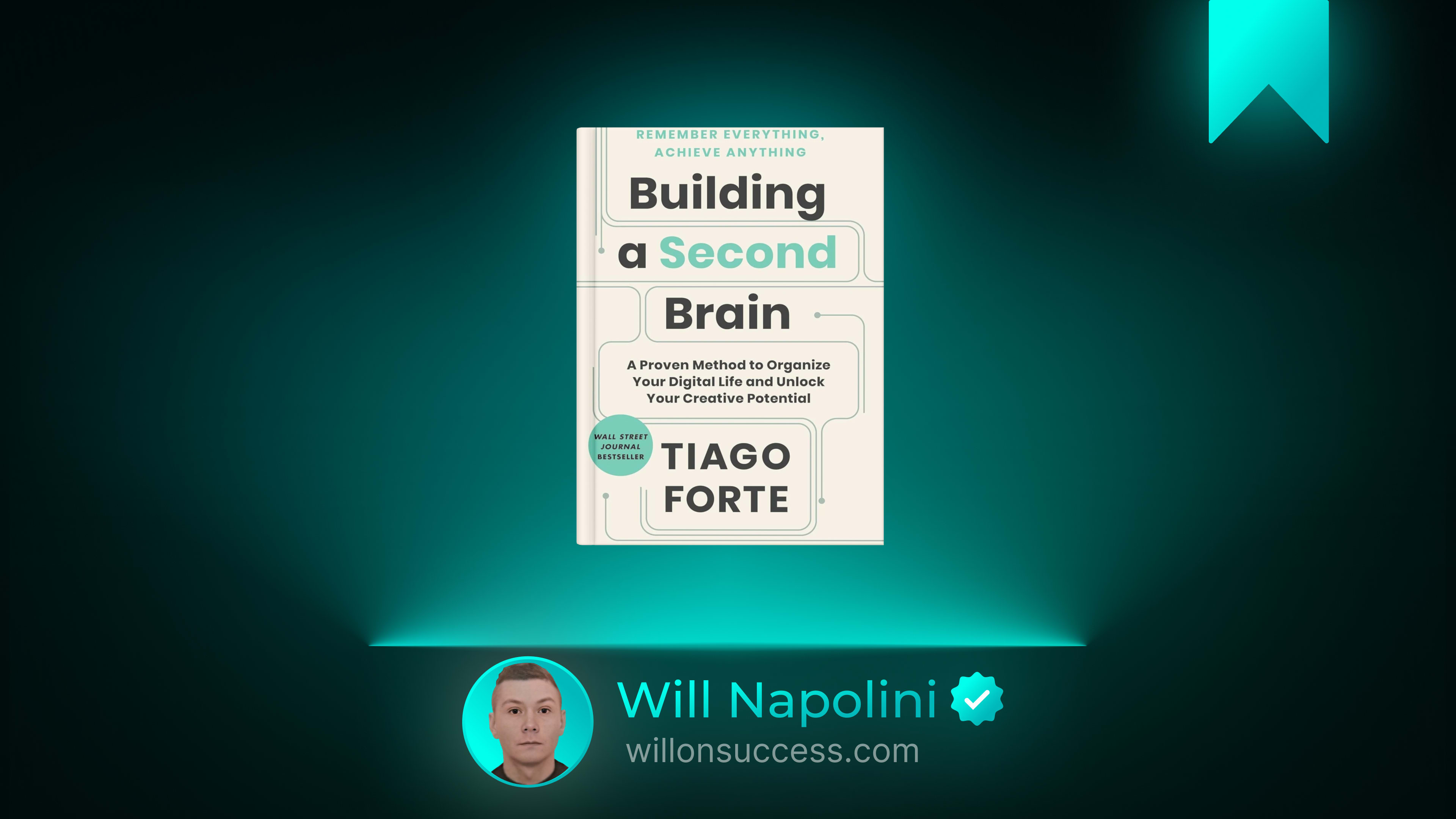
Building a Second Brain: How to Stop Hoarding Information and Start Creating
You know the feeling. You are in the shower, or driving, or just waking up, and a brilliant idea strikes you. It feels profound in the moment. You tell yourself, I will definitely remember this. But by the time you sit down at your desk, the thought has evaporated.
Or perhaps you read a fantastic book, underline half the pages, and then never look at it again. A year later, you cannot recall a single actionable takeaway. You have a digital graveyard of bookmarked articles, saved podcasts, and screenshots that you swear you will review “someday.”
If I could sit across the table from you right now, I would tell you this: the problem is not your memory. The problem is not your focus. The problem is that you are asking the wrong tool to do the wrong job.
The Big Idea: The Factory, Not the Warehouse
There is a dangerous assumption hiding inside the way most of us work and learn. We believe that to be smart, creative, or productive, we must hold all the relevant information inside our heads. We treat our minds like storage units, stuffing them with facts, tasks, quotes, and anxieties.
But as productivity expert David Allen famously noted—and as Tiago Forte builds his entire framework upon—your mind is for having ideas, not holding them.
In Building a Second Brain, Forte introduces a profound but simple shift: you need a trusted external system to capture, organize, and retrieve your knowledge. When you stop trying to remember everything, you free up your cognitive energy to actually do something with what you know. You transform your mind from a stressed-out warehouse into a creative factory.
The Origin of the System
Forte did not develop this system in a sterile corporate laboratory. He developed it out of absolute necessity.
Years ago, he was suffering from a chronic, undiagnosed illness that caused severe pain and debilitating brain fog. He could not rely on his biological memory to manage his medical appointments, track his symptoms, or keep his business afloat. The cognitive load was simply too heavy.
He began using a simple digital notes app to externalize his memory. He wrote everything down. Over time, he realized that this digital repository was not just a crutch for his illness; it was a catalyst for his creativity. He had built a “second brain.” By offloading the burden of remembering, his biological brain was finally free to connect dots, solve problems, and create.
What began as a survival mechanism became a universal methodology for anyone drowning in the information age.
The Architecture of a Second Brain
Forte breaks the process of managing knowledge down into four distinct steps, which he calls the CODE methodology: Capture, Organize, Distill, and Express. Let us look at how these principles actually work in the messy reality of daily life.
Capture Only What Resonates
Imagine a chef preparing for a busy dinner service. They do not run to the market every time a customer orders a dish. They practice mise en place—they gather, chop, and prepare their ingredients beforehand, keeping them within arm’s reach.
Your second brain works the same way. The first step is to capture the information that resonates with you. But here is the trap: most people capture everything. They save every article, bookmark every page, and hoard every newsletter. This does not build a second brain; it builds a digital landfill.
Instead, capture only what moves you, surprises you, or feels deeply useful. When you read a book, do not highlight entire chapters. Highlight the sentences that make you pause. When you listen to a conversation, write down the single insight that changes your perspective. You are not building an archive for a historian; you are gathering ingredients for your own life.
Organize for Action, Not by Topic
When most people organize their digital files, they do it like a librarian. They create folders for “Psychology,” “Marketing,” or “Health.”
But you are not a librarian. You are a creator, a problem-solver, a person trying to get things done. A library is designed for storage; your second brain must be designed for action.
Forte introduces the PARA method to solve this. You organize your digital life into just four categories based on actionability:
- Projects: Things you are actively working on right now with a specific deadline (e.g., “Write Q3 Report,” “Plan Family Vacation,” “Launch New Website”).
- Areas: Ongoing responsibilities you must maintain over time, with no end date (e.g., “Health,” “Finances,” “Professional Development”).
- Resources: Topics of interest that you want to keep on hand for the future (e.g., “Web Design,” “Coffee Brewing,” “Leadership”).
- Archives: Anything from the previous three categories that is no longer active or relevant.
When you organize by actionability rather than topic, your workspace instantly aligns with your current priorities. You stop getting distracted by old research and start focusing on what matters today.
Distill to Find the Essence
Have you ever saved a long article to read later, opened it six months down the road, and felt completely overwhelmed by the wall of text?
Information is only useful if it can be retrieved and understood quickly. This is where distillation comes in. Forte recommends a technique called Progressive Summarization.
When you save a note, you bold the best parts. Later, you highlight the best of the bold parts. Eventually, you write a brief executive summary at the top in your own words. You are essentially creating a map for your future self. You are making sure that when you need this information in a moment of stress or inspiration, you can grasp the core idea in seconds, not minutes.
Express Through Intermediate Packets
The final step is to use your second brain to create. But Forte challenges the romanticized, paralyzing idea of the “blank page.”
Waiting for a massive block of time and a burst of divine inspiration is a recipe for procrastination. Instead, view your work as a collection of “Intermediate Packets.”
An intermediate packet is a small, reusable piece of work. It might be a single paragraph, a rough outline, a list of bullet points, or a sketch. When you are having a great conversation, jot down the main points as a packet. When you read a book, write a short summary packet.
Over time, your second brain becomes filled with these packets. When it is time to write an article, give a presentation, or start a project, you are never starting from scratch. You are simply assembling the pieces you have already crafted. You are no longer a laborer moving boulders; you are an architect snapping together pre-fabricated components.
Why This Matters for Your Life
Why does this matter on an ordinary Tuesday? Because cognitive overload is the silent thief of your potential.
When your brain is constantly juggling tasks, worrying about what you might forget, and trying to recall where you saved that one important document, you have no energy left for deep thought. You become reactive. You feel incredibly busy, but you accomplish very little of substance.
Building a second brain is not about becoming a cyborg or optimizing yourself into a machine. It is about profound self-respect. It is about recognizing that your attention is your most valuable asset, and refusing to let it be squandered on the trivial mechanics of remembering.
When you trust your system, your anxiety drops. Your creativity rises. You begin to experience the compound interest of knowledge. A thought you capture today might sit quietly in your archives, only to connect perfectly with a problem you face three years from now. That is where true genius happens—not in a flash of isolated inspiration, but in the quiet collision of ideas you had the foresight to save.
Practical Application: Building the Habit
Understanding the philosophy is easy. Changing your behavior is harder. If you want to implement this today, do not get paralyzed by choosing the “perfect” note-taking app. The tool matters far less than the habit. Whether you use Notion, Evernote, Apple Notes, or Obsidian, the principles remain exactly the same.
Here is a daily practice to begin:
The Daily Capture: Keep a single, easily accessible “Inbox” note on your phone. Throughout the day, when you have a thought, hear a great quote, or think of a task, drop it into that inbox. Do not worry about organizing it yet. Just get it out of your head and into a trusted place.
The Weekly Review: Once a week, take fifteen minutes to process that inbox. Move the notes into your PARA folders. Distill the important ones. Delete the noise. This small, consistent ritual is what keeps the system trusted and alive.
Who Should Read This Book
If you are a knowledge worker, a writer, a student, an entrepreneur, or simply someone who feels buried under the weight of their own browser tabs, this book will feel like a deep breath of fresh air. It is highly practical and deeply empathetic to the realities of modern digital life.
However, if you are someone who thrives on pure, unstructured spontaneity, or if you deeply resent interacting with digital tools, you may find the methodology feels too rigid. Furthermore, this book is a manual for managing information, not necessarily for managing deep emotional trauma or complex interpersonal conflicts. It is a framework for the mind’s workshop, not the heart’s healing.
One Small Step
I want you to take one small step today.
Open the notes app on your phone or computer. Create exactly four folders, and name them: Projects, Areas, Resources, and Archives.
Do not spend hours reorganizing your entire digital life right now. Just build the scaffolding. The next time you have an active project, put it in the Projects folder. You have just laid the foundation.
We spend so much of our lives consuming the thoughts of others, only to let those thoughts slip through our fingers like sand. But you do not have to be a passive vessel for information. You can be a curator of your own wisdom.
When you stop trying to hold the world in your head, you finally create the space to change it. The ideas you need are already out there; your only job is to build a place where they can come home to you.