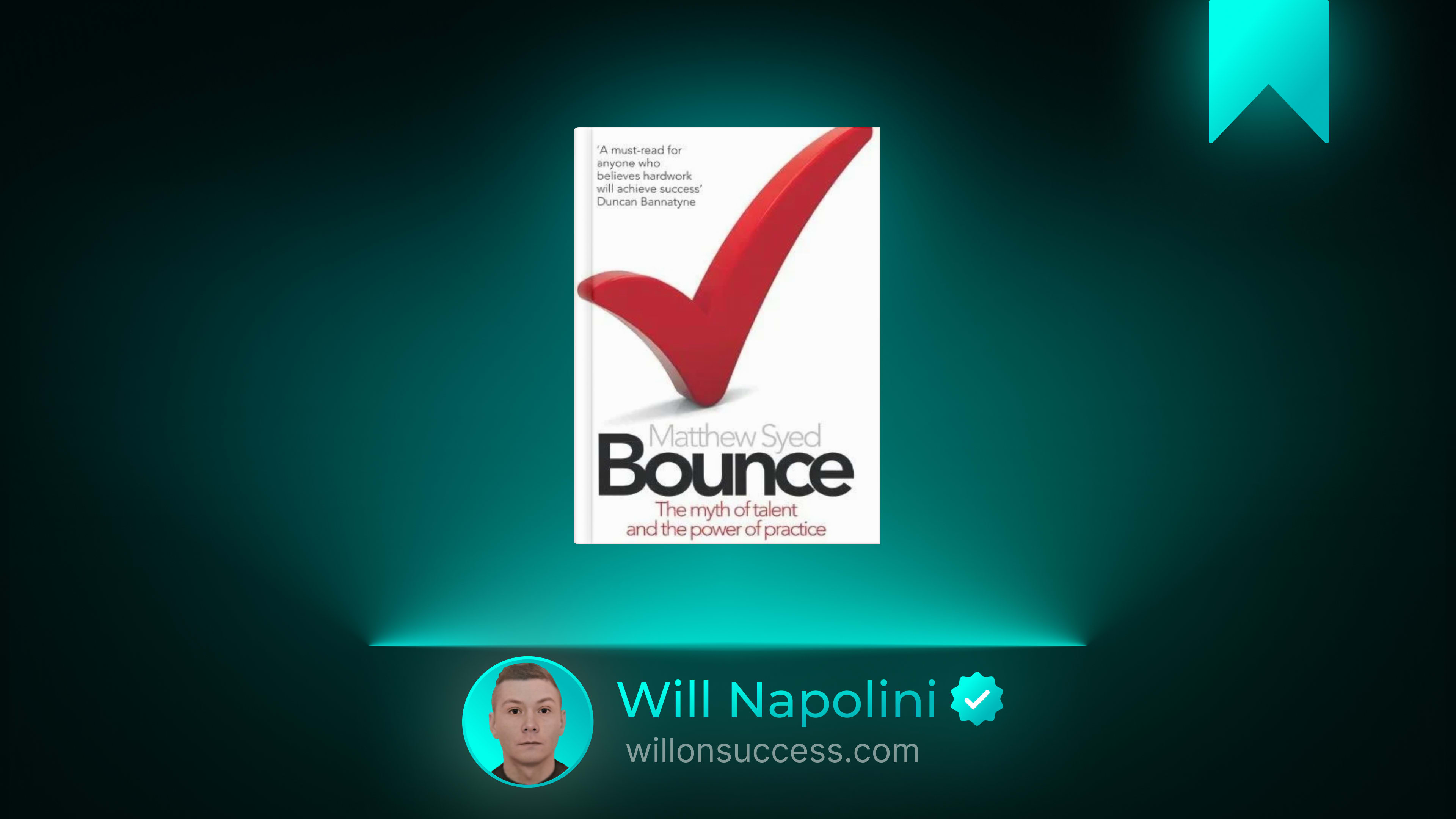
Bounce by Matthew Syed: What We Call Talent Is Mostly Invisible Practice
You have seen it happen. Maybe at work, maybe in a classroom, maybe watching someone play music or sport. A person performs something so fluid, so effortless, so far beyond your current reach that your brain reaches for the only explanation it knows: They were born with it. They have a gift. I simply don’t.
And in that instant, a door closes. Quietly. Without drama. You do not even hear the click. You simply stop trying, or try halfheartedly, or tell yourself the story that some people are wired for this and you are not.
I want to show you what is actually behind that effortless performance. Because the answer is not genetics. It is not a divine spark. It is something far more ordinary, far more accessible, and far more demanding than talent. And understanding the difference will change what you believe you are capable of.
Matthew Syed wrote Bounce to kill a myth. Not a small myth. One of the most deeply embedded stories we tell ourselves about human achievement: the idea that the people at the top got there because nature handed them something special at birth. Syed is not an armchair philosopher making this argument. He was a three-time Commonwealth table tennis champion and an Olympian. He spent his entire youth inside the machinery of elite performance. And what he discovered, both in his own life and in the research he spent years gathering, is that the talent story is not merely inaccurate. It is the single most expensive lie a person can believe about their own potential.
A Street in Reading and the Accident of Geography
The book opens with Syed’s own story, and it is the perfect lens for everything he argues. He grew up on Silver Street in Reading, England, an unremarkable residential road. And yet, in a single generation, that street produced an astonishing concentration of elite table tennis players. Multiple national champions. International competitors. A cluster of excellence that made no statistical sense for one small neighborhood.
If you believed in talent as a genetic gift, you would have to conclude that Silver Street had some extraordinary concentration of table tennis genes. A mutation. A biological anomaly passed down through the local bloodline.
The truth was less mystical and more revealing. On that street lived a remarkable coach named Peter Charters, who ran a local table tennis club. The club was open, accessible, welcoming. Children from the neighborhood could walk in after school and hit balls for hours. There was a culture of practice. There was a peer group that made training feel normal rather than obsessive. There was equipment. There was encouragement. There was time.
Syed did not grow up with a gift. He grew up inside an ecosystem that made ten thousand hours of practice not just possible but natural. The talent was real. But it was manufactured in a workshop, not delivered by a stork.
This distinction matters enormously, because if excellence is the product of opportunity and practice rather than inherited wiring, then the question changes. It is no longer Do I have what it takes? The question becomes Can I build the conditions for the work? And that is a question with an answer you can act on.
The Ten-Thousand-Hour Architecture
The backbone of Syed’s argument draws on decades of research into expertise, particularly the work of psychologist Anders Ericsson on deliberate practice. The finding that anchors the book is now well known: across virtually every domain studied — chess, music, sport, medicine, mathematics — elite performers have accumulated roughly ten thousand hours of serious, structured practice before they reach the top of their field.
But Syed is careful, and this is where the book earns its depth. He does not simply say “put in the hours.” Ten thousand hours of mindless repetition will not make you exceptional. You can hit a tennis ball against a wall for a decade and never improve beyond a certain point if you are not practicing deliberately.
Deliberate practice has specific features that distinguish it from mere activity. It operates at the edge of your current ability, not in the comfortable middle. It involves immediate feedback, so you know what went wrong and why. It breaks complex skills into components and attacks the weakest link. It is effortful, focused, and often unpleasant. It is not fun in the way a casual game is fun. It is the kind of work that leaves you mentally drained after an hour because you were fully engaged with failure, adjusting, recalibrating, trying again.
Syed puts it in terms that stayed with me: the difference between practice and deliberate practice is the difference between driving a familiar route and navigating an unfamiliar one. In the first, you are on autopilot. In the second, every turn demands attention. Growth lives in the second mode.
This is why some people accumulate twenty years of experience in a job and have not actually improved in fifteen. They found a comfortable level of competence and stopped pushing the boundary. They were driving the familiar route. The hours logged, but the learning stopped.
Why Praising Talent Actually Destroys Performance
One of the most practically important sections of the book draws on research into what we now commonly call fixed versus growth mindsets. Syed explores how the language we use around ability shapes whether people persist or collapse when things get difficult.
Here is the mechanism. If you tell a child she is talented, she hears: Your success is because of something innate and fixed inside you. The implicit corollary is terrifying: If you struggle, if you fail, if you hit a wall, then maybe the gift was never really there. So she begins to avoid challenges that might expose her. She sticks to what she already does well. She protects the label. The praise that was meant to encourage becomes a cage.
If instead you say, You worked hard on that and it shows, the message is different. Success is tied to effort, strategy, persistence. Struggle is not evidence of limitation. It is evidence of being in the learning zone. The child who hears this is more likely to lean into difficulty rather than retreat from it.
Syed extends this beyond childhood into adult performance, and I think this is where it hits hardest. How many of us have built an identity around being “the smart one” or “the natural one” in some domain, and then quietly stopped taking risks because failure would threaten the story? How many careers plateau not because ability runs out but because the person cannot tolerate being a beginner again?
The talent label is not a compliment. It is a constraint disguised as praise.
The Hidden Matrix of Opportunity
Syed does not argue that everyone is identical or that biology is irrelevant. He is not that simplistic. But he insists that the role of genetics is vastly overstated in popular culture and that the role of environment, timing, access, and accumulated advantage is vastly understated.
He explores what he calls the “matrix” of success: the web of hidden conditions that must align before ten thousand hours of practice are even possible. Being born in the right year for your sport’s age-group cutoffs. Having a parent with the time and resources to drive you to training. Living near a facility. Finding a coach who believes in you before you have given them reason to. Entering a field at a moment when the competitive landscape has a gap you can fill.
None of these are talent. All of them are luck. And yet we look at the person who benefited from this invisible architecture and say, What a gift. We mistake the scaffolding for the building.
This matters because it changes how you interpret your own position. If you have not yet achieved what you want, the question is not necessarily Am I missing some innate quality? The question might be Have I had the structure, the time, the feedback, the coaching, the repetition? And if the answer is no, then the path forward is not to grieve your supposed genetic limitation. It is to build the structure. To find the feedback. To create the repetition. To design the conditions that the lucky ones received by accident.
You cannot always control the starting conditions. But you can control whether you practice deliberately today.
Failure Is the Curriculum, Not the Punishment
A theme that runs through the book like a thread through fabric is the relationship between elite performers and failure. Syed examines how top athletes, musicians, and professionals treat errors differently from the rest of us.
For most people, failure is a verdict. It says something about who you are. You are not good enough. You do not belong here. You should stop. The emotional response is shame, and shame makes you hide. You avoid the situation that produced the failure. You stop practicing the thing that exposed you. The learning loop closes before it can teach you anything.
For the elite performer, Syed argues, failure is data. It is information about what to adjust. The tennis player who loses a match does not conclude she is fundamentally flawed. She reviews the tape. She identifies the three points where her positioning broke down. She goes back to the practice court and hits two hundred crosscourt backhands until the adjustment becomes automatic. The failure was not the end of the lesson. It was the beginning of it.
This is not a personality trait. It is a trained relationship with error. And it can be learned. You can teach yourself to look at a mistake with curiosity instead of flinching. You can build the habit of asking What does this tell me? before the shame response asks What does this say about me?
The reframe is small. The consequences are enormous. Because the person who can look honestly at failure will always outlearn the person who has to pretend it did not happen.
What This Looks Like on an Ordinary Wednesday
Let me ground this, because ideas about practice and potential can float away into abstraction if you do not pin them to the texture of a real day.
Suppose you are trying to improve at something professional — public speaking, writing, negotiation, coding, design. The talent myth whispers: Some people are just naturals at this. You are not one of them. Bounce asks you to set that story aside and ask a different question: Have I actually practiced this deliberately, or have I just been doing it on autopilot and hoping for improvement?
Deliberate practice in a professional context might look like this. You give a presentation. Instead of asking a colleague, “How was it?” and receiving a vague “Great job,” you ask one specific question: “Where did you lose my argument?” You listen to the answer without defending yourself. You identify the one transition where the logic broke. You rewrite that transition. You rehearse it aloud, three times, in the empty conference room before the next meeting. That is not talent. That is structure. That is feedback. That is the unglamorous, invisible work that compounds.
Suppose you want to learn a physical skill. The book’s lesson is not “go practice for ten hours a day.” It is: identify the specific sub-skill that is weakest. Isolate it. Repeat it at the edge of your ability with immediate feedback. Rest. Repeat. Over weeks and months, the neural pathways physically change. The skill that felt clumsy becomes automatic. What looked like a gift from the outside was actually myelin being laid down, one focused repetition at a time.
You do not need to be a child prodigy. You need to be a consistent, focused adult who has stopped waiting for permission from genetics.
Who Should Read This Book
Bounce will speak most directly to the person who has quietly decided that their ceiling was set at birth. You tried something once or twice, you were not immediately excellent, and you concluded that the domain was not for you. You carry a list of things you “could never do” — play piano, write well, lead a team, run a business, learn a language — and you have mistaken the absence of early opportunity for the absence of capacity.
It will also challenge the person at the other extreme: the one who has been told she is talented, who has built an identity around natural ability, and who is now terrified of any challenge that might reveal the limits of the gift. If you avoid difficulty to protect your self-image, this book is a gentle but firm intervention.
The book is less useful if you are looking for a precise, step-by-step training manual. Syed is a journalist and storyteller, not a coach designing your weekly program. He gives you the framework and the evidence. You still have to design your own practice. He also leans heavily on examples from sport, which may feel less immediately relevant if your interests are entirely in creative or intellectual fields, though the principles transfer cleanly.
What makes the book worth your time is not any single study or anecdote. It is the cumulative effect of having the talent myth dismantled from so many angles — personal, scientific, cultural, historical — that you can no longer comfortably hide behind it.
One Small Step for Today
Here is what I would ask you to do before this idea fades into the pleasant glow of a good read.
Choose one skill you have labeled yourself “naturally bad at.” Not the skill you wish you had. The one you have already decided is closed to you. The one where you said, years ago, I’m just not that kind of person.
Now identify the smallest possible unit of deliberate practice for that skill. Not the whole performance. One component. If it is writing, one paragraph revised with a specific focus — say, cutting every unnecessary adjective. If it is speaking, one two-minute explanation recorded on your phone and listened back with the question, Where did I lose clarity? If it is a physical skill, one isolated movement repeated twenty times with attention to form rather than speed.
Do that one unit of practice today. Twenty minutes. Maybe ten. Set a timer. Focus completely. Push slightly beyond what is comfortable. Notice where you struggle. That struggle is not evidence of your limitation. It is the exact location where growth is happening.
You do not need ten thousand hours today. You need one honest, focused session where you stop performing and start learning. The hours will accumulate. The skill will build. The person who seemed to have a gift will turn out to have had something far more available to you than you ever realized.
She had time. She had structure. She had repetition. She had a coach, a peer group, a reason to keep going when it got hard.
You can build those things. Not all of them. Not all at once. But enough. One deliberate hour, stacked on the next, stacked on the next, until the thing that once looked like magic looks like what it always was: work, made visible.
The gift was never the starting point. The gift is what you build when no one is watching, one focused repetition at a time, in the quiet room where no one calls you talented and you do not need them to.
Start there. Start small. Start before you are good. The bounce is not something you are born with. It is something you build, every time you choose to hit the ball back.