The Hidden Engine of Progress: What Black Box Thinking Teaches Us About Failure
There is a reflex we all share, one that kicks in the exact moment we realize we have made a serious mistake.
Your stomach drops. Your pulse quickens. And before you even have time to process what went wrong, your brain begins a rapid, subconscious campaign of self-defense. You start looking for external factors to blame. You begin minimizing the impact of the error. You rewrite the narrative of what happened so that the failure feels less like a reflection of your competence and more like a victim of circumstance.
I have seen this happen in boardrooms, in relationships, and in the quiet, private moments of people trying to build a better life. We are terrified of being wrong. We have been conditioned to believe that success is a straight line drawn by people who know exactly what they are doing, and that failure is an indictment of our worth.
But what if this fundamental assumption is the very thing keeping you stuck?
What if the most successful people, organizations, and systems in the world do not achieve greatness by avoiding failure, but by building a radically different relationship with it?
If I could sit across the table from you today, I would tell you that your mistakes are not a record of your inadequacy. They are a treasury of unread data. And until you learn how to read them, you will keep repeating them.
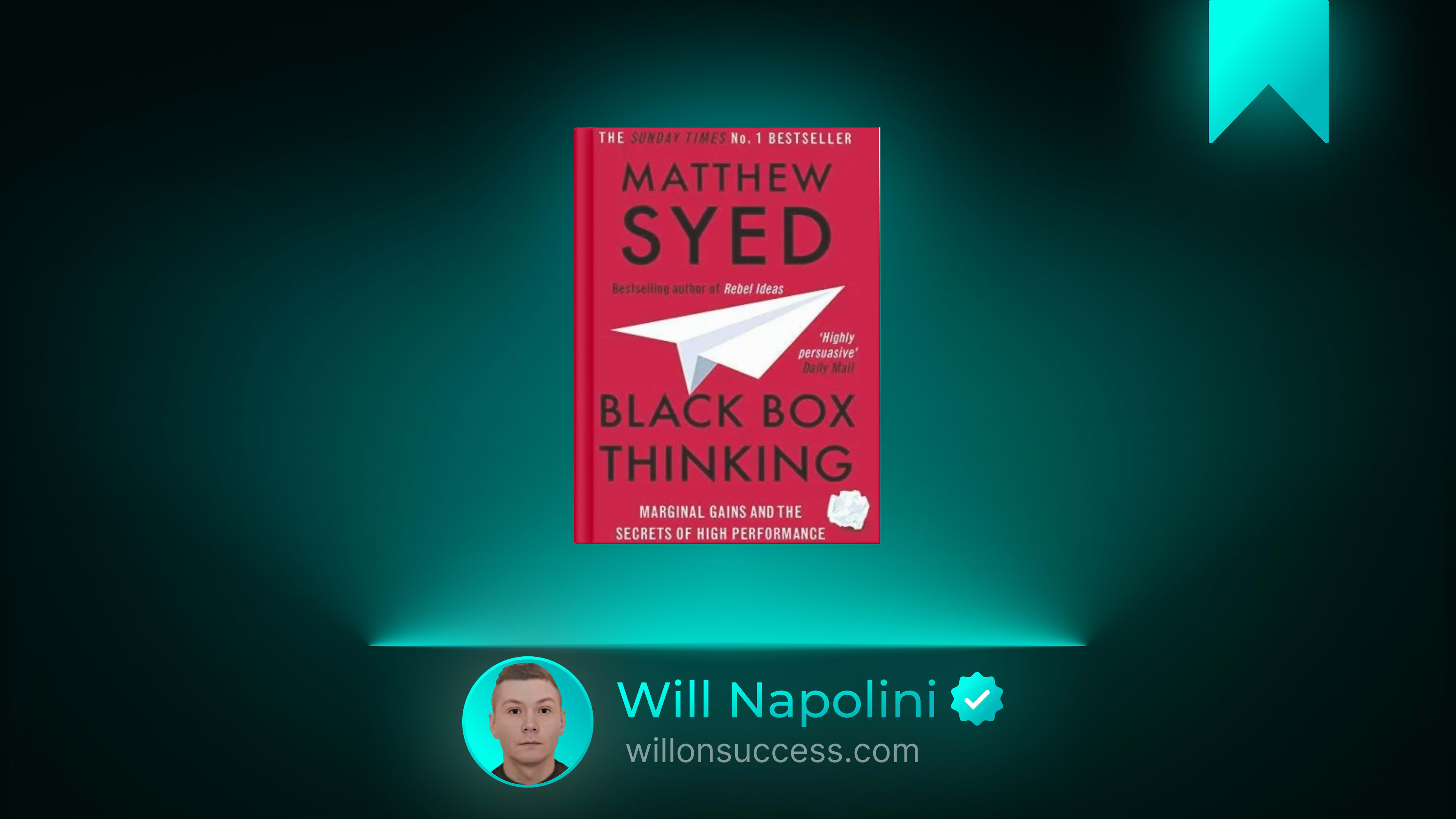
This is the profound, counter-intuitive truth at the heart of Matthew Syed’s masterwork, Black Box Thinking.
The Big Idea: Redefining Our Relationship with Failure
The central thesis of Black Box Thinking is deceptively simple: Progress depends entirely on how we respond to failure.
Syed argues that human beings and organizations generally fall into one of two categories when things go wrong. We either operate in a “blame culture,” where mistakes are hidden, rationalized, or punished, or we operate in a “learning culture,” where mistakes are exposed, investigated, and used to upgrade the system.
When you tie your ego to being right, failure becomes a threat to your identity. You will do anything to hide it. But when you tie your identity to learning, failure ceases to be a threat. It becomes the essential raw material for growth.
You do not need more motivation to succeed. You need a system that makes it safe to admit when you are wrong, and a mechanism to extract the lesson before the ego buries it.
The Tale of Two Industries
To understand why this matters, Syed introduces us to a fascinating historical contrast between two high-stakes industries: aviation and healthcare.
In the early days of commercial flight, aviation was incredibly dangerous. Planes crashed with tragic regularity. But the industry made a pivotal decision. They mandated that every commercial aircraft be equipped with two “black boxes” (which are actually painted bright orange to be easily found in wreckage). These virtually indestructible vaults record every conversation in the cockpit and every metric of the plane’s performance.
When a plane crashes, the industry does not immediately look for a scapegoat. They look for the black box. They retrieve the data, analyze the exact sequence of errors that led to the tragedy, and then they update the training, the software, and the engineering for every single pilot and plane in the world. The failure of one becomes the safety of all. Because of this relentless, unflinching confrontation with failure, aviation has become one of the safest modes of transport in human history.
Now, contrast this with the historical culture of healthcare. For decades, medicine operated as a closed system. When a medical error occurred, the hierarchy and the immense pressure of the profession often led to cover-ups. Mistakes were hidden in shame. Doctors, terrified of litigation and the loss of their reputations, would rationalize a bad outcome. The patient was too far gone. The anatomy was unusual. It was an act of God.
Because the mistakes were hidden, the data was never collected. Because the data was never collected, the system could not learn. The same errors were repeated in operating rooms across the globe, year after year.
Aviation created an “open loop” where failure leads to adaptation. Healthcare, in many historical instances, operated in a “closed loop” where failure was ignored, meaning the system remained stagnant and dangerous.
You may be working incredibly hard right now, pouring your energy into your career, your business, or your personal goals, and wondering why you aren’t seeing the breakthrough you deserve. The problem is rarely a lack of effort. The problem is that you might be operating in a closed loop. You are working hard, but you are not allowing your failures to update your system.
The Ego Is the Enemy of Data
Why is it so difficult to admit we are wrong? It is not merely a matter of stubbornness; it is a matter of deep psychological architecture.
Syed leans heavily on the concept of cognitive dissonance. This is the mental discomfort we experience when we hold two conflicting beliefs, or when reality clashes with our self-image.
Most of us view ourselves as smart, capable, and competent. When we make a significant mistake, that reality collides violently with our self-image. The brain perceives this dissonance as genuine psychological pain. To stop the pain, the brain does something remarkable and dangerous: it edits reality.
We are all amateur historians, constantly rewriting the past to protect our egos in the present.
If a business launch fails, the founder tells themselves the market wasn’t ready. If a relationship ends, we focus entirely on the flaws of our former partner. We filter out the evidence that contradicts our brilliance and magnify the evidence that supports it.
But here is the hard truth I have learned from watching brilliant people stall out: You cannot fix a problem you are busy pretending does not exist.
When you succumb to cognitive dissonance, you are choosing the temporary comfort of ego-protection over the long-term power of adaptation. You are choosing to remain blind so that you can feel good. To embrace black box thinking, you must develop the courage to look at the wreckage of your mistakes without flinching. You must separate your intrinsic worth from your temporary performance.
You are not your mistakes. You are the person learning from them.
Open Loops vs. Closed Loops
One of the most powerful frameworks in the book is the distinction between open and closed loops.
Syed uses the historical example of bloodletting. For nearly two thousand years, physicians believed that draining “bad blood” from a patient would cure various ailments. It was a fundamentally flawed, often fatal practice. Yet, it persisted for centuries. Why? Because it operated in a closed loop.
When a patient died after being bloodlet, the physician did not conclude that the treatment was wrong. They concluded that the patient’s illness was simply too severe, or that they hadn’t drained enough blood. The failure of the treatment was reinterpreted in a way that protected the core belief. No new data was allowed in. The loop remained closed.
A closed loop is a self-sealing echo chamber where your biases are constantly validated, and your errors are never corrected.
An open loop, by contrast, invites reality in, no matter how uncomfortable. It relies on testing, measuring, and confronting negative results. In the modern world, the “Lean Startup” methodology is a perfect example of an open loop. Entrepreneurs do not spend years building a product in secret, praying the market will love it. They build a minimum viable product, release it, and let the market brutally tell them what is wrong with it. They seek out the negative data. They invite the failure early, when it is small and cheap, so they can adapt before the stakes are fatal.
Ask yourself: Where in your life are you operating in a closed loop?
Are you avoiding looking at your bank statements because you are afraid of what they will tell you about your spending habits? Are you refusing to ask for honest feedback from your team because you are afraid they will point out your blind spots?
A mistake hidden in shame is a mistake destined for repetition. A mistake exposed to the light is a stepping stone to mastery.
Blame Culture vs. A Just Culture
If you lead a team, manage a family, or simply want to create an environment where you and those around you can grow, you must understand the difference between a blame culture and a “just culture.”
In a blame culture, every mistake is treated as a moral failing or an act of negligence. If someone messes up, they are punished, shamed, or fired. The immediate result of a blame culture is not perfection; it is secrecy. If people know they will be punished for honest errors, they will build elaborate systems to hide those errors. The data goes underground, and the organization becomes fragile, completely blind to the risks building up beneath the surface.
A just culture, however, recognizes the complexity of human performance. It draws a bright, clear line between reckless behavior (which must be disciplined) and honest errors (which must be investigated).
In a just culture, when an honest mistake happens, the question is not, “Who did this?” The question is, “What flaw in our system allowed this to happen?”
If you want the people around you to be honest with you, you must make it safe for them to be wrong. If you want to be honest with yourself, you must stop punishing yourself for every misstep. Shame does not breed excellence; it breeds cover-ups. Curiosity breeds excellence. When you approach your own failures with the cool, detached curiosity of an investigator rather than the harsh gavel of a judge, you unlock the ability to actually change.
Why This Changes Everything
You might be thinking that this sounds like a lot of corporate theory. But let me show you what this looks like on an ordinary Tuesday.
Imagine you have been trying to build a new habit—perhaps writing a book, getting into shape, or starting a side business. For the third time this year, you have fallen off the wagon. You missed a week of workouts. You haven’t written a word in ten days.
In a closed loop, driven by ego and shame, you tell yourself: I just don’t have the discipline. I’m lazy. This isn’t for me. You close the loop. You abandon the goal to protect yourself from the pain of trying and failing again.
In an open loop, driven by black box thinking, you sit down and open the black box. You ask: What exactly caused the system to break down? You look at the data. You realize you were trying to write at 9:00 PM after a grueling day of work and putting the kids to bed. Your willpower was depleted. The environment was full of distractions.
The failure wasn’t a lack of character; it was a flaw in the architecture of your routine. So, you update the system. You move the writing session to 6:00 AM. You leave your laptop on the kitchen counter the night before. You don’t rely on motivation; you rely on a corrected system.
This is the difference between those who dream and those who achieve. The achievers are not superhumans who never fall off the wagon. They are simply people who retrieve the data on their way back up.
External results almost always begin with internal development. But internal development does not mean magically generating more willpower. It means developing the humility to look at your own wreckage, extract the lesson, and build a better vehicle for tomorrow.
Building Your Personal Black Box
Understanding this philosophy is valuable, but understanding without action changes nothing. How do you actually build a personal black box? How do you institutionalize learning in your own life?
Here are three concrete ways to shift from a closed loop to an open loop starting today.
1. The Weekly Post-Mortem
Set aside twenty minutes every Friday afternoon or Sunday evening. Open a notebook and write down one thing that did not go well this week. It could be a missed deadline, a tense conversation, or a lost sale. Now, force yourself to write down three objective reasons why it happened, stripping away all emotional rationalizations. You are not allowed to blame the economy, your boss, or your spouse. Look only at your own inputs, your own preparation, and your own systems. Find the mechanical flaw and write down one adjustment for next week.
2. Conduct a Pre-Mortem
Before you launch a new project, make a major investment, or start a new initiative, gather your team (or just sit by yourself) and imagine it is one year in the future. The project has failed spectacularly. Now, work backward. Write down the story of why it failed. This bypasses the ego’s optimism bias. It forces you to look at potential vulnerabilities before they become tragedies, allowing you to build safeguards into your plan from day one.
3. Decouple Your Identity from Your Output
When you receive harsh feedback, notice your physical reaction. Notice the heat in your chest, the urge to interrupt, the desire to defend. Take a breath and silently repeat a grounding principle: The feedback is about the work, not my worth. Treat the criticism as a free consultation from the universe, pointing out a blind spot you could not see on your own.
Who Needs to Read This Book
Black Box Thinking is essential reading for leaders, entrepreneurs, and managers who want to build resilient, innovative teams. If you are in a position where the cost of hidden errors is high, this book will change how you structure your organization.
It is also profoundly healing for perfectionists. If you are someone who is paralyzed by the fear of making a mistake, who procrastinates because you are terrified of producing subpar work, Syed’s research will liberate you. It will show you that the most successful entities on earth are not the ones that never fail; they are the ones that fail the most intelligently.
Who might find this book less useful? If you are looking for a superficial “hack” to guarantee a painless road to success, or a motivational pep talk that pretends failure doesn’t hurt, this is not for you. This book requires the courage to look directly at your own shortcomings. It demands maturity. But if you are willing to do that work, the payoff is limitless.
One Small Step
I want you to take action before the inspiration fades.
Sometime in the last month, you experienced a failure, a rejection, or a disappointment that you have been quietly avoiding thinking about. You know exactly what it is. It is that project that didn’t get funded, that conversation that ended in an argument, or that habit you couldn’t maintain.
Today, I want you to take out a piece of paper and write down the answer to this single question: “If I assume this failure contains exactly the data I need to succeed next time, what is the system flaw it is trying to show me?”
Do not judge yourself. Do not make excuses. Just look for the mechanical flaw in your approach. Find the one variable you can change.
We spend so much of our lives trying to build a flawless record, desperately hoping the world will never see us stumble. But a flawless record is a fragile thing, easily shattered by the unpredictable nature of life. A resilient life, on the other hand, is built on a foundation of recovered data.
You do not need to be perfect. You just need to be willing to open the box.
The most successful people are not those who never fall; they are the ones who always retrieve the data on their way back up.