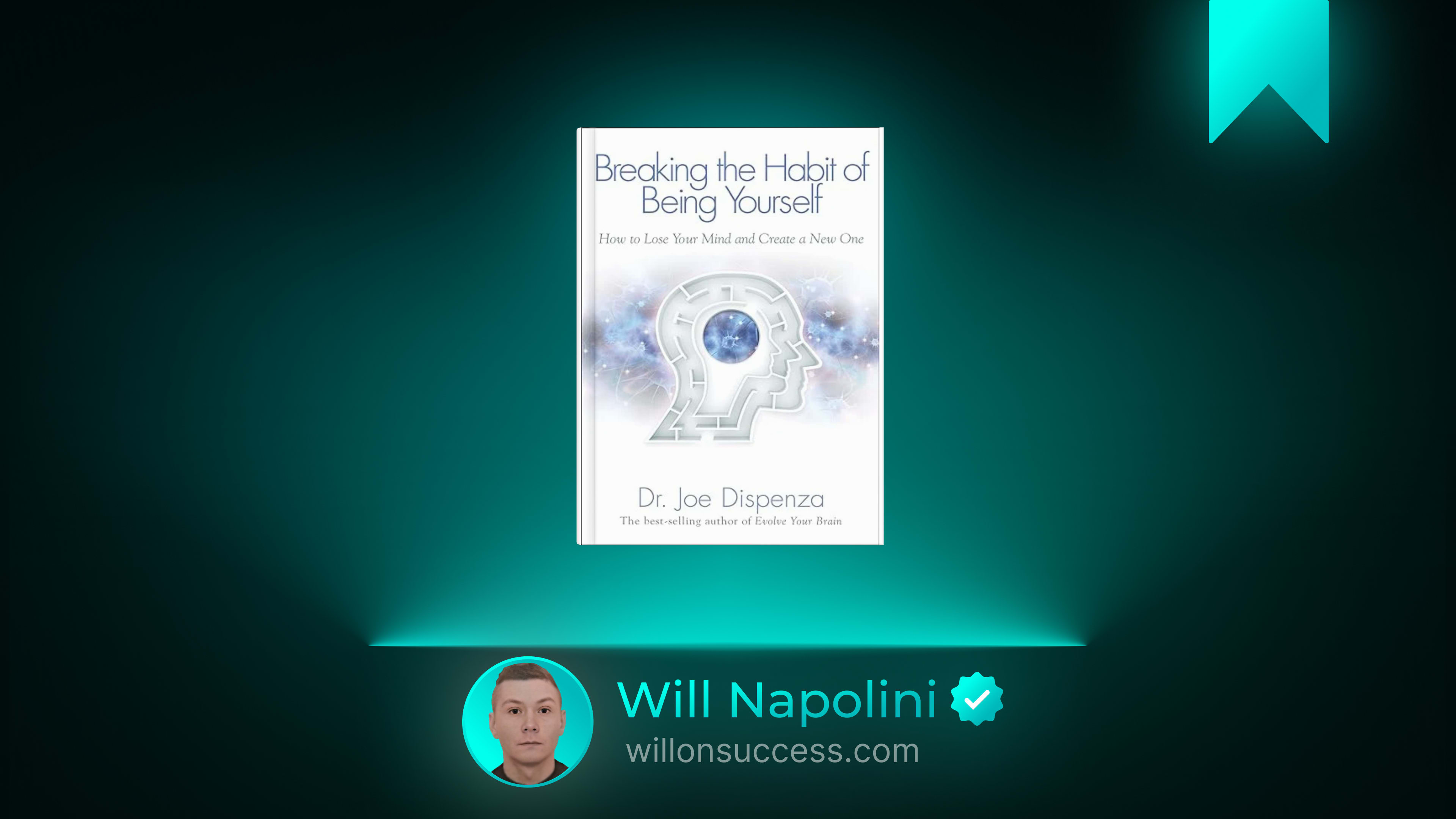
Breaking the Habit of Being Yourself: How to Rewrite the Patterns That Keep You Stuck
There is a version of you that wakes up tomorrow morning, reaches for the phone before the feet hit the floor, replays the same worry about money or work or that unfinished conversation, pours the same coffee, drives the same route, and says the same internal sentence it has said for years: This is just who I am.
I have watched that sentence do quiet, enormous damage. Not because it is always false, but because it functions as a lock. The moment you decide that your patterns are fixed, you stop looking for the door.
Joe Dispenza wrote Breaking the Habit of Being Yourself to hand you a key. His central claim is both simple and unsettling: the life you are living right now is, in large part, a reflection of the thoughts and emotions you repeat every single day without noticing. And if you want a different life, you do not start by rearranging the furniture. You start by interrupting the person who keeps walking into the same room and sitting in the same chair.
I want to walk you through the most useful ideas in this book. Not every idea—Dispenza ranges across neuroscience, quantum physics, and contemplative practice, and some of his more speculative claims deserve a skeptical eye. But the core engine of the book is genuinely powerful, and it has practical teeth. Let me show you what I mean.
The Loop You Did Not Choose but Keep Reinforcing
Dispenza opens with an idea worth sitting with: your personality—meaning your habitual combination of thoughts, emotional reactions, and behaviors—creates your personal reality.
That sounds abstract until you trace it through an ordinary week. Think about a recurring frustration in your life. Maybe it is the feeling of being overlooked at work. Maybe it is a relationship where you always end up in the same argument. Maybe it is the quiet conviction that you are not quite enough.
Now trace the loop. A thought appears—They probably don’t value what I do. That thought triggers an emotion—resentment, or sadness, or a tightening in the chest. That emotion shapes your behavior—you withdraw, or you overcompensate, or you make a sharp comment. That behavior produces a result that confirms the original thought. And the next morning, the loop starts again, slightly deeper, slightly more automatic.
Dispenza’s point is that this loop is not a character flaw. It is a well-worn neural pathway. Every time you think the same thought, the same neurons fire together, and the connection strengthens. Every time you feel the same emotion, your body releases the same chemical signature, and your cells begin to expect it. Over months and years, the thought becomes a reflex and the emotion becomes an addiction. You are not choosing your reactions anymore. You are running a program.
Here is what I find both humbling and liberating about that framing. Humbling, because it means many of the patterns I once blamed on bad luck or other people were patterns I was quietly maintaining. Liberating, because if a pattern is maintained by repetition, it can be dismantled by a different repetition. You are not stuck because you are broken. You are stuck because you are practiced.
Your Body Has Memorized Your Past
One of the most striking ideas in the book is what Dispenza calls the body becoming the mind.
The concept goes like this. When you experience an emotion—say, anxiety before a difficult meeting—your body floods with specific chemicals. Your heart rate changes. Your shoulders tighten. Your breathing shifts. If you experience that same anxiety every day for three years, your body begins to crave that chemical signature the way a person craves caffeine. The emotion stops being a response to an event and starts being a baseline state. You feel anxious, and then you look for something to be anxious about, because the feeling itself has become familiar, and familiar feels like you.
I have seen this play out in small, ordinary ways. A person who grew up in a household where conflict meant danger may spend decades scanning every room for tension, even in rooms that are perfectly safe. A person who was told repeatedly that they were too much or not enough may carry a low-grade shame that colors every accomplishment, no matter how large. The original event is long gone. The body keeps the score.
Dispenza argues that this is why willpower so often fails. You can decide on Monday that you will think positive thoughts, but if your body is chemically bonded to frustration or self-doubt, the body pulls you back by Wednesday. The conscious mind votes for change. The subconscious body votes for the familiar. And the subconscious, being faster and more automatic, usually wins.
If that resonates with you, I want you to hear something important. This is not a moral failing. It is biology doing what biology does—seeking the known, conserving energy, repeating what has been rehearsed. Recognizing that mechanism is the first real step toward interrupting it. You cannot change a program you do not know is running.
Rehearsing the Future Before It Arrives
The practical heart of the book is a claim that sounds strange until you try it: to change your life, you must feel the emotions of your desired future before the external circumstances produce them.
Dispenza draws on research in mental rehearsal and neuroplasticity to make this point. When you vividly imagine an experience—running a race, giving a speech, having a calm and honest conversation—your brain fires many of the same neural circuits it would fire if the experience were actually happening. The brain, in a meaningful sense, does not fully distinguish between a richly imagined event and a real one.
So if you spend twenty minutes each morning mentally rehearsing who you want to be—how you want to show up, what you want to feel, how you want to respond to the pressures of your day—you are, in a very literal neurological sense, laying down new pathways before the day has a chance to reinforce the old ones.
This is where the book moves from interesting theory to demanding practice, and I want to be honest with you. Dispenza asks you to close your eyes, slow your brainwaves through meditation, and generate a genuine emotional experience of a future that has not happened yet. He wants you to feel gratitude for a healing that has not yet occurred. To feel the confidence of a career shift that is still months away. To feel the peace of a relationship you are still building.
That is hard. Some days it feels almost impossible. You sit down, close your eyes, and your brain immediately serves up the grocery list, the unpaid bill, the awkward thing you said at dinner. That is normal. That is the old program trying to keep running. The work is not to fight those thoughts. The work is to notice them, let them pass, and return, gently and stubbornly, to the feeling you are trying to rehearse.
You start small. You stay consistent. You let the repetition build something new.
Moving from Survival to Creation
A distinction Dispenza makes that I find genuinely useful is the difference between living in survival mode and living in creation mode.
Survival mode is what happens when your nervous system is dominated by stress hormones. You are reactive. You are scanning for threats. Your attention is locked on the external world—what other people think, what the news says, what went wrong yesterday, what might go wrong tomorrow. In survival mode, you are essentially responding to your environment. Your environment is writing your story.
Creation mode is what becomes possible when you quiet the external noise and turn your attention inward. When you are no longer frantically reacting, you can choose a thought instead of inheriting one. You can select an emotion instead of being ambushed by one. You become, in Dispenza’s language, the cause rather than the effect.
I do not want to make this sound mystical or easy. If you are in genuine crisis—if you are dealing with poverty, illness, grief, or abuse—the language of “just shift into creation mode” can feel dismissive, and I would never offer it that way. Circumstances are real. Pain is real. But even within difficult circumstances, there is usually a small space between what is happening to you and how you choose to relate to it. That space is where agency lives. And Dispenza’s book is ultimately about widening that space.
The Three-Week Meditation: What It Actually Asks of You
The final portion of the book is a guided, three-week meditation program. Dispenza structures it progressively.
The first week focuses on unbecoming. You learn to observe your automatic thoughts and emotional reactions without engaging them. You practice recognizing the old program running and choosing not to follow it. This is the hardest part, because it requires you to sit still with your own patterns and not fix, judge, or escape them. Just watch.
The second week shifts toward disconnecting from the body’s habitual emotional states. You practice not becoming the anxiety, not becoming the irritation, not becoming the old story. You create a small gap between the stimulus and the identity you usually attach to it.
The third week is where you begin rehearsing the new self. You mentally and emotionally experience the person you want to become. You feel it in your body. You let the gratitude, the confidence, the calm register as real experience, even though the external evidence has not yet caught up.
I would encourage you not to treat this as a passive listening exercise. The value is in the doing. Twenty minutes, eyes closed, one morning. That is the whole assignment. You do not need a retreat. You do not need special equipment. You need a quiet chair, a little patience, and the willingness to feel clumsy at something new.
Where I Would Offer a Gentle Caution
I respect what this book attempts, and I think its core message is genuinely important. But I would be doing you a disservice if I did not mention that Dispenza sometimes stretches his quantum-physics analogies further than most physicists would comfortably follow. The idea that your focused attention directly reshapes a quantum field and thereby rearranges external reality is presented with more confidence than the current scientific evidence supports.
You do not need to believe in quantum mysticism to benefit from this book. The neuroplasticity research is solid. The evidence for meditation’s effect on stress, attention, and emotional regulation is robust. The psychological principle that repeated mental rehearsal changes behavioral patterns is well established. You can take all of that, leave the speculative physics on the shelf, and still walk away with a powerful, practical framework for change.
What I am saying is this: you do not need to accept every claim in the book to be transformed by its central practice. Take what is grounded. Test it in your own life. Let your experience be the judge.
What This Looks Like on an Ordinary Tuesday
Let me bring this down to the ground, because ideas that stay abstract do not change anything.
Suppose you are someone who wakes up and immediately feels behind. Before your eyes are fully open, your mind is already cataloguing what you did not finish, what is expected of you, where you are falling short. That emotional signature—low-grade dread, a tightness in the stomach—becomes the lens through which the entire day is filtered.
The Dispenza approach would ask you to interrupt that sequence before it starts. Before you pick up the phone. Before you check the email. You sit. You breathe. You notice the old feeling arriving, and you do not follow it. Instead, you spend five or ten minutes mentally rehearsing how you want to move through the day. Not in a vague, wishful way. Specifically. You imagine walking into the office and speaking calmly in the meeting you have been dreading. You imagine handling the difficult conversation with steadiness instead of defensiveness. You imagine feeling, at the end of the day, a quiet pride in how you showed up.
And here is the critical part: you try to feel that steadiness now, in the chair, with your eyes closed. You let your body experience the emotion before the event. You are, in a very real sense, giving your nervous system a new memory to draw from when the actual moment arrives.
Will it work perfectly the first time? No. Will your mind wander? Constantly. Will you sometimes skip the practice because you overslept or the kids needed you or you simply did not feel like it? Of course. That is not failure. That is being a person building a new habit inside an old life. The question is not whether you miss a day. The question is whether you return the next morning.
Who This Book Is For, and Who Might Set It Down
If you have been working on yourself for a while—reading books, setting goals, trying to think more positively—and you still feel like you are running the same emotional software, this book speaks directly to that frustration. It is especially useful if you sense that your obstacle is not a lack of information but a deep, bodily attachment to old emotional patterns.
People dealing with chronic stress, anxiety loops, or a persistent sense of being stuck in a role they outgrew will find the most here. The meditation framework gives you a concrete daily practice, which is more than most personal-development books offer.
That said, if you are looking for a quick fix or a weekend transformation, this will disappoint you. The book asks for consistent, patient inner work. And if you are strongly science-oriented, some of the quantum-language chapters may test your patience. Read those sections with a generous but critical eye, and focus on the practical core.
One Small Step You Can Take Before You Sleep Tonight
I do not want you to close this article and file it away as interesting. Understanding without action changes nothing.
So here is what I would ask of you. Tonight, before you go to sleep, set your alarm ten minutes earlier than usual. Tomorrow morning, before you touch your phone, before you check a single message, sit in a quiet place. Close your eyes. Take five slow breaths. Then ask yourself one question:
If I could feel one emotion tomorrow that I rarely let myself feel—calm, confidence, gratitude, joy—which one would I choose?
Pick one. Just one. Then spend five minutes trying to feel it in your body. Not think about it. Feel it. Let your shoulders drop. Let your jaw soften. Let the feeling register in your chest, your hands, your breath.
Five minutes. That is all. You are not transforming your entire identity before breakfast. You are casting one small vote for a different pattern. And tomorrow, you cast another. And the day after that, another.
A single thought does not change a life. But a thought, repeated with feeling, becomes a pathway. A pathway, walked often enough, becomes a road. And a road, followed with patience, becomes the direction of your life.
You have been rehearsing the old version of yourself for years, faithfully, every single morning, without even realizing it. You owe it to yourself to spend five minutes rehearsing someone new.
Start tomorrow. The chair is waiting. The only thing you need to bring is the willingness to sit down and begin.