Bridget Jones's Diary: The Quiet Revolution of Liking Yourself Just as You Are
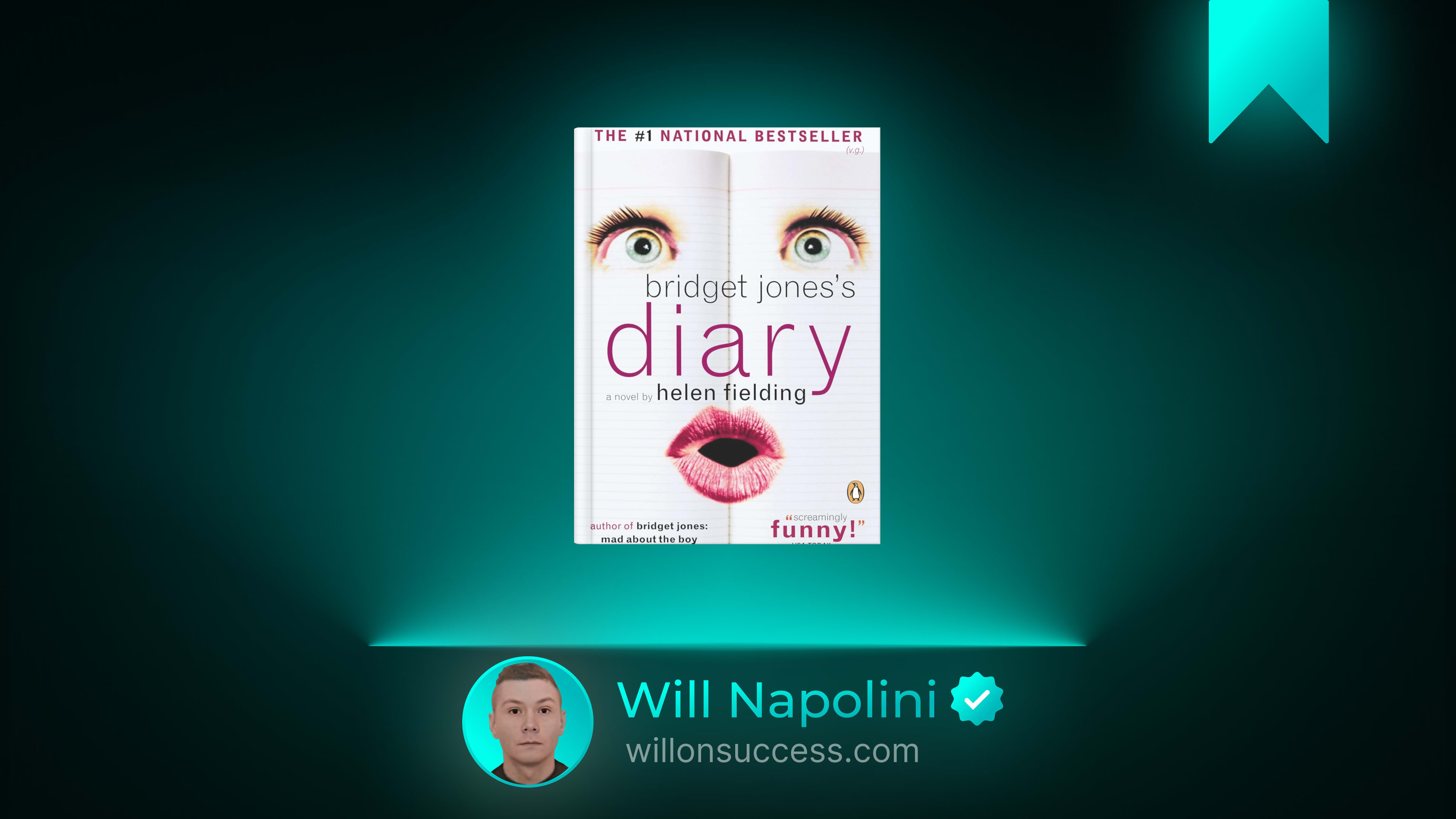
I want to talk to you about a book that pretends to be about counting calories.
It opens on the first of January, and a woman in her early thirties sits down to make her list. Lose weight. Stop smoking. Cut back on wine. Find a decent man. Become, in her own hopeful phrasing, a “Serene Person” who glides through life with poise and purpose. She writes the resolutions with complete sincerity. She will break most of them within the week.
If that sounds familiar—if you have ever made a list of improvements on New Year’s Eve with the quiet, desperate feeling that the current version of you is not quite acceptable—I think Helen Fielding’s Bridget Jones’s Diary has something genuinely important to say to you. Not because it offers a solution. But because it looks at the whole exhausting project of trying to become someone else and says, with tremendous warmth and a glass of Chardonnay in hand: What if you are already enough, and the only thing missing is your willingness to believe it?
I know that sounds like a greeting card. The book is not a greeting card. It is funny, sharp, a little messy, and more emotionally honest than its reputation as a “chick-lit” comedy suggests. Let me show you what I mean.
A Diary That Tells the Truth by Accident
The structure of the novel is deceptively simple. Bridget Jones, a single woman working at a publishing house in London, keeps a diary for one calendar year. Each entry begins with a small inventory: weight, cigarettes smoked, alcohol units consumed, calories ingested. Then the entry spirals into whatever is actually happening—a disastrous dinner party, a flirtation at the office, a phone call from her mother that leaves her wanting to crawl under a duvet.
What makes the diary format work so beautifully is the gap between Bridget’s intentions and her reality. She writes down the person she means to be. Then she records the person she actually was. And the distance between those two versions is where all the comedy lives, and where all the quiet ache lives too.
I have noticed that gap in my own life. I suspect you have noticed it in yours. The version of yourself you narrate in your head—the one who exercises before dawn, responds to emails promptly, never says the wrong thing at a party, never eats the second slice of cake while standing over the kitchen sink at eleven p.m.—and the version who actually shows up. Fielding builds an entire novel out of that gap, and she does it without cruelty. Bridget is not pathetic. She is human. And the book loves her for being human, even when Bridget cannot manage it herself.
The Tyranny of the “Should” Self
Here is what I think is the book’s sharpest observation, the one hiding underneath all the jokes about bad dates and turkey curry buffets.
Bridget is not really fighting her weight, or her smoking habit, or her tendency to drink one too many glasses of wine. She is fighting the person she believes she should be. She has absorbed a catalogue of expectations—be thinner, be calmer, be partnered, be the kind of woman who has her life organized by thirty-two—and she treats every deviation from that catalogue as evidence of personal failure.
The novel is populated by what Bridget calls the “Smug Marrieds,” couples who seem to have achieved the approved script and who look at single, slightly chaotic women like Bridget with a mixture of pity and mild horror. There are dinner parties where she is the odd number. There are well-meaning relatives who ask, with aggressive cheerfulness, whether she is seeing anyone. There is the constant, low-grade hum of the message: You are not yet the finished product. Keep working on yourself.
If I could sit across the table from you and you told me that you felt this pressure, I would not dismiss it. The pressure is real. And it has not gone away since 1996, when Fielding published the book. If anything, it has intensified. The Smug Marrieds have been joined by the curated Instagram feed, the optimized morning routine, the five-a.m. wellness empire, the quiet assumption that every aspect of your life is a project to be improved. You are supposed to be building a brand, not just living a Tuesday.
What Fielding does, gently and persistently, is let Bridget be a person in the middle of all that noise. Not a project. Not a before-photo in someone else’s transformation story. Just a woman trying to get through the week, making mistakes, feeling embarrassed, wanting to be loved, and slowly—very slowly—beginning to suspect that the love she is looking for might require her to stop apologizing for taking up space.
Two Men, Two Kinds of Attention
The romantic plot of the novel is structured around two men, and the choice between them is really a choice about what kind of love Bridget thinks she deserves.
Daniel Cleaver is her colleague at the publishing house. He is witty, flirtatious, exciting. He sends suggestive emails. He makes Bridget feel chosen, visible, wanted. The attention is intoxicating, and for a while she mistakes the electricity of being pursued for the substance of being known.
Mark Darcy is introduced at a New Year’s party arranged by Bridget’s parents. He is a barrister. He is stiff, formal, seemingly judgmental. He appears to look down on Bridget’s family, her career, her whole slightly chaotic world. The initial impression is terrible, and Bridget writes him off with considerable satisfaction.
I will not walk you through every turn of the plot, but I will say this: the novel slowly, carefully inverts your first impression of both men. Daniel’s charm turns out to have a hollow center. He is skilled at making you feel like the only person in the room, right up until you are no longer useful to him. Mark’s reserve turns out to be something closer to integrity. He is awkward because he is sincere. He does not perform. And when he finally tells Bridget, in a scene I find genuinely moving, that he likes her very much, just as she is—not the thinner, calmer, more organized version she keeps trying to manufacture, but the actual woman standing in front of him—it lands with the force of something she has needed to hear for a very long time.
Fielding drew openly on Jane Austen’s Pride and Prejudice for this structure, and the echo is deliberate. But where Austen’s Elizabeth Bennet is sharp and self-assured, Bridget is uncertain, self-deprecating, and frequently wrong about her own worth. That difference matters. It makes the moment of being seen—truly seen, without conditions—feel harder-won and more emotionally necessary.
The question the book poses through these two relationships is one I think about often: Are you drawn to people who make you feel like a performance, or people who make you feel like a person? The first kind of attention is louder. The second kind is rarer. And the novel quietly argues that you will keep choosing the first kind as long as you believe you must earn love by being a more polished version of yourself.
The Friends Who Hold the Center
I would be leaving out something essential if I talked only about the romance, because one of the book’s truest portraits is of friendship.
Bridget’s circle of close friends—Tom, Jude, Shazzer—show up consistently. They listen to her agonize. They talk her through the bad dates and the worse phone calls. They sit with her in the flat when she is feeling sorry for herself, and they do not try to fix her. They are also honest with her, in the way that real friends are honest: not cruel, but unwilling to let her disappear into a fantasy about a man who is clearly no good for her.
In a culture that often treats romantic partnership as the sole measure of a life well lived, the novel quietly insists that friendship is not a consolation prize for people who have not yet found “the one.” It is a sustaining, essential, sometimes saving force. Bridget’s friends do not solve her problems. They keep her company inside them. And there are seasons in every life where being kept company is the most important thing another person can offer.
If you have a friend like that—someone who will answer the phone at ten p.m. and listen to you talk through the same worry for the fourth time without rolling their eyes—hold on to them. The book reminded me of that, and I was grateful for the reminder.
What the Novel Knows About Change
Here is something I have learned that the book illustrates beautifully: real change rarely looks like the dramatic transformation we plan in January. It looks more like a slow shift in what you are willing to tolerate, what you are willing to believe about yourself, and what you are willing to ask for.
Bridget does not lose twenty pounds and become a Serene Person. She does not stop smoking entirely. She still drinks too much at the office Christmas party. She still says the wrong thing. She still spends an evening in her pyjamas feeling sorry for herself. But by the end of the year, something has shifted underneath all of that. She has begun, tentatively, to stop treating her own life as a rough draft waiting for revisions. She has let one person see her without the performance. And that small act of being seen, without editing, turns out to be more transformative than any resolution she wrote on the first of January.
You start where you are. You stop apologizing for the mess. You let someone hand you a cup of tea and say, You are fine. You are actually fine.
That is not a small thing. In a world that profits from your insecurity, deciding that you are acceptable as you stand is a quiet, stubborn act of rebellion.
Who Should Read This Book, and How to Read It
If you have ever felt like you are perpetually auditioning for your own life—performing competence, performing happiness, performing the version of yourself that would finally be enough—this book will feel like a friend sliding into the seat beside you and saying, Oh, thank God, someone else feels this way.
It is especially good if you are in your late twenties or thirties and feeling the particular social pressure around partnerships, careers, and whether your life is unfolding on schedule. It is also genuinely funny, which matters. You do not have to be in a contemplative mood to read it. You can read it on a train, in a bath, in bed with a cup of something warm, and laugh out loud at Bridget’s disastrous dinner parties and mortifying encounters with her parents.
That said, if you are looking for a tightly plotted novel or literary prose in the traditional sense, this may not be your book. The diary format is episodic, sometimes repetitive, and the humor is broad and very British. Some of the attitudes around weight and singlehood, while satirical, can feel a little dated depending on when you are reading. Fielding is poking fun at the pressure, but the pressure is the medium she works in, and a small amount of it inevitably rubs off.
Read it for the comedy. Stay for the moment when Bridget stops performing and lets herself be liked, unedited, by someone who was paying attention all along.
One Small Step for Tonight
I am not going to ask you to make a list of resolutions. The book has made the case against that pretty thoroughly, and I respect the case.
Instead, I want to offer you something smaller. Tonight, before you go to sleep, take out a piece of paper or open the notes app on your phone. Write down one thing you have been trying to fix about yourself—not because it is genuinely harming you, but because you have absorbed a message that you should be different. Maybe it is your body. Maybe it is your career trajectory. Maybe it is the fact that you are single, or that you are too loud, or too quiet, or too much, or not enough.
Write it down. Look at it. And then ask yourself, honestly: Whose standard is this?
You do not have to solve it tonight. You do not have to decide, in one evening, whether to keep working on it or let it go. You just have to notice whether the drive to change is coming from your own genuine desire or from a script someone else handed you years ago.
That small act of noticing is where Bridget’s year really begins. Not with the resolution. With the moment she looks at the resolution and thinks, Wait. Who told me I needed this?
You do not owe anyone a better version of yourself. You owe yourself the chance to find out whether the version you already are might be, quietly and without fanfare, enough.
The diary is open. The pen is in your hand. And you do not have to write a single resolution. You just have to write what is true.