Build the Life You Want: The Architecture of a Quietly Happy Life
There is a specific, quiet disappointment that arrives on an ordinary Tuesday, usually a few months after you finally get the thing you have been chasing for years.
You got the promotion. You closed on the house. You reached the target number in your bank account. You crossed the finish line you had been staring at since you were twenty-five. And for a week, it felt exactly like you thought it would. But then the novelty faded, the baseline reset, and you woke up one morning realizing that you are still you, with the same internal restlessness, staring at a new ceiling.
I have been in that room. I suspect you have been in that room, too. It is the room where we realize that achieving our circumstances did not automatically fix our lives.
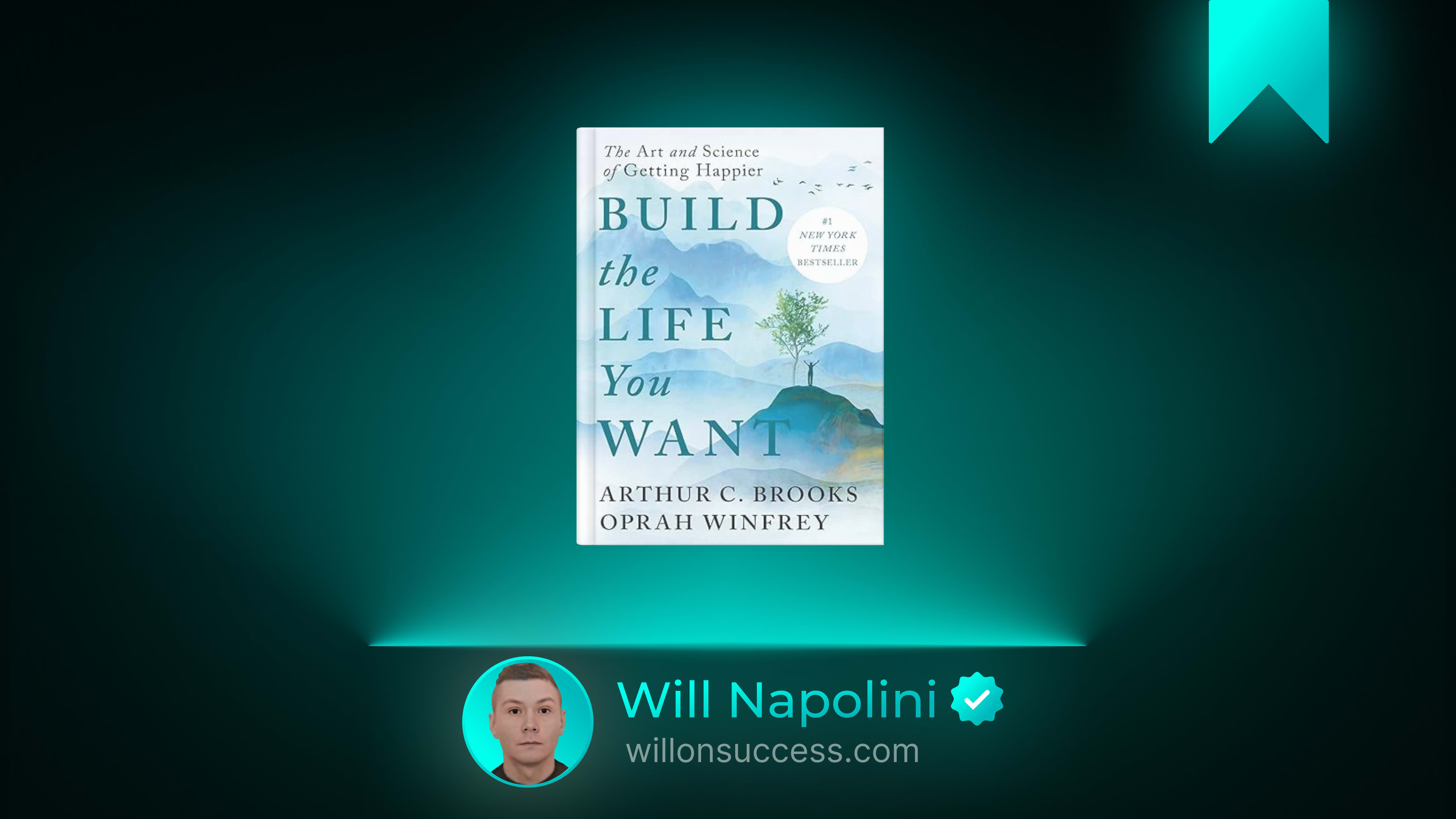
If that realization feels heavy to you, I want to introduce you to a framework that takes that weight and turns it into a blueprint. In their book Build the Life You Want: The Art and Science of Getting Happier, social scientist Arthur C. Brooks and media pioneer Oprah Winfrey join forces to dismantle our cultural obsession with “arriving.” Brooks brings the rigorous data of human happiness; Winfrey brings the deep, empathetic wisdom of a life lived in the public eye.
Together, they offer a profound and deeply practical thesis: Happiness is not a place you reach. It is a house you build. And if you do not like the house you are living in, you do not need to burn it down. You just need to learn how to use the tools.
The Equation That Changes Everything
Before you can build, you have to understand the ground you are building on. Brooks introduces what he calls the Happiness Equation, and it is one of the most liberating concepts I have encountered in years of studying human behavior.
Research suggests that your baseline level of happiness is determined by three factors:
- Genetics: About 50% of your happiness set-point is inherited. Some people are just born with a sunnier disposition.
- Circumstances: About 10% to 15% is determined by your external reality—your wealth, your health, your geography, your marital status.
- Actions and Values: The remaining 35% to 40% is determined by what you do, what you believe, and how you manage your mind.
Read that again. Look at the middle number. Circumstances—the things we spend 90% of our waking hours stressing over, striving for, and sacrificing our sleep to achieve—account for roughly 10% of our lasting happiness.
When I first internalized this, I felt a strange mix of grief and relief. Grief, because it meant all those years I spent thinking, I will finally be happy when I make more money, were based on a mathematical error. Relief, because it meant I could stop carrying the impossible burden of trying to control the uncontrollable.
You cannot change your genetics. You cannot entirely control your circumstances. But you have absolute authority over your actions and your values. The book asks a simple, piercing question: Why do we spend almost all our energy trying to manipulate the 10%, while completely ignoring the 40% that is actually in our hands?
The Four Pillars of a Sustaining Life
If happiness is a structure, what holds the roof up? Brooks and Winfrey identify four pillars that the data consistently shows are required for a deep, enduring sense of well-being. If your life feels shaky, it is almost always because one of these pillars is neglected.
1. Family: The People Who Claim You
When the authors talk about family, they are not just talking about biology. They are talking about the people who are unconditionally committed to your well-being. This is your “real family.” It might be your parents and siblings, but it might also be a chosen family, a mentor, or a partner. The defining characteristic of this pillar is not DNA; it is a covenant. It is the presence of people who know your flaws, have seen you at your worst, and still refuse to let you go. In a world of transactional networking, family is the one place where you are loved not for what you produce, but simply because you exist.
2. Friends: The Mirrors of Your Soul
Friendship, in the context of this book, is not about having a large social media following or a crowded contact list. It is about having a small number of people with whom you can be completely unguarded. True friends are the ones who tell you the truth when you are lying to yourself. They are the ones who celebrate your victories without a shadow of envy. Brooks points out that as we age, our friendship networks naturally shrink, but the quality of those remaining friendships is a massive predictor of our happiness. You do not need fifty friends. You need three good ones.
3. Work: The Dignity of Earned Success
Notice that the pillar is not “money” or “career.” It is work. Human beings have a deep, psychological need to feel useful. We need to feel that our effort creates value for others. Brooks calls this “earned success.” You can win the lottery and never have to work again, but if you do not have a way to earn success—to solve problems, to serve others, to master a craft—you will eventually become miserable. Work becomes a pillar of happiness when it is aligned with your values and when it allows you to see the tangible impact of your effort on the world around you.
4. Faith: The Upward Gaze
This pillar often makes secular readers nervous, but the authors define it broadly. Faith, in this framework, is about transcendence. It is the practice of connecting yourself to something vastly larger than your own ego. For some, this is organized religion and a relationship with God. For others, it is a deep communion with nature, a dedication to a philosophical tradition, or the experience of awe when looking at the night sky. The mechanism is what matters: faith pulls you out of the claustrophobic center of your own self-importance and reminds you that you are a small part of a magnificent whole.
The Trap of “More” and the Power of “Enough”
If the four pillars are what we need, why do we so often build our lives out of the wrong materials?
Oprah Winfrey writes candidly about the trap of “more.” She reached the absolute pinnacle of worldly success—wealth, fame, influence, acclaim. And she discovered a brutal truth that many high achievers learn too late: More is a direction, not a destination.
We are biologically wired to seek more. Our ancestors survived by accumulating more food, more shelter, more resources. But in the modern world, this survival mechanism becomes a trap. We get the promotion, and within a month, we are looking at the next promotion. We buy the house, and immediately start looking at the neighborhood with the bigger houses. This is the hedonic treadmill. It keeps us running, exhausted, until our hearts give out.
The antidote to the addiction of “more” is not poverty. It is the deliberate, conscious definition of “enough.”
I have found that very few people actually sit down and define what “enough” looks like for them. How much money is enough to feel secure? What level of recognition is enough to feel valued? How many possessions are enough to feel comfortable? If you do not draw the line, the culture will draw it for you, and the culture will always draw it just out of your reach.
Defining “enough” is not about settling. It is about taking back your agency. It is looking at the ladder you have been climbing and having the courage to ask, Is this ladder leaning against the right wall?
Making Peace with Your Negative Emotions
There is a dangerous myth in modern self-help culture that being happy means being positive all the time. If you are sad, anxious, or angry, the thinking goes, you are doing it wrong. You need to vibrate higher. You need to manifest better.
Brooks and Winfrey dismantle this myth with refreshing clarity. Happiness is not the absence of negative emotions. It is the ability to manage them.
Think of your emotions like passengers in a car. You are the driver. Sadness, anger, fear, and frustration are going to get in the car. They are supposed to be there; they are signaling that something in your environment needs your attention. The problem arises when you let the negative emotions grab the steering wheel.
When you try to banish negative emotions—when you numb them with scrolling, or drinking, or overworking, or toxic positivity—they do not leave the car. They just move to the trunk, and eventually, they break through the backseat.
The practice the book advocates is emotional granularity and acceptance. When a difficult emotion arrives, you do not judge yourself for feeling it. You name it. You say, I am feeling grief right now. I am feeling disappointed. You let it sit in the passenger seat. You listen to what it is trying to tell you. And then, you keep your hands on the wheel and drive toward your values anyway.
You cannot hate yourself into a version of yourself you can love. And you cannot shame yourself into happiness. You get there by accepting your humanity, messy emotions and all, and choosing to act with integrity regardless of how you feel in the moment.
Why This Matters on an Ordinary Wednesday
It is easy to read about pillars and transcendence and think it sounds nice, but how does it apply when your inbox is full, your kids are screaming, and the car needs new brakes?
It matters because it changes where you look for solutions.
When you feel empty, the default human response is to look at your circumstances. If I just had a better boss, a cleaner house, or a different partner, I would be happy. The Happiness Equation reminds you that changing the boss might improve your life by 10%, but it will not touch the deep, structural emptiness.
To fix the emptiness, you have to look at the pillars. Maybe you have been working eighty-hour weeks to secure your financial circumstances, but in doing so, you have completely neglected your Friends pillar. Maybe you have been so focused on your romantic relationship (Family) that you have abandoned the Work that gives you a sense of earned success. Maybe you have everything you ever wanted, but you have stopped looking up at the sky (Faith) and become entirely consumed by your own ego.
When you view your life through this lens, your daily decisions change. You stop asking, What do I need to buy? and start asking, Who do I need to call? You stop trying to optimize your schedule for maximum productivity, and start optimizing it for maximum connection.
You start small. You protect your time. You invest in the people who matter.
Practical Application: The Life Audit
Understanding the four pillars is valuable, but understanding without action changes nothing. If you want to apply this book to your life today, I suggest a simple, honest audit.
Take a piece of paper and draw four columns: Family, Friends, Work, and Faith.
Under each column, write down how much of your discretionary time and emotional energy you invested in that pillar over the last seven days. Be brutally honest. Did you spend ten hours scrolling through social media (which feeds none of the pillars) and zero hours calling a friend? Did you spend fifty hours stressing over a work project but zero minutes in quiet reflection or prayer?
Look at the gaps. The pillar with the least investment is usually the one causing your underlying anxiety.
Then, choose one pillar to strengthen this week. Not all four. Just one. If it is Friends, schedule a coffee with someone you haven’t seen in a year, and leave your phone in the car. If it is Work, identify one small task where you can deliver genuine value to a colleague, rather than just checking a box. If it is Faith, spend ten minutes tomorrow morning sitting outside without any devices, just observing the complexity of the natural world.
Consistency matters more than intensity. You do not build a house by dropping a massive boulder on the foundation. You build it by laying one brick perfectly, and then another, day after day.
Who Should Read This Book
Build the Life You Want is profoundly useful for anyone who feels a vague, persistent sense of “is this it?” It is especially powerful for high achievers who have checked all the boxes on their cultural script but still feel hollow inside. It is also deeply comforting for people going through difficult seasons, as it provides a framework for finding meaning even when circumstances are painful.
The dynamic between the two authors is one of the book’s greatest strengths. Brooks provides the intellectual scaffolding, and Winfrey provides the emotional resonance. They balance each other beautifully.
However, if you are looking for a highly tactical, step-by-step productivity system to double your income, this is not that book. And if you are dealing with severe clinical depression or deep trauma, while the book’s principles are supportive, it is not a substitute for professional psychological care. It is a book about building a good life, not necessarily about rescuing a life in acute crisis.
Read it if you are ready to stop chasing the horizon and start building the sanctuary.
One Small Step for Today
I want to leave you with an exercise that Brooks champions, one that I have used to break the spell of the hedonic treadmill. It is called the Reverse Bucket List.
We are all familiar with a bucket list: the things we want to do, see, and acquire before we die. It is a list of “more.” A reverse bucket list is a written inventory of the incredible things you have already experienced, achieved, and survived.
Tonight, take ten minutes and write down twenty things you have already done that your younger self would be amazed by. Write down the degree you finished. The illness you recovered from. The friendship you mended. The beautiful meal you cooked last week. The quiet moment you had watching the rain. The fact that you survived your hardest year.
Look at the list. Let it sink in.
You have already done so much. You have already been given so much. The pressure to acquire “more” to justify your existence is an illusion. You are already whole. The work now is not to become someone new, but to deeply inhabit the life you have already built, and to tend to the pillars that hold it up.
Happiness is not waiting for you at the end of a long, exhausting road. It is waiting for you in the quiet, deliberate choices you make today.
Pick up the hammer. The work is yours to do.