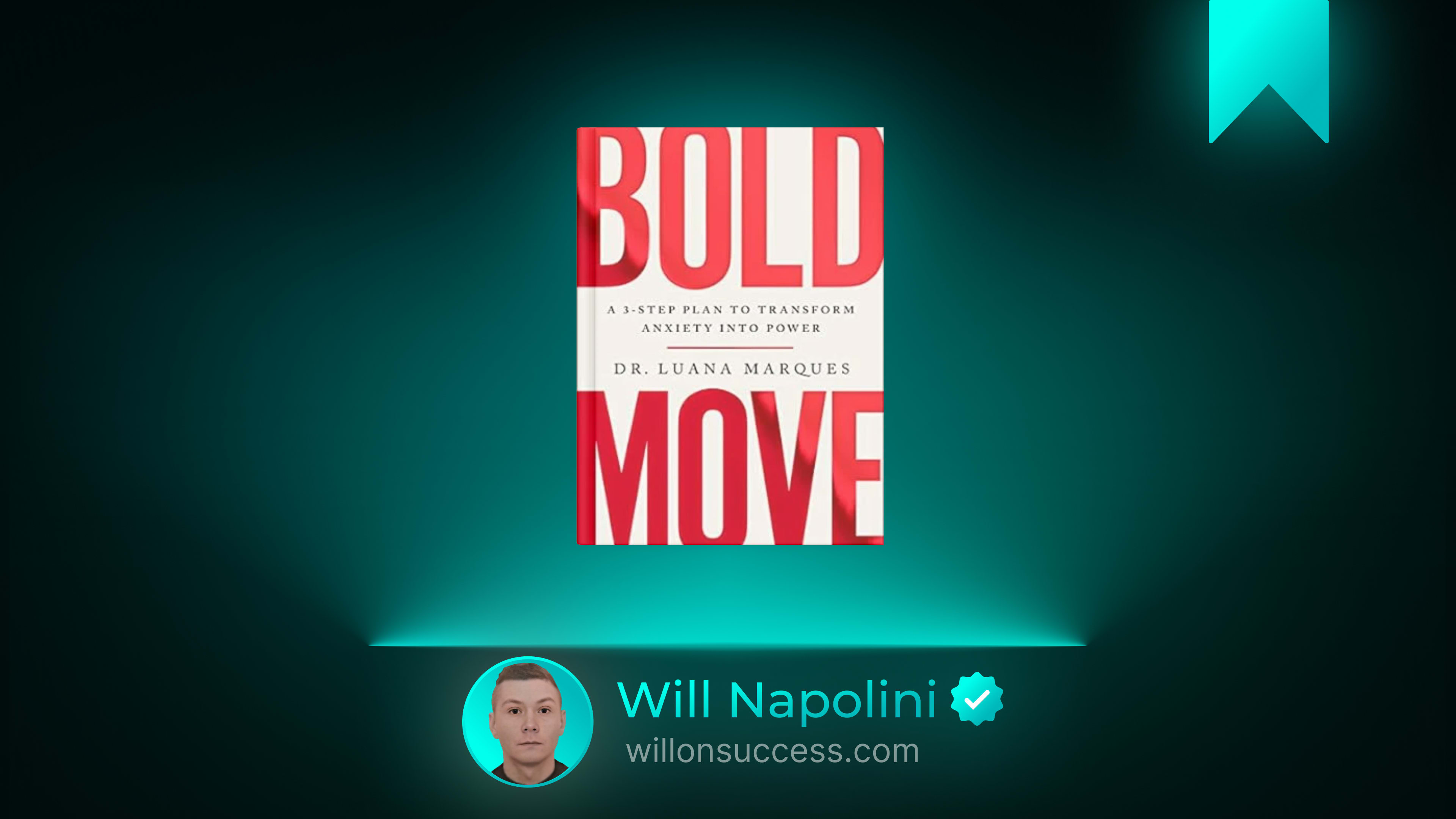
Bold Move by Luana Marques: Why Waiting to Feel Ready Is the Most Expensive Decision You Make
There is a moment I have watched people freeze inside a thousand times. It is not a dramatic moment. No one is chasing you. No alarm is ringing. You are simply sitting at your kitchen table, or staring at your phone, or lying awake at two in the morning, and you know — clearly, undeniably — what you need to do next. You need to have the conversation. You need to apply for the position. You need to leave the relationship. You need to say no. You need to begin.
And then a voice rises. Not a shout. A whisper. What if it goes wrong? What if you look foolish? What if you try and fail? What if you succeed and it is even more terrifying?
So you wait. You wait until you feel ready. You wait until the fear quiets down. You wait for a version of yourself who will not hesitate.
And the waiting becomes your life.
I want to talk to you about a book that challenged the very foundation of that waiting. Luana Marques wrote Bold Move not as a psychiatrist lecturing from a comfortable office, but as a woman who carried anxiety like a second skeleton through her own journey from Brazil to Harvard Medical School. Her central claim is both simple and radical: the feeling of readiness you are waiting for will never arrive. And you do not need it. You need something smaller, stranger, and far more powerful than the absence of fear.
You need a bold move.
The Lie Anxiety Tells You About Timing
Marques spent years studying and treating anxiety at Harvard, founding the Community Psychiatry Program for Anxiety Research and Education. But the book is not a clinical textbook. It reads more like a letter from someone who has sat in the same chair you are sitting in, who knows the exact texture of the dread, and who discovered — painfully, slowly — that the standard advice of “calm down first, then act” was keeping her stuck.
The central insight of Bold Move is this: anxiety does not function as a stop sign. It functions as a threshold. A threshold is not a wall. It is the narrow passage between where you are and where you could be. You do not wait for a doorway to disappear before walking through it. You walk through it while your hands are shaking.
Most of us, Marques argues, have built an entire architecture of avoidance around a single misunderstanding. We treat anxiety as evidence that something is wrong — that the situation is dangerous, that we are unprepared, that we should retreat and regroup. But anxiety is often not reporting danger. It is reporting significance. The things that matter most to us generate the most fear precisely because the stakes are real. If you did not care, you would not be afraid.
That reframe changes everything. Because if anxiety is a signal that something matters, then running from it means running from what matters. And the cost is not just a single missed opportunity. The cost is a slow, quiet shrinking of your entire life.
The Avoidance Trap: How Staying Safe Keeps You Stuck
One of the most important mechanisms Marques describes is what she calls the avoidance cycle, and understanding it is essential because it explains why anxiety grows stronger the more you try to protect yourself from it.
Picture it this way. Imagine you are afraid of deep water. So you stay on the shore. The relief you feel when you step back is immediate and powerful. Your nervous system learns: retreat equals safety. The next time you approach the water, the fear is slightly louder, because your brain has now confirmed that the water was genuinely something to flee from. You step back again. The relief comes again. The lesson deepens.
Over months and years, the shore becomes your entire world. Not because the water changed. Because your relationship to it was rehearsed, reinforced, and locked in.
This is what happens when you skip the difficult conversation, decline the stretch assignment, cancel the plans, silence the idea before you speak it. Each act of avoidance feels like self-protection in the moment. But it is actually a small vote for the belief that you cannot handle discomfort. And that belief, repeated enough times, becomes a prison you built brick by brick and then forgot you were holding the trowel.
Marques is careful not to dismiss this. She does not say avoidance makes you weak. She says avoidance makes sense — it is the brain doing what evolution wired it to do. The problem is that the wiring was designed for predators, not for performance reviews, not for vulnerability, not for the terrifying freedom of building a life on your own terms. The alarm system is real. But it is miscalibrated for the world you actually live in.
A Bold Move Is Not a Grand Gesture
Here is where I think many people misread the title and miss the book’s most practical teaching. A bold move is not quitting your job in a blaze of glory. It is not leaping off a cliff into the unknown. It is not some cinematic act of bravery that requires a soundtrack.
A bold move is the next right action that fear is trying to prevent you from taking.
It might be sending one email. It might be saying, “I need help.” It might be sitting with an uncomfortable feeling for ninety seconds instead of reaching for your phone. It might be letting someone see your work before it is perfect. It might be walking into the room where you do not know anyone.
The boldness is not in the size of the action. The boldness is in the direction. You moved toward the thing rather than away from it, and you did it while the fear was still in the room. You did not ask the fear to leave first. You simply did not let it drive.
Marques draws on principles rooted in cognitive-behavioral therapy and acceptance-based approaches, but she translates them into language that feels human rather than clinical. The idea is not to eliminate anxious thoughts. The idea is to change your relationship with them — to hear the voice saying you cannot and respond not with an argument, but with a step.
You do not need to win the debate in your head. You need to move your feet.
Your Values Are the Compass; Fear Is Just Weather
One of the frameworks I found most grounding in the book is the distinction between your values and your anxiety. Marques encourages readers to get clear on what actually matters to them — not what they think should matter, not what looks impressive, but what genuinely lights something up inside them or, conversely, whose absence creates a quiet, persistent ache.
Why does this matter? Because when you know what you are moving toward, fear becomes weather. Unpleasant, sometimes fierce, but not a reason to cancel the journey. You dress for it. You lean into it. You keep walking. But you do not turn around and go home just because it is raining.
Without a clear sense of your values, every anxious feeling becomes an equally valid reason to stop. You cannot distinguish between this is genuinely dangerous and I should turn back and this is significant and I am afraid because it matters. Everything feels like a reason to retreat. Everything becomes a reason to retreat.
But when you know your direction, you can feel the fear and still ask the only question that matters: Does this step take me toward the person I am trying to become, or away from her?
That question is not a thought experiment. It is a filter. Apply it to the next decision on your calendar. Apply it to the conversation you have been rehearsing for three weeks. Apply it to the project sitting in a folder labeled “someday.” The answer will not remove the fear. But it will make the fear smaller than the direction.
What Happens on the Other Side of the Move
I will not pretend that every bold move produces an immediate reward. Sometimes you speak up and the conversation is awkward. Sometimes you apply and do not get the position. Sometimes you set the boundary and the other person is angry.
But something else happens that no external outcome can take from you. You prove to yourself that you can act in the presence of fear. You collect evidence. One small data point. Then another. Then another. And over time, those data points build something that no motivational speech can manufacture: genuine self-trust.
You begin to believe, not because someone told you to, but because you watched yourself do it, that you can handle more than you assumed. The world did not end. You stumbled, and you recovered. You were uncomfortable, and you survived. You were seen, and you were still standing.
That accumulation of small evidences is the actual architecture of confidence. Not a feeling you summon. A record you build.
And here is the part that surprised me most when I first encountered this idea: the anxiety itself begins to change. Not because you defeated it. Because you stopped feeding it the one thing it needs to grow — your obedience. Every time you act despite the fear rather than because of its absence, the fear loses a small measure of authority. It still speaks. But you no longer treat it as the final word.
Where This Meets Your Ordinary Tuesday
Let me bring this out of the abstract, because that is where ideas go to die if they never touch the ground.
Suppose you have been thinking about asking for a raise. The anxiety says: They will say no. They will think you are greedy. They will question whether you deserve your role at all. The avoidance says: Maybe next quarter. Maybe after the big project. Maybe never. A bold move, in Marques’ framework, is not storming into your manager’s office with a speech. It might be writing down, on a Tuesday afternoon, the three concrete contributions you made this year. Just writing them down. Moving toward the thing while the fear is still talking.
Suppose you are in a relationship where something important has gone unsaid for months. The anxiety says: If I bring this up, everything falls apart. The avoidance says: It is probably fine. I am overreacting. I will let it go. A bold move is not an ultimatum. It is one honest sentence spoken in a calm moment. I have been carrying something and I need to share it with you. That is the threshold. You walk through it with your voice slightly unsteady.
Suppose you have an idea for a business, a book, a class, a creative project, and you have been “researching” it for two years, which is another word for hiding. The bold move is not launching the whole thing tomorrow. It is making one piece of it visible to one other human being. Showing the sketch. Sending the draft. Saying the idea out loud to someone who is not inside your head.
The size of the move is almost irrelevant. The direction is everything.
Who Will Find This Book Most Useful
Bold Move will resonate most deeply with the person who is not in crisis but is stuck. You are functioning. You are responsible. You are probably quite good at managing the logistics of your life. But there is a persistent gap between the life you are living and the life you quietly believe you are capable of, and that gap is maintained not by a lack of ability but by a well-practiced relationship with fear.
If you are someone who over-prepares, over-thinks, over-waits — who treats uncertainty as a problem to be solved before action can begin — this book was written with you in mind. It is also particularly valuable if your anxiety shows up as people-pleasing, perfectionism, or chronic indecision, because Marques addresses how those patterns are forms of avoidance dressed in respectable clothing.
If you are in acute psychiatric crisis, this book is not a substitute for professional treatment, and Marques would be the first to say so. It is a guide for the person who needs to build a different relationship with everyday fear, not a replacement for clinical care.
The book is warm, structured, and practical. It does not drown you in theory. If you prefer dense academic treatment of anxiety, you may find it lighter than you expect. But if you want a framework you can actually use on a Wednesday morning when the fear is loud and the inbox is full and you are trying to decide whether to play it safe one more time, this is the right book.
One Small Step You Can Take Before You Close This Tab
I do not want you to finish reading this and feel inspired for about forty-five minutes before the feeling fades and the old patterns reassert themselves. So here is what I would ask you to do, and I mean specifically, concretely, today.
Think of one thing you have been postponing because of a feeling you have labeled as fear, anxiety, doubt, or “not being ready yet.” It does not need to be the biggest thing. It might be a phone call. A paragraph of writing. A boundary you need to set. A question you need to ask.
Now identify the smallest possible version of that action. Not the whole thing. The first physical motion. Opening the document. Dialing the number. Writing the first sentence of the email. Standing up and walking toward the room.
Do that one small motion within the next hour. Not tomorrow. Not after you have “prepared.” Within the hour. While the hesitation is still warm. While the excuse to wait is still forming in your mind, beat it by thirty seconds. Move before the argument finishes.
You do not need to feel brave. You need to feel the fear and take the step anyway.
That is the entire teaching. Everything else is commentary.
The person you are trying to become is not waiting for you on the far side of fearlessness. She is waiting for you on the far side of the next small, trembling, ordinary step you have been putting off. She has been waiting a long time. You do not owe her a grand gesture. You owe her one honest move in her direction, made today, made before you are ready, made while your hands are still shaking.
That is enough. That has always been enough.
Take the step. The ground will meet you.