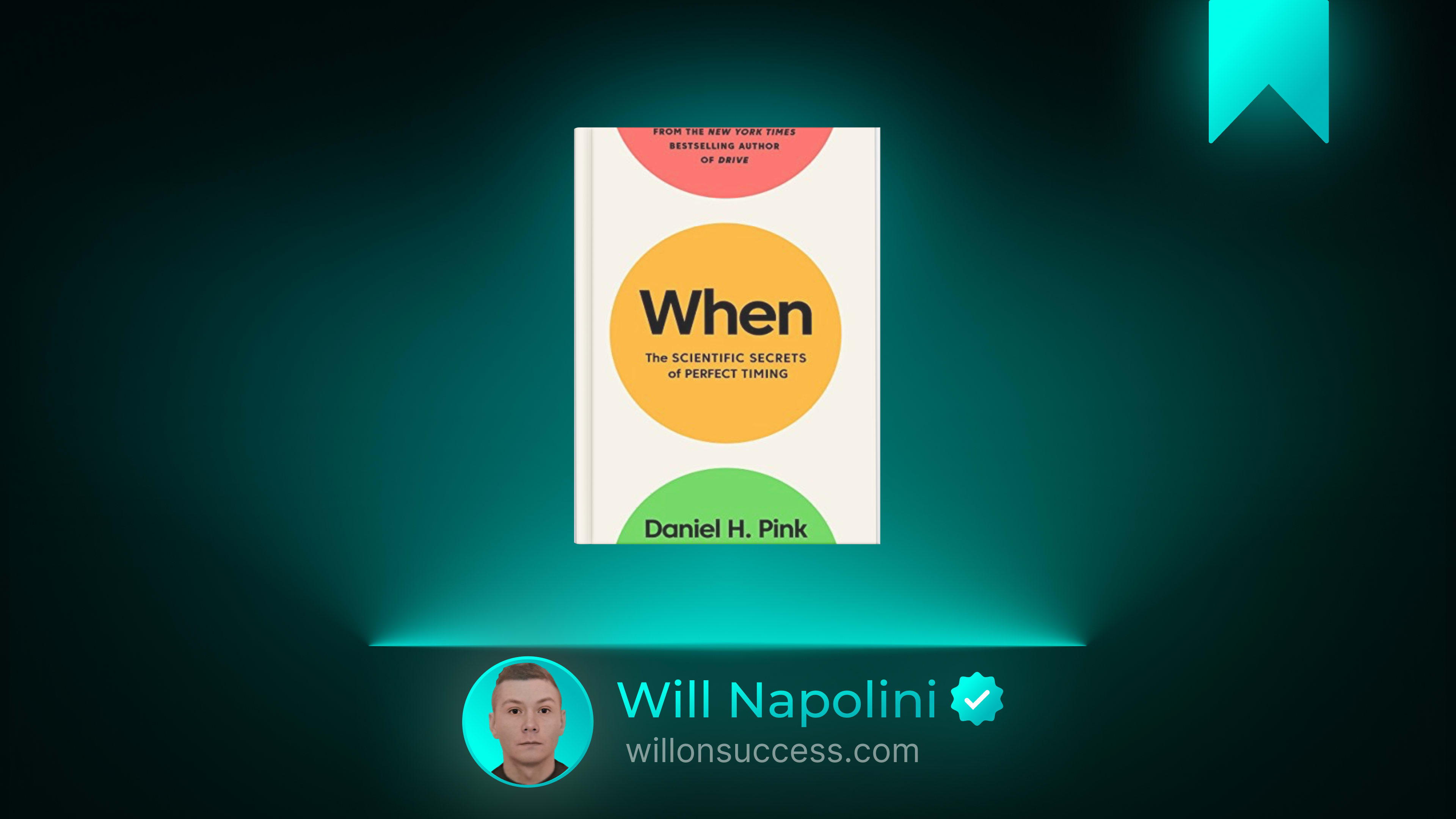
Mastering the Clock: A Mentor’s Guide to When by Daniel H. Pink
I have learned that you can do everything right and still fail, simply because you did it at the wrong time.
You may be working incredibly hard, pushing through fatigue, and forcing yourself to tackle complex problems at three in the afternoon, only to wonder why your efforts feel so futile. You might believe that your lack of progress is a character flaw. You might think you simply need more discipline, more grit, or more coffee.
If I could sit across the table from you, I would gently challenge that assumption. What if the problem is not your effort, but your timing?
We have been taught to treat time as a blank container. We assume that an hour at 9:00 AM is identical to an hour at 3:00 PM, and that our willpower should be enough to bridge any gap. But decades of research in psychology, biology, and economics reveal a different reality. Timing is not a mystical art. It is a science. And when you understand the predictable patterns of human rhythm, you can stop fighting your own biology and start collaborating with it.
This is the profound, liberating insight at the heart of When: The Scientific Secrets of Perfect Timing by Daniel H. Pink.
The Big Idea: Align Your Actions with Your Rhythms
The central thesis of this book is deceptively simple: your cognitive abilities, emotional state, and creative capacity do not remain constant throughout the day. They rise and fall in predictable patterns.
When you ignore these patterns, you waste energy. You try to do analytical work when your brain is foggy, or you attempt deep creative thinking when your mind is sharpest. But when you align your tasks with your natural rhythms—a concept scientists call the “synchrony effect”—you dramatically boost your performance and your well-being.
External results often begin with internal awareness. Before you can manage your time, you must understand your timing.
The Story of the Daily Tide
To understand how this works, we must look at the architecture of a typical day. Pink synthesizes extensive research to show that most human beings move through their waking hours in three distinct stages: a peak, a trough, and a rebound.
Imagine the ocean tide. In the morning, the water rises. For most people, this is the peak. Vigilance is high, mood is positive, and analytical thinking is sharp. This is the time to tackle the hardest, most logical problems.
Then, the tide recedes. This is the trough, typically hitting in the early to mid-afternoon. Mood dips, vigilance drops, and the brain’s executive function slows down. This is not a personal failure; it is a biological reality.
Finally, the tide rolls back in. This is the rebound, usually occurring in the late afternoon or early evening. Mood improves, but the rigid, analytical guard of the morning is relaxed. This relaxed state is actually the perfect environment for creative insight, brainstorming, and making connections between seemingly unrelated ideas.
Understanding this rhythm changes everything. It means that struggling to write a complex report at 2:30 PM is not a sign of weakness. It is a sign that you are asking your brain to swim against the tide.
The Major Principles
1. Know Your Chronotype and Respect the Synchrony Effect Not everyone experiences the peak-trough-rebound pattern in the exact same way. Pink categorizes people into three broad chronotypes: Larks (early risers), Owls (night owls), and the vast majority of us, “Third Birds,” who fall somewhere in the middle.
Larks peak early, trough early, and rebound early. Owls have a reversed pattern, often hitting their analytical peak in the evening. Third birds follow the standard pattern described above.
The principle here is alignment. If you are a Third Bird, do not schedule your most demanding analytical work for the afternoon trough. Save that time for administrative tasks, routine emails, or a walk. Conversely, if you are an Owl, do not force yourself to do your deepest thinking at 8:00 AM. Protect your evening hours for the work that requires your sharpest mind. You cannot outsmart your biology, but you can certainly collaborate with it.
2. The Midpoint is a Pivot, Not a Plateau We often think of progress as a steady, linear climb. But research shows that human motivation behaves differently. When we begin a project, we are energized. But as we reach the exact middle of a timeline—whether it is a project, a school semester, or even a decade of life—we frequently experience a slump.
However, this midpoint also triggers what researchers call the “uh-oh effect.” It is a mental siren that alerts us that half our time is gone. This injects a healthy dose of stress that can either paralyze us or, if managed correctly, revive our motivation and reshape our strategy.
The middle of the journey is not where you coast; it is where you course-correct. When you feel that mid-project drag, do not interpret it as a sign that the project is failing. Interpret it as a natural psychological signal to tighten your focus, cut unnecessary scope, and push toward the finish line.
3. Endings Dictate Memory (The Peak-End Rule) How do we remember an experience? We do not remember it by averaging every single moment. Instead, our brains rely on the “peak-end rule.” We assign the greatest weight to two specific moments: the most intense point of the experience (the peak) and how it concludes (the end).
This has profound implications for how we live and work. If you are leading a team, running a meeting, or even planning a family vacation, the final moments matter disproportionately. A meeting that drags on with no clear conclusion will be remembered as a waste of time, even if the first hour was highly productive.
Growth before achievement means we must be intentional about how we close things. A deliberate, positive ending can rescue an otherwise mediocre experience and leave people feeling valued and inspired.
4. Rest is a Strategic Weapon, Not a Reward One of the most damaging myths of modern work is that taking a break is a sign of laziness, or a reward you only earn after you have finished your work. Pink’s research demolishes this idea. Breaks are not a deviation from the path to success; they are a prerequisite for it.
The science of breaks reveals five clear principles:
- Something beats nothing: Even a brief pause is better than pushing through fatigue.
- Moving beats stationary: A short walk is more restorative than scrolling on your phone.
- Social beats solo: Talking to a colleague or friend replenishes energy better than isolating yourself.
- Outside beats inside: Nature and daylight reset our circadian rhythms.
- Fully detached beats semi-detached: Leaving your phone at your desk while you walk is far more effective than taking your phone with you.
Why It Matters on an Ordinary Tuesday
You might be thinking that this sounds like a luxury for people with complete control over their schedules. What if you have kids, demanding bosses, or unpredictable emergencies?
I understand that reality is messy. Life rarely adheres perfectly to a textbook rhythm. But the goal here is not robotic optimization; it is damage reduction and strategic advantage.
On an ordinary Tuesday, applying these principles looks like this: Instead of forcing yourself to power through a complex budget spreadsheet at 2:30 PM while feeling foggy and frustrated, you recognize the trough. You step away for a ten-minute walk outside. You return at 3:00 PM to handle routine, low-stakes emails. You save the heavy analytical lifting for 9:30 AM the next day, when your mind is naturally sharper.
You stop borrowing trouble from your own biology. You stop judging your worth by your afternoon sluggishness. You begin to work with your design, rather than against it.
Practical Application: Your Next Steps
Understanding the philosophy is only the first step. Action before intention. Here is how you can translate these concepts into tangible behavior this week.
1. Audit Your Chronotype and Task Alignment For three days, track your energy levels on a simple scale of 1 to 10 every two hours. Notice when you feel sharpest and when you feel sluggish. Identify your chronotype. Then, look at your calendar for next week. Move at least one major analytical task into your identified “peak” window, and move one low-stakes administrative task into your “trough” window.
2. Engineer a Better Break Tomorrow, when you feel the afternoon slump approaching, do not reach for another cup of coffee or open social media. Instead, commit to a “detached moving break.” Set a timer for fifteen minutes. Leave your phone and computer behind. Walk outside, even if it is just around the block. Notice the shift in your mental clarity when you return.
3. Harness the Power of a Temporal Landmark If you have been procrastinating on a goal, use the science of beginnings to “start again.” Researchers have found that “temporal landmarks”—like the start of a new week, a birthday, or even the first day of a new month—psychologically separate our past failures from our present potential. Do not wait for January 1st. Declare tomorrow morning as a fresh starting line. Write down one specific action you will take to begin again.
4. Design a Deliberate Ending Think of a recurring meeting or a daily routine that often feels unsatisfying. Apply the peak-end rule. For the next week, intentionally design the final five minutes of that experience. Summarize the wins, clearly state the next steps, or simply express genuine gratitude to the people involved. Observe how this small shift changes the overall memory of the event.
Who Should Read This Book
This book is a vital resource for anyone who feels chronically overwhelmed, burnt out, or frustrated by their own perceived lack of discipline. It is incredibly useful for students, project managers, parents, and creatives who want to work smarter, not just harder. It is for the person who is tired of grinding their gears and wants to find a more sustainable rhythm.
However, I will be honest with you: this book is not for everyone. If you are looking for a magic bullet that promises you can sleep four hours a night and still be a CEO, you will be disappointed. This book requires you to look honestly at your habits and make structural changes to your day. It also relies on data and research, so if you strongly prefer purely intuitive or spiritual approaches to time management, the scientific framing may feel too clinical.
But if you are willing to look at the evidence and experiment with your own life, this book will give you the tools to reclaim your time.
One Small Step
If you take only one thing away from this today, let it be this: You do not need more willpower. You need a schedule that respects your humanity.
Right now, do not try to overhaul your entire life. Just look at tomorrow. Identify the single most important, analytically demanding task you need to accomplish.
Now, look at your calendar. When is your natural peak? Move that task to that time block, and protect it fiercely.
A small decision becomes a direction, and a direction repeated long enough becomes a life. Stop fighting the tide. Learn to sail with it.