Surviving Your Own Marsh: Life Lessons from Where the Crawdads Sing
If you have ever felt like an outsider looking in—watching the rest of the world move forward while you feel stuck in the mud of your own circumstances—I want you to know you are not alone.
We all have seasons where we feel abandoned, misunderstood, or entirely cut off from the people who are supposed to support us. You may be going through a period of profound loneliness right now. You might be navigating a career setback, the end of a significant relationship, or a transition that has left you feeling entirely unmoored. The silence in your life may feel deafening, and the judgment of others may feel heavy.
I have sat across the table from many people who felt exactly as you do now. They believed that because they were isolated, they were somehow broken. They thought that because their environment was harsh, their future had to be bleak.
But I have learned that the places where we feel most stranded are often the very places where we develop our deepest roots.
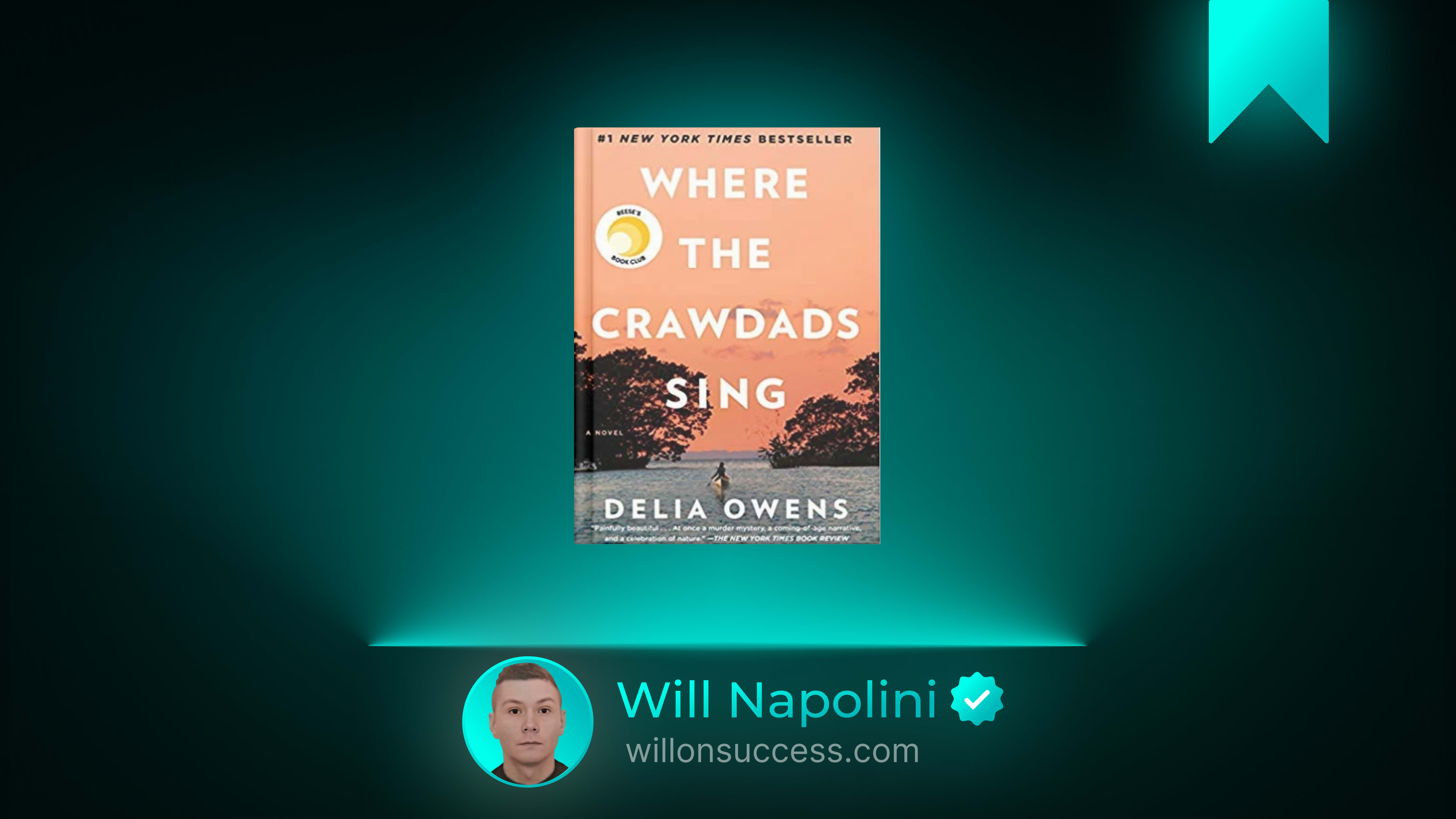
There is a brilliant novel that captures this exact journey. It is Where the Crawdads Sing by Delia Owens. While it is technically a work of fiction, weaving a coming-of-age story with a murder mystery, its thematic core offers some of the most profound lessons on resilience, observation, and the human spirit I have ever encountered.
This is not just a story about a girl in a marsh. It is a masterclass in how to survive your own wild, untamed seasons.
The Big Idea: The Marsh Is Not a Punishment
The central thesis of this narrative is deceptively simple, yet it requires a massive shift in how you view your lowest moments. The big idea is this: Isolation is not inherently a punishment; it is an environment. And in any environment, you can either be destroyed, or you can learn to read the landscape and thrive.
When we find ourselves in a “marsh”—a period of life marked by lack, loneliness, or hardship—our default instinct is to panic. We look for a way out. We beg for rescue. We resent the mud, the humidity, and the mosquitoes. We focus entirely on what we lack compared to the people on the solid ground.
But the story of Kya Clark, the “Marsh Girl,” teaches us a different approach. She does not survive by waiting for the tide to recede. She survives by learning the exact rhythm of the tide. She stops fighting the reality of her environment and starts studying it.
External results always begin with internal adaptation. Before you can change your circumstances, you must stop resenting them and start observing them.
The Story of the Marsh Girl
To understand why this shift in perspective matters, we have to look at Kya’s reality.
Abandoned one by one by her mother, her siblings, and eventually her abusive father, Kya is left entirely alone in a shack in the North Carolina coastal marsh in the 1950s. She is just a child. The local townspeople view her with a mixture of pity, disgust, and deep prejudice. They call her the “Marsh Girl.” They assume she is uneducated, feral, and incapable of surviving the winter.
By all conventional metrics, Kya’s life is a tragedy. She has no safety net. She has no formal education. She has no social standing.
But Kya does not curl up and wait to perish. Instead, she turns her attention outward. She learns to navigate the skiff through the muddy creeks. She learns to harvest oysters and trade them for gasoline and grits. She teaches herself to read using an old children’s book. And, most importantly, she becomes a keen observer of the natural world. She studies the mating dances of the fireflies, the migration of the gulls, and the complex ecosystem of the wetlands.
She transforms her isolation into a sanctuary. The marsh stops being a prison and becomes her teacher.
Stop Resenting the Mud
The first major principle to master is understanding the difference between isolation and solitude.
Society often conflates the two. We assume that being alone is a failure of socialization. The townspeople in the novel look at Kya and see a tragic, lonely figure. They project their own discomfort onto her.
But Kya experiences her time in the marsh differently. She is physically isolated from the town, but she is profoundly connected to the natural world. She is never truly alone because she is in constant relationship with the ecosystem around her.
When you are going through a difficult season, you will feel isolated. Friends may drift away. Colleagues may not understand your struggle. The silence can feel like a rejection.
But here is what I have discovered: Isolation is what happens to you; solitude is what you make of it.
If you spend your isolated seasons resenting the mud, you will only sink deeper. But if you can shift your perspective and embrace the solitude, you can use the quiet to hear your own thoughts, to observe your own patterns, and to build a foundation that does not rely on the applause of others. You do not need a crowded room to know your own worth.
Observation Is the First Step to Understanding
The second principle is the power of observation.
Kya survives because she watches. She does not just look at the marsh; she studies it. She notices the subtle changes in the water, the behavior of the animals, the shifting of the seasons. This deep, mindful observation allows her to predict the weather, find food, and stay safe.
In our own lives, we often move through our days on autopilot, reacting emotionally to every trigger. When we face a problem, we immediately try to fix it, or we immediately complain about it. We rarely stop to simply observe it.
Observation requires you to detach your ego from the situation. It requires you to look at your life as a scientist looks at an ecosystem.
When you feel stuck, stop trying to force a solution. Step back and observe. What patterns are repeating in your life? What triggers your anxiety? What environments drain your energy, and which ones restore it?
You cannot change a pattern you refuse to observe. When you start paying attention to the details of your own life without immediate judgment, you gain the clarity needed to navigate out of the swamp.
You Cannot Control the Tide, But You Can Build a Boat
The third principle is taking radical responsibility for your own survival.
It would have been incredibly easy for Kya to blame her family for leaving her. It would have been easy to blame the townspeople for their prejudice. It would have been easy to sit in the shack and wait for someone to come save her.
But the marsh does not care about your excuses. The tide comes in whether you are ready or not.
Kya realizes early on that no one is coming to rescue her. If she wants to eat, she has to learn to fish. If she wants to keep the skiff running, she has to learn to trade. If she wants to understand the world, she has to convince a local boy, Tate, to teach her to read.
This is the essence of responsibility before excuses. Circumstances matter. It is deeply unfair that Kya was abandoned. But focusing on the unfairness of her situation would not have filled her stomach.
In your own life, you may be facing circumstances that are entirely unfair. You may have been dealt a terrible hand by your family, your economy, or your health. Those facts are valid. But they are not useful if they keep you paralyzed.
Waiting for a rescue boat often guarantees you will drown; building your own raft guarantees you will float.
What is one small thing you can control today? You cannot control the job market, but you can control how many new skills you learn this week. You cannot control how someone else treats you, but you can control how you respond. Focus entirely on the wood, the rope, and the tools you have in front of you. Build your boat.
The Danger of the Stories We Tell
The final principle is recognizing the danger of the stories we accept about ourselves and others.
The town of Barkley Cove has a very specific story about Kya. They believe she is wild, untrustworthy, and dangerous. Because they believe this story, they treat her with suspicion and cruelty. And because she is treated this way, she initially withdraws further, inadvertently reinforcing their beliefs.
When we are isolated, we are highly vulnerable to the narratives others project onto us. If your boss tells you that you are not leadership material, you might start to believe it. If society tells you that you are too old, too young, or too inexperienced to succeed, you might internalize that limitation.
Kya’s journey is ultimately about realizing that the opinions of people who do not understand her landscape are irrelevant to her survival. She eventually stops caring about the town’s judgment. She finds her own identity, her own love, and her own peace, entirely independent of their approval.
You must fiercely guard the story you tell about yourself. Do not let the prejudices, limitations, or misunderstandings of others become your internal monologue. You are the author of your own life. If the current chapter is difficult, write the next one with courage, not with the ink of someone else’s doubts.
Why It Matters on an Ordinary Tuesday
You might be thinking that this sounds beautiful in the context of a novel, but the reality of modern life is much more demanding. You have bills to pay, emails to answer, and a reputation to maintain. You cannot just retreat to a marsh and study fireflies.
I understand that urgency. The modern world is loud, demanding, and deeply disconnected from nature.
But the principles in this story matter because they protect you from the long-term cost of short-term reactivity.
On an ordinary Tuesday, applying these principles looks like this: When you feel overwhelmed by the noise of your inbox and the demands of your colleagues, you do not react with panic. Instead, you practice observation. You step away from the screen for ten minutes. You look out the window. You breathe. You observe your own rising heart rate and choose not to let it dictate your actions.
When you face a setback at work, you do not immediately tell yourself the story that you are a failure. You take responsibility for the mistake, extract the lesson, and start building your boat for the next opportunity.
You bring the quiet resilience of the marsh into the chaos of the city.
Practical Application: Your Next Steps
Understanding the philosophy is only the first step. Action before intention. Here is how you can put this into practice immediately.
1. Reframe Your Solitude The next time you find yourself alone on a Friday night, or going through a period of social isolation, consciously change the narrative. Do not sit in the dark feeling sorry for yourself. Put on your shoes and go for a walk. Go to a park, a botanical garden, or just a quiet street. Observe the trees, the birds, the architecture. Shift your focus from your internal loneliness to the external world. Let the environment remind you that you are part of something much larger than your current mood.
2. Conduct an Observation Audit Take a piece of paper and draw a line down the middle. On the left side, write down the things in your life that consistently drain your energy (specific habits, certain types of conversations, particular environments). On the right side, write down the things that restore your energy. Do not judge yourself for what is on the list. Just observe it. Once you have the data, make one small adjustment this week to reduce a drain and increase a restoration.
3. Build Your Raft Identify one area of your life where you have been waiting for rescue. Maybe you are waiting for a mentor to notice you, or for a partner to fix your happiness, or for the perfect opportunity to fall into your lap. Stop waiting. Take one concrete action today to build your own raft. Send the email. Read the book. Take the class. Sign up for the workshop. Do the work yourself.
Who Should Read This Book
This novel is a masterpiece for anyone who has ever felt like an outsider, anyone who has experienced profound loss, and anyone who finds peace in the natural world. It is a beautiful reminder that healing is possible, even after the deepest betrayals.
However, I will be honest with you about what this book is. It is not a light, breezy read. It deals heavily with themes of child abandonment, domestic abuse, prejudice, and murder. The pacing is deliberate and atmospheric, much like the marsh itself.
If you are looking for a fast-paced, purely uplifting motivational book, this is not it. But if you are willing to sit with the darkness, you will find that the light in this story is all the more brilliant because of the shadows that surround it. It is a book that stays with you long after you turn the final page.
One Small Step
If you take only one thing away from this today, let it be this: You do not need to be rescued to be whole.
Right now, close your laptop or put down your phone. Step outside. It does not matter if it is raining, cold, or dark. Just step outside.
Find one living thing—a tree, a patch of moss, a bird, or even a weed pushing through the concrete. Look at it closely. Observe how it has adapted to its environment. Observe how it continues to grow despite the conditions.
Take a deep breath. Let the quiet of the natural world remind you that you, too, are built to survive. You, too, are built to grow.
The marsh did not pity Kya; it simply provided the space for her to become who she was meant to be. Your environment does not owe you comfort, but it will always give you exactly what you need to grow if you are willing to pay attention.