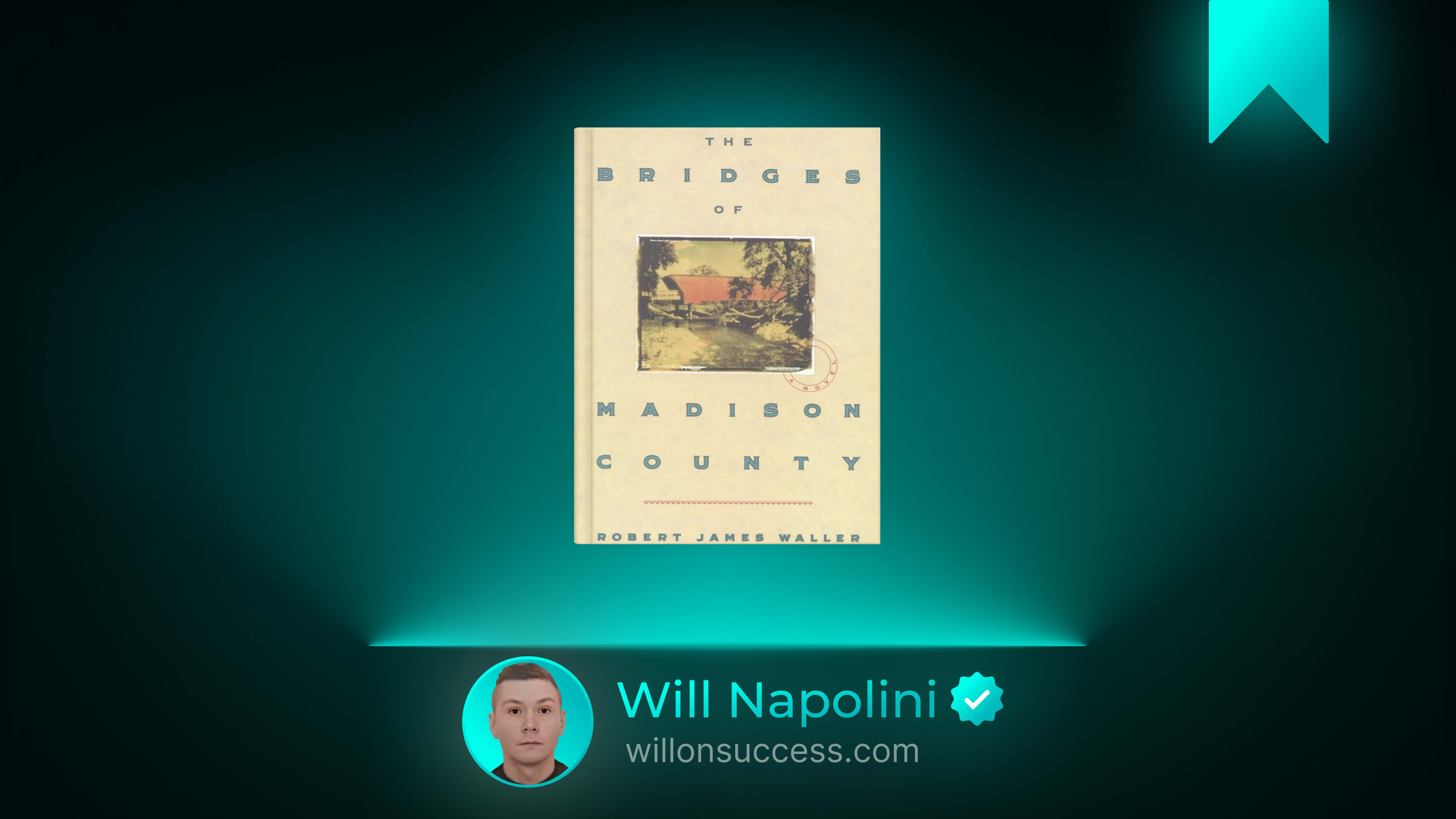
The Bridges of Madison County by Robert James Waller: What Four Days Can Teach You About the Choices That Quietly Define a Life
There is a moment in this novel that I have thought about for years. A woman sits in the front seat of a pickup truck beside her husband. It is raining. Through the windshield, she can see another truck parked at the next intersection. In that truck is the man she loves. The man she has spent four days with. The man who has asked her to leave everything and go with him.
The light turns green. The truck in front does not move. Her husband honks.
And her hand moves toward the door handle.
She does not open the door. The light changes. The trucks pull apart. And she never sees him again.
That moment—hand on the handle, the whole life she might have lived balanced on a hinge of rain and hesitation—is the entire novel compressed into three seconds. Robert James Waller published The Bridges of Madison County in 1992, and millions of readers picked it up expecting a romance. What they found was something harder and more honest than that. A story about the architecture of choice. About the lives we build and the lives we bury. About the terrible, beautiful weight of deciding who you will be when no one is watching except yourself.
If you have ever stood at a crossroads—real or metaphorical—and felt the pull of two directions at once, this book was written for you. Let me show you what it taught me.
The Big Idea: A Life Is Not Built in Years. It Is Built in Moments.
Waller’s novel is set in the summer of 1965 in Madison County, Iowa. Francesca Johnson is an Italian war bride living on a farm with her husband Richard and their two teenage children. Her days are structured around meals, chores, and the quiet machinery of rural domesticity. She was once a teacher. She once lived in Naples. She once had dreams that looked very different from the life she now lives.
Robert Kincaid is a photographer for National Geographic. He is fifty-two, solitary, weathered, and rootless. He drives into Madison County to photograph its covered bridges for a magazine assignment. He stops at Francesca’s farmhouse to ask for directions to the Roseman Bridge.
Her family has left for a four-day trip to the Illinois State Fair. She is alone.
And in those four days, two people who have lived careful, contained lives collide with a force neither expected. They talk. They walk. They cook dinner. They look at each other with the kind of attention that most people go decades without receiving. And they fall in love. Not gradually. Not safely. Completely.
But here is the idea Waller is pressing into your chest with both hands: the four days do not erase the twenty years. And the twenty years do not erase the four days. Both are real. Both are true. And Francesca must decide which one she will build the rest of her life around.
She chooses to stay. She chooses her husband, her children, the farm, the life she built. Not because she does not love Robert. Not because the four days were less real. But because she cannot bring herself to detonate the lives of the people who depend on her.
And that choice—the choice to stay, to carry the love in silence, to let it live only in the private rooms of her memory—is not a failure of courage. It is its own kind of courage. The quiet, grinding, uncelebrated kind.
The Story That Holds the Whole Book
I want to tell you about the structure of this novel, because Waller made a deliberate choice that deepens everything.
The story is not told as it happens. It is told years later, after Francesca has died. Her two adult children, Michael and Carolyn, return to the farm to settle her estate. They find journals. Letters. Photographs. And slowly, page by page, they discover that the mother they thought they knew—the woman who made pot roasts and worried about the weather and seemed, to them, fairly ordinary—lived an interior life of staggering depth.
She loved a man they never met. She carried that love for decades. She never spoke of it. She never left. She simply lived beside the memory of those four days like a woman living beside a locked room in her own house, pressing her palm against the door sometimes, in the dark, when no one was looking.
The children are stunned. And then, slowly, they are changed. Because seeing their mother as a full, complex, desiring human being—rather than the fixed role she occupied in their lives—forces them to see themselves differently too.
This is what Waller understands: the people closest to us are often the most invisible to us. We see the function they serve. The mother. The father. The spouse. The steady one. The reliable one. And we mistake the function for the whole person. We assume that because their life looks settled, it is simple. We assume that because they chose us, there was nothing else to choose.
There was almost always something else.
The Crossroads Moment: How a Decision Becomes a Direction
Let me return to that scene in the rain. Francesca’s hand on the door handle. Robert’s truck in front of her. The wipers going. Her husband beside her, unaware.
Waller stretches that moment across several pages. He slows time down. He lets you feel the gravity of it. Because he knows what Francesca knows: that this is not just a decision about one afternoon. It is a decision about the shape of the rest of her life. Every life she might live branches from this single hinge.
If she opens the door, she becomes one person. If she keeps her hand still, she becomes another. And the person she does not become does not disappear. She carries that unlived life inside her, like a stone in her chest, for the rest of her days.
I think about this when I consider the choices I have made. Not the dramatic ones. The quiet ones. The morning I decided to stay in a difficult conversation instead of walking out. The afternoon I chose the steady path over the exciting one. The evening I said no to something I wanted because someone needed me to say yes to something they needed more.
A small decision becomes a direction, and a direction repeated long enough becomes a life. But the road not taken does not vanish. It runs parallel to you, always visible out of the corner of your eye. And part of maturity—part of the honest, unglamorous work of growing up—is learning to look at that parallel road without hatred, without bitterness, and without the exhausting fantasy that you could have lived it perfectly.
You chose. The choice cost you something. And the cost was real. You are allowed to grieve it. You are allowed to grieve it and still believe you chose well. Both can be true at once.
Being Truly Seen Changes Everything
There is a quality to the four days Francesca and Robert share that I find almost unbearable in its tenderness. It is not primarily physical. It is not primarily romantic, in the conventional sense. It is the quality of attention.
Robert looks at Francesca. Not through her. Not past her. Not as a function—wife, mother, cook, caretaker. He looks at her the way a photographer looks at a landscape: searching for the light in it. Asking what is true about it. What is hidden. What is beautiful and particular and unrepeatable.
And Francesca, who has spent twenty years being useful, being steady, being the person who holds the household together while no one notices the holding, feels herself seen for the first time in a very long time.
This is what I have learned, and what Waller dramatizes with such quiet force: most people are not starving for grand romance. They are starving for attention. For the experience of being looked at carefully by another person and hearing, without words, I notice you. You are not invisible. Your inner life matters.
You do not need a photographer from National Geographic to offer this. You can offer it. To your partner across the dinner table, putting your phone down and asking a question you have never asked before. To your aging parent, asking about a year in their life you know nothing about. To your colleague who has been quiet in meetings, asking them afterward what they think. To yourself, in the mirror, in the journal, in the honest five minutes before sleep where you ask, What do I actually want? Not what do I owe. What do I want?
Attention is the cheapest and most expensive gift a person can give. It costs nothing. And it can change the entire weather of someone’s inner life.
Choosing to Stay Is Its Own Kind of Bravery
I want to be careful here, because I do not want to turn Francesca’s decision into a moral lesson. I do not want to say, She stayed, and that was the right thing, and you should always stay too. Life is more complicated than that. There are situations where leaving is the brave thing. There are commitments that should be broken. There are lives that are slowly suffocating a person, and walking away is not selfishness but survival.
But Waller is writing about a specific kind of choice. The choice where both paths are valid. Where leaving would not be escaping cruelty but dismantling something good. Where the people who would be hurt are innocent—children, a decent spouse, a community. And the person choosing to stay is not a martyr. She is not noble in a performative way. She is simply a woman who looked at the cost of leaving, looked at the cost of staying, and decided she could carry the second cost more honestly than the first.
And then she carries it. For decades. In silence. Without resentment becoming her identity. Without making her family pay for the life she gave up.
That is a kind of bravery that does not get celebrated. It does not make for a good story at a dinner party. No one writes songs about the Tuesday you chose to stay when you could have gone. No one hands you a trophy for the quiet grief you folded into the laundry and never mentioned.
But it is real. And if you have made that kind of choice—if you have chosen the harder, steadier, less glamorous path because someone depended on you, because you made a promise, because you decided that the life you built was worth more than the life you imagined—I want you to know: your choice is not a consolation prize. It is not a failure of imagination. It is a life. A full one. And the fact that it cost you something does not make it less.
The Stories We Leave Behind
The novel’s frame story—Francesca’s children discovering her journals after her death—carries one more lesson I find essential.
We curate ourselves for the people we love. We show them the version that is useful, that makes sense in the story of the family. And we lock away the rest. The longings. The doubts. The alternate selves we almost became.
Francesca does not tell her children while she is alive. Perhaps she is protecting them. Perhaps she is protecting herself. Perhaps some truths can only be spoken when the speaker is beyond the reach of consequence.
But she writes them down. She leaves the journals. She trusts that someday, someone will open the door to that locked room and find her there. Whole. Complicated. Not just the mother. Not just the wife. A woman who stood at a crossroads in the rain and felt the whole weight of two lives pressing against her chest.
If you are carrying a story you have never told—if there is a chapter of your life, a longing, a grief, a love, a decision, that you have folded up and put in a drawer—I would gently ask you to consider writing it down. Not necessarily to publish. Not necessarily to hand it to someone tomorrow. But to put it into language. To say, This was real. This happened to me. This mattered.
You do not owe anyone the performance of a simple life. You are allowed to be complicated. You are allowed to have loved the road you did not take and still be grateful for the road you did.
Who Should Read This Book
Read this book if you have ever felt that your interior life is larger than the life you are living on the outside. If you have ever made a choice that cost you something, and you carry that cost quietly, without complaint. If you believe that love is not only the grand, cinematic kind but also the quiet, daily, unglamorous kind that shows up in the making of meals and the keeping of promises.
Read it if you appreciate slow, sensory prose. Waller writes landscapes the way Robert Kincaid photographs them—carefully, with attention to light and weather and the particular quality of a place. The pacing is unhurried. The novel is short, but it asks you to sit with feeling rather than racing toward plot.
I will be honest: if you are looking for a fast-paced thriller, or if the premise of a brief extramarital affair makes you uncomfortable regardless of how it is handled, this may not be the book for you. Waller does not judge Francesca, but he also does not pretend the situation is simple. The emotional territory is mature, nuanced, and sometimes painful.
But if you let it in, it will stay with you. It will change the way you look at the quiet people in your life. The ones you assume are settled. The ones you assume have no locked rooms.
One Small Step
Here is what I would ask of you today. One thing. Small. Specific.
Think of one person in your life who has been steady for a long time. A parent. A spouse. A colleague who has been in the same role for years. Someone whose reliability has become so familiar that you have stopped being curious about them.
This week, ask them one question about their interior life. Not about their tasks. Not about what they need from you. About them.
What did you want to be when you were twenty? Is there a place you have always wanted to see? What is something you loved doing that you stopped?
Then listen. Do not fix. Do not plan. Just listen.
Because the person sitting across from you is not only the role they play in your life. They are a whole landscape. With weather. With locked rooms. With roads they did not take, running parallel to the one they walk beside you.
You cannot know every road another person did not walk. But you can look at the one they did walk, and the one you are walking, and choose to be present on it. Fully. Without resentment. Without the exhausting fantasy of a different life.
The bridge you cross today is the one that is real. Cross it slowly. Look at the light. Remember who is walking beside you.
That is enough. That has always been enough.