The Bravest Words You Can Say: What a Bedtime Story Teaches About Love
There is a sentence that most of us never say. Not because we do not mean it. Not because we do not feel it. But because saying it out loud makes us vulnerable in a way that terrifies us.
Three words. Maybe four. The kind of words a child says without thinking and an adult rehearses in the shower, in the car, in the quiet minutes before falling asleep — hoping someone will hear them, and terrified they actually will.
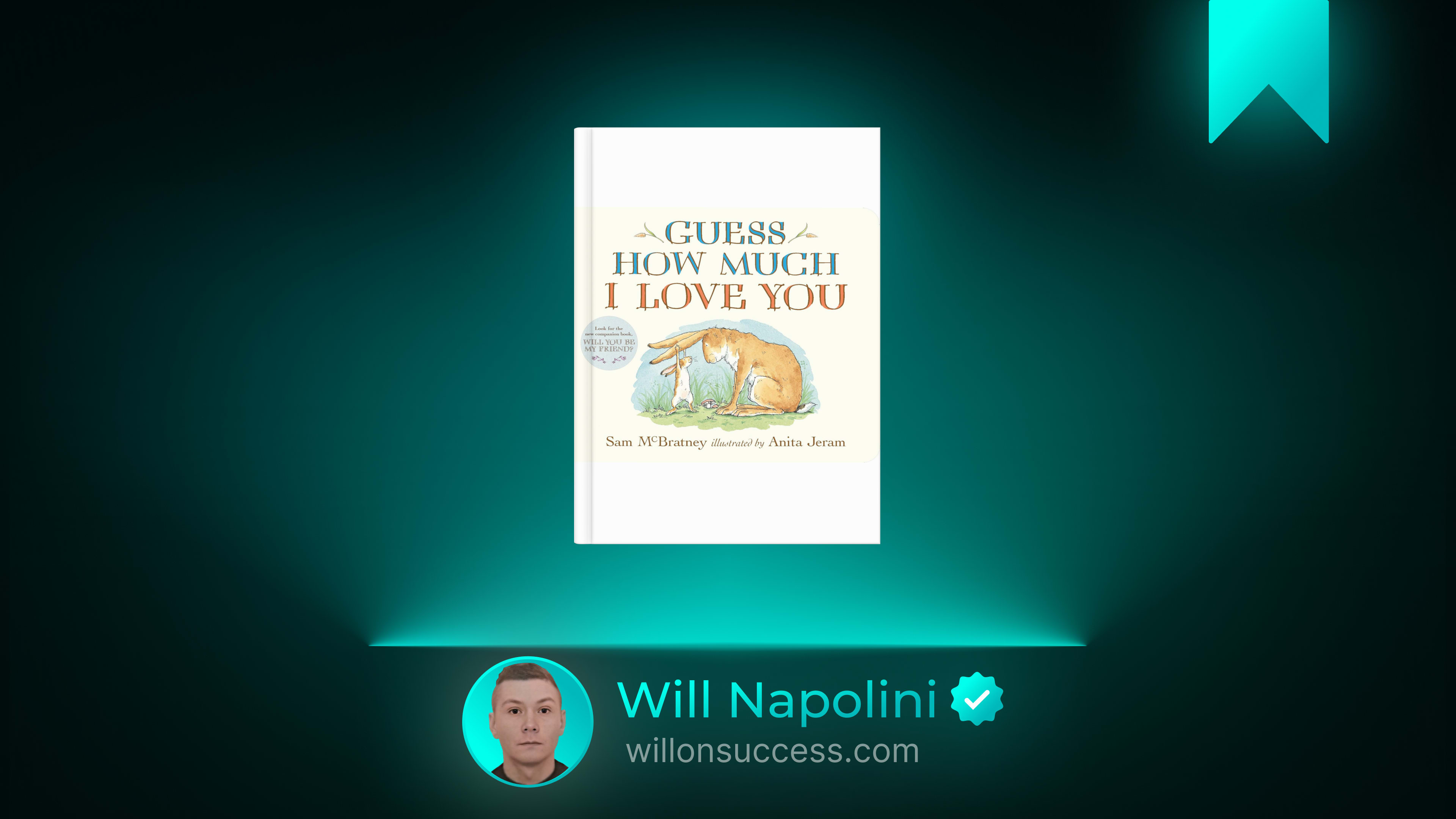
I want to talk to you about a picture book published in 1994 that has sold over fifty million copies around the world. It contains no plot twist. No villain. No moral delivered in bold letters at the end. Just two hares, a stretch of open meadow, and a question that changes everything:
Guess how much I love you.
If you think this is just a bedtime story for toddlers, I understand. I thought so too, the first time. But then I read it slowly. And I realized it is one of the most honest books ever written about what it costs to love someone, and what it gives back.
The Big Idea
Sam McBratney’s Guess How Much I Love You is, on the surface, a conversation between a young hare and an older hare about the size of their love. But beneath that simplicity lives a profound truth: love that is never spoken is love that slowly disappears. And love that is spoken — clumsily, imperfectly, with outstretched arms and stretching legs — becomes something neither person could have built alone.
The book is not really about measurement. It is about the attempt. The willingness to reach, to stretch, to say the words even though they will never be large enough. It teaches that the bravest thing you can do is not conquer a mountain or build an empire. It is look at someone you love and try, with your whole limited vocabulary, to tell them what they mean to you.
The Story and the Concept
The book opens simply. Little Nutbrown Hare is getting ready for bed. He looks up at Big Nutbrown Hare and asks the question that drives the entire story:
“Guess how much I love you.”
Big Nutbrown Hare does not dismiss the question. He does not say, “I’m busy.” He does not say, “You know I love you, let’s go to sleep.” He stops. He looks. He listens. And he says, “Well, I don’t think I could guess that much.”
So Little Nutbrown Hare begins to demonstrate. He stretches his arms out wide. “This much,” he says. Big Nutbrown Hare stretches his arms wider. “I love you this much,” he replies.
Little Nutbrown Hare reaches his paws up as high as he can. “I love you this high.” Big Nutbrown Hare leaps up, reaching far higher. “I love you this high.”
The little hare hops, tumbles, stretches, and reaches in every direction he can think of. Each time, Big Nutbrown Hare matches him and exceeds him — not to compete, but to show that love has no ceiling. That no matter how far the child reaches, the parent’s love stretches further still.
Finally, as the evening settles and Little Nutbrown Hare’s eyes grow heavy, he whispers the biggest measurement he can imagine: “I love you right up to the moon.”
Big Nutbrown Hare lays him down. He kisses him goodnight. And then, softly, he whispers the words that have made millions of readers catch their breath:
“I love you right up to the moon — and back.”
That is the entire book. No climax. No resolution beyond the quiet of a child falling asleep in the certainty of being loved.
And yet it is enough. It has been enough for thirty years. Because it speaks to something we all hunger for but rarely admit: the need to be told, plainly and without reservation, that we are loved beyond measure.
The Courage to Reach First
Notice who speaks first in this story. It is the smaller one. It is Little Nutbrown Hare who asks the question, who stretches his arms, who makes himself vulnerable by declaring the size of his love before he knows if it will be received.
I have learned that the person who says “I love you” first is not the weaker one. They are the braver one. They are the one who builds the bridge and then stands on it, waiting.
Most of us wait. We wait for the other person to say it first. We wait for the perfect moment, the right mood, the occasion that justifies the words. And in the waiting, years pass. Relationships calcify. The words become harder to say because the silence between them grows longer and longer.
You start small. You say the words on an ordinary Tuesday. You say them in the kitchen while the coffee is brewing. You say them in the car before someone walks into a meeting. You let time do its work.
The little hare does not wait for a special occasion. He does not need a holiday or an anniversary to justify the question. He asks it because it is true, and because the truth deserves a voice.
What you repeat in private eventually becomes visible in your life. If you practice saying the words that matter — not perfectly, not eloquently, but honestly — you will eventually become the kind of person whose loved ones never have to wonder.
Love Is Not a Contest — But It Is a Conversation
One of the most beautiful structural choices in this book is the back-and-forth. Little Nutbrown Hare declares his love. Big Nutbrown Hare responds. Then Little Nutbrown Hare tries again, reaching further. Then Big Nutbrown Hare responds again, reaching further still.
This is not a competition. The bigger hare is not trying to win. He is saying, in every gesture: I see your love. I receive it. And I want you to know that mine is large enough to hold it.
In our adult lives, we often treat vulnerability as a transaction. I will say “I love you” only if you say it back. I will reach only if I am certain my hand will be met. We protect ourselves from the possibility of an unreturned gesture.
But real love is not a transaction. It is a conversation. One person reaches. The other reaches back. And then the first person reaches again, a little further, because the safety of being received has made them braver.
If you are in a relationship where vulnerability feels like a risk, where saying the true thing might be met with silence or deflection, I want you to know that your longing for reciprocity is not weakness. It is human. You deserve a conversation, not a monologue.
But if you are the one who has been silent — the one who feels the love but holds it behind your teeth because you are afraid of what it might cost you — I would gently challenge you to reach first. Stretch your arms wide. Say the words. Let them be imperfect. Let them be enough.
The Impossibility of Measurement
Little Nutbrown Hare tries everything he can think of to quantify his love. The width of his arms. The height of his reach. The distance of his hop. The path of the river. The distance to the moon.
And every single measurement falls short. Not because his love is small, but because love does not submit to measurement. The moment you try to contain it in a number or a distance, it overflows.
This is one of the hardest lessons for practical, achievement-oriented people. We want to quantify everything. We want to know: Am I doing enough? Am I loving enough? Is it enough?
The book whispers a different answer: You will never find the right measurement. And that is not a failure. That is the nature of the thing itself.
You cannot love someone “enough” the way you cannot fill a glass with the ocean. The glass is too small. The ocean is too large. And the beauty is not in the filling. The beauty is in the reaching.
A small decision becomes a direction, and a direction repeated long enough becomes a life. If your direction is toward the people you love — toward speaking, toward showing, toward staying — then you are building something that no measurement can capture.
The Gift of Undivided Attention
There is a detail in this story that is easy to miss but changes everything. Big Nutbrown Hare is not doing anything else. He is not multitasking. He is not glancing over his shoulder. When Little Nutbrown Hare asks his question, the bigger hare stops. He listens. He looks. He participates.
In a world that fractures our attention into a thousand glowing rectangles, this quiet act of presence is almost radical.
I have seen marriages erode not because of cruelty or betrayal, but because of distraction. Two people in the same room, each looking at a different screen, slowly becoming strangers who share a mortgage. I have seen children stop asking “Guess how much I love you?” because the last three times they asked, the answer came with eyes still fixed on a phone.
Presence is not a luxury. It is the soil in which love grows. Without it, the words become hollow. With it, even the simplest sentence becomes a cathedral.
You do not need a grand gesture. You do not need a vacation or a gift. You need ten minutes of looking at someone as though they are the only person in the room. You need to put down the thing that is not alive and pick up the one that is.
The Whisper at the End
The final line of the book is spoken softly. Little Nutbrown Hare is already half asleep. His eyes are closing. And Big Nutbrown Hare does not shout his answer. He whispers it.
“I love you right up to the moon — and back.”
There is something sacred about a whisper. A whisper says: This is for you alone. This is not for the world. This is the truest thing I know, and I am giving it to you in the quiet.
In our culture, we tend to reserve big declarations for public moments. Weddings. Anniversaries. Social media posts. And those are fine. But the love that sustains a life is not built in the spotlight. It is built in the whispers. In the goodnight kisses. In the quiet “I’m proud of you” spoken when no one else is listening.
The moon is very far away. But “and back” makes it a round trip. It says: My love does not just reach you. It returns to you. It comes home. It is not a one-way journey into the dark.
That is what we all need to hear, whether we are four years old or forty-four. That the love we send into the world does not vanish into the void. That it travels to the person we love, and then it travels back to us. That we are not shouting into empty space.
Why This Matters Beyond the Nursery
You might wonder why a grown adult should care about a picture book with two hares and a moon.
Here is why: most of us were not taught how to say the words that matter. We grew up in homes where love was assumed but not spoken. Where “I love you” was considered unnecessary if the bills were paid and the meals were cooked. Where vulnerability was treated as weakness and emotion was something to manage privately.
And so we carry that silence into our marriages, our friendships, our relationships with our own children. We love them. God knows we love them. But we do not say it. Not often. Not loudly. Not with our arms stretched wide.
And then one day, the person we meant to tell is gone. And the words we held behind our teeth have nowhere to go.
I am not saying this to frighten you. I am saying it to free you. Because the book is still being written. The hares are still reaching. Tonight, you can still say the words. Tonight, you can still stretch your arms wide and let someone see how much they mean to you.
Practical Application
Understanding this is gentle work. But understanding without action changes nothing. Here is where you begin.
Say It Tonight Before you go to sleep, tell one person you love them. Not in a text. Not in a card. Out loud, in person, or in your own voice on a phone call. Look at them. Let them see you mean it. If they are asleep already, say it tomorrow morning. Do not let another week pass in silence.
Create a Ritual of Reassurance The little hare asks the question at bedtime. Find your own ritual moment. Maybe it is in the car on the way to school. Maybe it is at the dinner table before the plates are cleared. Maybe it is the last thing you say before turning off the light. Repeat the ritual until it becomes as natural as breathing.
Put Down the Phone The next time someone you love asks for your attention — a child, a partner, a friend — put the phone in another room. Turn off the screen. Turn your whole body toward them. Give them ten minutes of undivided presence. Let them see that they matter more than the feed.
Stretch Further Than Feels Comfortable The little hare stretches his arms as wide as they will go. The big hare stretches wider. Today, stretch further than feels natural. Write the letter you have been composing in your head for months. Make the call you have been postponing. Say “I’m proud of you” to someone who does not expect to hear it. Let your arms be fully extended. Let yourself look foolish. Let it be enough.
Whisper the Truest Thing Find one sentence that is so true it almost hurts. “I love you.” “I forgive you.” “I’m sorry.” “Thank you for staying.” Whisper it to the person who needs to hear it. Let the quiet make it sacred.
Who Should Read This Book
This book is for every parent who wants their child to grow up knowing — without question, without ambiguity — that they are loved beyond measure.
It is for every adult who grew up in a house where the words were never spoken and now finds them trapped somewhere behind the ribs.
It is for every person in a long relationship who has stopped saying the words because they assume the other person already knows.
It is for the grieving, who wish they had said it one more time. And for the grateful, who still can.
If you are looking for complex narrative structure or intellectual challenge, this is not your book. It will not teach you a new framework or a productivity system. But if you need permission to be tender, a reminder that the simplest words carry the most weight, and a gentle nudge to say the thing you have been holding in — then this small book will do more for you than a hundred self-help manuals.
One Small Step
Tonight, before you sleep, find one person you love. It can be a child, a partner, a parent, a friend. It does not matter who. It matters that you speak.
Look at them. Stretch your arms wide if you can. And say the words out loud.
Not perfectly. Not eloquently. Just honestly.
You do not need to measure it. You do not need to justify it. You only need to release it from the silence where it has been waiting.
Love is not the grand gesture you are saving for the right moment. It is the small, ordinary sentence you speak tonight, in the quiet, before the light goes out.
And it is always, always enough.