The Trap of Endless Preparation: How to Stop Planning and Start Building
I want to tell you about the most dangerous habit an entrepreneur can have. It is not a lack of discipline. It is not poor marketing. It is not a failure to wake up at 4:00 AM.
The most dangerous habit is the illusion of work.
You know the feeling. You spend eight hours researching the perfect domain name. You read another book on funnel optimization. You redesign your logo for the third time this month. You feel exhausted at the end of the day, so you tell yourself you worked hard.
But if I could sit across the table from you, I would gently ask: What did you actually build today? What did you put into the world that someone else could see, use, or buy?
Most of us are not lazy. We are hiding. We are hiding behind the comfortable, risk-free activity of “preparation” because the actual work of launching, creating, and facing the market is terrifying.
The Big Idea
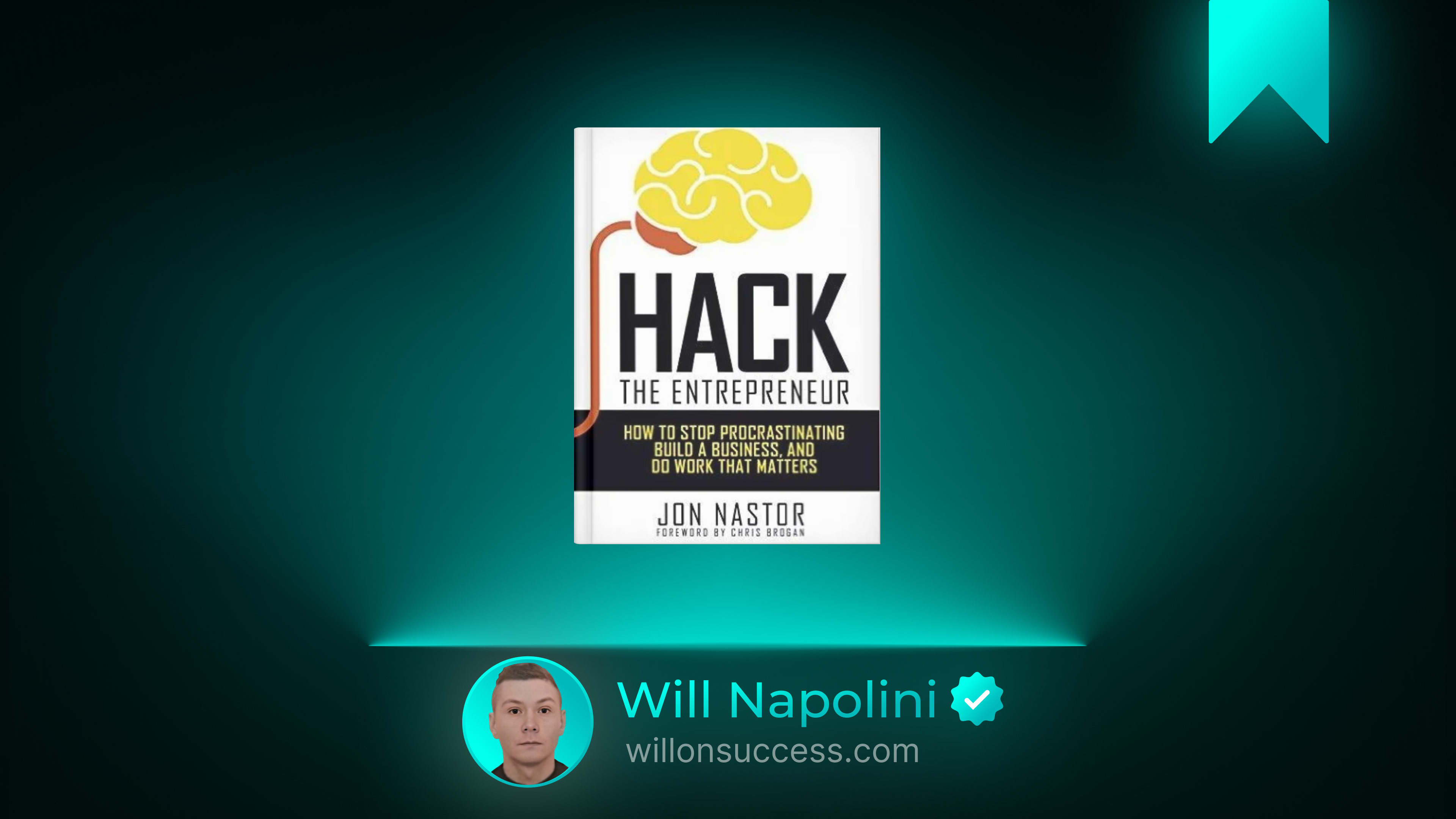
Jon Nastor’s Hack the Entrepreneur strips away the glamorous mythology of startup culture to reveal a quieter, harder truth: entrepreneurship is fundamentally an inside job. The subtitle of the book promises to teach you how to stop procrastinating, build a business, and do work that matters. But the core thesis is even more foundational. Before you can build a successful enterprise, you must first dismantle the inner battles—the fear, the comparison, and the chronic hesitation—that are quietly sabotaging your progress.
Nastor discovered that the gap between the people who dream and the people who do is rarely a difference in talent, capital, or secret knowledge. It is a difference in action. Success belongs to those who are willing to be uncomfortable, to ship imperfect work, and to build a business that serves their life, rather than a life that serves their business.
The Story and the Concept
Jon Nastor did not write this book from the ivory tower of a billion-dollar exit. He wrote it from the trenches. As the host of the Hack the Entrepreneur podcast, Nastor spent years sitting down with top performers, digital marketers, and successful founders. He didn’t just ask them for their tactical advice; he probed their fears, their habits, and their inner struggles.
What he found was startling. The most successful people he interviewed were not fearless. They were just as plagued by imposter syndrome, doubt, and the urge to procrastinate as anyone else. The difference was not the absence of fear. The difference was their relationship to it. They had learned to recognize the urge to “prepare a little more” for what it really was: avoidance. They had learned to hack their own psychology.
Nastor realized that building a business is not a linear checklist of marketing hacks and SEO strategies. It is a deeply personal journey of self-mastery. You cannot outsource your mindset. You cannot automate your courage. You have to face the blank page, the empty inbox, and the quiet voice in your head that whispers, Who do you think you are?
Stop Hiding Behind the Comfort of Preparation
There is a profound difference between planning and procrastinating, though they often wear the exact same clothes. Planning is strategic; it has a deadline and a clear outcome. Procrastination is emotional; it is a defense mechanism designed to protect you from the possibility of failure or judgment.
When you spend three weeks outlining the perfect business plan for an idea you have not yet validated with a single customer, you are not being thorough. You are being afraid.
Nastor challenges the “hustle” culture that glorifies endless grinding while ignoring the actual needle-moving work. Real work is often quiet, unglamorous, and deeply uncomfortable. It is making the sales call. It is hitting “publish” on the article that exposes your true thoughts. It is asking for the money.
Action before intention is a principle that changes everything. You do not need to feel confident to take action; you take action to build confidence. Momentum is not the result of feeling ready. Momentum is the result of moving before you feel ready. A ship cannot be steered until it is already in the water. You must launch the messy first draft, the imperfect beta version, the clumsy first offer. The market will teach you more in one day of real feedback than you could learn in a year of solitary planning.
The Comparison Trap is a Business Killer
We live in an era of curated highlight reels. You open your laptop and see a peer announcing their six-figure launch. You scroll through social media and see someone else working from a beach in Bali.
When you compare your messy, chaotic, behind-the-scenes reality to someone else’s polished public relations, you paralyze yourself. Nastor emphasizes that comparing your chapter one to someone else’s chapter twenty is not just unfair; it is a strategic error. It causes you to abandon your unique path to chase someone else’s ghost.
Every entrepreneur has an “unfair advantage”—a unique intersection of their skills, their experiences, their network, and their passions. When you obsess over how others are doing things, you dilute your own advantage. You start mimicking their tactics instead of leaning into your own strengths.
What you repeat in private eventually becomes visible in your life. If you spend your private hours comparing yourself to others, your public work will lack authenticity. It will feel derivative. The market does not need another copy of what already exists. The market needs your specific lens, your specific voice, and your specific solution. When you put your blinders on and focus entirely on your own lane, the anxiety of competition fades into the quiet satisfaction of creation.
Build a Business Around Your Life, Not the Other Way Around
One of the most tragic mistakes I see ambitious people make is building a prison and calling it a business.
They start with a desire for freedom, for autonomy, for the ability to spend more time with their families. But somewhere along the way, the business becomes a jealous master. They take on clients they despise. They work eighty-hour weeks to maintain a bloated overhead. They sacrifice their health, their marriages, and their peace of mind on the altar of “growth.”
Nastor’s philosophy flips the traditional entrepreneurial narrative. The goal is not to build the biggest company. The goal is to build the right company. A business should be a vehicle that funds and facilitates your ideal lifestyle, not a treadmill that dictates it.
This requires you to be ruthlessly clear about your “why” and your “who.” Nastor stresses the importance of identifying your ideal client. When you try to serve everyone, you serve no one, and you burn out in the process. But when you laser-focus on the specific people you genuinely want to help, your marketing becomes sharper, your boundaries become firmer, and your work becomes deeply fulfilling.
You must decide what your life is supposed to look like first. How many hours do you want to work? Where do you want to live? What kind of energy do you want to have at the dinner table? Once you have that vision, you reverse-engineer a business model that fits those parameters. Sometimes that means staying small. Sometimes that means saying no to lucrative opportunities that would compromise your peace. Character before circumstances means having the discipline to protect your life from the very business you created to improve it.
Why This Matters in Your Life
You might be reading this and thinking, But I have to pay the bills. I have to grind right now so I can relax later.
I understand that pressure. I have felt the weight of financial obligation and the fear of falling behind. But the “grind now, live later” mentality is a lie that destroys the present for a future that is never guaranteed.
If you do not learn to hack your own psychology now, you will carry the same anxieties, the same procrastination, and the same lack of boundaries into your success. A million dollars will not cure your imposter syndrome. A viral marketing campaign will not fix your inability to say no.
Mastering the inner game of entrepreneurship changes your relationship with time. You stop viewing your days as a series of boxes to check and start viewing them as a canvas for meaningful work. You stop spinning your wheels in the mud of procrastination and start laying bricks for a foundation that will actually support you.
In your daily routine, this shifts your focus from volume to value. In your leadership, it transforms you from a stressed-out taskmaster into a grounded visionary. In your personal growth, it teaches you that the ultimate metric of success is not your revenue, but your peace of mind.
Practical Application
Understanding the mindset of a successful entrepreneur is only half the battle. You must translate these concepts into observable behavior. Here is how you begin to hack your own momentum today.
The “Ship It” Rule Identify one piece of work you have been holding back because it is not “perfect.” An email newsletter, a podcast episode, a product update, a portfolio piece. Give yourself a hard deadline of two hours to make the final edits. When the timer goes off, you must ship it. Do not let it sit in your drafts folder for another day of silent agonizing. Teach your brain that completion is more valuable than perfection.
Define Your “Anti-Client” Grab a piece of paper and write down the exact traits of the client or customer you absolutely refuse to work with. The ones who drain your energy, demand your weekends, and haggle over every penny. Naming your “anti-client” gives you the power to spot them early and politely decline their business. Protecting your energy is just as important as generating revenue.
The 30-Minute Deep Work Sprint Procrastination thrives in open-ended time. If you have “all day” to write a proposal, it will take all day. Tomorrow morning, before you open your email or social media, set a timer for 30 minutes. Choose the single most important needle-moving task on your list. Work with intense, undistracted focus until the timer rings. Then, walk away. You will be amazed at how much friction disappears when you shrink the commitment.
Audit Your “Productive” Distractions Look at your calendar and your to-do list for the past week. Circle the tasks that made you feel busy but did not actually move your business forward. The logo tweaks. The endless research. The organizing of files. Consciously cross these off your list for the upcoming week. Replace them with one uncomfortable task that actually generates value.
Who Should Read This Book
Hack the Entrepreneur is a lifeline for the solopreneur, the freelancer, and the creator who feels stuck in the mud of their own making. It is for the chronic over-planner who has read every business book but has never launched a product. It is for the overwhelmed founder who has built a successful business but realizes they have accidentally created a job they hate.
If you are looking for a dense, academic treatise on venture capital funding, supply chain logistics, or corporate mergers, this book will not serve you. Nastor’s work is highly personal, conversational, and deeply focused on the psychology of the individual creator. It is a mentor speaking to you over a cup of coffee, not a professor lecturing from a podium.
But if you need a compassionate but firm kick in the pants to stop hiding, to trust your own voice, and to build a business that actually serves your life, this book is exactly the companion you need for the journey.
One Small Step
Today, I want you to identify the one task you have been avoiding because it makes you feel vulnerable. The sales call you haven’t dialed. The “About Me” page you haven’t finished. The price increase you haven’t emailed to your clients.
Do not plan it. Do not research it. Do not wait until you feel ready.
Set a timer for fifteen minutes. Open the document, pick up the phone, or write the email. Take one small, imperfect step into the arena.
You do not need more motivation to succeed. You do not need a better strategy. You just need the courage to start before you are ready.
The life you are trying to build is waiting for you on the other side of your hesitation.