How to Build Wealth and Freedom Without Quitting Your Job
There is a loud, persistent myth in our culture that whispers a very specific lie: If you want to be truly free, you have to quit your job and start a business.
I have watched so many talented people burn themselves out chasing a version of success that was never meant for them. We are bombarded with stories of college dropouts and garage startups. We are told that the only way to escape the daily grind is to hand in our resignation, drain our savings, and take on massive financial risk. We are taught to view our current employment as a prison sentence we must eventually escape.
But what if that is a false choice? What if the reason you feel stuck has nothing to do with your employment status, and everything to do with your mindset?
If you are working hard and still wondering why nothing is changing, the problem might not be your job. The problem might be the lens through which you are viewing your life.
The Big Idea
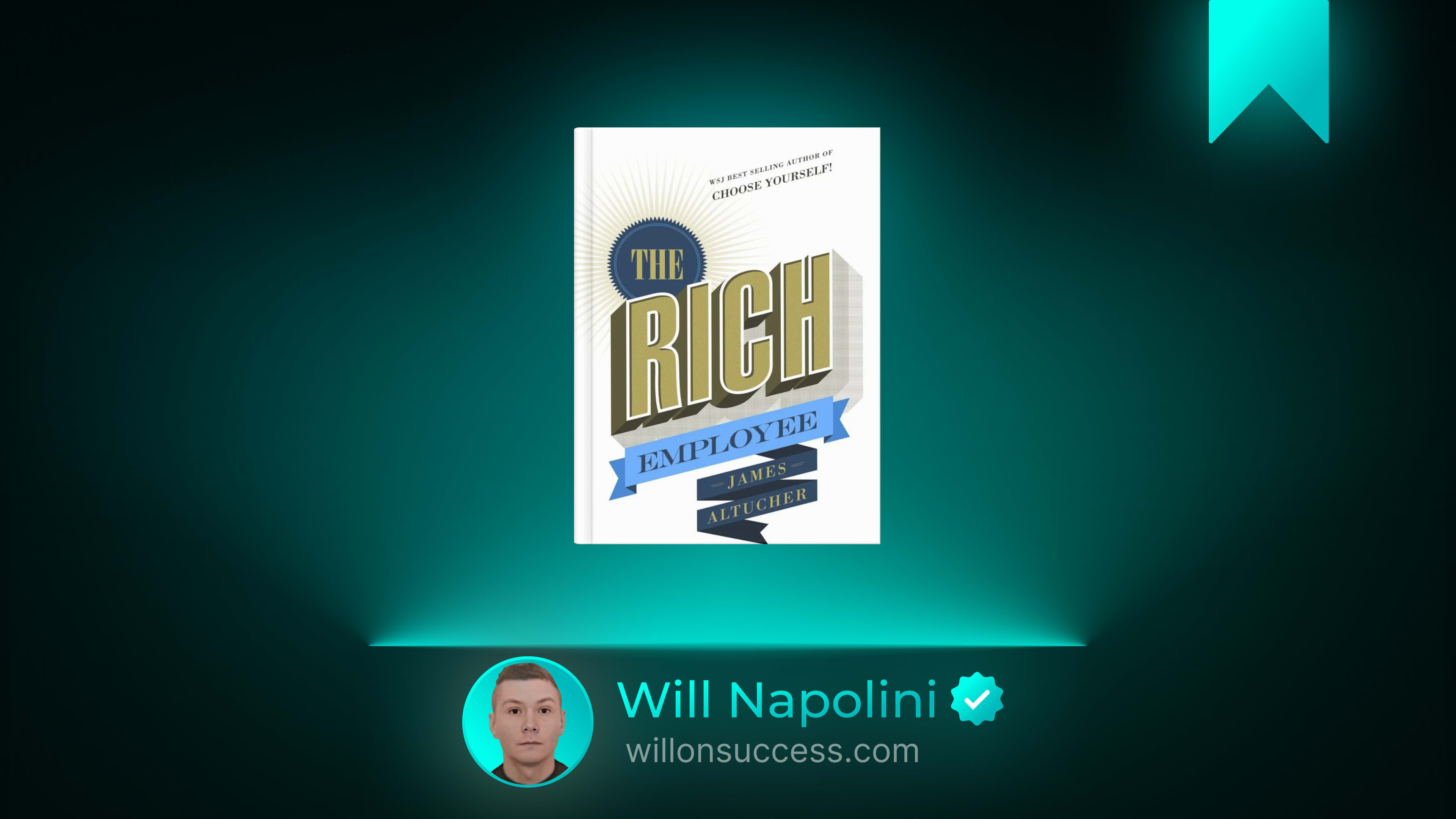
In The Rich Employee, James Altucher dismantles the false binary between the powerless corporate worker and the high-risk entrepreneur. He proposes a third path—one that is far more accessible to the vast majority of people.
The central thesis is simple but profound: you do not need to quit your job to take ownership of your life. You can choose yourself, build wealth, and create immense freedom while remaining an employee. True security does not come from a corporate title or a startup label. It comes from how you architect your days, how you generate value, and how you refuse to hand the keys of your destiny to a single employer.
Altucher argues that companies in this new century will only succeed if they encourage their employees to develop this mindset, but you do not need to wait for your company’s permission to start. You can begin today.
The Story: The Poor Employee vs. The Rich Employee
Imagine two people sitting in the same office, doing the exact same job, for the exact same salary. Let’s call them Sarah and David.
Sarah operates with a “Poor Employee” mindset. She views her time as something she is forced to sell. She waits for permission to act, waits for a promotion to feel valuable, and relies entirely on one single stream of income. When she clocks out, she stops thinking about her career entirely. If the company restructures, or if her boss decides to cut costs, her entire financial world collapses. She is entirely at the mercy of the weather. She believes her worth is determined by the person sitting in the corner office.
David, on the other hand, operates with a “Rich Employee” mindset. He views his job not as a master, but as a foundation. He uses the stability of his paycheck to fund his curiosity, his network, and his side projects. He understands that his employer is simply one client in a larger portfolio of a well-lived life. He does not just work for the company; he works on himself. He builds relationships across departments, learns the underlying mechanics of the business, and quietly develops skills that the market values.
What I have discovered over the years is that the difference between Sarah and David is rarely their intelligence, their talent, or even their starting bank account. The difference is who holds the pen when it comes time to write the story of their life. Sarah is waiting for someone else to write her next chapter. David is writing it himself, one deliberate decision at a time.
Your Job is an Investor, Not a Warden
When you change your perspective, your nine-to-five stops being a prison sentence and starts looking like an angel investment. Your employer is paying you to learn, to build a network, and to hone your craft.
I have seen too many people resent their day jobs, allowing that resentment to drain their energy by the time they get home. They view their salary as hush money to keep them quiet and compliant. The Rich Employee flips this dynamic entirely. They extract maximum value from their environment. They ask better questions. They volunteer for projects that teach them new skills. They treat their salary as the seed capital for their future freedom.
You start small. You stay curious. You let the environment work for you.
When you view your job as an investor in your personal growth, you stop giving away your power. You realize that every meeting, every challenge, and even every frustrating corporate policy is data you can use to build your own future.
True Wealth is Built on Multiple Streams
Altucher makes a brilliant point about risk: being an entrepreneur is not about taking wild, reckless chances; it is about mitigating risk.
Think about the traditional employee. They have one client—their boss. If that one client decides to walk away, their revenue drops to zero overnight. That is not security; that is extreme fragility. We have been taught to believe that a steady paycheck is the safest route in life, but relying on a single source of income is actually one of the riskiest financial strategies you can employ.
The Rich Employee builds multiple streams of income. This does not mean you need to launch a massive corporation on the weekend or work yourself into exhaustion. It means planting small seeds. A freelance skill you offer on the side. A small dividend-paying investment. A digital product that generates a few dollars a month. A consulting gig that takes two hours a week.
Over time, these small streams converge into a river. When your income comes from five different sources, the loss of one job is no longer a tragedy. It is merely a transition. You have built a financial ecosystem that can withstand a drought.
Leadership is a Behavior, Not a Title
Many people wait for a promotion before they decide to lead. They believe that authority must be granted from above before they can make a difference. They sit quietly in meetings, waiting for the manager to speak, assuming that leadership is a destination you arrive at rather than a practice you embody.
But true leadership is not about achieving your own dream; it is about helping everyone else achieve theirs.
You can lead from any seat in the room. You lead by taking ownership of a broken process. You lead by mentoring a newer colleague who is struggling to find their footing. You lead by remaining calm and focused on solutions when the rest of the team panics.
I have seen junior employees command the respect of an entire room simply because they were the only ones focused on the solution rather than the blame. When you become the person who solves problems rather than the person who points them out, you become indispensable. And in a rapidly changing economy, being indispensable is the ultimate leverage. It gives you the power to negotiate, the freedom to set boundaries, and the confidence to know your worth is not tied to a performance review.
Why It Matters
Why does this distinction matter on an ordinary Tuesday?
Because the way you view your work dictates the energy you bring to your life. If you view yourself as a victim of your circumstances, you will spend eight hours a day feeling drained, and you will have nothing left for the people you love when you get home. You will carry the weight of your resentment into your evenings, your weekends, and your relationships. You will find yourself complaining over dinner, venting to friends, and slowly convincing yourself that you are trapped in a system designed to keep you small.
But when you adopt the Rich Employee mindset, you reclaim your agency. You stop waiting for a savior in the executive suite. You realize that your career is your responsibility. This shift does not just change your bank account; it changes your posture. You walk into meetings differently. You negotiate differently. You live differently.
You begin to understand that character precedes circumstances. A bad economy, a difficult boss, or a boring project cannot break a person who has decided to take ownership of their own growth. The external results you desire—the wealth, the freedom, the respect—always begin with internal development.
When you operate from a place of ownership, failure stops being a verdict and starts being data. If a side project fails, you learn from it and pivot. If a promotion is denied, you evaluate your leverage and adjust your strategy. You are no longer emotionally tethered to the whims of your employer. You have built an internal foundation that remains steady regardless of the corporate weather.
Practical Application
Understanding this philosophy is valuable, but understanding without action changes nothing. If I could sit across the table from you right now, I would tell you to stop waiting for permission to be valuable.
Here is how you can begin to build this architecture in your own life:
- Audit Your Assets: Write down the skills you use every day at work. Are you good at organizing chaotic data? Are you skilled at mediating conflicts between difficult personalities? Are you adept at writing clear, persuasive emails? Which of these could be packaged and offered to someone outside your company?
- The 10% Rule: Dedicate just 10% of your week—perhaps three hours on a Saturday morning or an hour each evening—to building a secondary stream of income. Consistency before intensity. You do not need to work until you collapse. You just need to show up regularly. Small actions repeated over time will always outperform dramatic, unsustainable bursts of effort.
- Fire Your Bad Boss (Mentally): If you are dealing with a toxic manager, do not let them dictate your self-worth. Do your job well, document your achievements, and spend your mental energy building your exit strategy. You cannot control their behavior, but you can control your preparation. A bad boss is a temporary circumstance; your character and your skills are permanent assets.
Who Should Read This Book
This book is a lifeline for the mid-career professional who feels trapped by the golden handcuffs. It is for the parent who wants to build wealth but cannot afford the volatility of quitting their day job to start a business. It is for anyone who wants to choose themselves but needs a practical roadmap for doing so without blowing up their current life.
It may be less useful for the seasoned entrepreneur who is already running a scalable company and is looking for advanced operational or fundraising tactics. Altucher’s work is about the foundation of personal agency, not the mechanics of corporate scaling. If you are already deeply embedded in the entrepreneurial world, you may find the core concepts familiar, though the perspective shift is always worth revisiting.
One Small Step
You do not need to overhaul your life today. You do not need to stay up until 3:00 AM building a website, and you do not need to hand in your resignation tomorrow morning. You just need to prove to yourself that you have agency.
Tonight, take out a piece of paper and write down one specific problem you solve at your current job. Then, write down three ways you could solve that exact same problem for a completely different person or business, outside of your company.
Do not worry about the logistics yet. Do not worry about setting up an LLC or finding your first client. Just see the possibility. Recognize that the value you create belongs to you, and you can carry it wherever you go. The skills you have honed in the trenches of your day job are the exact tools you will use to build your freedom.
The door to your freedom is not locked. You just have to be willing to turn the handle.
You do not need to burn the bridge to find your freedom; you just need to learn how to build your own boat while you walk across it.