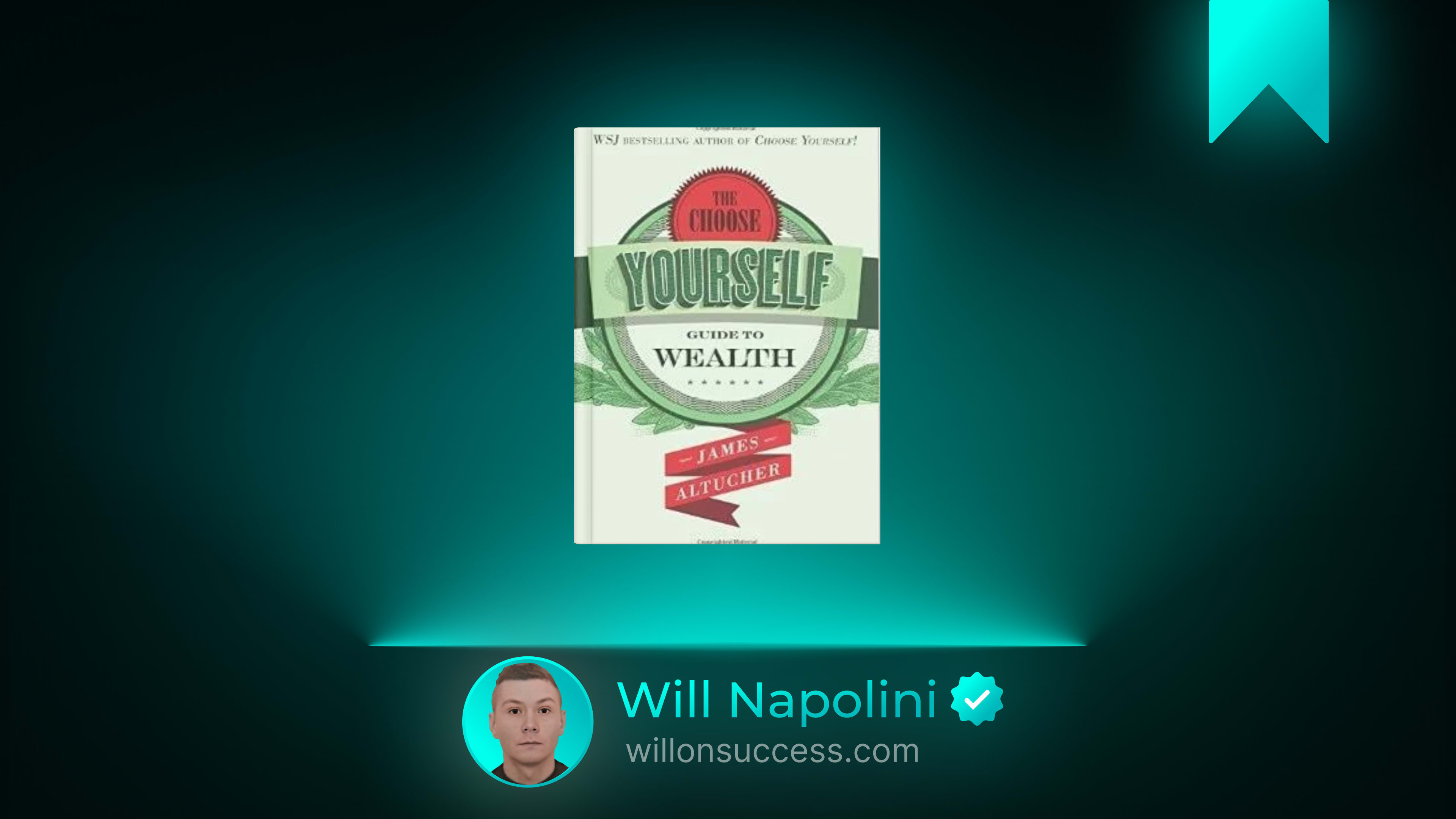
The Choose Yourself Guide to Wealth by James Altucher: Why the Old Rules of Money Are Broken and How to Rebuild Your Life From Scratch
We were all handed a map when we were young.
The map was simple, and the promise was clear: Do well in school. Get a stable job. Save ten percent of your paycheck in a retirement account. Keep your head down, follow the rules, and at sixty-five, you will be free.
I believed that map for a long time. Maybe you did, too. I watched my parents follow it. I watched my teachers follow it. It seemed like the only responsible way to navigate the world.
But over the last two decades, the terrain has changed. The ground beneath that map has fractured. Pensions have vanished. The cost of living has outpaced wages. Companies lay off loyal employees via automated emails to boost quarterly stock prices. The “safe path” is no longer safe. It is just a slow, comfortable walk toward a cliff.
If you have been feeling a quiet, persistent anxiety about your financial future—if you have been doing everything you were told to do, yet still feel like you are falling behind—you are not crazy. You are just using an outdated map in a new world.
James Altucher knows what happens when the map fails. In his book The Choose Yourself Guide to Wealth, he does not offer a get-rich-quick scheme. He offers a survival manual for the modern economy, written by a man who had to use it to save his own life.
Let us look at what he found when the old world burned down, and how you can build a new one.

The Big Idea: Wealth Is a Four-Legged Stool, and Money Is Just One Leg
Before we talk about money, we have to redefine what wealth actually is.
Most of us equate wealth with a number in a bank account. We look at a billionaire and assume they are wealthy. But Altucher argues that true wealth is a four-legged stool. The legs are Physical, Emotional, Mental, and Spiritual health. Financial wealth is simply the seat that rests on top of those four legs.
If you have ten million dollars in the bank, but your body is failing from stress and poor diet (Physical), your marriage is crumbling and you have no real friends (Emotional), your mind is foggy and you cannot focus (Mental), and you feel entirely devoid of purpose or gratitude (Spiritual)—you are not wealthy. You are just a well-funded prisoner.
When Altucher’s financial life collapsed, he realized that his entire identity had been tied to the seat, while the legs of the stool were rotting. To rebuild his financial life, he first had to rebuild the foundation.
You cannot build sustainable financial wealth on a foundation of physical exhaustion, emotional toxicity, mental stagnation, and spiritual emptiness. The money will eventually slip through your fingers, or it will crush you under its weight. Choosing yourself means committing to the daily maintenance of all four legs.
The Story: The Fall and the Daily Practice
To understand the urgency of this book, you have to understand the man who wrote it.
James Altucher is not an academic theorizing about money from a university office. He is a serial entrepreneur who built and sold several companies, making tens of millions of dollars. He was the guy who had “made it.”
And then, through a combination of bad investments, the 2008 financial crash, and his own hubris, he lost it all. He went from a sprawling estate to living in a tiny, rented apartment. He was deeply depressed. He felt entirely worthless. He had followed the entrepreneurial dream, won the game, and still ended up broken.
Sitting at his kitchen table, facing a future that looked bleak and terrifying, Altucher realized a profound, uncomfortable truth: No one is coming to save me.
The government was not going to save him. His former business partners were not going to save him. A magical new job was not going to save him. If he was going to survive, he had to choose himself.
He did not start by trying to make a million dollars. He started by implementing a rigorous, unglamorous “Daily Practice.” He focused on healing his body, curating his emotional environment, and exercising his mind every single day. He treated his recovery not as a financial problem, but as a holistic one.
Slowly, the legs of the stool grew strong. And as his internal capacity expanded, his external financial reality began to shift. He started generating ideas. He started writing. He started building new businesses. He rebuilt his wealth, not by chasing money, but by becoming a person capable of generating massive value.
The Myth of the Safe Path and the Hourly Trap
One of the most challenging concepts in the book is Altucher’s dismantling of the “employee mindset.”
We are taught to trade our time for money. You work forty hours, you get paid for forty hours. It feels secure because the exchange is predictable. But Altucher points out a brutal mathematical reality: You cannot become truly wealthy by renting out your time, because your time is strictly limited.
When you trade time for money, your income has a hard ceiling. There are only twenty-four hours in a day. Furthermore, when you are an employee, you are being paid a fraction of the value you create. The surplus value goes to the owner of the system.
Choosing yourself means shifting from being a renter of your time to an owner of your assets. It means disconnecting your income from the clock. You do this by creating things that can be replicated and sold without your direct, hourly involvement: a book, a software program, a digital course, a productized service, or a business system.
This is not to say that having a job is a moral failure. A job is often a necessary bridge. But if your long-term strategy relies entirely on your employer’s willingness to keep paying you for your hours, you are building your house on land you do not own.
The walls of the corporate box were built by people who needed you to stay inside. Choosing yourself is the act of realizing you have the tools to build your own house.
The Idea Muscle: Your Greatest Financial Asset
If you want to generate wealth in the modern economy, you must understand what the market actually pays for. The market does not pay for your time. It does not pay for your effort. It does not pay for your loyalty.
The market pays for the solution to problems. It pays for value.
And where do solutions come from? They come from ideas.
Altucher argues that the “idea muscle” is the most important financial asset you possess. But like any muscle, if you do not exercise it, it atrophies. Most people stop generating original ideas the day they leave school. They spend their days consuming the ideas of others—scrolling through social media, watching television, reading the news—and wonder why they feel stuck.
To rebuild his life, Altucher instituted a non-negotiable daily rule: Write down ten ideas every single day.
They do not have to be good ideas. In fact, most of them will be terrible. You might write ten ideas for a new app, ten ways to improve your local coffee shop, ten book titles, or ten ways to make your spouse’s day easier.
The goal is not to execute all ten ideas. The goal is to sweat. When you lift weights, you do not expect to instantly become a bodybuilder; you lift to create micro-tears in the muscle so it grows back stronger. Writing ten ideas a day creates micro-tears in your brain. It forces you to look at the world not as a passive consumer, but as an active problem-solver.
Over time, your idea muscle becomes incredibly strong. You start seeing opportunities where others see complaints. You start seeing inefficiencies where others see “just the way things are.” And in a world that pays for solutions, a strong idea muscle is a license to print your own money.
The Architecture of Multiple Streams
When your idea muscle is strong, and you have detached your income from your time, you can begin to build what Altucher calls the “Career Square.”
Imagine a square. In the center is your core competency—the thing you are best at, the skill you have honed. For Altucher, it was writing and coding.
From that center, you project outward to the four corners of the square, creating multiple, distinct streams of income that all leverage your core skill:
- A Salary/Contracting: Using your skill to do direct work for clients or an employer (the bridge).
- A Product: Packaging your skill into a scalable good (a book, a software tool, a template).
- A Service Business: Building an agency or team that delivers your skill at scale.
- Speaking/Teaching: Sharing your knowledge about your skill with others.
When you rely on a single stream of income, you are fragile. If the economy shifts, or the boss changes, or the industry automates, you are destroyed. When you build a Career Square, you are anti-fragile. If one stream dries up, the other three sustain you while you adapt.
You do not build the square overnight. You start in the center. You build one corner. Then another. But the intention is always to diversify your value, so that no single entity holds the keys to your survival.
Why This Matters on an Ordinary Tuesday
You might be reading this and thinking, This sounds great for an entrepreneur, but I have a mortgage, two kids, and a demanding boss. I don’t have time to build a Career Square.
I understand. I have been in the trenches of the daily grind. The beauty of Altucher’s philosophy is that it does not require you to quit your job tomorrow and move to a cabin in the woods to “find yourself.”
It requires you to change how you spend the margins of your day.
It means that on an ordinary Tuesday, you wake up thirty minutes earlier. You spend ten minutes exercising (Physical). You spend ten minutes writing down ten ideas (Mental). You spend ten minutes reviewing what you are grateful for (Spiritual).
It means that when you get to work, you stop viewing your boss as a warden and start viewing them as your first client. You look for ways to deliver massive, undeniable value. You document your processes. You build your reputation.
And it means that when you come home, instead of collapsing in front of a screen to numb the exhaustion, you spend thirty minutes building one corner of your square. You write a page of a book. You code a feature. You outline a course.
Choosing yourself is not a dramatic, one-time leap off a cliff. It is the quiet, daily decision to lay one brick in the direction of your own freedom.
You do not find time to build your future. You steal it back from the things that do not matter.
Who Should Read This Book
You should read The Choose Yourself Guide to Wealth if you feel a deep, structural misalignment between the effort you are putting into your career and the security you feel in your life.
You should read it if you are an aspiring creator, freelancer, or entrepreneur who needs a blunt, realistic framework for turning your skills into multiple streams of income.
You should read it if you have experienced a major failure—a bankruptcy, a divorce, a career collapse—and you need to hear from someone who has walked through the fire and mapped the way out.
I want to be honest about the book’s limitations. Altucher’s style is highly conversational, anecdotal, and sometimes repetitive. He writes like a friend talking to you over a coffee, not like a professor delivering a lecture. If you are looking for dense, academic economic theory, or highly technical guides on options trading and real estate syndication, this is not the book for you. It is a book about the psychology, philosophy, and daily mechanics of wealth creation.
It is also a book that demands responsibility. Altucher has zero patience for victimhood. He believes the system is rigged, but he also believes that complaining about the rigging is a waste of the energy you need to beat it. If you prefer to blame the economy, your boss, or your upbringing for your financial state, this book will likely irritate you.
But if you are ready to take the pen out of someone else’s hand and write your own next chapter, it will change your life.
One Small Step
I am not going to ask you to quit your job, start a company, or overhaul your entire financial portfolio today.
I am going to ask you to do the one thing that started James Altucher’s recovery, and the one thing that will begin to rewire your brain for abundance.
Write down ten ideas today.
Grab a physical notebook or open a blank document on your phone. Set a timer for five minutes. And write ten ideas about a specific topic. If you are stuck, use one of these prompts:
- 10 ways I could improve the morning routine of my household.
- 10 problems I notice in my current industry that no one is solving.
- 10 topics I know enough about that I could teach a beginner.
- 10 ways I could make my partner’s or best friend’s day 1% better.
Do not judge the ideas. Do not edit them. If idea number four is “invent a toaster that also irons shirts,” just write it down and move to number five.
When the five minutes are up, close the notebook. You do not need to do anything with the list.
You have just done a rep. You have just lifted the weight. You have signaled to your brain that you are no longer just a consumer of the world’s ideas, but a generator of your own.
Do it again tomorrow. And the next day.
The old map is torn. The safe path is an illusion. But the ground beneath your feet is solid, and the tools to build a new life are sitting right in front of you.
No one is coming to choose you. The world is too busy, too loud, and too distracted to notice your potential.
You have to choose yourself. And the beautiful, terrifying truth is that once you do, you will realize you were the only one who ever had the power to do it.