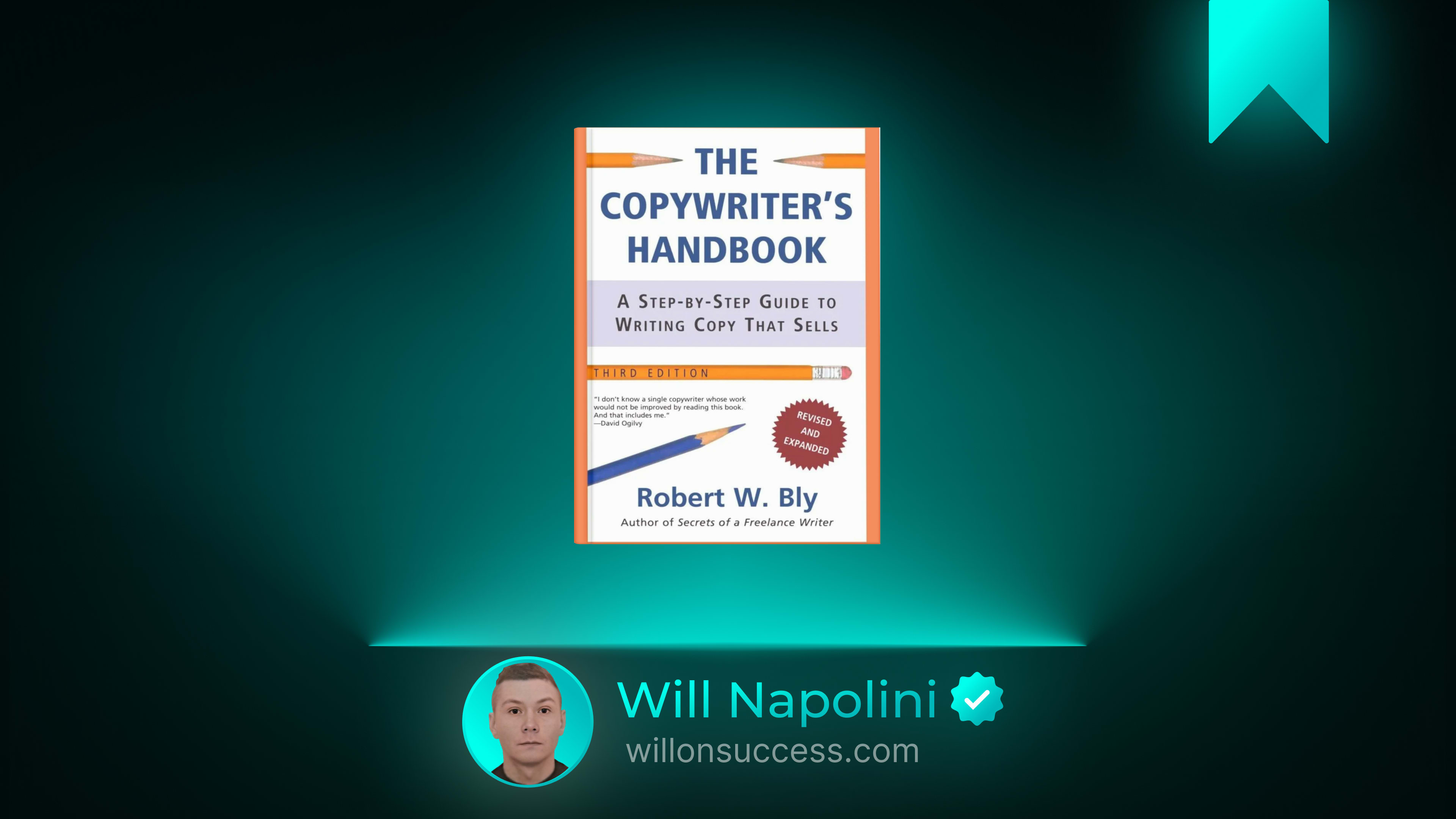
The Copywriter's Handbook by Robert W. Bly: What the Art of Persuasive Writing Can Teach You About Listening, Clarity, and the Quiet Power of Serving the Person in Front of You
Here is something I have noticed about the way most people write, whether they are drafting an email, building a presentation, pitching a project, or trying to explain themselves in a difficult conversation:
They write about themselves.
They write about their qualifications. Their product. Their idea. Their effort. Their intentions. They pour everything they have into the page, and they feel proud of it, because it is honest, and it is thorough, and it represents who they are.
And then no one reads it. Or they skim it. Or they nod politely and forget it by lunch.
And the writer is confused, because they worked so hard. Because they meant well. Because they had something genuine to say.
If you have ever poured your energy into communicating something important and felt it land flat on the other side, I want to show you a book that will change how you approach every sentence you write from this day forward.
Robert W. Bly has spent decades as a working copywriter—writing the words that sell products, services, and ideas in print, online, and in direct mail. His book The Copywriter’s Handbook is, on its surface, a manual for writing advertising copy. It is structured, practical, and deeply unsentimental. It teaches you how to write headlines, how to structure a sales letter, how to format an email, how to close a pitch.
But underneath the commercial machinery, Bly is teaching something far more universal. He is teaching you how to stop talking at people and start speaking to them. How to shift your entire orientation from what I want to say to what the person in front of me needs to hear. And how to build trust not through cleverness or volume, but through clarity, specificity, and genuine attention to another person’s world.
Let me walk you through what this book taught me. Not just about writing. About how we show up for each other in language.
The Big Idea: The Reader Does Not Care About You. And That Is the Most Liberating Truth You Will Learn.
Bly states a principle early in the book that, if you let it land fully, will reorganize the way you communicate in every area of your life:
The reader is not interested in you. The reader is interested in themselves. Specifically, they are interested in what your words can do for them.
This sounds harsh. It sounds cold. But stay with me, because it is actually the most generous principle in the book.
When you accept that the person reading your email, listening to your pitch, or sitting across from you in a conversation is primarily asking What does this mean for me?, you stop performing. You stop trying to impress. You stop listing your accomplishments like items on a shelf. And you start asking a different question: What does this person need? What problem are they carrying? What fear keeps them up at night? What would make their Tuesday easier?
And then you write to that. You speak to that. You build your words around their reality, not yours.
This is not manipulation. It is the opposite of manipulation. Manipulation says, I will use your needs to get what I want. What Bly is teaching says, I will understand your needs so thoroughly that what I offer becomes genuinely useful to you. The first is extraction. The second is service.
And service, communicated clearly, is the most persuasive force in the world.
The Concept: Benefits Over Features
One of the most practical frameworks Bly teaches throughout the book is the distinction between features and benefits. It is simple, but its implications reach far beyond advertising.
A feature is what something is. A benefit is what something does for the person using it.
A drill’s feature is its motor, its torque, its ergonomic grip. Its benefit is the hole it makes in your wall so you can hang the photograph of your daughter’s graduation.
A software program’s feature is its processing speed. Its benefit is that you get to leave the office at five instead of seven.
A mentor’s feature is their twenty years of experience. Their benefit is that you do not have to make the same mistakes they made, and you get those years back.
Bly insists, throughout the book, that features inform but benefits persuade. People do not buy the drill. They buy the hole. They buy the photograph on the wall. They buy the feeling of a home that looks like theirs.
I think about this every time I sit down to write something important. Every time I prepare for a meeting. Every time I try to explain to someone why an idea matters. I catch myself listing features—here is what I did, here is what I know, here is the technical specification of my proposal. And I stop. And I ask myself: So what? What does this mean for the person on the other side of this sentence?
People do not respond to what you have. They respond to what your having means for them. Translate your features into benefits. Translate your accomplishments into relevance. Translate your effort into impact. And watch how the room changes.
The Headline Is Everything: Why Beginnings Carry So Much Weight
Bly dedicates significant attention to the headline. In advertising, the headline is the first thing the reader sees. It is the gate. And Bly is blunt about its importance: if the headline does not work, nothing else matters. The body copy can be brilliant, the offer can be generous, the product can be life-changing. But if the headline does not stop the reader, none of it is ever seen.
He teaches that a good headline does one of a few things. It promises a benefit. It poses a question the reader cannot ignore. It delivers news. It selects the audience by speaking directly to a specific person’s specific situation.
And it does all of this in plain, direct language. Not clever language. Not ornate language. Language that a tired person, scrolling quickly, can understand in less than two seconds.
I want you to think about this principle beyond advertising. Think about every beginning in your life.
The first sentence of an email to your boss. The opening line of a difficult conversation with your partner. The first thirty seconds of a presentation. The way you introduce yourself at a gathering where you know no one.
These are your headlines. They are the gates. And most of us waste them. We begin with throat-clearing. With context. With apologies. With three paragraphs of background before we get to the point. And by the time we arrive at the thing that actually matters, the person on the other side has already mentally checked out.
You do not get to earn attention. You get to deserve it in the first sentence. Begin with what matters most. Begin with the benefit, the question, the specific truth. Give the reader a reason to keep going. Then, and only then, build the case.
Research Before Writing: Understanding Is the Foundation of All Persuasion
One of the most valuable chapters in the book is not about writing at all. It is about research.
Bly insists that before you write a single word of copy, you must understand three things with absolute clarity: the product, the market, and the customer. What is the product actually doing? Who is the market, and what do they already believe? And who is the specific customer—what do they fear, what do they want, what language do they use, what objections will they raise?
He recommends reading customer reviews. Talking to salespeople. Studying competitors. Looking at what questions people ask. Listening to the words customers actually use, rather than the words the company wishes they would use.
This principle is so obvious that it is easy to skip. But I have watched people skip it at enormous cost. The manager who announces a new policy without asking the team how it will affect their workflow. The entrepreneur who builds a product based on what they find interesting, without asking whether anyone else finds it useful. The partner who tries to resolve an argument by explaining their own perspective more loudly, without ever asking, Wait. What do you actually need from me right now?
You cannot speak persuasively to a person you have not listened to. And you cannot listen to a person you have not made time to study. The research phase is not a delay. It is the work. The writing is just the visible result of the understanding you built in silence.
Before you write your next important email, before you prepare your next presentation, before you walk into your next difficult conversation, ask yourself: What do I actually know about the person on the other side of this? What are they carrying? What do they need to hear, in their own language, in the order that makes sense to them?
If you cannot answer those questions, you are not ready to write. You are ready to listen.
Clarity Trumps Cleverness: The Discipline of Plain Speech
Bly returns repeatedly to one conviction: clear writing beats clever writing. Every time.
He warns against jargon. Against abstraction. Against sentences so convoluted that the reader must read them twice to extract the meaning. Against the temptation to sound impressive when sounding clear would be more effective.
His standard is simple: if the reader has to work to understand you, you have failed. Not the reader. You.
I have had to learn this the hard way. There was a period in my life when I believed that complex language signaled complex thought. That if I used bigger words, longer sentences, more subordinate clauses, people would take me more seriously. And I watched, over and over, as people’s eyes glazed over. As my ideas were passed over not because they were bad, but because no one could follow them fast enough to care.
The turning point came when I realized that clarity is not a sign of simplicity. It is a sign of respect. When you write clearly, you are saying to the reader: I value your time. I value your attention. I will not make you work to understand me. I have already done the work of understanding myself.
The most generous thing you can do with language is make it easy to understand. Not dumbed down. Not stripped of nuance. But organized. Specific. Direct. Written in the rhythm of natural speech.
Bly teaches you to write the way people talk. Short sentences where short sentences serve. Longer ones where the idea needs room to breathe. Active voice. Concrete nouns. Verbs that move. No filler. No decoration for its own sake.
Every word earns its place, or it goes.
Revision as Humility: The Willingness to Cut What You Love
Bly does not spend a great deal of time on the emotional experience of writing, but the implication runs through the entire book: good copy is built in revision. The first draft is raw material. The second draft is where the real work begins. And the revision process requires a specific kind of humility.
You must be willing to cut the sentence you are most proud of if it does not serve the reader. You must be willing to restructure the entire piece if the logic is not flowing. You must be willing to delete the paragraph that took you an hour to write if it adds nothing the reader needs.
This is not just a writing principle. It is a character principle.
I have watched people cling to ideas, strategies, and positions long past the point where those things were serving anyone, simply because they had invested time in building them. The project that no longer makes sense but continues because someone spent three months on it. The argument that both parties know is over, but neither will concede because conceding feels like losing. The identity you built at twenty-five that no longer fits the person you are at forty, but that you keep wearing because removing it would mean admitting you changed.
The willingness to cut what no longer serves is not a failure. It is the highest form of respect for the work you are actually trying to do. Revision is not destruction. It is refinement. It is the slow, patient act of removing everything that stands between the reader and the truth you are trying to deliver.
Why This Matters on an Ordinary Tuesday
You are probably not writing a direct-mail sales letter today. You are probably not crafting a print ad or a landing page. But you are writing. You are communicating. You are trying to get someone to understand you, to trust you, to act.
The email to your client that needs to land right. The proposal to your team that needs to generate buy-in. The text to your friend who has been distant and you are not sure why. The cover letter. The performance review. The note to your child’s teacher. The voicemail you keep rewriting in your head before you press record.
Every one of these is an act of persuasion. Not manipulation. Persuasion. The honest attempt to help another person see what you see, feel what you feel, and move toward an action that benefits them.
And every one of them benefits from the principles Bly teaches. Lead with what matters to the reader. Be specific. Be clear. Do the research. Cut what does not serve. Begin with the headline—the one sentence that makes them want to keep reading.
You do not need to sell a product to benefit from this book. You just need to care about whether your words actually reach the person you are sending them to.
Who Should Read This Book
Read this book if you write for a living in any capacity—marketing, sales, fundraising, content creation, product descriptions, email campaigns. It is a thorough, practical, no-nonsense manual that will sharpen your craft immediately.
Read it if you are an entrepreneur or freelancer who needs to communicate the value of your work to clients, investors, or collaborators. Bly’s frameworks will help you stop describing your process and start articulating your impact.
Read it if you are a leader, a teacher, or a manager who wants your communication to actually land. The principles of clarity, specificity, and audience awareness will transform your meetings, your emails, and your one-on-one conversations.
I will be honest about the book’s limitations. It is dense. It is structured like a reference manual, not a narrative. Bly covers an enormous range of formats—print, digital, email, direct mail, brochures, catalogs, multimedia—and some of the specifics will feel dated depending on the edition you read. If you are looking for inspiration, for lyrical prose, for a book that moves you emotionally, this is not that book. It is a toolbox. You open it when you need a specific wrench.
But if you are willing to engage with it as a working document, as a set of principles to practice and refine, it will make you a clearer, more effective, more generous communicator. And that skill will compound in every area of your life.
Practical Application: The “So What?” Test
Here is an exercise you can start using immediately. Bly does not name it exactly this way, but it is the principle that runs beneath everything he teaches.
Take the next important piece of writing you produce—an email, a proposal, a presentation, a letter. Before you send it, read it through once. Then read it through a second time, and after every sentence, ask yourself one question:
So what?
So what that I have ten years of experience? What does that mean for the person reading this? So what that the project is on schedule? What does that mean for their workload next week? So what that I am passionate about this initiative? What will it change in their daily life?
Every sentence that cannot answer the “So what?” question with a concrete, specific benefit to the reader gets cut or rewritten.
You will be surprised how much of what you write is about you. And you will be even more surprised how much stronger your writing becomes when you strip that self-focus away and replace it with genuine, specific attention to the person on the other side of the page.
One Small Step
Here is what I would ask of you today. One thing. Small. Specific. Achievable before the day is over.
Think of one email or message you need to send this week. A request. A proposal. A follow-up. Something you have been putting off because you are not sure how to frame it.
Before you write a single word, take three minutes. Set a timer. And answer these three questions on a scrap of paper:
Who is this person, and what is their day like right now? What do they need that I can provide? What is the one sentence that would make them stop, read, and feel that this message was written specifically for them?
Then write your email. Start with that sentence. Keep it short. Be specific. Sign your name. Send it.
You do not need to be a copywriter to communicate with clarity and care. You just need to remember that the person on the other side of the screen is a person. With a day. With a problem. With a limited amount of attention and a deep, quiet hope that someone will finally say something that actually helps.
You can be that someone. Not by being clever. Not by being loud. By being clear. By being specific. By doing the quiet work of understanding before you speak.
The right words, aimed at the right person, at the right moment, will do more than a thousand clever ones shouted into the void.
Write the sentence that matters. Send it. Then write the next one.
That is how you build a life where your words actually land. One clear, honest, specific sentence at a time.