The Count of Monte Cristo by Alexandre Dumas: What a Man Who Lost Everything Can Teach You About Patience, Power, and the Hardest Lesson of All
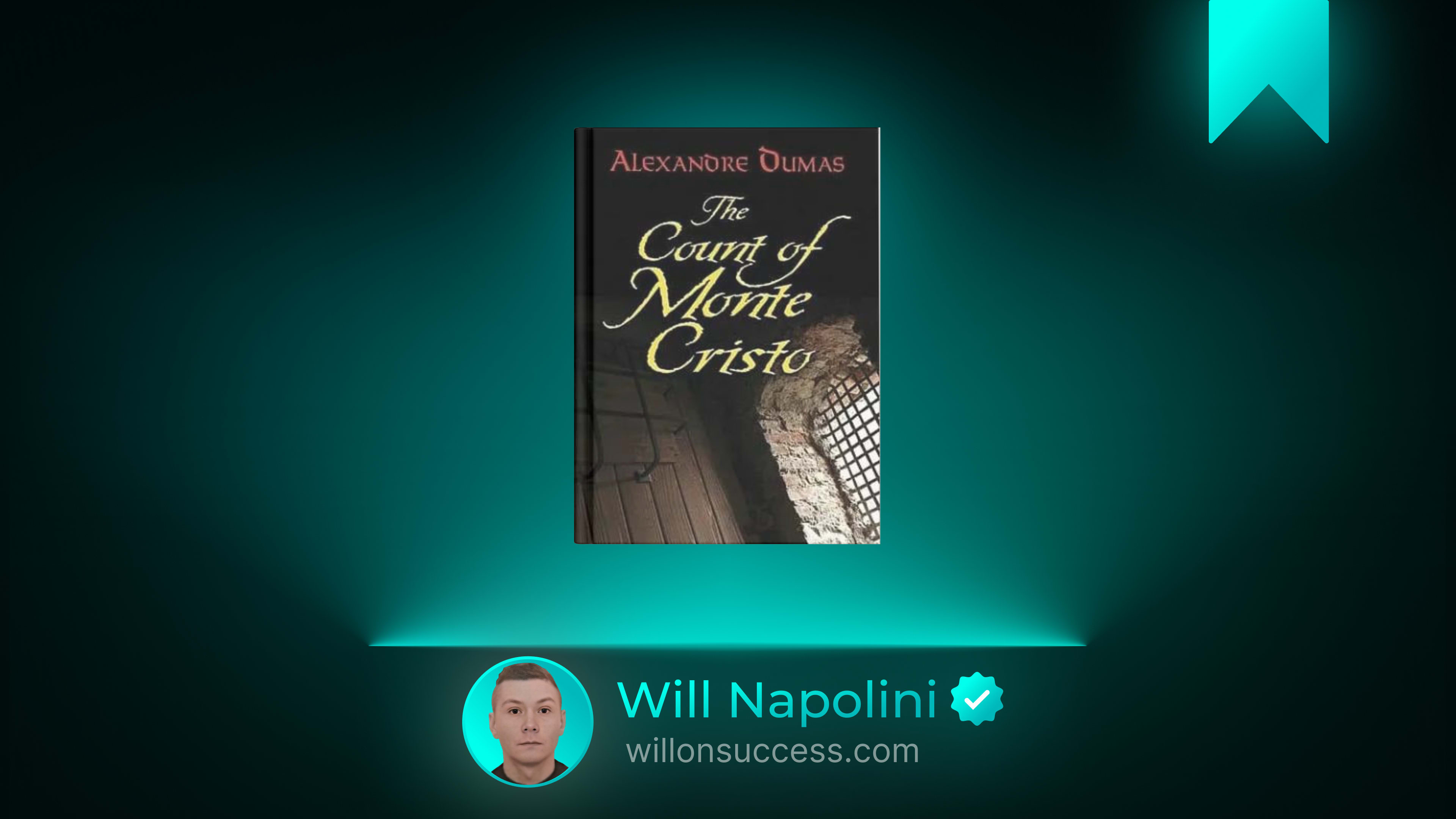
There is a moment in this novel, early on, when everything is perfect. A young man stands in the sunlight of Marseille. He is nineteen. He has just been promised the captaincy of a ship. The woman he loves has said yes to becoming his wife. His father is proud. His future is a straight, shining road.
And within forty-eight hours, three men destroy all of it. Not because he wronged them. Because his happiness made them envious, his success made them fearful, and his innocence made him easy to frame. They write a letter. They make an accusation. And the young man is thrown into a stone cell on an island prison, with no trial, no sentence, no date of release.
He will stay there for fourteen years.
If you have ever had something taken from you that you did not lose through any fault of your own—a career, a relationship, a reputation, a season of life you thought was secure—and if you have ever sat in the wreckage of it, unable to understand how the people you trusted could do what they did, then Alexandre Dumas wrote this novel for you.
The Count of Monte Cristo was published in serial form between 1844 and 1846. It is long. It is sprawling. It is full of disguises, secret identities, financial machinations, and a cast of characters that fills dozens of pages. But beneath all of that, it is asking one question, and it is asking it of you directly:
What do you do with the years they stole from you?
Let me show you what Dumas discovered. And what I have learned, slowly, from walking beside this story.
The Big Idea: Transformation Is Inevitable. But What You Become Is Not Guaranteed.
The novel’s central arc is one of the most complete transformations in all of literature. Edmond Dantès enters the Château d’If as a naive, trusting, joyful young sailor. He emerges fourteen years later as someone else entirely. Someone harder. Quieter. More calculating. A man who has learned languages, history, science, philosophy, and the patient architecture of revenge.
And then he spends the next decade executing that revenge with a precision that is almost architectural. He dismantles his betrayers one by one. Not quickly. Not violently, at first. Slowly. Systematically. He finds the exact pressure point in each man’s life—the vanity, the greed, the hidden shame—and he presses it until the whole structure collapses.
It is thrilling to read. I will not pretend it is not. There is a satisfaction in watching someone who was wronged finally, meticulously, set the record straight. Dumas understood that satisfaction. He built the novel around it.
But here is what elevates this book above a simple revenge fantasy, and what makes it one of the most honest stories ever written about the human heart:
The novel does not let Dantès get away with it.
His revenge works. Every target falls. But in the process, innocent people are hurt. A child dies. A woman who loved him suffers. And Dantès, who believed he was an instrument of divine justice, is forced to confront a truth that breaks him more thoroughly than the prison ever did:
He is not God. He is a man. And a man’s judgment, no matter how wounded, no matter how justified, is fallible. Limited. Capable of monstrous error dressed in the robes of righteousness.
That is the deepest idea in this book. Not that suffering transforms you. It does. But that what you become through suffering is not automatic. You can become wiser, or you can become cruel. You can become more compassionate, or you can become more certain of your own rightness. The forge does not decide what the blade becomes. The blade does.
The Forge: What Fourteen Years in a Stone Cell Actually Teach
Let me tell you about the middle of the novel, because the middle is where the real education happens.
Dantès spends the first years of his imprisonment in despair. He stops eating. He considers death. He rages against the walls. He is a young man who has been severed from everything that gave his life meaning, and he has no framework for understanding why.
And then, one day, he hears a sound. A scraping. A tunnel being dug. And through the broken stone, he meets the Abbé Faria—an elderly priest, a scholar, a man who has been imprisoned for political reasons and who has spent his years in confinement not in despair but in study.
Faria becomes Dantès’ teacher. Over the course of years, he teaches him languages, mathematics, history, philosophy, chemistry. He teaches him how to think. How to analyze. How to understand systems—political, financial, social. He teaches him to read the mechanisms of power, the architecture of human motivation, the hidden levers that move the world.
And he gives Dantès something else. He helps him understand, through careful questioning, exactly who betrayed him and why. He gives Dantès the truth. Not the comfort of ignorance. The specific, named, detailed truth.
And then Faria tells him about the treasure. A vast fortune hidden on the island of Monte Cristo. Enough wealth to make a man invisible. Enough wealth to make a man powerful beyond any institution’s reach.
Faria dies. Dantès hides in the priest’s burial sack, is thrown into the sea, cuts himself free, and swims to survival.
He finds the treasure. And he begins.
What strikes me, every time I return to this part of the story, is that the treasure is not the real gift. The gold is useful. It gives Dantès the resources to execute his plan. But the real gift—the thing that actually freed him—was the education. The years of patient learning in a dark cell. The slow, grinding accumulation of knowledge and understanding that no one could take from him because it lived in his mind.
They can lock you in a room. They can take your name, your future, your freedom. But they cannot take what you have learned, unless you stop learning.
I think about that when I am in a season that feels like confinement. A job that has become a cell. A relationship that has gone cold and routine. A period of illness or loss that has narrowed my world to a single, gray room. The temptation is to wait. To endure. To count the days and hope the door opens.
But Dantès’ years teach something else. They teach that the cell can be a classroom. That the confinement can be the very thing that forces you to build the inner architecture no one can touch. Not because suffering is good. It is not. But because you are in it, and you can decide whether it will hollow you out or build you up.
The Long Game: Patience as a Form of Power
Dantès does not rush.
This is what I find most remarkable about the novel’s structure, and what I think it teaches most clearly about how real change happens. After his escape, after he finds the treasure, Dantès does not sail immediately to Paris and confront his enemies. He does not storm the Château d’If and demand justice.
He waits. He plans. He travels. He studies the world his betrayers now inhabit. He learns their businesses, their families, their secrets, their vulnerabilities. He builds a network. He creates multiple identities. He positions himself.
And then, over the course of roughly ten years, he executes his plan. Move by move. Thread by thread. Like a weaver at a loom, pulling each strand into place until the pattern is complete.
I think about this when I feel the urgency to fix everything now. To resolve the injustice immediately. To make the person who hurt me understand what they did, today, this hour, before the feeling fades. I think about how that urgency has led me, more than once, to act before I was ready. To speak before I understood. To strike before I had positioned myself to actually change anything.
Patience is not passivity. Patience is the discipline of building your power slowly, deliberately, until the moment you act is the moment the outcome is certain.
Dantès could have rushed. He could have gone to the authorities. He could have confronted Danglars in his counting house or challenged Fernand to a duel. And he would have been crushed. Because he was one man against a system that had already decided he was guilty.
Instead, he became something the system could not anticipate. He became patient. He became prepared. He became a man who understood the terrain so thoroughly that by the time he made his move, the game was already won.
You start small. You stay consistent. You let time do its work. And when you finally act, you do not act from rage. You act from readiness.
The Danger of Becoming What You Hate
I need to be honest with you about the second half of this novel, because it is where Dumas earns his place among the great moral storytellers, and it is where the book becomes more than an adventure.
Dantès’ revenge is thorough. It is devastating. And for a long time, it feels justified. Danglars, the banker who wrote the letter that destroyed him, is ruined financially. Villefort, the prosecutor who imprisoned him to protect his own secret, is exposed publicly, his career and reputation destroyed. Fernand, who stole Mercédès, is humiliated before the world and takes his own life.
But the revenge does not stop where Dantès intended it to stop.
Villefort’s young son, Édouard, dies. A child. Innocent. Caught in the machinery of a judgment he had no part in making. And when Dantès sees the boy’s body, something breaks in him. Not his resolve. His certainty.
He realizes that in his pursuit of justice, he has become something that looks very much like the men who imprisoned him. They used their power to destroy an innocent man for their own convenience. He used his power to destroy men and their families for his own satisfaction. The architecture is different. The mechanism is the same.
And he realizes that he appointed himself judge, jury, and executioner over lives he had no right to adjudicate. That his wound, however deep, did not make him infallible. That the fourteen years of suffering gave him a claim to redress, but not a mandate to become God.
I have felt this in my own life in smaller ways. The moment when I was wronged, and I held that wrong like a stone in my chest, and I let it harden into a certainty that I was right and the other person was wholly, irredeemably wrong. And I let that certainty justify a coldness, a distance, a refusal to see them as anything other than the thing they did to me.
And the stone got heavier. And the certainty got narrower. And I became, in my own small way, a person who could not be moved by the other person’s humanity because I had decided that their humanity was forfeit.
The hardest part of being wronged is not surviving the wound. It is refusing to let the wound become your entire identity. It is refusing to let the person who hurt you dictate the shape of the person you become.
Mercy as the Hardest Lesson
Near the end of the novel, Dantès does something unexpected. He shows mercy.
Not to his enemies. They have already fallen. But to the living. To the people still standing in the wreckage of his justice. He saves Maximilien Morrel, the son of the one man who tried to help him before his imprisonment. He gives Maximilien a reason to live when the young man has lost all hope. He arranges a future for him.
And then he leaves. With Haydée, the woman who has loved him through his long work of vengeance, he sails away. Not triumphant. Not satisfied. Changed. Humbled. Aware that he overstepped. Aware that the justice he sought was real, but that his hand was not the right instrument to deliver all of it.
The novel’s final words, written as a letter from Dantès to Maximilien, contain the simplest and most profound wisdom in the entire book. Two words. A philosophy compressed to its essence:
Wait and hope.
I think about those words often. They are not a dismissal. They are not a platitude. They are the words of a man who spent fourteen years in a stone cell and ten years executing a plan, and who learned, at the end of it all, that neither the waiting nor the acting was the point. The point was to remain human through both. To wait without becoming bitter. To act without becoming monstrous. To hope without becoming naive.
You do not have to fix everything today. You do not have to balance every ledger. You do not have to make every person who hurt you understand what they did. Some debts are not yours to collect. Some justice is not yours to deliver. Your task is to remain yourself—whole, open, capable of love—through the long season of the wrong.
Why This Matters on an Ordinary Tuesday
You are not imprisoned in the Château d’If. You do not have a nemesis to dismantle over a decade. You are probably going to work tomorrow, making dinner, answering emails, trying to hold a life together in a world that often feels indifferent to your effort.
But here is where Dantès’ story meets yours.
Maybe someone betrayed you. A business partner. A friend. A parent. A spouse. And you are carrying it. Maybe you have been carrying it for years. And it has become a lens through which you see every new relationship, every new opportunity. They will leave. They will lie. They will take.
Maybe you are in a season that feels like confinement. A job you cannot leave yet. A responsibility you did not choose. A body that is not cooperating. A grief that has narrowed your world to a single room.
Maybe you have been wronged, and you want justice, and the justice is not coming, and the waiting is making you hard in ways you can feel but cannot stop.
Dantès’ story does not tell you to forget. It does not tell you to pretend the wound is not real. It tells you that the wound is real, and that you will survive it, and that what you build in the surviving will be the truest thing about you. But it also warns you: do not let the wound become your only architect. Do not let the desire for justice curdle into a need for control. Do not appoint yourself the sole arbiter of every wrong done to you, because you will make mistakes, and those mistakes will cost you the very humanity you are trying to protect.
Wait. Build. Learn. Grow strong in the quiet. And when the time comes to act, act from readiness, not from rage.
And then, when the acting is done, when the ledger is as balanced as it will ever be, put the stone down. Walk toward the sea. Let someone love you. Let yourself hope again.
Who Should Read This Book
Read this book if you love a story that is vast and patient and rewards your attention over hundreds of pages. Dumas builds his world slowly, layer by layer, and the payoff is enormous. The novel is long—over a thousand pages in most editions—but it moves with the momentum of a thriller once the revenge begins.
Read it if you are in a season of waiting. If you feel stuck, overlooked, or wronged, and you need to see a character who endures the worst of it and comes out the other side still capable of love.
Read it if you are interested in the psychology of justice and vengeance. Dumas does not give you easy answers. He gives you a man who is right to be angry, and then shows you what happens when that anger is given unlimited power and no accountability. It is a warning disguised as a triumph.
I will be honest: the novel is a product of its era. Some of the plotting is convoluted. Some of the secondary characters are thinly drawn. The financial machinations of the Parisian chapters can feel dense if you are not interested in the mechanics of nineteenth-century banking. And the pacing in the middle section, before the revenge accelerates, requires patience.
But the patience is the point. Dumas is asking you to wait alongside Dantès. To feel the weight of the years. To earn the satisfaction of the reckoning by sitting with the cost of it first.
One Small Step
Here is what I would ask of you today. One thing. Small. Specific.
If you are carrying a wrong—if there is a person who hurt you, a situation that was unjust, a season that was taken from you—and if you have been holding that wrong in your chest for longer than you can comfortably admit, I want you to do one thing this week.
Write it down. Not a letter you will send. Not a public declaration. A private accounting. On a piece of paper, in your own handwriting, write three sentences:
What was taken from me. What it cost me. What I refuse to let it make me.
That third sentence is the most important. Because it is the one where you draw the line. Where you say, This happened. This was real. This cost me something I will never get back. And I will not let it take the rest of me, too.
You do not have to forgive. You do not have to reconcile. You do not have to pretend it was not unjust. You just have to name it, and then name what you will not let it become.
Dantès spent fourteen years in a cell and ten years building his revenge. And at the end of it all, the thing that finally set him free was not the treasure, and not the reckoning. It was the moment he put the sword down and walked toward the sea with someone who loved him, carrying nothing but the memory of what he survived and the quiet, stubborn, unkillable decision to hope anyway.
You do not have to wait fourteen years. You do not have to build a ten-year plan. You just have to decide, today, in this small moment, that the person who hurt you does not get to write the rest of your story.
You write it. Slowly. Patiently. In your own hand.
Wait. And believe. And build something they can never touch.