The Creative Act by Rick Rubin: Why Creativity Is Not a Skill You Learn but a Way of Paying Attention
There is a question I have been asked many times, and one I have asked myself more often than I care to admit: Am I creative enough?
It sits behind so much of our hesitation. The painting we do not start. The business we do not build. The conversation we do not have because we cannot find the right words. The project we abandon in the first week because the thing in our hands looks nothing like the thing in our heads. We assume creativity is a gift distributed at birth, a fixed quantity, a door that either opens for you or stays shut forever.
Rick Rubin has spent over four decades producing music for artists whose names you already know. Johnny Cash. The Beastie Boys. Red Hot Chili Peppers. Adele. Jay-Z. Metallica. Lana Del Rey. He has sat in studios with people at the absolute peak of their craft, and he has sat with people who were terrified, lost, and convinced they had nothing left to say.
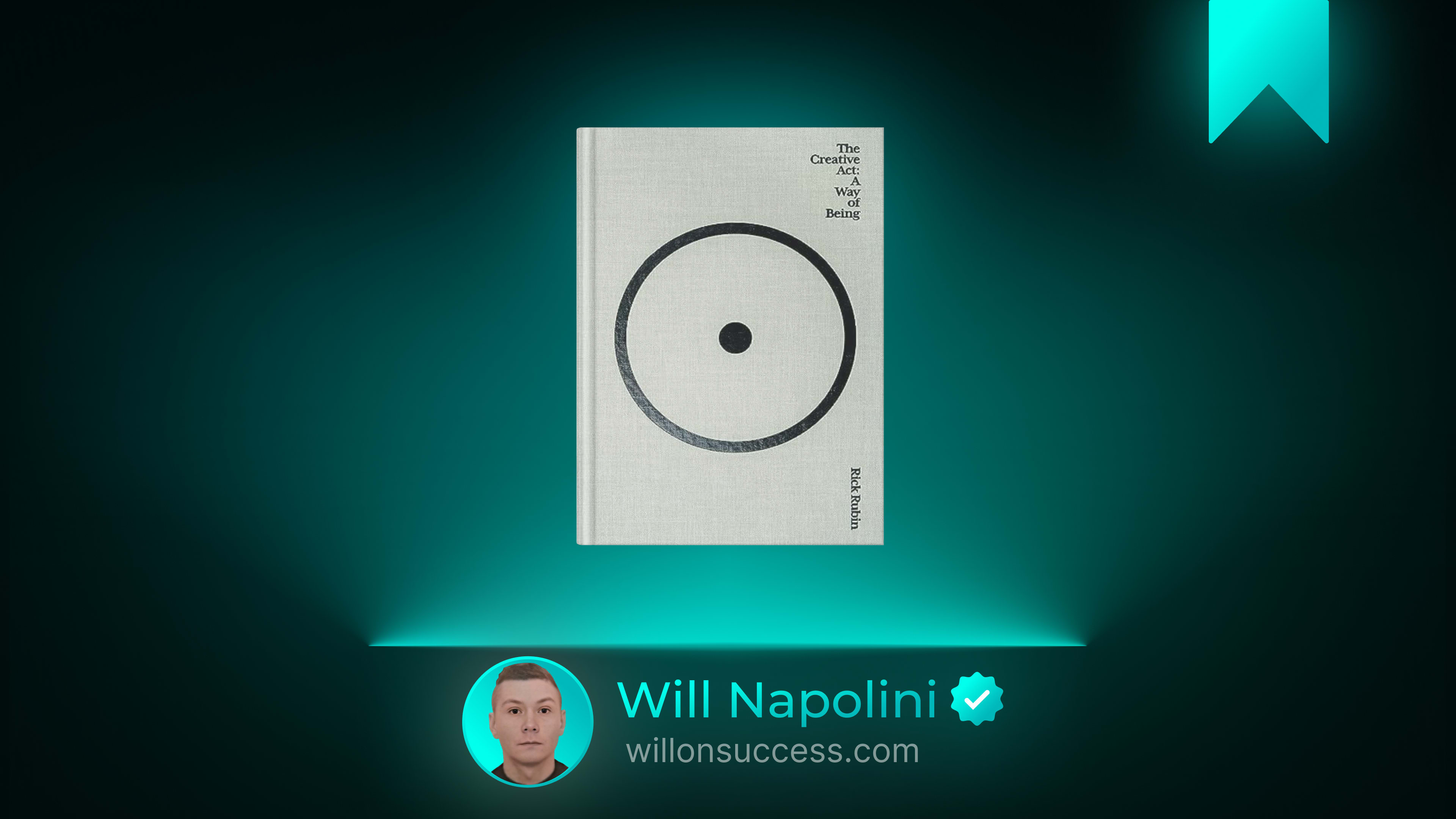
And after all those years, after thousands of hours of listening, of watching an idea arrive in a room and slowly become a song, he wrote a book called The Creative Act: A Way of Being. It is not a manual. It is not a ten-step process. It reads more like a field guide to consciousness, written by someone who has spent his life standing at the edge of the invisible, waiting for something to walk through.
And the first thing he wants you to understand is this: you already have what you need. You have always had it. You simply forgot how to notice.
The Big Idea: The Work Already Exists. Your Job Is to Notice It.
Rubin’s central thesis is not a technique. It is a philosophy. And it goes something like this:
The creative act is not the act of making something from nothing. It is the act of noticing something that already exists, and then having the patience and the craft to bring it into the world.
The song is already in the air. The story is already in the landscape. The solution to the problem is already sitting in the room, waiting for someone to look at it from the right angle. The artist is not a generator. The artist is an antenna.
This is not a mystical claim, though Rubin is comfortable with the mystical. It is a practical one. Think about the best ideas you have ever had. Did you manufacture them? Did you sit down and grind them into existence through sheer willpower? Or did they arrive? Did you notice them? Did you catch them the way you might catch a scent on the wind and then turn to see where it was coming from?
Most of us spend our lives trying to force the work into being. We clench. We push. We stare at the blank page and demand that it yield something. And when it does not, we conclude that we are not creative. That we are empty. That the gift was given to someone else.
Rubin offers a different posture. Not pushing. Receiving. Not forcing. Noticing. Not manufacturing. Discovering.
And this shift—from creator to discoverer—changes everything. Because it means the pressure is off. You do not have to be a genius. You do not have to invent the universe. You just have to be awake enough to see what is already here.
The Story: The Producer Who Does Not Play
To understand Rubin’s philosophy, you have to understand the man himself. And the most important thing to know about Rick Rubin is this: he does not play an instrument. He does not write songs. He does not engineer the equipment. He cannot, by most technical definitions, make music.
What he does is listen.
He sits in a room with an artist—someone who can play, who can write, who has all the technical skills—and he listens. He listens to what they are playing. He listens to what they are trying to play but cannot quite reach. He listens to the space between the notes. He listens to the silence underneath the sound. And then, very gently, he asks a question. Or suggests a direction. Or simply says, That. Do more of that.
He creates a container. A space where the artist feels safe enough to stop performing and start discovering. He removes the audience from the room. He removes the expectations. He removes the pressure to be good. And in that cleared space, the artist often finds something they did not know they had.
This is the entire philosophy of the book, enacted in a single career. Rubin does not impose his vision on the work. He does not arrive with a blueprint and demand the artist execute it. He arrives with attention. With curiosity. With the willingness to sit in the unknown and wait.
And the result, over four decades, is a body of work so varied and so vital that it defies any single genre or style. Because the work was never his. It was the artist’s. He just helped them hear it.
You do not need to be the loudest voice in the room to change what the room sounds like. You just need to be the one who is actually listening.
Awareness: The Foundation of Everything
The book opens not with a chapter on technique or craft, but with a chapter on awareness. On paying attention. On the quality of your noticing.
Rubin argues that creativity begins long before you pick up the brush or open the notebook. It begins with how you walk through the world. Whether you are looking up or looking down. Whether you are present in the conversation or rehearsing your response. Whether you notice the way the light falls on the pavement in the late afternoon, or whether you walk past it without registering it at all.
He writes about the artist as someone who has retained a childlike openness to the world. Not naivety. Not ignorance. But the willingness to see something for the first time, even if you have seen it a thousand times before. The willingness to be surprised by the ordinary.
I think about this when I consider how most of us move through our days. We are efficient. We are optimized. We have routines that get us from point A to point B with minimal friction. And that efficiency is useful. It keeps the trains running. It keeps the bills paid.
But it also builds a kind of callus over our perception. We stop noticing. We stop being curious. We assume we already know what the day will contain, what the person across from us will say, what the project will require. And because we assume we already know, we stop looking. And because we stop looking, nothing new arrives.
Awareness is not a talent you are born with. It is a practice you return to. Every morning, you get to choose whether you will walk through the world with your eyes open or your eyes closed.
Rubin is not asking you to abandon your routines. He is asking you to walk through them with a slightly wider lens. To let the ordinary be ordinary, and then to notice it anyway. To let the familiar be familiar, and then to look at it once more, as though you had just arrived.
The Seed and the Craft: Two Different Modes
One of the most liberating distinctions in the book is Rubin’s separation of the creative process into two fundamentally different phases: the seed phase and the craft phase.
The seed phase is the beginning. The first spark. The fragment of a melody, the image, the sentence, the question, the feeling that something wants to exist. In this phase, Rubin says, there are no rules. There is no editing. There is no judgment. There is no audience. There is only the raw, fragile, half-formed thing that has just arrived, and your willingness to let it be messy, incomplete, and strange.
In the seed phase, you do not ask, Is this good? You do not ask, Will people like this? You do not ask, Does this make sense? You simply let it land. You hold it gently. You follow it wherever it goes, even if it goes somewhere confusing or uncomfortable. You protect it from your own inner critic, which will arrive almost immediately, whispering that this is not good enough, that you should start over, that you are wasting your time.
Then, later—much later—comes the craft phase. This is where you shape the seed. Where you edit. Where you make decisions about structure, rhythm, clarity, and form. This is where you bring your skill, your training, your knowledge of the medium. This is where you ask the hard questions: Does this work? Does it communicate? Where is it weak? What can be removed?
The mistake most of us make is that we try to do both at once. We sit down to write the first draft and immediately begin editing the first sentence. We hum a melody and simultaneously judge whether it is original enough. We start a project and immediately worry about how it will be received.
And the result is that the seed never gets to grow. It is strangled in the soil by the very hands that were supposed to water it.
You cannot build the house and pour the foundation at the same time. You must let the first thing be messy, and trust that the shaping will come later.
If you have ever abandoned a project in the first week because it did not look like the finished version in your head, this is the lesson. The finished version does not exist yet. You are in the seed phase. The seed is supposed to look like dirt and a small green shoot. It is not supposed to look like a tree.
The Audience Is Not in the Room
Rubin returns to this idea again and again, and I think it is one of the most important things he says: when you are creating, the audience is not in the room.
Not your boss. Not your followers. Not your parents. Not the person you are trying to impress. Not the critic who will review it. Not the algorithm. Not the market. Not the trend.
Just you and the work.
This is not arrogance. This is not saying the audience does not matter. Rubin is clear that at some point, the work must leave the studio and enter the world, and at that point, communication matters. Clarity matters. The experience of the listener, the reader, the viewer matters.
But not yet. Not in the first phase. Not when the seed is still fragile. In the first phase, your only job is to be honest. To follow what interests you. To pursue what makes you lean forward. To ask, Does this feel true to me? and ignore every other question until the work is strong enough to stand on its own.
I think about how often I have shaped something—a piece of writing, a decision, a direction—based not on what felt true, but on what I thought would be well-received. How often I have edited the life out of a first draft because I was already imagining the reader’s skepticism. How often I have chosen the safe option because the risky one might not be understood.
And I think about how much quieter, how much flatter, how much more generic those things turned out to be. Because they were not made for me. They were made for an imagined judgment that had not yet been rendered.
The work you make for an audience that does not yet exist will always be smaller than the work you make for the truth that is already here.
Limits Are the Frame That Makes the Picture
There is a section of the book where Rubin talks about constraints. About rules. About limits. And he says something that initially sounds contradictory: limits are not the enemy of creativity. Limits are the engine of creativity.
Think about it. A blank canvas with no boundaries, no constraints, no rules, no requirements, is not liberating. It is paralyzing. The infinite possibility is the enemy of action. If anything is possible, how do you choose? Where do you begin?
But give yourself a limit. Write the story in exactly one hundred words. Compose the song using only three chords. Build the business with no marketing budget. Paint the picture using only blue. And suddenly, the infinite collapses into the specific. The paralysis breaks. The mind starts working. It starts finding paths through the constraint, finding beauty within the boundary, finding solutions that would never have occurred to you in the open field.
Rubin knows this from decades in the studio. Some of the most vital, urgent, alive music he has produced was made under severe constraints. Limited budgets. Limited time. Limited equipment. And those limitations forced the artists to be inventive, to be resourceful, to find the essence of what they were trying to say and strip away everything that was not essential.
A river without banks is a swamp. Give it edges, and it becomes a current. Give it a direction, and it becomes a force.
If you are waiting for the perfect conditions before you begin—the right amount of money, the right amount of time, the right equipment, the right mood—you will wait forever. The conditions will never be perfect. But they do not need to be. They just need to be enough. And the limitations of “enough” will make you sharper, more inventive, more honest than the luxury of “everything” ever could.
The Work Is Never Finished, Only Released
Rubin talks about editing with a kind of reverence that surprises me. He treats the act of removing as equal in importance to the act of adding. Sometimes more important.
He describes the process of taking a piece of work—whether it is a song, a painting, or a life decision—and asking, with ruthless honesty, What is essential here? What is the thing this wants to be? And what is in the way?
Then you remove what is in the way.
Not because it is bad. Sometimes the most beautiful passage, the most clever line, the most impressive technique, is the thing that must go. Because it is not serving the work. It is serving the ego of the maker. It is there because you wanted to show you could do it, not because the piece needed it.
This is painful. I know. I have cut paragraphs I loved because they were not what the piece was actually about. I have walked away from directions I was proud of because they were not the direction the work wanted to go. It feels like loss. It feels like failure.
But it is not. It is the final act of service to the work. It is the moment where you stop making it about you and start making it about what it wants to become.
The most generous thing you can do for your work is to remove the parts that are about you.
Why This Matters Beyond Art
You might be reading this and thinking, I am not a musician. I am not a painter. I am not a writer. This is beautiful, but it is not for me.
And I would gently push back. Because Rubin’s book is not about art. It is about attention. It is about the quality of your engagement with the world. And that applies to every single thing you do.
The way you listen to your partner when they are telling you about their day. The way you approach a problem at work that everyone else has given up on. The way you raise a child. The way you cook a meal. The way you make a decision about where to live, what to build, who to become.
All of these are creative acts. They all require the same qualities Rubin describes: awareness, openness, patience, play, the willingness to sit in the unknown, the courage to follow what interests you even when you do not know where it leads.
You do not need to make art to live as an artist. You need to pay attention. You need to notice. You need to let the work of your life arrive, rather than forcing it into a shape you decided on twenty years ago.
Who Should Read This Book
Read this book if you have ever felt the quiet pull of something you wanted to make, say, or build, and talked yourself out of it because you did not feel qualified, talented, or ready. Read it if you are tired of the pressure to be productive, optimized, and publicly validated. Read it if you want permission to be slow, to be messy, to be curious without a destination.
Read it if you are already a working artist and you have lost the thread. If the craft has become a grind. If you are making things for the algorithm, for the market, for the approval of people you do not respect. This book will remind you why you started.
I will be honest: this is not a book for everyone. It is slow. It is contemplative. It is written in very short sections that read more like poetry or philosophy than instruction. There are no worksheets. There is no five-step framework. There is no “do this on Monday.” If you need structure, checklists, and measurable outcomes, you may find it frustrating.
But if you need to breathe. If you need someone to look you in the eye and say, You are already enough. The work is already inside you. You do not need to earn the right to notice what is here. Then this book will feel like a hand on your shoulder in a moment you did not know you needed it.
One Small Step
Here is what I would ask of you today. One thing. Small. Specific. Something you can do before the day is over.
Take ten minutes. Go outside if you can. If you cannot, sit by a window. Put your phone in another room. Do not bring a notebook. Do not bring a camera. Do not bring an agenda.
Just look. Just listen. Just notice.
Notice the color of the sky. The sound of the traffic, or the birds, or the silence. The way the light falls on the surface in front of you. The texture of the air. The small, ordinary, unremarkable details of the moment you are in.
Do not judge them. Do not photograph them. Do not think about how you would describe them to someone else. Just let them be here. Just let them enter you.
And then, at the end of the ten minutes, write down one sentence about what you noticed. One sentence. It does not have to be good. It does not have to be profound. It just has to be true.
That is the seed. That is the beginning. That is the creative act.
You do not need to be a genius. You do not need to be special. You do not need to earn your place in the world of making and noticing and being alive.
You just need to be here. Awake. Willing to see what is already in front of you.
The work is waiting. It has always been waiting. Not for someone better. Not for someone more ready.
For you.
Open your eyes. Begin.