The Da Vinci Code by Dan Brown: What a Midnight Chase for the Holy Grail Can Teach You About Decoding the Symbols Running Your Life
There is a moment in every life when you realize the map you were handed does not match the territory you are actually walking.
You followed the symbols. You got the degree. You took the title. You stood in the right rooms, bought the right things, and said the right words. And yet, standing there, holding the prize you were told would make you whole, you feel a quiet, echoing emptiness. You realize, with a sudden and unsettling clarity, that the “official story” of your life was written by someone else, for someone else’s purposes.
If you have ever felt that quiet dissonance—the suspicion that the rules you are playing by are arbitrary, and that the truth of your life is hiding somewhere just outside the margins of your calendar—then a thriller published in 2003 was written for you.
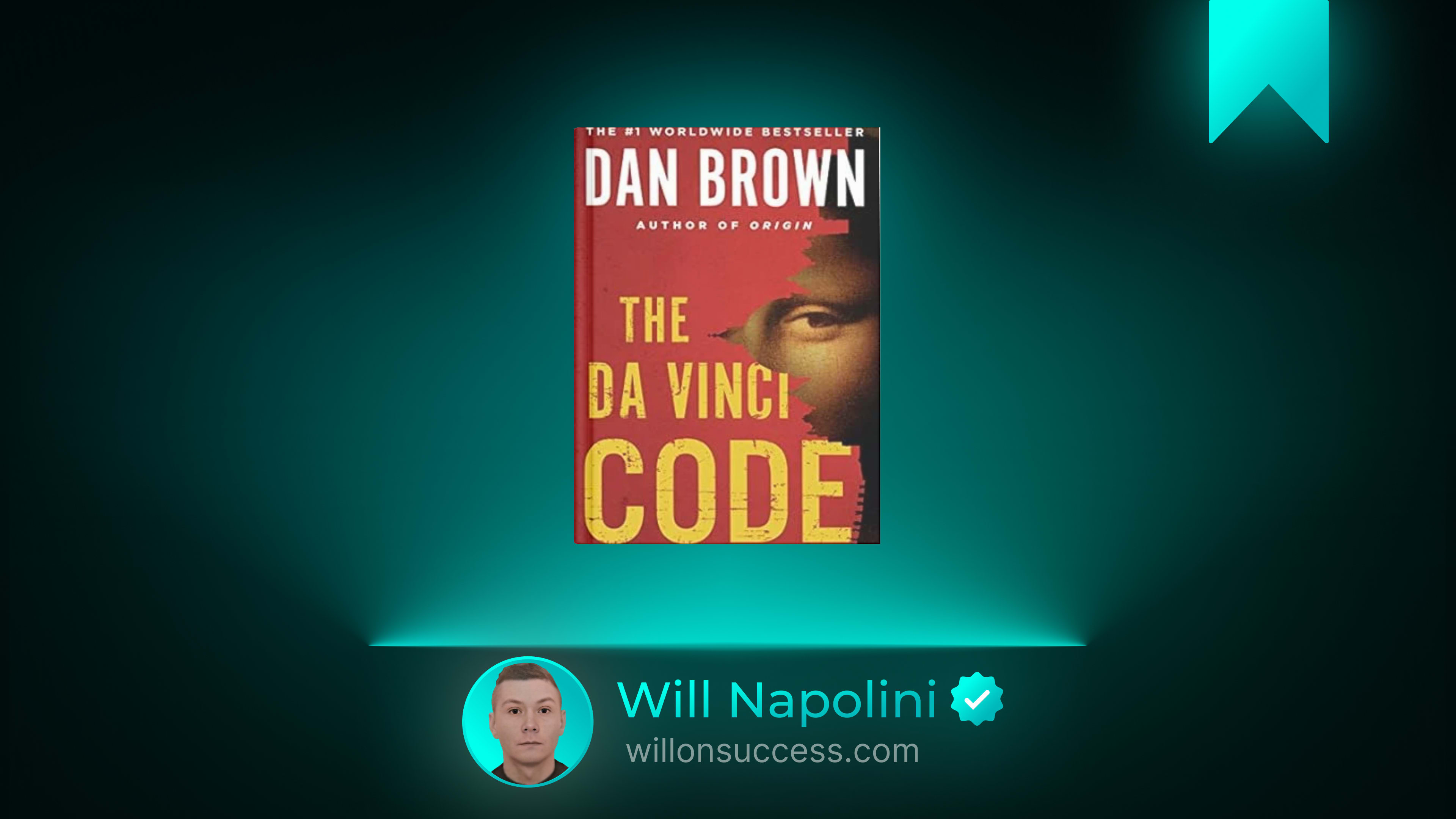
The Da Vinci Code by Dan Brown is ostensibly a book about a murder in the Louvre, a secret society, and a breathless, two-day car chase across Europe. It is famous for its anagrams, its cryptexes, and its cliffhangers. But if you strip away the pulp-fiction adrenaline, you are left with a surprisingly deep philosophical question: What happens when the foundational story of your world is built on a suppression of the truth?
Let us walk through the museum of this novel and look at what it is actually trying to teach you about decoding your own life.
The Big Idea: The “Official Story” Is Rarely the Whole Truth
The engine of The Da Vinci Code is a conspiracy. The novel posits that the foundational narrative of Western history was curated, edited, and enforced by powerful institutions to maintain control. The messy, human, mystical realities of the past were paved over to create a clean, unified, and easily manageable “official story.”
The protagonists, Harvard symbologist Robert Langdon and French cryptologist Sophie Neveu, spend the entire novel running from the authorities—the police, the church, the institutions—because the authorities are invested in maintaining the official story. To find the truth, Langdon and Neveu must become fugitives from the consensus.
Here is the translation for your own life: The “official story” of success, happiness, and fulfillment that society hands you is a highly curated narrative designed to keep the system running smoothly. It is not necessarily designed to keep you alive.
We all have an official story. Go to school, get a safe job, buy a house, retire at sixty-five, and then you can finally start living. We accept this story because it is loud, it is validated by the people around us, and it offers the illusion of safety. But if you follow it blindly, without asking who wrote it and what it is suppressing, you will wake up at the end of it feeling like a stranger in your own life.
Finding your actual path requires the willingness to look at the official story, recognize it as a construct, and occasionally become a fugitive from the expectations of the crowd.
The Story: A Trail of Breadcrumbs in the Dark
To understand the mechanics of the book, you have to look at how it begins.
The curator of the Louvre, Jacques Saunière, is murdered inside the museum. But before he dies, he uses his final moments to leave a trail of clues. He arranges his own body in the pose of Da Vinci’s Vitruvian Man. He writes a sequence of numbers on the floor—the Fibonacci sequence. He leaves an anagram.
He does this because he knows that the “official story” (the police, the authorities) will misunderstand his death. He knows that only someone who understands symbols—someone who knows how to look beneath the surface of reality—will be able to follow his breadcrumbs to the truth. He leaves the trail specifically for his granddaughter, Sophie, and for Robert Langdon.
The entire novel is a process of decoding. A cryptex is a cylinder with rotating dials; it only opens when the letters are aligned to spell the correct password. The characters are constantly presented with locked boxes, hidden messages, and inverted symbols. They must learn to look at the negative space. They must learn that what is hidden is often more important than what is displayed.
Note on Factual Accuracy: Before we go further, I must be entirely honest with you about the book’s relationship with history. Dan Brown famously included a “Fact” page at the beginning of the novel, claiming that the descriptions of artwork, architecture, and secret societies were accurate. Historians, theologians, and art experts quickly and thoroughly dismantled this claim. The Priory of Sion, the secret society central to the plot, was revealed to be a hoax invented by a Frenchman in the 1950s. The historical assertions about the Holy Grail and early Christianity are widely considered by scholars to be fiction presented as fact.
I tell you this not to ruin the fun of the thriller, but to protect your intellectual integrity. Read The Da Vinci Code as a brilliant, fast-paced philosophical metaphor. Do not read it as a history textbook. The literal history in the book is highly disputed, but the psychological truth it points to is profound.
Let us look at the three major psychological principles hiding inside the puzzle.
Principle 1: You Must Decode the Symbols Running Your Life
Robert Langdon’s superpower is not physical strength or martial arts. His superpower is that he understands symbology. He knows that a symbol is just an empty container. It has no inherent power until human beings agree to fill it with meaning. A piece of colored cloth is just cloth until we agree it is a flag. A gold band is just metal until we agree it is a marriage.
Most of us move through life entirely unconsciously, reacting to symbols as if they are physical laws of nature. We see a corner office, and we feel a biological urge to acquire it. We see a luxury car, and we feel a spike of inadequacy. We see a specific milestone on social media, and we feel like we are falling behind.
We let the symbols dictate our emotional weather.
What Langdon teaches us is the power of decoding. When you feel a sudden spike of anxiety, desire, or shame, you have to stop and look at the symbol triggering it. You have to ask: What meaning have I assigned to this? Who gave me this definition? Is this meaning actually true, or is it just an inherited script?
When you learn to decode the symbols in your environment, they lose their hypnotic power over you. You realize that the title on your business card is just a word. You realize that the number in your bank account is just a metric, not a measure of your soul’s worth.
You are not a victim of the symbols around you. You are the author of the meaning you assign to them. When you take back the pen, the anxiety dissipates.
Principle 2: The Exile of the Intuitive Self (The Sacred Feminine)
This is the philosophical heart of the novel, and it is the most applicable to modern personal development.
The central historical conspiracy in The Da Vinci Code is the suppression of the “sacred feminine.” The novel argues that early human spirituality revered the feminine—the goddess, nature, intuition, creation, and mystery. But as institutions grew, they needed structure, control, and hierarchy. The “masculine” energy (in the archetypal, Jungian sense, not strictly gendered) was elevated, and the feminine was demonized, suppressed, and driven underground.
Whether or not you agree with Brown’s historical timeline, the psychological metaphor is devastatingly accurate for how we live today.
Look at the modern workplace. Look at the modern hustle culture. We worship at the altar of the archetypal masculine shadow. We value logic over intuition. We value output over rest. We value aggressive expansion over quiet nurturing. We measure our days by how many items we crossed off a list (conquest) rather than how deeply we connected with the people we love (communion).
We have built a world that is incredibly efficient, highly structured, and profoundly exhausted.
If you are feeling burned out, cynical, or hollow, it is likely because you have exiled your own internal “sacred feminine.” You have suppressed your intuition in favor of spreadsheets. You have ignored your body’s need for rest in favor of your mind’s demand for productivity. You have treated your life like an empire to be conquered rather than a garden to be tended.
Langdon and Sophie’s journey is ultimately about restoring the balance. The “Grail” they are looking for is not a weapon; it is a symbol of the feminine, of receptivity, of the vessel that holds life.
You cannot logic your way into a meaningful life. You cannot optimize your way into peace. You must make space for the quiet, the unstructured, the intuitive, and the mysterious. You must allow yourself to be a vessel that receives, not just an engine that produces.
Principle 3: The Grail Is Not a Cup; It Is a Vessel
The greatest twist in the novel—and the reason it sparked so much controversy—is the revelation of what the Holy Grail actually is.
For centuries, the official story told us the Grail was a physical cup. The chalice used at the Last Supper. A magical object that, if found, would grant eternal life or ultimate power. Kings sent knights on crusades to find it. Men died looking for it in the desert. They were looking for an external object to fix their internal void.
But in the novel, the Grail is revealed to be something entirely different. It is not a cup. It is a lineage. It is Mary Magdalene herself. It is the human capacity to carry the divine within the physical body. The symbol of the chalice is actually a metaphor for the womb, for the human vessel.
This is the deepest personal development lesson hidden in the thriller: Stop looking for the external cup to fill you.
We spend our lives hunting for the Grail. We think, When I get the promotion, I will feel whole. When I find the perfect partner, I will feel safe. When I hit this financial number, I will finally be able to rest. We treat the Grail as an object to be acquired, a prize to be won, a destination to be reached.
But the Grail is not the water. The Grail is the cup.
You are the vessel. The capacity for meaning, for peace, for connection, for the “divine”—whatever that word means to you—is already built into your architecture. You do not need to conquer the world to find it. You need to stop running, sit down, and look inward.
The knights who rode off to the Holy Land were looking in the wrong direction. The treasure was in the room they started in. It was in themselves.
Why This Matters on an Ordinary Tuesday
You are not going to wake up tomorrow and find a cryptex on your nightstand. You are not going to be chased by an albino monk through the streets of London.
But you are going to face the exact same forces Langdon and Sophie faced.
You are going to sit in a meeting where the “official story” is being enforced, and you are going to feel the quiet, intuitive tug that something is wrong. You will have to decide whether to nod along to maintain the peace, or whether to speak your truth and risk becoming a fugitive from the room’s consensus.
You are going to feel the exhaustion of the relentless, masculine drive to “do more,” and you will have to decide whether to push through it with more caffeine, or whether to honor the sacred feminine within you and close the laptop, go for a walk, and simply be.
You are going to be tempted to chase an external symbol—a new car, a new title, a new relationship—believing it will finally make you feel complete. And you will have to remember the twist of the Grail. You will have to remember that no external object can do the internal work of making you whole.
This book teaches you to trust your own eyes. To look at the negative space. To follow the breadcrumbs of your own genuine curiosity, even when they lead you away from the crowded, well-lit paths and into the quiet, unknown margins of your life.
Who Should Read This Book
You should read The Da Vinci Code if you love puzzles, art history, and relentless pacing. It is a masterclass in narrative hooks. Dan Brown knows exactly how to end a chapter on a cliffhanger that makes it physically impossible to put the book down. If you need a story to pull you out of a reading slump, this is the defibrillator you need.
You should read it if you are interested in the intersection of history, religion, and symbolism, provided you read it with a critical, discerning mind.
I must offer a clear caveat: If you are a strict literalist, or if you are deeply protective of orthodox religious history, the novel’s central premises will likely offend you or frustrate you. Furthermore, if you are looking for deeply nuanced, lyrical character development, you will not find it here. The characters are brilliant archetypes and vehicles for the plot, but they are not deeply complex psychological portraits.
Read it for the ride. Read it for the puzzles. Read it for the profound, lingering questions it asks about who gets to write the history books, and what gets left out in the margins.
One Small Step
I want you to do something today that requires a quiet, internal kind of bravery. I want you to find one locked box in your life and look at the dials.
Identify one “Grail” you are currently chasing, and ask yourself if it is a cup or a vessel.
Think of one major goal you are pursuing right now. A financial target. A career milestone. A specific lifestyle change.
Take out a piece of paper and draw a line down the middle. On the left side, write: What I think this object will give me. (e.g., Peace of mind. Respect from my father. The feeling of finally being “enough.”) On the right side, write: How I can generate that exact feeling today, without the object.
If you are chasing a promotion because you think it will give you the feeling of security, what is one small way you can cultivate internal security today, without the title? If you are chasing a specific relationship because you think it will give you the feeling of being seen, how can you practice truly seeing yourself today?
Stop waiting for the external cup to fill you.
Look at the symbols you are chasing. Decode them. Reclaim your intuition. And remember that the most profound mysteries of your life are not hidden in a vault in Zurich or a chapel in London.
They are hiding in the quiet, unexamined spaces of your own ordinary Tuesday.
The trail of breadcrumbs is already laid out. You just have to be willing to follow it.