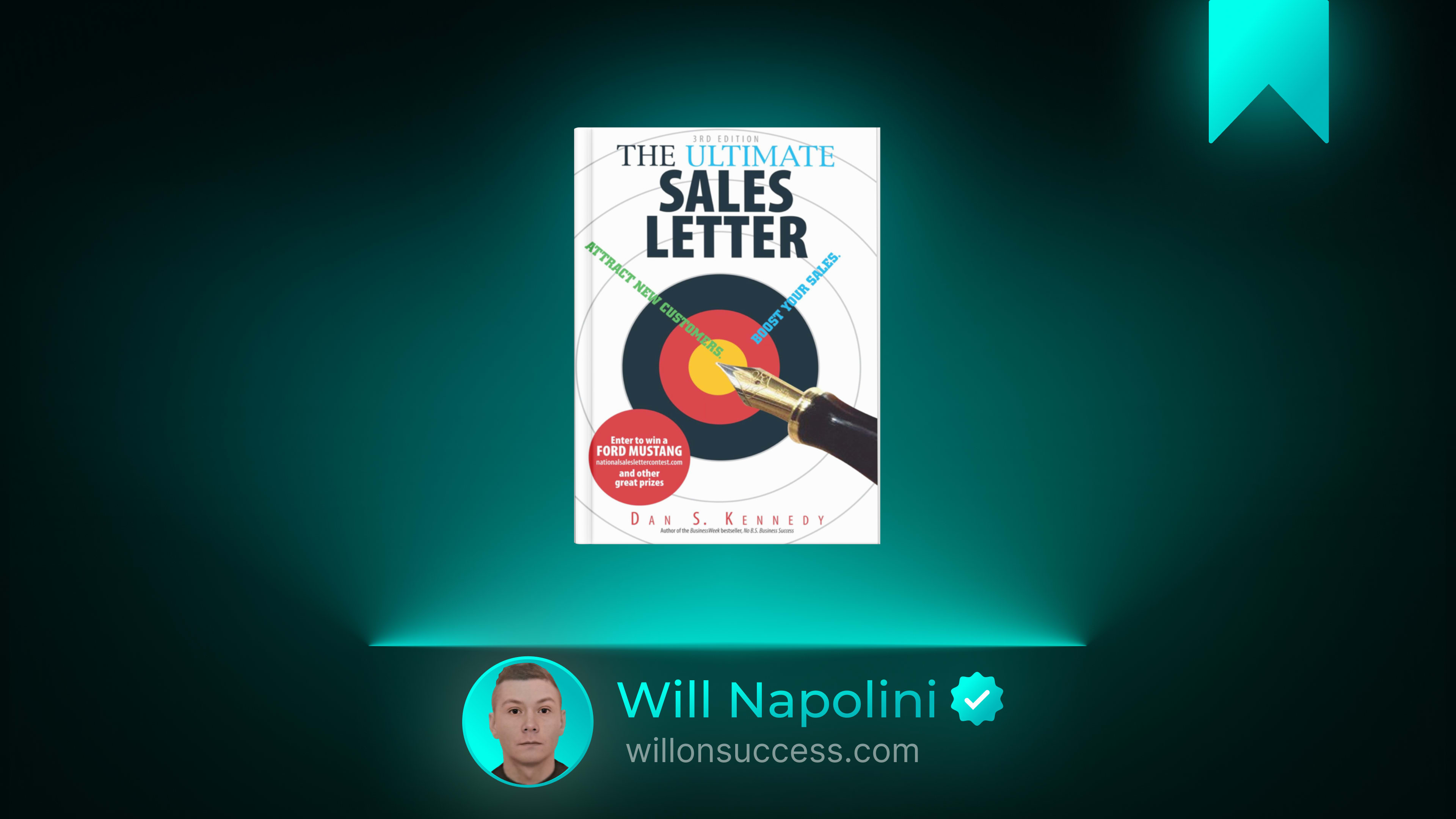
The Ultimate Sales Letter by Dan S. Kennedy: The Psychology of Getting Heard When It Matters Most
You have a solution. A product, an idea, a way to fix a broken process at work, or even a proposal for how to handle a recurring conflict at home. You know it works. You know it is valuable.
But every time you present it, you get the polite nod. The “let me think about it.” The deafening silence of an unread email.
It is one of the most quietly frustrating experiences in professional and personal life: knowing you have value, but lacking the bridge to deliver it to the person who needs it. You assume the idea wasn’t good enough. You assume they just didn’t get it. You assume you need to work harder, speak louder, or send another follow-up.
But what if the problem isn’t your idea? What if the problem is the bridge?
Dan S. Kennedy wrote The Ultimate Sales Letter to solve this exact problem. On the surface, it is a manual for direct-response marketing—a guide to writing long, text-heavy letters that convince strangers to pull out their wallets and buy a product. It is unapologetically about commerce.
But if you read it closely, beneath the tactics and the templates, Kennedy is teaching something much more profound. He is teaching the psychology of human attention. He is teaching how to step entirely out of your own ego and into the lived reality of the person sitting across from you.
Whether you are launching a business, asking for a raise, pitching a project to your board, or simply trying to be understood by the people you love, the principles in this book will change how you communicate. Let me walk you through what Kennedy gets right, why it works, and how you can use it.
The Big Idea: Persuasion is an Act of Radical Empathy
Most people think persuasion is about talking. It is about presenting your features, listing your benefits, and arguing your case with enough logic and enthusiasm that the other person finally gives in.
Kennedy’s central thesis is the exact opposite. Persuasion is not about you. It is not about your product. It is not about your brilliance. Persuasion is the act of proving to the other person that you understand their current pain better than they do.
When people feel misunderstood, their defenses go up. When they feel deeply, accurately understood, their defenses come down.
Kennedy builds his entire framework on a concept he calls “Message to Market Match.” It means that the most brilliant solution in the world will fail if the message does not perfectly align with the specific desires, fears, and vocabulary of the person holding the wallet. You cannot sell a cure to someone who doesn’t believe they are sick. And you cannot persuade someone who feels that you are talking at them rather than to them.
The ultimate sales letter is not a monologue. It is a guided conversation where the reader feels seen, understood, and safely led toward a better version of themselves.
The Architecture of Attention: Building the Bridge
Think of communication as building a bridge across a river. You are standing on one side with your solution. Your audience is standing on the other side with their problem.
Most people build their bridge starting from their own side. They lay the first plank down and say, “Look at my credentials.” The next plank says, “Look at my innovative features.” The third plank says, “Look at my competitive pricing.”
By the time the bridge reaches the middle of the river, the person on the other side has already walked away. Why? Because you didn’t start where they were.
Kennedy insists that you must build the bridge starting from their side. You have to step into their mud, acknowledge their weather, and validate their frustration before you ever ask them to walk across to your solution.
Here is how he structures that bridge, and what it looks like when applied to your life.
The Headline is a Filter, Not a Clever Slogan
In copywriting, the headline is the first sentence. Kennedy famously notes that if the headline fails, the rest of the letter doesn’t matter because no one will read it. He spends more time crafting the headline than any other part of the document.
But here is the mistake most people make: they try to be clever. They use puns. They use abstract, brand-building language.
Kennedy teaches that a headline has one job: to qualify the reader and make a clear, compelling promise. A clever headline gets a compliment. A clear headline gets a customer.
Think about how this applies to your inbox. When you send an email with the subject line “Checking in” or “Quick question,” you are being clever, or at least lazy. You are forcing the recipient to do the work of figuring out why they should care. If you change the subject line to “Idea for reducing Q3 software costs by 15%,” you have built a headline. You have stated the promise. You have made it impossible for the right person to ignore.
Agitate the Problem Before Offering the Cure
This is the part of Kennedy’s teaching that makes some people uncomfortable. He advises writers to “agitate” the problem. To poke the bruise. To describe the reader’s pain in such vivid detail that the reader thinks, This person has been reading my diary.
Why do this? Because human beings are deeply resistant to change. We will tolerate a familiar pain much longer than we will embrace an unfamiliar solution. People do not buy prevention; they buy cures. They do not change their lives because things are “kind of okay.” They change when the pain of staying the same becomes greater than the pain of changing.
If you are a leader trying to get your team to adopt a new, difficult software system, do not start by praising the software’s features. Start by describing the exact, agonizing reality of their current Friday afternoons. Describe the manual data entry. Describe the lost weekends. Describe the frustration.
When you articulate their pain accurately, you earn the right to offer the solution. You cannot heal a wound the other person hasn’t admitted they have.
Write Like You Speak, Not Like You Publish
One of the most liberating lessons in The Ultimate Sales Letter is Kennedy’s demand for a conversational tone. He despises “corporate speak.” He hates jargon, buzzwords, and the sterile, passive voice that infects modern business writing.
He tells his students to write to one person. Picture your ideal customer sitting across from you at a diner. How would you explain your idea to them over a cup of coffee? You wouldn’t say, “We leverage synergistic paradigms to optimize deliverables.” You would say, “We help you stop losing money on bad hires.”
This is a profound lesson in respect. When you use jargon, you are trying to sound smart. When you use simple, direct language, you are trying to be understood. Clarity is the highest form of intellectual generosity.
Whether you are writing a resume, a cover letter, a proposal, or a difficult text message to a friend, strip away the armor of complex words. Speak plainly. Use the word “You” three times more often than you use the word “I”.
The Architecture of the Close and the Power of the P.S.
Kennedy is a master of the “Call to Action.” He teaches that you must tell the reader exactly what to do next, remove the friction of doing it, and give them a compelling reason to do it right now.
But one of his most famous tactical insights is the power of the P.S. (the postscript).
In direct mail, the eye naturally drops to the bottom of the page. If the headline is the most read part of a letter, the P.S. is the second most read. Kennedy uses the P.S. to restate the core promise, remind the reader of the guarantee, or add a final, urgent reason to act.
You can use this psychological quirk in your daily life. If you write a long, detailed proposal or a heartfelt letter, do not just sign off with “Sincerely.” Add a P.S. that cuts to the heart of the matter.
P.S. I know this requires a shift in how we operate, but I truly believe this is what will give us our weekends back by December.
The P.S. feels intimate. It feels like an afterthought, which makes the reader drop their guard and absorb it as a secret truth.
Why This Matters Beyond the Business World
It is easy to read a book about sales letters and think, This is for marketers. I am an engineer, a teacher, a manager.
But I want to challenge that assumption. Every time you try to change someone’s mind, you are in direct response.
If you are asking your spouse to change a habit that is hurting your marriage, you are writing a sales letter. If you use logic, statistics, and accusations (your “features”), they will build a wall. If you use Kennedy’s method—starting with deep empathy for their stress, validating their intentions, and clearly painting a picture of a better future for both of you—you build a bridge.
If you are interviewing for a job, your resume is a sales letter. Most resumes are a list of historical facts. A Kennedy-style resume is a document that agitates the employer’s problem (“You need someone who can untangle this specific mess”) and positions you as the inevitable cure.
Understanding these principles shifts you from being a passive participant in your life to an active architect of your circumstances. You stop waiting to be noticed. You start designing how you are perceived.
Who Should Read This Book
If you are an entrepreneur, a freelancer, or someone responsible for generating revenue, this book is mandatory reading. It will likely pay for itself the first time you apply its headline formulas to your website or emails.
If you are a leader, a manager, or someone who frequently needs to persuade stakeholders, this book will cure you of the habit of writing dense, unreadable memos. It will teach you how to command attention in a distracted world.
Who is this book not for? If you are looking for aesthetic design advice, or if you work in high-level corporate “brand awareness” where the goal is vague sentiment rather than measurable action, Kennedy’s blunt, aggressive, response-driven style will irritate you. He does not care about pretty logos. He cares about whether the cash register rings.
It is also a book of its time in some of its specific examples. You will have to translate his direct-mail tactics into modern digital formats. But the psychology remains untouched. Human nature has not changed since the book was written. We still crave understanding, we still fear loss, and we still want to know what is in it for us.
One Small Step You Can Take Today
I do not want you to just read this and nod in agreement. I want you to change how you communicate today.
Here is your assignment. Think of an email you need to send tomorrow. It could be a request to a boss, a pitch to a client, or an outreach to a mentor.
Before you write a single word, take out a blank piece of paper and write down the answers to these three questions:
- What is the specific, painful problem the person on the other side of the screen is dealing with right now?
- What is the exact, tangible result they want to achieve?
- How can I state my request in a way that proves I am helping them get from #1 to #2?
Write your email based only on those answers. Strip out every sentence that is about you, your needs, or your background. Make the first sentence about them. Make the last sentence a clear, frictionless request.
You will find that when you stop trying to be impressive, and start trying to be useful, the world suddenly becomes very willing to listen.
People do not buy features, and they do not listen to lectures. They invest in clarity. And the person who brings clarity to a noisy room is the person who ultimately leads it.