Mastering the Art of Persuasion: A Mentor's Guide to The Adweek Copywriting Handbook
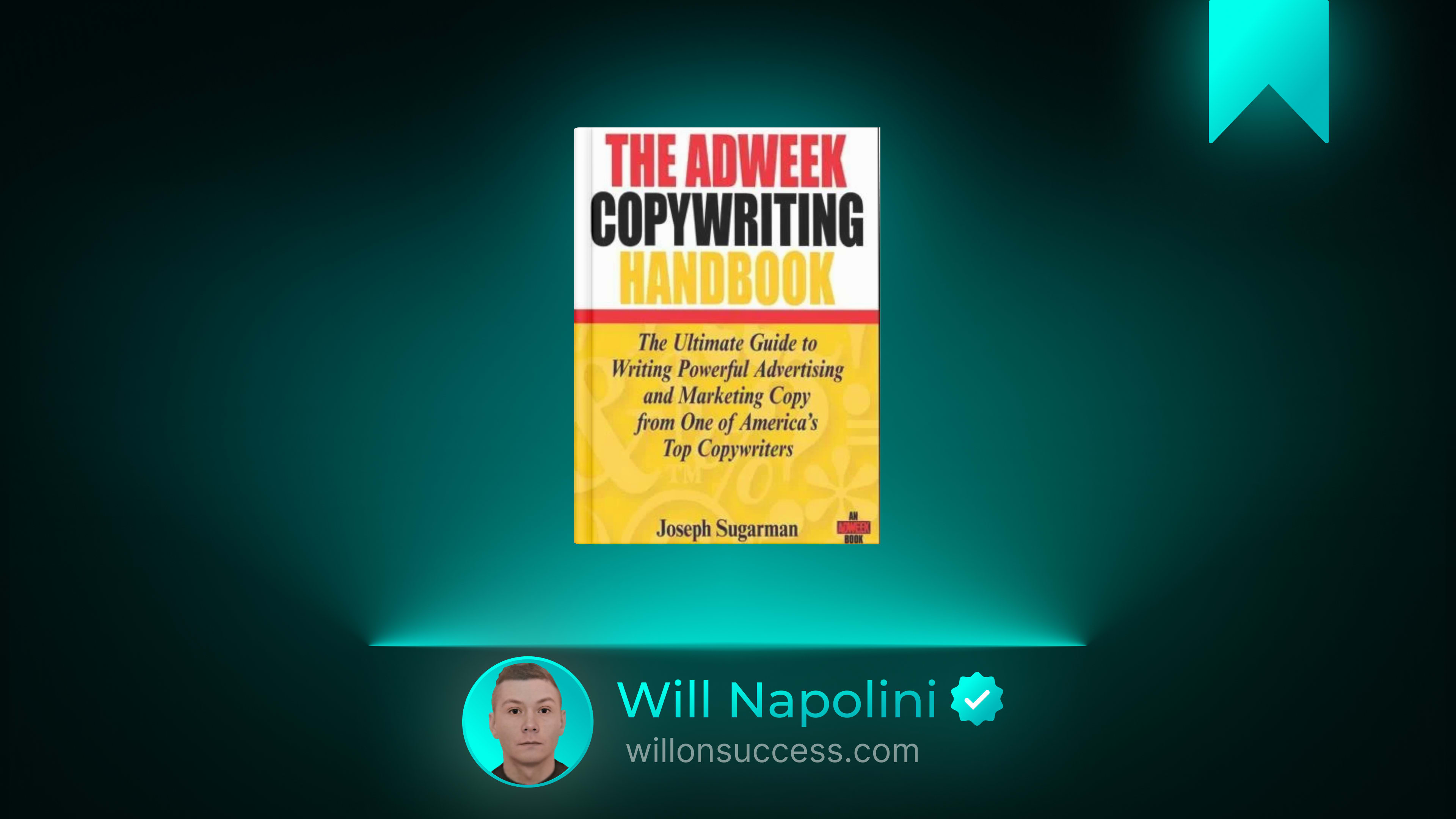
I used to believe that good writing was about having the biggest vocabulary or the cleverest turns of phrase. Early in my career, I thought that if I just used the right adjectives and structured my sentences perfectly, people would naturally understand my point and agree with me.
Then I encountered the work of Joseph Sugarman, and it completely dismantled my ego.
He taught me that writing is not about you at all. It is not about showing off your intellect. It is about the person on the other side of the page. If I could sit across the table from you right now, I would tell you that the greatest mistake we make in communication is assuming our job is to impress. Our actual job is to guide.
In his legendary book, The Adweek Copywriting Handbook, Sugarman distills a lifetime of direct-response marketing into a masterclass on human psychology. But if you look closely, this is not just a book about selling products. It is a profound study on how to move people from a state of indifference to a state of action.
Whether you are writing an email, leading a team, pitching an idea, or simply trying to be understood by your spouse, the principles in this book will change the way you connect with others.
The Big Idea: The Sole Purpose of the First Sentence
If you take only one concept away from Joseph Sugarman’s work, let it be this: The sole purpose of the first sentence of any communication is to get the reader to read the second sentence.
The purpose of the second sentence is to get them to read the third. And so on, until the desired action is taken.
We spend so much time agonizing over the final pitch, the big conclusion, or the ultimate call to action. But Sugarman flips the script. He argues that you do not sell in the headline. You do not persuade in the final paragraph. You persuade in the invisible, frictionless momentum you build between every single word.
Persuasion is not a heavy lift; it is a gentle slope. When you understand this, you stop trying to force your ideas onto people, and you start designing an experience that makes it effortless for them to follow you.
The Story of the Slippery Slide
To understand how this works, we need to look at Sugarman’s most famous framework: The Slippery Slide.
Imagine a child at a playground. If the slide is dry, bumpy, and covered in debris, the child will get stuck halfway down. They will have to push themselves, struggle, and eventually just climb off. The friction stops the momentum.
But if that slide is wet, polished, and perfectly smooth, the child doesn’t have to do any work at all. Gravity takes over. They slide all the way to the bottom without ever thinking about the effort required.
Your writing, your emails, your presentations—these are the slide. Every piece of jargon, every confusing transition, every moment where you try to say too much at once is a patch of dry friction. It stops the reader’s momentum. They get stuck. They close the tab. They delete the email.
Your job is to make the slide so smooth that the reader’s attention simply glides to the bottom. You do this by keeping things simple, creating curiosity, and ensuring that every sentence naturally demands the next one.
Your First Sentence Exists Only to Serve the Second
Most of us try to do too much in our opening lines. We try to explain the entire premise, establish our credibility, and make our main point all at once. The result is a dense, heavy paragraph that repels the reader.
Sugarman teaches that the opening must be light, engaging, and deeply relevant to the reader’s immediate reality. It should be a hook, but not a heavy one. It should be an invitation.
When you write, you must ruthlessly eliminate anything that causes the reader to pause and think, “Wait, what does that mean?” Confusion is the ultimate friction. If the reader has to re-read a sentence to understand it, you have lost the slippery slide. They are now pushing themselves uphill.
What this looks like in practice is a shift from complexity to clarity. You start small. You establish a rhythm. You make a simple promise, and then you deliver on it in the very next breath. You build trust through microscopic agreements. When the reader nods at your first sentence, they are psychologically primed to nod at your second.
You Are Not Writing to an Audience; You Are Writing to One Person
There is a dangerous illusion in modern communication: the idea of the “audience.” When we imagine we are speaking to a crowd, our tone naturally becomes formal, distant, and performative. We use bigger words. We adopt a professional posture. We try to sound like an institution.
Sugarman vehemently rejects this. He insists that all effective communication is essentially a one-on-one conversation.
You are not writing to a demographic. You are not writing to “stakeholders” or “followers.” You are writing to one specific person who happens to be sitting in a crowded room.
If I were to ask you to write a letter to your best friend explaining why they need to change a bad habit, how would you write it? You would use simple words. You would speak with warmth. You would be direct, but compassionate. You wouldn’t use the word “utilize” when “use” works perfectly fine.
When you write to one person, your tone becomes intimate. Intimacy breeds trust, and trust is the currency of persuasion. If you want your words to move someone, strip away the corporate polish and the academic posturing. Pull up a chair. Speak to them as if they are the only person in the world.
Emotion Opens the Door, and Logic Locks It
We like to think of ourselves as rational creatures. We believe we make decisions based on facts, data, and careful analysis. Sugarman, having spent decades testing what actually makes people buy, knew the truth: people buy on emotion, and they use logic to justify the decision after the fact.
This is not a cynical view of human nature; it is simply an honest one.
Think about the last major decision you made. Perhaps you bought a car, chose a house, or accepted a new job. You likely spent weeks gathering data, comparing specs, and reading reviews. But deep down, you already knew which one you wanted on the first day. The data was just the alibi your mind constructed to feel good about what your heart had already decided.
When you communicate, you must appeal to the heart first. What does the person desire? What are they afraid of? What do they hope to become? Once you have connected with their emotional reality, then you provide the logic.
Logic is the steering wheel, but emotion is the engine. If you try to steer a car with no engine, you aren’t going anywhere. Give your reader a reason to care before you give them a reason to agree.
The Power of the Seed and the Harvest
In gardening, you do not plant a seed and expect a tomato the next morning. You plant the seed, water it, and wait. Sugarman applies this same principle to persuasion through what he calls psychological triggers and resonance.
When you introduce a concept early in your communication, you are planting a seed. You don’t need to explain it fully right away. You just need to let it sit in the reader’s mind. As you continue to write, you water that seed with related ideas, stories, and benefits. By the time you reach your conclusion, the seed has grown into a harvest. The reader feels as though they have arrived at the conclusion entirely on their own.
This is the difference between telling someone what to think and guiding them to think it themselves. When you force a conclusion, people resist. When you plant seeds and let them connect the dots, they feel a sense of ownership over the idea. And people fiercely defend ideas they believe are their own.
Why This Matters on an Ordinary Tuesday
You might be reading this and thinking, “This is great for selling sunglasses or gadgets, but I’m just a manager trying to get my team to adopt a new software.”
Here is why this matters for you, on an ordinary Tuesday, in the middle of your regular life.
Every time you send an email asking for a favor, you are copywriting. Every time you try to explain your side of an argument to your partner, you are copywriting. Every time you pitch a new initiative to your boss, you are copywriting.
The mistake most of us make is assuming that because our cause is just, or our logic is sound, people will automatically listen. We rely on the inherent “rightness” of our position. But the world is noisy. People are tired, distracted, and protective of their own time.
If you do not reduce the friction in your communication, your brilliant ideas will die in unread inboxes and ignored conversations. Applying Sugarman’s principles helps you avoid the tragedy of being right but being ignored. It shifts your focus from what you want to say to what the other person needs to hear. It transforms you from someone who demands attention into someone who earns it.
Practical Application: Turning Principles into Behavior
Understanding these concepts is only the first step. Action is where the real change happens. Here is how you can integrate this wisdom into your daily routine.
1. The “Next Sentence” Audit Take an important email or document you are currently drafting. Read it aloud. After every single sentence, ask yourself: Does this sentence make the reader want to read the next one? If the answer is no, rewrite it. Cut the jargon. Shorten the thought. Add a bridge of curiosity. Make the slide smooth.
2. The “Empty Chair” Technique Before you write your next proposal, presentation, or difficult message, visualize one specific person who needs to receive it. Put an empty chair across from you. Imagine they are sitting in it. Now, write the document as if you are speaking directly to them, looking them in the eye. Notice how your vocabulary simplifies and your tone warms up. Keep that tone when you hit “send.”
3. Lead with the Emotional Reality The next time you need to persuade someone, spend the first twenty percent of your communication entirely on their emotional reality. Do not mention your solution yet. Validate their frustration, acknowledge their goals, and show them that you understand how they feel. Only once they feel understood should you introduce the logic of your solution.
Who Should Read This Book
The Adweek Copywriting Handbook is a masterpiece, but it is not for everyone.
If you are looking for a quick, modern guide to social media algorithms or viral marketing hacks, this book will frustrate you. It is dense, unapologetically old-school, and deeply focused on long-form direct response. It is also not for the purely academic reader who views marketing as a theoretical science; Sugarman is a practitioner, and he writes like one.
However, if you are an entrepreneur, a writer, a leader, or anyone whose livelihood depends on the ability to influence others, this book is essential. It is for the person who wants to understand the deep, mechanical psychology of why people say “yes.” It is for the reader who values timeless principles over fleeting trends.
Joseph Sugarman does not just teach you how to write better ads. He teaches you how to think more clearly about human desire.
One Small Step
You do not need to rewrite your entire website or launch a massive marketing campaign to start using these ideas today. You just need to change your next interaction.
Right now, open your email inbox or your messaging app. Find a message you need to send to a colleague, a client, or a friend.
Look at the first sentence. Is it about you? Is it heavy? Is it full of context that the reader doesn’t care about yet?
Rewrite that first sentence. Make it entirely about them. Make it so clear, so relevant, and so intriguing that they have no choice but to read the second one.
The Path Forward
Persuasion is often misunderstood as manipulation. But true persuasion is not about tricking someone into doing something they don’t want to do. It is about clearing the path so they can see the value of what you are offering, and making it effortless for them to choose it.
You are not just arranging words on a page or speaking into the void. You are laying down stones for someone else to walk on.
Make the stones smooth. Remove the obstacles. Guide them gently, one step at a time, and you will find that people are much more willing to follow you than you ever imagined.