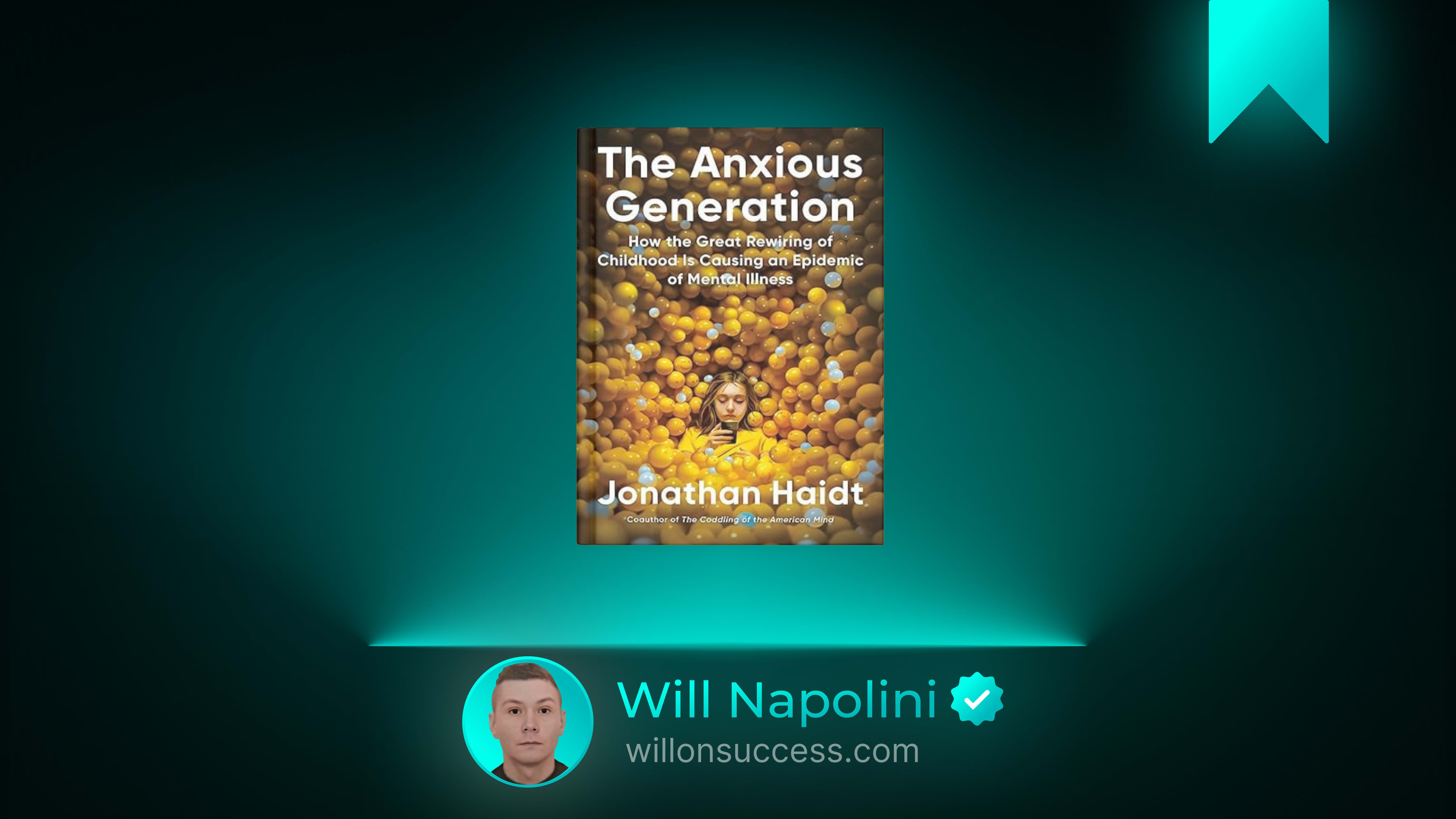
The Anxious Generation Summary: Reclaiming Childhood in a Phone-Based World
I remember a time when the sound of childhood was the slamming of a screen door. It was the noise of kids spilling out into the neighborhood, negotiating the rules of a pickup game, scraping their knees, and figuring out how to resolve conflicts without an adult immediately stepping in.
Today, that sound has been replaced by a profound, eerie silence.
If you walk into a middle school cafeteria or a teenager’s bedroom, you are far more likely to see the blue glow of a screen than the vibrant chaos of real-world play. And alongside this silence has come a deafening crisis: skyrocketing rates of anxiety, depression, self-harm, and social withdrawal among young people.
For years, we treated this crisis as a mystery. We blamed academic pressure, economic uncertainty, or simply the natural turbulence of adolescence. But Jonathan Haidt, a social psychologist who has spent decades studying human flourishing, looked at the data and saw something entirely different. He saw a cliff.
In The Anxious Generation, Haidt delivers a diagnosis that is both deeply unsettling and profoundly hopeful. The mental health crisis is not a mystery, and it is not inevitable. It is the direct result of a massive, uncontrolled experiment we conducted on an entire generation. We replaced a play-based childhood with a phone-based childhood.
If you are a parent, an educator, or a young adult trying to make sense of the exhaustion and anxiety permeating modern life, this book is not just a warning. It is a roadmap for how we take our world back.
The Big Idea: The Great Rewiring
The central thesis of The Anxious Generation is straightforward and backed by overwhelming data: between roughly 2010 and 2015, childhood underwent a “Great Rewiring.”
During this brief window, smartphones became ubiquitous, front-facing cameras became standard, and high-speed mobile internet allowed social media platforms to migrate from desktop computers into the pockets and bedrooms of adolescents.
Almost immediately, the data on youth mental health changed direction. Rates of severe anxiety, depression, and self-harm, which had been relatively stable for decades, suddenly spiked. This was not a gradual slope; it was a cliff. And it happened first in countries that adopted smartphones earliest, and most severely among adolescent girls.
Haidt’s core argument is that human brains and bodies evolved to develop through real-world, embodied experiences. We are not designed to spend our formative years tethered to a device that maximizes engagement through outrage, comparison, and infinite novelty. When we deprive children of the physical world and immerse them in the virtual one, we disrupt the very mechanisms that build resilience, identity, and emotional stability.
The Four Foundational Harms
To understand why this shift is so damaging, Haidt breaks down the mechanics of the phone-based childhood into four foundational harms. These are not abstract concepts; they are daily realities for millions of young people.
1. Social Deprivation For generations, children learned how to read body language, navigate conflict, and build deep friendships through unstructured, face-to-face play. The phone-based childhood replaces this rich, embodied interaction with flat, asynchronous digital communication. You cannot learn to resolve a real-world dispute via emoji. The result is a generation that is hyper-connected digitally but profoundly lonely in reality.
2. Sleep Deprivation This is perhaps the most easily fixable, yet most ignored, harm. When a smartphone is in a child’s bedroom, sleep is inevitably compromised. The blue light suppresses melatonin, the notifications trigger cortisol, and the infinite scroll delays bedtime. Chronic sleep deprivation in a developing brain is a direct pipeline to anxiety, depression, and cognitive decline.
3. Attention Fragmentation The modern digital environment is engineered to shatter focus. Short-form videos, constant pings, and algorithmic feeds train the brain to expect a new stimulus every few seconds. When a child’s attention is constantly fragmented, they lose the ability to engage in deep work, sustained reading, or the quiet introspection required to build a stable sense of self.
4. Addiction We must call it what it is. Social media platforms and video games are not neutral tools; they are sophisticated behavioral engines designed to exploit psychological vulnerabilities. They use variable-ratio reinforcement schedules—the same mechanism that makes slot machines addictive—to keep users scrolling, clicking, and returning. You cannot out-argue a dopamine loop with a teenager. Willpower is not a match for a supercomputer.
The Collective Action Problem
If you are a parent reading this, you might be feeling a familiar knot of guilt or defensiveness. You might be thinking, I tried to take the phone away, but my child was the only one in their friend group without one. They were socially isolated. I had to give it back.
Haidt anticipates this, and it is one of the most compassionate and crucial insights in the book: This is a collective action problem.
We are trapped in a tragedy of the commons. Individually, parents are making rational choices to keep their children safe and included. But collectively, these individual choices create a toxic environment for everyone. If you are the only parent who insists on a phone-free sleepover, your child pays the social price.
Therefore, the solution cannot be individual. You cannot protect your child from the tide by building a small sandcastle. We must build a seawall together. This means parents in a community, or a grade level in a school, must make a pact. When everyone agrees to delay smartphones or social media, the social pressure vanishes, and the children are freed.
The Gender Divide in Digital Harm
While the phone-based childhood harms everyone, it does not harm everyone in the same way. Haidt draws a clear, data-driven distinction between how this rewiring affects boys and girls.
Girls are disproportionately harmed by social media. The visual, comparison-driven nature of platforms like Instagram and TikTok exacerbates relational aggression, body image issues, and internalizing disorders. The harm is loud and visible in the form of anxiety, depression, and self-harm.
Boys, on the other hand, are disproportionately harmed by gaming, pornography, and the broader withdrawal from the real world. The harm to boys is often quieter. It manifests as externalizing disorders: a lack of motivation, declining academic performance, and a failure to launch. They are not necessarily crying out in distress; they are simply logging off from reality and retreating into virtual worlds where the rules are simple and the rewards are guaranteed.
Recognizing this divide is essential. We cannot apply a one-size-fits-all solution. Girls need protection from the relentless social comparison of the feed, while boys need to be actively pulled back into the physical world of risk, effort, and real-world achievement.
Independence Is the Antidote
It is easy to read this book and feel that the only solution is to ban technology entirely. But Haidt is clear: the goal is not to raise children in a bubble. The goal is to give them back their childhood.
The antidote to the phone-based childhood is the return of the play-based childhood.
This does not mean scheduling more extracurricular activities or hovering over your child to ensure they are playing “correctly.” It means granting them the gift of independence. It means allowing them to walk to the park alone, to ride their bikes in the neighborhood, to experience minor failures, and to resolve their own disputes.
Risk is not the enemy of safety; it is the prerequisite for resilience. When children are allowed to test their limits in the physical world, they learn what they are capable of. They build an internal locus of control. They learn that they can handle difficult things. A child who has never been allowed to navigate the real world without a parent or a screen will be utterly unequipped to handle the inevitable hardships of adult life.
Why This Matters on an Ordinary Tuesday
You might be thinking that this is a macro-level societal issue, far beyond your control on an ordinary Tuesday. But the macro is built entirely of micro decisions.
Every time you hand a distracted, whining child a smartphone to keep them quiet in a restaurant, you are casting a vote for the phone-based childhood. Every time you allow a laptop to stay in a teenager’s bedroom overnight, you are compromising their foundation.
But the reverse is also true. Every time you choose to have a device-free dinner, every time you encourage your child to walk to a friend’s house instead of driving them, every time you join with another parent to say, “We are waiting until eighth grade for a smartphone,” you are actively rewiring the culture.
You are not just managing behavior; you are protecting a developmental ecosystem. You are giving your child the space to become a solid, grounded human being in a world that is desperately trying to turn them into a data point.
Practical Application: Turning Principles into Behavior
Understanding the problem is only the beginning. Action is where we reclaim our agency. Here is how you can apply Haidt’s framework immediately.
1. Initiate the Collective Pact Do not fight this battle alone. Reach out to three other parents in your child’s grade or neighborhood. Propose a simple, unified agreement: no smartphones until at least eighth grade (or high school), and no social media accounts before age 16. When you act as a group, you remove the social stigma and give your children the gift of a shared norm.
2. Enforce the Phone-Free Bedroom This is non-negotiable. Buy a cheap, traditional alarm clock today. Establish a rule that all phones, tablets, and laptops charge in the kitchen or a parent’s bedroom overnight. Expect resistance. Your child will argue, bargain, and claim that everyone else does it. Hold the line with warmth and firmness. Say, “I love you too much to let you sacrifice your sleep and your mental health. This is not up for debate.” Protect their sleep as fiercely as you would protect them from a physical threat.
3. Engineer Real-World Independence Look at your child’s weekly routine. Where can you safely step back? Can they walk to school? Can they go to the local store alone? Can they build a fort in the woods without you hovering? Start small, but start. Give them the responsibility of navigating the physical world. Let them be bored. Boredom is the birthplace of creativity and self-direction.
Who Should Read This Book
The Anxious Generation is essential reading for parents of children aged 8 to 18, educators, school administrators, and policymakers. It is also highly valuable for young adults (ages 18-25) who are trying to understand the roots of their own digital fatigue, anxiety, and lack of focus, and who want to take deliberate steps to reclaim their attention.
However, this book is not for the reader who believes that technology is inherently neutral, or who dismisses the youth mental health crisis as “just normal teenage angst.” If you are unwilling to consider that a fundamental shift in childhood development has occurred, the data in this book will likely make you defensive.
But if you are willing to look honestly at the cost of our digital convenience, this book will arm you with the clarity and courage to make a change.
One Small Step
You do not need to overhaul your entire family’s digital life this very second. You just need to win the battle for the bedroom tonight.
Right now, go to your child’s room (or your own). Take the phone, tablet, or laptop. Plug it into a charger in the kitchen or the hallway. Place a simple, inexpensive alarm clock on the nightstand instead.
When your child asks why, look them in the eye and say, “Because your brain needs to rest, and I am on your team.”
The Path Forward
We cannot scroll our way back to childhood. The genie is out of the bottle, and the technology is not going to disappear. But we are not powerless.
We have the power to set boundaries. We have the power to build communities of parents who support one another in holding the line. We have the power to step back and let our children scrape their knees, navigate their own conflicts, and discover the quiet joy of a world that does not require a password.
The most profound gift you can give a young person today is not the latest device. It is the freedom to look up, to breathe deeply, and to discover who they are when the screen goes dark.