The Art of Being Alone Summary: Finding Wholeness in Your Own Company
There is a specific kind of panic that sets in for many of us the moment the room goes completely quiet. We reach for our phones. We turn on a podcast. We fill the air with background noise because the alternative—sitting alone with our own unfiltered thoughts—feels like a threat.
For a long time, I viewed being alone as a failure. I thought that if I was truly successful, truly loved, and truly living, my calendar would be full and my phone would never stop buzzing. I treated solitude as a waiting room, a temporary inconvenience I had to endure until my “real” life began.
If you have ever felt the sting of loneliness, or if you find yourself constantly seeking external validation to feel worthy, I want to share a perspective that will fundamentally change how you experience your own life.
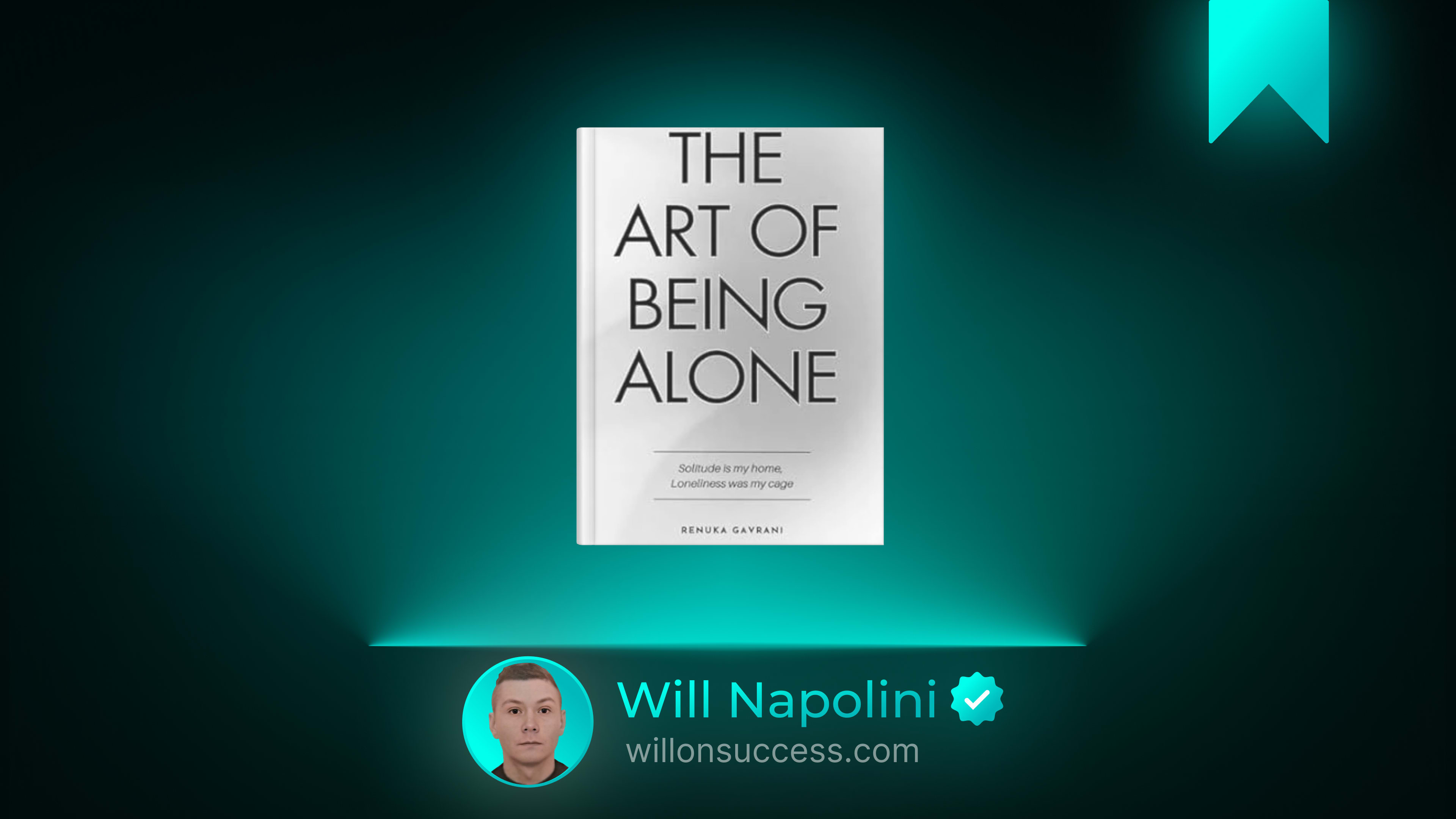
In The Art of Being Alone, Renuka Gavrani offers a gentle but radical shift in how we view our own company. This is not a book about how to find a partner, nor is it a manual for isolating yourself from the world. It is a profound exploration of emotional independence. It is about learning how to transform the heavy, aching void of loneliness into the rich, empowering experience of solitude.
The Big Idea: Solitude is the Presence of Yourself
The central thesis of Gavrani’s work rests on a crucial distinction that most of us miss: the difference between being lonely and being alone.
Being alone is simply a physical state. It means there is no one else in the room. Loneliness, however, is an emotional state. It is the painful feeling of isolation, of being disconnected, of lacking something vital. You can be deeply lonely in a crowded room, and you can be profoundly fulfilled sitting by yourself in a quiet house.
Gavrani teaches that the goal of life is not to avoid being alone, but to master the art of solitude. Solitude is not the absence of company; it is the presence of yourself. When you learn to cultivate a rich inner world, being alone ceases to be a punishment and becomes a sanctuary. It becomes the place where you recharge, where you heal, and where you discover who you actually are when no one else is watching.
The Concept: The Waiting Room Mentality
To understand why we struggle so much with being alone, we have to look at what Gavrani calls the “Waiting Room Mentality.”
Many of us, particularly when we are single or going through a major life transition, treat our current lives as a waiting room. We convince ourselves that our real life—the life filled with joy, purpose, and deep connection—will only begin once we meet the right person, get the right job, or achieve a certain milestone.
While we wait, we put our lives on hold. We don’t buy the nice furniture for our apartment because “someone else will help me choose it later.” We don’t go to that beautiful restaurant because “I don’t want to eat alone.” We shrink our lives to fit the empty space beside us.
This mentality is a quiet tragedy. It robs you of your present. It teaches your brain that you are incomplete as you are, and that your happiness is entirely dependent on an external arrival. Gavrani challenges you to step out of the waiting room. She asks you to realize that this is not a rehearsal. This is the show. Your life is happening right now, and you are the only main character you are guaranteed to have for the entire run.
Loneliness is a Void, but Solitude is a Full Room
When we first find ourselves alone, the silence can be deafening. Without the distraction of other people, all the unresolved thoughts, insecurities, and anxieties we have been ignoring suddenly demand our attention.
This is why so many of us run from solitude. We use other people, our jobs, and our digital devices as anesthetics to avoid the pain of our own company.
But Gavrani offers a beautiful reframing: Loneliness is an empty house, but solitude is a home you have decorated with your own interests.
When you are lonely, you are acutely aware of what is missing. You are focusing on the empty chairs. When you practice solitude, you focus on what is present. You begin to fill the space with your own passions, your own peace, and your own self-acceptance. You start to read the books you want to read, take the walks you want to take, and cultivate the hobbies that bring you joy.
You stop looking at your own company as a deficit, and you start treating it as an opportunity to build a relationship with the most important person in your life: yourself.
You Cannot Outsource Your Own Peace
One of the most difficult truths Gavrani guides the reader through is the realization that no one else can regulate your emotions for you.
When we are terrified of being alone, we often rush into relationships, friendships, or social situations that are unhealthy, simply to avoid the silence. We tolerate poor treatment, we suppress our own needs, and we compromise our boundaries, all because the alternative of being by ourselves feels too heavy to bear.
We try to outsource our peace. We hand the keys to our emotional stability to a partner, a friend, or a social circle, and then we live in constant fear that they will leave and take our peace with them.
Gavrani emphasizes that true emotional independence requires you to become your own anchor. You must learn how to self-soothe, how to validate your own feelings, and how to sit with discomfort without immediately trying to fix it with external input. When you learn to generate your own peace, you no longer use other people as emotional life rafts. You can engage with them from a place of wholeness, rather than a place of desperate need.
Healing the Inner Critic
If you want to enjoy being alone, you have to make peace with the voice in your head. For many of us, when the external noise stops, the internal critic gets incredibly loud.
We judge our past mistakes. We worry about the future. We tell ourselves we are not enough. If you are at war with yourself, solitude will feel like being locked in a room with your worst enemy.
Gavrani’s work heavily emphasizes self-compassion and healing emotional baggage. You cannot build a rich inner life if the foundation is cracked. You must learn to speak to yourself with the same gentleness and patience you would offer a dear friend. You have to forgive yourself for the times you settled for less than you deserved, and you must gently redirect your mind when it spirals into self-criticism.
Healing is not a destination; it is a daily practice of choosing self-kindness over self-condemnation. When you soften your relationship with yourself, the quiet moments stop feeling like a tribunal and start feeling like a refuge.
Why This Matters on an Ordinary Tuesday
You might be thinking that this is beautiful philosophy, but you have a busy life. You have a career, a family, and social obligations. You don’t have time to sit in a quiet room and contemplate your inner ecosystem.
But here is why this matters on an ordinary Tuesday: If you do not know how to be alone, you will never truly know how to be with others.
When you are codependent, your relationships are built on extraction. You are constantly taking from others to fill your own voids. But when you are emotionally independent, your relationships are built on contribution. You are sharing your overflow.
Furthermore, learning to be alone protects you from making terrible decisions out of desperation. When you are comfortable in your own company, you will never accept a bad job, a toxic friendship, or an unhealthy romance just to avoid being by yourself. You raise your standards for how you allow people to treat you, because you no longer fear the alternative.
Mastering the art of being alone makes you a better partner, a better friend, and a more grounded human being. It gives you the quiet confidence that no matter what happens in the external world, you will be okay, because you have yourself.
Practical Application: Turning Principles into Behavior
Understanding the value of solitude is only the first step. You have to actively train your mind to enjoy it. Here is how you can integrate this wisdom into your daily life.
1. The Solo Excursion Once a week, take yourself on a date. Go to a coffee shop, a museum, or a park by yourself. Leave your headphones at home. The goal is not to distract yourself; the goal is to practice being in public while entirely in your own company. Notice the initial discomfort, let it pass, and then observe the world around you. Reclaim the joy of doing things simply because you enjoy them, not because you need an audience.
2. The Input Fast We often confuse being alone with being bored, but true solitude requires removing digital inputs. Choose a fifteen-minute window each day where you are completely alone with zero inputs. No phone, no music, no television, no books. Just sit. Let your mind wander. When the inner critic speaks, do not fight it; just observe it. This daily practice builds your tolerance for silence and strengthens your emotional independence.
3. The Self-Compassion Audit Pay attention to how you speak to yourself when you make a mistake or feel lonely. If you catch yourself thinking, “I’m so pathetic for being alone again,” consciously reframe it. Change the narrative to, “I am taking this time to recharge and reconnect with myself.” The words you use to describe your solitude dictate how you experience it. Choose words that honor your independence.
Who Should Read This Book
The Art of Being Alone is a deeply nurturing read, but it is specifically targeted at a certain season of life.
If you are looking for a tactical guide on how to navigate the modern dating world, this book will not give you strategies for finding a partner. It is also not a highly clinical, academic text on psychology; it is written in a gentle, conversational, and deeply empathetic tone.
However, if you are currently single and feeling like your life is on pause, if you have recently gone through a breakup and are struggling to rediscover your identity, or if you are simply someone who feels chronically lonely even when surrounded by people, this book is a balm. It is for the reader who needs permission to stop waiting for their life to begin, and who is ready to do the quiet, beautiful work of becoming their own best company.
One Small Step
You do not need to retreat to a cabin in the woods to start practicing the art of being alone. You just need to change your relationship with the next fifteen minutes.
Right now, find a quiet space. Put your phone in another room, or at least out of arm’s reach. Sit in a comfortable chair.
Set a timer for ten minutes. Close your eyes and take three deep breaths. When your mind inevitably starts racing with to-do lists or anxieties, do not judge yourself. Just gently bring your attention back to the physical sensation of breathing.
When the timer goes off, notice how you feel. Acknowledge that you just spent ten minutes entirely with yourself, and you survived. You are your own safe place.
The Path Forward
We spend so much of our lives looking outward, believing that the missing piece of our happiness is hiding in someone else’s pocket, or in the next achievement, or in the next relationship. We treat our own company as a burden to be managed.
But the truth is, you are the only person you are guaranteed to spend every single second of your life with. From the moment you take your first breath to the moment you take your last, you are your own constant companion.
It is time to stop treating that relationship as an afterthought. It is time to decorate the empty rooms of your mind, to forgive yourself for past mistakes, and to build a life that feels full even when you are the only one in the room.
When you finally learn to love your own company, you will realize that you were never empty at all. You were just waiting for yourself to arrive.