The Art of Letting Go Summary: How to Release the Past and Reclaim Your Future
I used to believe that holding on was a sign of strength. For years, I wore my grudges, my past regrets, and my rigid expectations like armor. I thought that if I just gripped the past tightly enough, I could control the outcome. I believed that letting go meant I was admitting defeat, or worse, that I didn’t care.
But I eventually learned a difficult, liberating truth: you cannot steer a ship if your hands are too busy clinging to the anchor.
If you are feeling weighed down by past decisions, if you find yourself mentally replaying old arguments, or if you are staying in a situation that drains you simply because you have already invested so much time into it, I want to share a framework that will change how you carry your life.
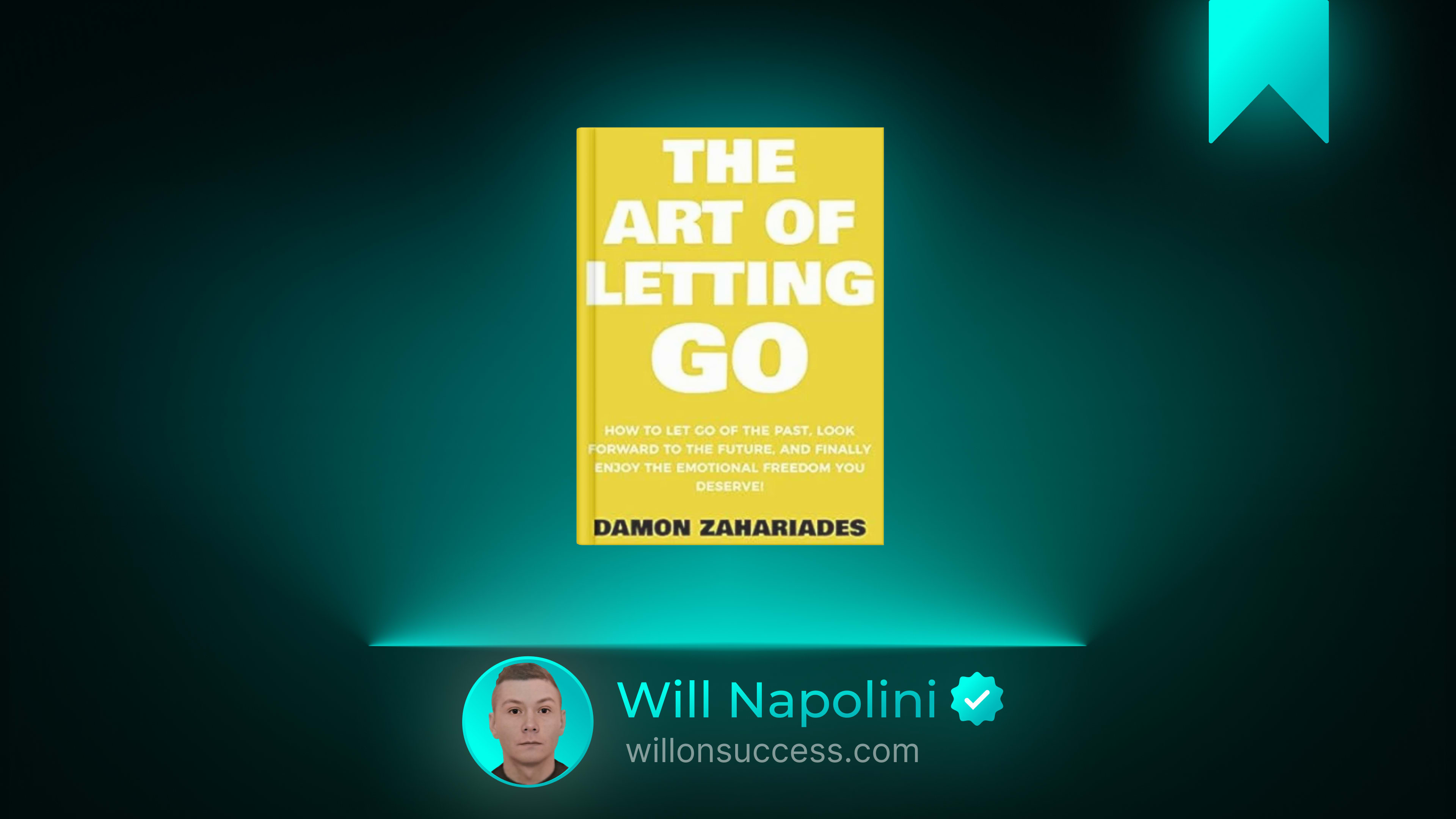
In The Art of Letting Go, author Damon Zahariades offers a deeply practical, no-nonsense guide to emotional freedom. This is not a book of toxic positivity. It does not tell you to simply “smile and move on.” Instead, it provides a clear, actionable toolkit for understanding why we hold on to pain, how that attachment ruins our quality of life, and the specific steps we can take to finally set it down.
The Big Idea: Letting Go Is an Active Choice, Not Passive Avoidance
The central thesis of Zahariades’ work rests on a crucial correction to how we view release. Most of us think letting go is something that just happens to us over time, or that it requires us to suppress our feelings and pretend the past didn’t matter.
Zahariades argues the exact opposite. Letting go is an active, deliberate process. It is not about avoiding discomfort or erasing your emotional history. True freedom emerges when we recognize and accept our emotions—anger, sadness, regret, or disappointment—and then consciously choose to detach from the outcomes we can no longer control.
Letting go begins with accepting reality as it is, rather than clinging desperately to a past we wish we could reclaim. It is the understanding that difficulties are a fundamental part of life, and that our power lies not in changing what has already happened, but in how we navigate the present with clarity and resolve.
The Concept: The Mirage of the Idealized Self and the Sunk Cost Fallacy
To understand why letting go is so difficult, we have to look at the psychological traps that keep us anchored to the past. Zahariades identifies two of the most powerful of these traps: the sunk cost fallacy and the illusion of the idealized self.
Imagine you are hiking up a mountain. Early in the journey, you pick up a heavy backpack full of rocks. As you climb, the pack becomes heavier. Your shoulders ache, and your progress slows. But you keep carrying it. Why? Because you tell yourself, “I have already carried this backpack for three miles. If I drop it now, those three miles will have been a waste.”
This is the sunk cost fallacy. We cling to unhealthy relationships, unfulfilling careers, or old grievances because we have invested time, energy, or emotion into them. We endure misery in the present to justify the investments of the past.
Compounding this is the “idealized self.” Zahariades points out that we often hold onto past versions of ourselves, or an imagined, perfect version of how our lives were supposed to turn out. We compare our messy, complicated reality to this pristine mirage. When reality inevitably falls short, we experience chronic disappointment and self-criticism. We refuse to let go of the past because letting go feels like admitting that our idealized vision is dead.
But a mirage cannot quench your thirst, and a backpack of rocks will not magically turn into gold. The only way to reach the summit is to set the pack down and walk forward with the body you have, in the conditions that actually exist.
Your Idealized Self Is an Illusion; Reality Is Your Foundation
One of the most profound shifts Zahariades guides the reader through is the abandonment of perfectionism. We frequently attempt to stifle or flee from emotions like sorrow, frustration, or disenchantment because they do not fit the narrative of the “idealized” life we think we should be living.
But the idealized self is little more than a mirage. It is an unattainable illusion, much like an oasis in a desert.
When you recognize this, you stop fighting reality. You begin to accept your authentic self, complete with real strengths and real weaknesses. This acceptance is not a resignation to mediocrity; it is the solid foundation upon which genuine growth is built. You cannot build a house on a fantasy. You can only build it on the ground that is actually there. When you embrace your current reality, you reduce the chronic disappointment that comes from chasing a ghost.
Gratitude Is the Antidote to the Negativity Bias
Why do painful memories stick to us like burrs on a wool sweater, while positive experiences seem to slip right off? Zahariades explains that this is due to the brain’s natural negativity bias. Our minds are evolutionarily wired to focus on potential threats, past failures, and negative experiences to keep us safe.
The problem is that in the modern world, this survival mechanism keeps old pain alive. We ruminate on a single critical comment while ignoring ten compliments.
Fortunately, Zahariades notes that we can short-circuit this negativity bias by actively practicing gratitude. This is not about pretending everything is wonderful. It is about deliberately training your attention to notice the good. By being mindful of the positive things that happen to us, we erode our natural fear of anything that might cause us sorrow. Gratitude does not erase the past, but it changes the lens through which you view the present, making it easier to release painful memories.
Forgiveness Is a Gift You Give Yourself, Not Them
Perhaps the heaviest rock in the backpack is resentment. We hold onto grudges because we believe that staying angry is a form of justice. We think that if we forgive the person who wronged us, we are letting them off the hook.
Zahariades dismantles this myth with quiet conviction. When we adopt an attitude of forgiveness toward others, we can more easily move on from past hurts. Yes, it makes us more vulnerable. And no, forgiving others won’t necessarily change their behavior toward us or absolve them of responsibility.
But forgiveness is not about them. It is about you. It is the deliberate act of releasing the bitterness and resentment that are poisoning your own well. Holding onto anger is like drinking poison and expecting the other person to die. Forgiveness is the act of finally spitting the poison out. The same principle applies to self-forgiveness. You must release the harsh judgment of your past mistakes to make room for your future growth.
Take Responsibility for What You Can Control
When we are hurt or when things go wrong, our default instinct is often to blame external circumstances or other people. While it is true that we are not responsible for everything that happens to us, Zahariades emphasizes that the most effective way to counter the paralysis of blame is to take responsibility for the problems we can influence.
This does not mean you immediately accept blame for things that are not your fault. Rather, it means you stop wasting energy on the pointless act of blaming others, and you pivot to asking: “What is my next move? What part of this situation can I influence?”
Taking responsibility restores your agency. It shifts you from the role of a helpless victim of circumstance to the active author of your response. You cannot control the weather, but you can control whether you bring an umbrella.
Why This Matters on an Ordinary Tuesday
You might be thinking that this is deep psychological work, but you are just trying to get through a normal week. You have a job, a family, and a long list of obligations. You don’t have time to sit on a mountain and contemplate your emotional baggage.
But here is why this matters on an ordinary Tuesday: the weight you carry in your mind dictates the quality of your day.
When you are ruminating on a past failure, you are not present for your child’s question. When you are harboring resentment toward a colleague, you are bringing a defensive, closed-off energy to your meetings. When you are clinging to an idealized version of a past relationship, you are blind to the genuine connections available to you right now.
Letting go is not a one-time spiritual event. It is a daily maintenance practice. It is the decision, made repeatedly, to stop pouring energy into a dead end. When you apply these principles, you stop wasting your finite emotional resources on things you cannot change. You become lighter, more focused, and more capable of handling whatever the current day throws at you.
Practical Application: Turning Principles into Behavior
Understanding the philosophy of letting go is only the beginning. Action is where the real change happens. Here is how you can integrate Zahariades’ toolkit into your daily routine.
1. The “Needs vs. Sunk Cost” Audit Take a piece of paper and write down a situation, relationship, or habit you are struggling to leave. Draw a line down the middle. On the left side, write down what you have already invested (time, money, emotion). On the right side, write down what this situation is actually providing for you today. Are your core needs truly being met? If the right side is empty, acknowledge that your past investment is a sunk cost. It is gone. Do not throw good time after bad. Make a plan to step away.
2. The 15-Minute Emotional Outlet Zahariades emphasizes that letting go of painful memories or grief is easier when we have a healthy outlet for those emotions. Do not let them bottle up. Commit to a 15-minute daily practice of constructive release. This could be a brisk walk, journaling without filtering your thoughts, or a physical workout. The goal is not to “solve” the emotion, but to give it a safe, physical pathway out of your body so it does not fester.
3. The Gratitude Rewiring Practice To counter your brain’s negativity bias, you must actively train it. Every evening, write down three specific, small things that went well that day. Do not use generic phrases like “I am grateful for my family.” Be specific: “I am grateful for the way the sun hit the trees on my drive home,” or “I am grateful my coworker offered to help me with that report.” This specific, daily practice physically rewires your brain to scan the world for the positive, loosening the grip of past negativity.
Who Should Read This Book
The Art of Letting Go is a highly practical, accessible read, but it is not for everyone.
If you are looking for a deeply academic, clinical exploration of trauma, or if you prefer abstract, poetic philosophy, this book may feel too straightforward for you. It is also not a magic wand; it requires you to do the uncomfortable work of self-reflection.
However, if you are feeling stuck in a cycle of rumination, if you are struggling to move on from a breakup, a career setback, or a past mistake, this book is an invaluable resource. It is for the reader who is tired of carrying unnecessary weight and is ready for a clear, step-by-step guide to setting it down. It is especially useful for those who tend to overthink and need actionable, grounded strategies to break the cycle of negative thought patterns.
One Small Step
You do not need to overhaul your entire emotional life today. You just need to practice the mechanics of release on a single, manageable target.
Right now, take a blank piece of paper and a pen. Write down one specific regret, grudge, or past decision you have been mentally replaying. Look at it. Acknowledge that it happened, and that you cannot change it.
Next to it, write down one single lesson that experience taught you. You have now extracted the value from the memory.
Finally, tear the paper into small pieces and throw it in the trash. You have acknowledged the past, learned from it, and physically symbolized your choice to stop carrying it.
The Path Forward
We spend so much of our lives looking backward, trying to edit a story that has already been written. We believe that if we just analyze the past enough, we can somehow fix it. But the past is a place of reference, not a place of residence.
Letting go is not about forgetting what happened. It is about remembering it without the sting. It is about looking at your scars and recognizing them not as sources of ongoing pain, but as proof that you healed.
You have a long journey ahead of you, and the path forward requires both of your hands. It is time to open them, let the heavy rocks fall to the ground, and walk lightly into the life that is waiting for you.