The Art of Money Getting Summary: Timeless Principles for Building Wealth and Character
For a long time, I operated under a dangerous assumption. I believed that financial success was reserved for the lucky, the cunning, or the well-connected. I thought that building wealth required a secret hack, a loophole, or a willingness to compromise my values.
I was wrong.
If I could sit across the table from you right now, I would tell you that the most profound truths about money are not hidden in complex algorithms or get-rich-quick schemes. They are found in the quiet, unglamorous disciplines of focus, frugality, and character.
When you hear the name P.T. Barnum, you likely picture the flamboyant “greatest showman,” a master of hype and spectacle. It is easy to assume that a man famous for circus tents and curiosities built his fortune on deception. But the historical reality is quite the opposite. Behind the public spectacle was a fiercely disciplined, pragmatic businessman who understood human nature and the mechanical realities of enterprise.
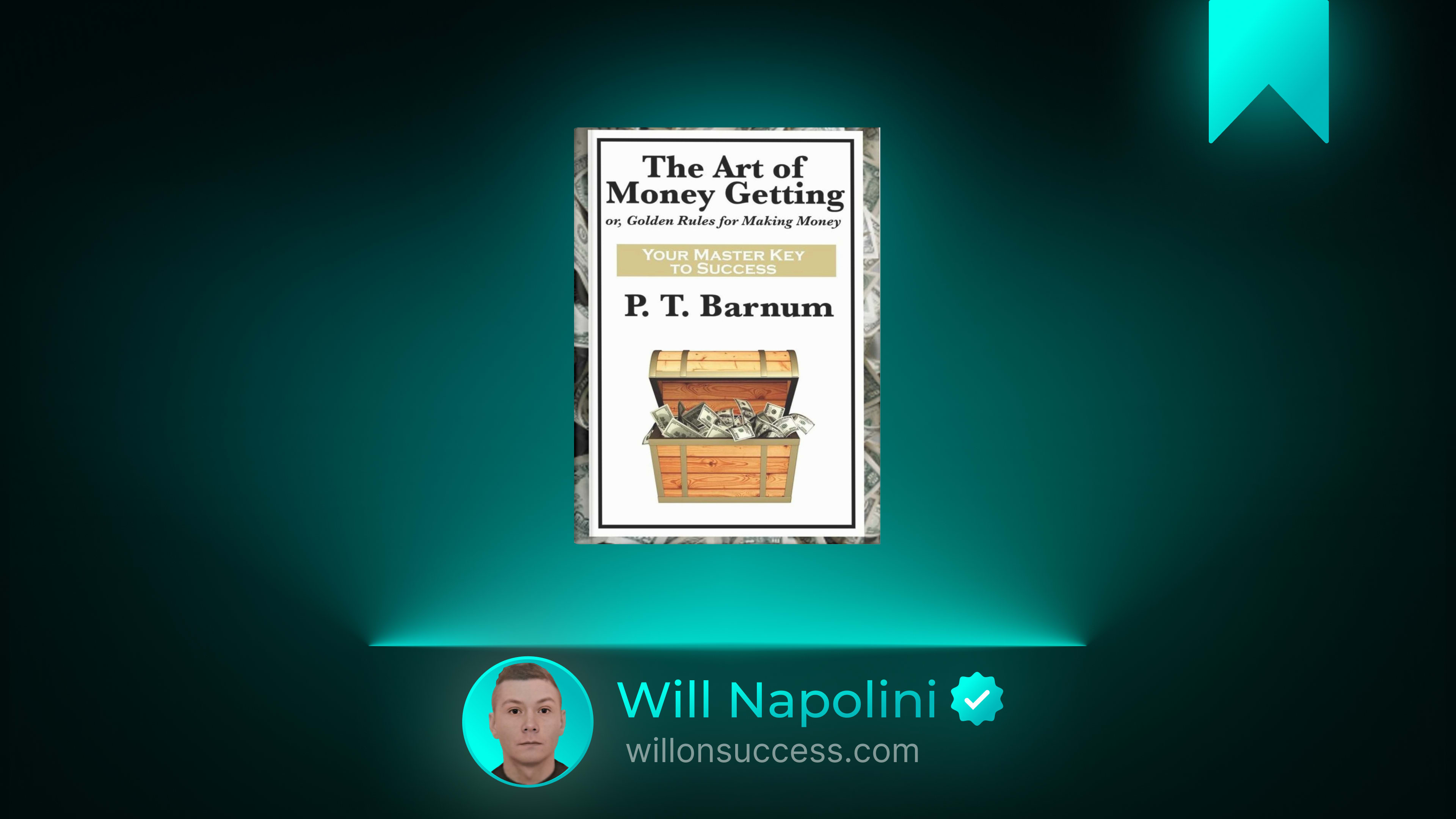
In 1880, late in his life, Barnum wrote a short, powerful essay titled The Art of Money Getting. It was not a manual for trickery. It was a deeply principled, brutally honest blueprint for building wealth through hard work and integrity.
If you are feeling overwhelmed by financial chaos, distracted by shiny new opportunities, or weighed down by the stress of debt, this book is a mirror and a map. It will show you exactly where you are leaking energy, and it will give you the timeless principles needed to build a foundation that lasts.
The Big Idea: Wealth Is a Byproduct of Character
The central thesis of The Art of Money Getting is simple but profound: making money honestly is an art, and that art is rooted entirely in character.
Barnum argues that external results are a direct reflection of internal habits. You do not get rich by chasing money; you get rich by becoming the kind of person who naturally attracts and sustains it. This requires selecting the right work, focusing your energy, avoiding the trap of debt, treating people with genuine respect, and, above all, maintaining your integrity.
In a modern world obsessed with shortcuts, Barnum’s message is a grounding force. He reminds us that there is no elevator to success. You have to take the stairs, and you have to carry your own weight.
The Story: The Showman Who Valued Frugality
To understand Barnum’s principles, we have to separate the myth from the man. Yes, he promoted extravagant shows. But in his personal and business operations, he was famously, almost obsessively, frugal and systematic.
He did not build his empire by throwing money at problems. He built it by paying attention to the details that others ignored. He knew the cost of every nail, every poster, and every hour of labor. He understood that a single dropped coin, multiplied by a thousand days, becomes a fortune.
He also understood the power of a good name. In an era before digital reviews and instant background checks, a man’s word was his only real collateral. Barnum knew that if he deceived his customers once, they would never return, and word would spread. Therefore, his most famous business rule was not about hype; it was about delivering genuine value and keeping his promises. The spectacle drew the crowd, but the integrity kept them coming back.
Focus Your Energy: The Danger of Scattering Your Powers
One of Barnum’s most emphatic rules is this: “Do not scatter your powers.”
He observed that many people fail not because they lack talent, but because they lack focus. They dabble in a little bit of everything. They start a business, get bored, and jump to another. They take on too many projects, diluting their energy until none of them succeed.
Barnum used a powerful metaphor: a beam of sunlight can be focused through a magnifying glass to start a fire, but if that same light is scattered, it produces no heat at all.
Your time, attention, and capital are your sunlight. If you scatter them across a dozen half-hearted ventures, you will produce no meaningful heat. You must choose a path that aligns with your natural aptitudes and pour your concentrated energy into it. Mastery requires the courage to say “no” to a hundred good opportunities so you can say “yes” to the one great one.
The Invisible Anchor: Why Debt Is the Enemy of Freedom
Barnum was unequivocal about debt. He called it “the worst of all poverty.”
When you go into debt, you are not just borrowing money; you are mortgaging your future labor. You are waking up every morning already behind, working not for your own advancement, but to pay off the mistakes or indulgences of your past.
Debt creates an invisible anchor. It forces you to stay in jobs you hate, tolerate toxic environments, and make decisions out of desperation rather than strategy. Barnum advised his readers to live strictly within their means, to save a little from every earning, and to avoid the temptation of “buy now, pay later” at all costs.
Financial freedom does not begin when you make a million dollars. It begins the day your expenses fall below your income, and you refuse to let the anchor of debt drag you under.
The Architecture of Success: System and Frugality
We often romanticize the “big break,” but Barnum knew that lasting success is built on the unglamorous foundation of system and frugality.
He advised readers to be systematic in all their dealings. Keep accurate records. Know where every dollar goes. Do not let small leaks sink a great ship. Frugality, in Barnum’s view, was not about being cheap or miserable; it was about respecting your resources. It is the discipline of ensuring that your money is working for you, rather than you working to replace wasted money.
A business without a system is just a hobby. A life without financial boundaries is a recipe for anxiety. By establishing order in your daily habits, you remove the friction that prevents growth. You start small. You stay consistent. You let the compound interest of good habits do the heavy lifting.
The Currency of Courtesy: Kindness as a Strategy
It is easy to view business as a cold, transactional battlefield. Barnum rejected this entirely. He insisted that politeness and kindness are not just moral virtues; they are highly effective business strategies.
He wrote extensively about the importance of treating employees, customers, and competitors with respect. He knew that a cheerful, helpful demeanor costs nothing but yields immense returns. People do business with people they like and trust.
If you are rude to your staff, they will do the bare minimum. If you are dismissive of your customers, they will take their money elsewhere. Courtesy is the lubricant that keeps the engine of commerce running smoothly. It is a reminder that behind every transaction is a human being who wants to be seen, heard, and valued.
The Ultimate Foundation: Integrity at All Times
Of all the rules in the book, Barnum placed the greatest emphasis on this one: “Never allow yourself to be tempted to do a mean or dishonest action.”
He argued that integrity is the absolute foundation of wealth. You might be able to make a quick dollar through deception, but you will never build a lasting enterprise on a cracked foundation. A tarnished reputation is a debt that can never be fully repaid.
When you operate with integrity, you sleep well at night. You do not have to remember which lies you told to whom. Your word becomes your bond, and in the long run, that is the most valuable asset you can possibly own. Character before circumstances, always.
Why This Matters on an Ordinary Tuesday
You might be reading this and thinking, “This is a 19th-century book. What does it have to do with my modern life, my student loans, my tech job, or my side hustle?”
Everything.
We live in an age of unprecedented distraction. Your “scattered powers” are no longer just a result of taking on too many projects; they are the result of endless notifications, social media feeds, and the illusion that you can monetize every passing hobby. Barnum’s call to focus is more urgent now than ever.
We also live in an age of normalized, easy debt. Credit cards, buy-now-pay-later apps, and predatory loans make it incredibly easy to mortgage your future for a moment of present comfort. Barnum’s warning about the anchor of debt is a vital antidote to modern financial anxiety.
And in a culture that often rewards outrage, cutting corners, and self-promotion, Barnum’s insistence on integrity and courtesy is a radical, counter-cultural stance. It reminds you that you do not have to become a cynical, ruthless operator to succeed. You can be kind, you can be honest, and you can still build something remarkable.
Practical Application: Turning Principles into Behavior
Understanding these principles is only the first step. Action is where the real change happens. Here is how you can integrate Barnum’s wisdom into your life starting today.
1. The “Scattered Powers” Audit Take out a piece of paper and write down every active project, side hustle, financial goal, and major commitment currently demanding your attention. Look at the list. Are you trying to start a fire with scattered light? Choose one primary income-generating focus for the next 90 days. Put the other ideas in a “someday” folder. Give your chosen focus the concentrated heat of your undivided attention.
2. The Debt Declaration If you carry consumer debt, you must declare war on it. List every debt, from smallest to largest. Commit to a strict, systematic plan to eliminate it. This may mean canceling subscriptions, cooking at home, or selling unused items. Treat every extra dollar as a soldier you are deploying to buy back your future freedom. Do not take on a single ounce of new debt while this battle is ongoing.
3. The Integrity Check For the next week, make a conscious promise to yourself: you will do exactly what you say you will do, no matter how small. If you say you will send an email by noon, send it by noon. If you promise to be home by six, be home by six. Notice how this small, consistent practice of keeping your word to yourself and others begins to build a quiet, unshakable confidence.
Who Should Read This Book
The Art of Money Getting is a short, potent read, but it is not for everyone.
If you are looking for a modern guide to cryptocurrency, stock market day-trading, or aggressive real estate leveraging, this book will not serve you. It is also not for the reader who believes that wealth can be achieved without hard work or personal sacrifice.
However, if you are an entrepreneur, a young professional, or anyone feeling financially overwhelmed and directionless, this book is a masterclass. It is for the reader who wants to build wealth the right way: slowly, steadily, and with a clear conscience. It is for anyone who needs a reminder that the oldest rules of success are still the most effective.
One Small Step
You do not need to restructure your entire life or pay off all your debt today. You just need to take one deliberate step toward focus and frugality.
Right now, open your banking app or your budget spreadsheet. Find one recurring expense—a subscription, a service, or a habit—that is no longer serving you and is quietly draining your resources.
Cancel it.
Take the money you just saved and move it directly into a separate savings account, or apply it as an extra payment toward your highest-interest debt. You have just taken your first step in reclaiming your power.
The Path Forward
We spend so much of our lives looking for the magic bullet, the secret formula, or the lucky break that will finally solve our financial problems. But the truth is far more grounded, and far more empowering.
Wealth is not something you chase; it is something you build, brick by honest brick. It is built by focusing your energy, respecting your resources, treating people well, and refusing to compromise your character for a quick dollar.
You already have everything you need to begin. The magnifying glass is in your hands. The sun is shining. It is time to focus your light, burn away the distractions, and start building the life you are truly capable of creating.