The Richest Man in Babylon: Why Saving 10% Changes Everything About Your Financial Life
There is a question I have heard asked in a hundred different ways, usually with a tired voice and a half-smile that is really a grimace: “I work hard. I’ve always worked hard. Why does the money still slip through my fingers?”
If that question belongs to you, I want you to know something before we go any further. You are not broken. You are not uniquely undisciplined. You are caught in a pattern so common that a man wrote an entire book about it nearly a century ago, setting his lessons in the dust and lamplight of ancient Babylon because he understood that the problem is older than any of us.
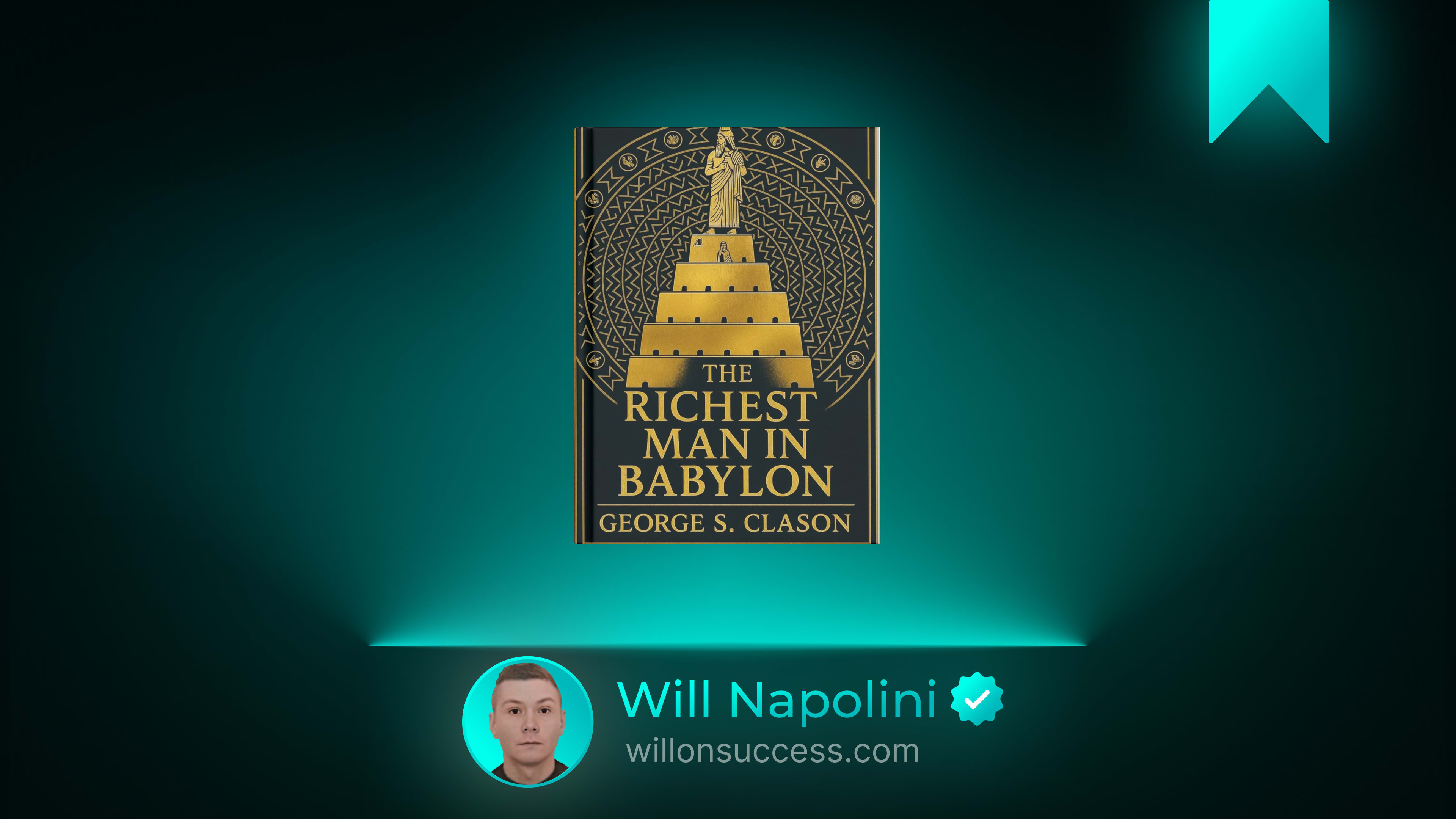
The book is The Richest Man in Babylon, written by George S. Clason in 1926. It is thin. It reads like a collection of stories. And yet the ideas inside it have shaped the financial thinking of millions of readers for almost a hundred years. Not because the ideas are complicated. Because they are startlingly simple, and because most of us have never been taught to take them seriously.
I want to walk you through what this book actually teaches, why it still works, and—most importantly—what you can do with it starting this week. Not next month. This week.

The Big Idea: Wealth Is Not an Event. It Is a Direction.
Clason’s central argument, threaded through every parable in the book, is this: becoming wealthy is not the result of a single lucky break, a windfall, or some secret known only to the fortunate few. It is the result of obeying a handful of principles so basic they almost feel disappointing. Save a portion of everything you earn. Spend less than you earn. Put your savings to work. Protect what you have built. Invest in your own ability to earn more.
That is the whole architecture. No mystery. No hidden lever.
The reason these principles feel disappointing is that we secretly want wealth to arrive like weather—a storm that sweeps in and changes the landscape overnight. Clason pushes back against that hope gently but firmly. He shows, through story after story, that the people who build lasting wealth are not the ones who caught a lucky wave. They are the ones who laid one brick, then the next, then the next, until a wall stood where nothing had been before.
The book’s most famous character is Arkad, a man who rises from being a humble scribe to becoming the wealthiest citizen in Babylon. The king, noticing that the city’s wealth seems concentrated in one man’s hands while his subjects struggle, summons Arkad and asks him to teach the people his methods. What follows is the heart of the book: Arkad sharing what he calls the Seven Cures for a Lean Purse and the Five Laws of Gold.
But before Arkad speaks, Clason gives us something I think is even more important. He gives us Bansir and Kobbi.
Two Friends Sitting on a Wall, Wondering Why They Are Still Poor
The book opens not with Arkad’s grandeur but with two ordinary men. Bansir is a chariot builder. Kobbi is a musician. They have worked their entire adult lives. They are skilled. They are honest. And they are broke.
They sit together on a wall overlooking Babylon and talk. Not about grand strategy. About the quiet ache of working year after year and having nothing to show for it. Bansir confesses that he has never had enough gold to do more than cover his immediate needs. Kobbi admits the same. They look at the wealth around them and ask the question you may be asking right now: What are we missing?
What they decide to do is simple. They go to their old friend Arkad and ask. They ask for help. They ask for instruction. And Arkad, to his credit, does not hand them a bag of gold. He hands them a principle.
He tells them the first rule of wealth, the one everything else is built on:
A part of all you earn is yours to keep.
He tells them to set aside no less than one-tenth of everything they earn, before any other expense touches it. Not what is left over. Not what they can spare. A fixed portion, taken first, treated as sacred.
If I could sit across the table from you right now, I would lean forward and say this: that single sentence has more power to change your financial life than any investment tip, any side-hustle strategy, any budgeting app. Because it changes your relationship with your own income. You stop being a conduit through which money flows to other people. You become someone who keeps a piece for yourself, every single time.
The Seven Cures: A Ladder, Not a Leap
Arkad’s teaching in the book is structured as seven “cures,” and they build on one another. Let me walk you through them because each one addresses a different failure mode, and I suspect at least two or three of them will hit close to home.
First: Start thy purse to fattening. Save at least ten percent of your income. Before rent. Before entertainment. Before the small comforts that feel earned. Pay yourself first.
Second: Control thy expenditures. Clason is careful here. He does not say “suffer.” He says distinguish between necessary expenses and desires that have disguised themselves as necessities. The budget, in his telling, is not a cage. It is a lens. It shows you where the money actually goes versus where you assumed it went.
Third: Make thy gold multiply. Savings alone are not wealth. Savings that sit still lose value slowly. Arkad teaches that every gold coin you save is a worker. You must send those workers out to earn more workers. In modern terms: invest. Let compounding do what your labor alone cannot.
Fourth: Guard thy treasures from loss. This is where the book earns its cautionary edge. Arkad tells stories of people who handed their savings to a bricklayer to buy jewels, or entrusted their money to someone whose expertise did not match the task. The lesson: protect your principal. Seek counsel from people who have actually succeeded in the domain you are entering. Do not let the excitement of a potential return blind you to the reality of risk.
Fifth: Make of thy dwelling a profitable investment. Clason wrote this in a time and place very different from ours, and the housing market has changed enormously. But the underlying principle holds: where you live is a financial decision, not just a lifestyle one. Own what you can. Reduce the portion of your income that vanishes into rent you will never see again.
Sixth: Insure a future income. Plan for the season when your labor will no longer be enough. Retirement, in Clason’s framing, is not a punishment for growing old. It is a responsibility you build toward while you still have strength.
Seventh: Increase thy ability to earn. This is the one people skip, and I think it matters more than they realize. Clason argues that your most productive asset is your own skill, knowledge, and judgment. Invest in learning. Study your craft. Become more capable. A person who can earn more will always find it easier to save more.
Notice the shape of this. It is not a get-rich-quick sequence. It is a ladder. Each rung is stable. You stand on one before reaching for the next. And the whole structure rests on that first rung: keep a part of what you earn.
The Five Laws of Gold: What Happens When You Ignore the Ladder
Later in the book, Clason introduces the Five Laws of Gold, told through the story of a father who gives his son a bag of gold and a clay tablet inscribed with these laws, then sends him out into the world. The son loses the gold because he ignores the tablet. He returns years later, wiser, having learned the laws through the most expensive teacher available: failure.
The laws echo the Seven Cures but frame them as warnings. Gold flows to those who save it. Gold labors diligently for those who invest it wisely. Gold clings to the protection of the cautious owner. Gold slips away from those who invest in things they do not understand. Gold flees the person who would force it into impossible returns or who follows the advice of the inexperienced.
That last point deserves a pause. How many times have you watched someone pour savings into a venture they understood only in the vaguest outline, because a friend was excited about it? How many times have you felt the pull of a return that sounded too good, and told yourself that this time the rules were different?
Clason is not saying never take risks. He is saying: understand what you are doing before you commit what you have saved. Guard the seed corn. You cannot plant next year’s crop with this year’s last handful of grain.
Why This Book Still Works When Everything Else Has Changed
You might wonder whether a book written in 1926, set in a civilization that fell thousands of years ago, has anything to say to someone navigating student loans, a 401(k), inflation, and the endless scroll of financial content online.
I think it does. In fact, I think its age is part of its power.
The specific instruments change. The vehicles change. The tax codes change. But the human being sitting at the center of the financial system—the one who feels the pull of immediate gratification, the one who confuses busyness with progress, the one who hopes a single lucky decision will erase years of neglect—that person has not changed. Clason understood that the obstacle to wealth is rarely a lack of opportunity. It is a lack of structure around the money that already passes through your hands.
And structure is what this book gives you. Not a stock tip. Not a crypto thesis. Structure. A sequence of decisions, repeated, that bends the arc of your finances in a direction you chose rather than one that was chosen for you by impulse and habit.
What This Looks Like on an Ordinary Tuesday
Let me pull this out of ancient Babylon and into your actual week.
You get paid. Before the bills autopay, before you open the shopping app, before you calculate what is “left over” after the fun stuff, you move ten percent into a separate account. You do not negotiate with yourself. You do not say, “This month is different.” You move the money the way the tide moves. It simply goes.
Then you look at your spending. Not to punish yourself. To see clearly. You notice that the small subscriptions you forgot to cancel have quietly become a second rent payment. You notice that “treating yourself” after a hard day has become a weekly habit that costs more than the savings you meant to build. You adjust. Not by swearing off all pleasure. By choosing which pleasures actually matter to you and releasing the ones that are just inertia.
You research one investment option you do not yet understand. You read. You ask questions of people who have done it. You do not hand your savings to someone whose only qualification is enthusiasm.
You set aside thirty minutes this week to learn something that makes you better at your work. A course. A chapter of a technical book. A conversation with someone two levels above you. You are investing in the asset that will fund every other investment: your own capability.
None of this is dramatic. None of it will make a good story at a dinner party. But this is how walls get built. One brick. Then the next. Then the next.
Who Should Read This Book, and Who Might Not
If you have never had a clear, calm framework for thinking about money, this book will feel like someone turning on a light in a room you have been navigating by touch. It is especially powerful for younger readers, for anyone early in their career, for anyone who earns a decent income but cannot figure out where it disappears.
If you are someone who has felt shame around money—shame about debt, about not saving, about starting late—Clason’s tone is gentle. He does not scold. He tells stories. He lets the characters make mistakes so you can learn from them without paying the price yourself.
Where the book may feel limited: if you already understand basic saving and investing principles and are looking for advanced portfolio strategy, tax optimization, or entrepreneurial finance, this will feel elementary. It is a foundation text, not a specialization text. And its parable structure, while charming, can feel slow if you prefer direct instruction. Read it knowing what it is: a first principles book. The kind you read once, then return to every few years when you need to be reminded that the basics still apply.
One Small Step You Can Take Before You Sleep Tonight
I do not want you to finish reading this and simply feel inspired. Inspiration without a next move fades by morning.
Here is what I would ask you to do. Tonight, before bed, open your banking app. Look at your next expected deposit. Calculate ten percent. Write that number down. Then decide, concretely, where you will move it the moment it arrives. A separate savings account. An investment account you have been meaning to open. Anywhere that is not your checking account. Anywhere you do not see it every time you glance at your balance.
You do not need to figure out the entire plan tonight. You do not need to solve retirement, eliminate debt, and build a portfolio in one evening. You need to make one decision: a part of what I earn is mine to keep, and I will keep it starting now.
That decision, repeated every payday, is not a small thing. Over a year it is a habit. Over five years it is a foundation. Over twenty years it is a life that looks different from the one you would have built by letting the current carry you.
Arkad did not become the richest man in Babylon because he was smarter than everyone else. He became the richest man in Babylon because he started keeping a piece of what he earned, and he never stopped. The wall was not built in a day. But it was built. And it was built by a person who decided, on an ordinary day, to lay the first brick.
Your first brick is waiting. Go lay it tonight.