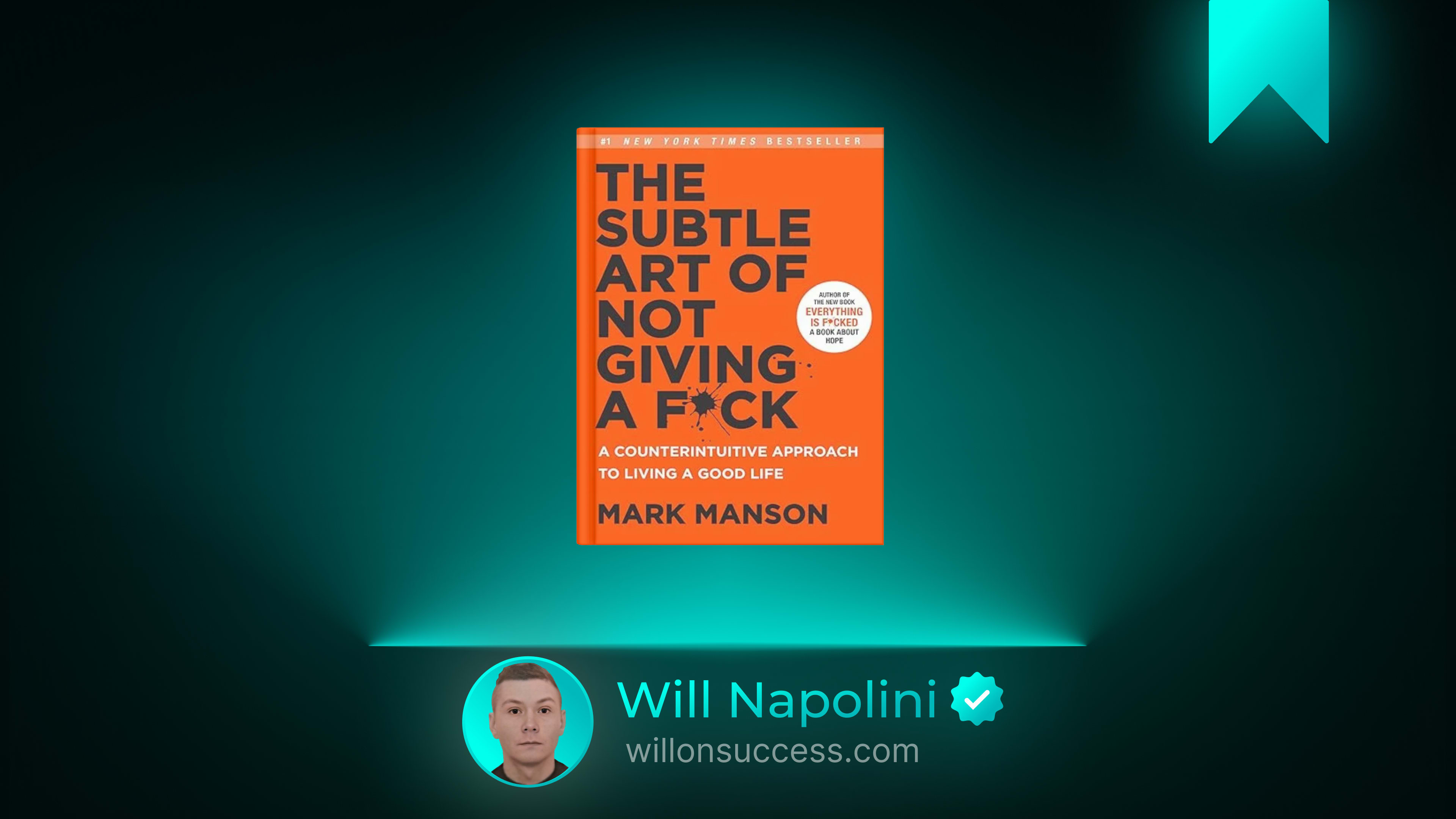
The Subtle Art of Not Giving a F*ck: Why Caring Less Is the Most Honest Path to Caring More
You are exhausted. Not because your life is empty, but because it is too full. Too many opinions to weigh. Too many comparisons to survive scrolling past. Too many problems that feel urgent because someone on the internet said they should be. Too many versions of a “good life” competing for your attention, each one insisting that you are one purchase, one promotion, one morning routine away from finally being enough.
And somewhere underneath all that noise, a quieter voice is asking: What if I just stopped caring about most of this?
Mark Manson wrote a book with that exact impulse in its title, and here is the first thing you should understand about it, because almost everyone gets it wrong. The Subtle Art of Not Giving a F*ck is not a book about apathy. It is not a permission slip to stop caring, to coast, to treat other people’s suffering with indifference. It is almost the opposite. It is a book about the fact that you have a limited supply of caring, and that most of us are spending it on things that give nothing back.
The title is a provocation. The argument underneath it is a philosophy. And if you let it land, it might quietly rearrange the way you make every decision for the next decade.

The Big Idea: You Do Not Have Infinite Fucks to Give
Manson’s central claim is deceptively simple. You do not have unlimited emotional energy. You cannot care deeply about everything, solve every problem, fix every injustice, respond to every notification, and still have something left over for the things that actually matter to your one, unrepeatable life.
So the question is not how do I stop caring? The question is: what do I care about, and is it worth the cost?
Most self-help literature tells you to add. Add habits. Add goals. Add gratitude practices. Add five a.m. routines. Add optimization. Manson looks at that endless accumulation and says, essentially, you are drowning because you keep adding water to the boat. The answer is not a bigger boat. The answer is to stop scooping water in.
He calls this the “subtle art” because it is not dramatic. It does not announce itself. It is the quiet, unglamorous act of looking at the thousand things pulling at you and saying, gently and firmly, no, not this. This one. And maybe this one. And that is all I have today.
The Feedback Loop from Hell
Early in the book, Manson describes something he calls the feedback loop from hell. You feel bad about something. Then you feel bad about feeling bad. Then you feel bad about feeling bad about feeling bad. The layers stack. What started as a small, manageable discomfort becomes an avalanche of self-recrimination.
I have seen this play out more times than I can count. A person makes a mistake at work. That is the first layer. Then they think, I should not have made that mistake. Competent people do not make mistakes like that. Second layer. Then: Why am I beating myself up? I should be over this by now. Third layer. Then: Something must be wrong with me if I cannot just move on. Fourth layer.
And now the original mistake, which was a five-minute fix, has become a three-day spiral of shame.
Manson’s response to this is not “think positive thoughts.” His response is more radical and, I think, more honest: stop caring about the second layer. You are allowed to feel bad. You are allowed to make a mistake and be annoyed about it. You are not required to also be angry at yourself for being annoyed. You are not required to audit your emotions for correctness.
The first layer of suffering is unavoidable. The second through tenth layers are optional. And most of the exhaustion you feel at the end of a day is not from the first layer. It is from the ones you built on top of it.
Choose Your Suffering, Because You Will Have Some
One of the ideas in this book that I return to most often is this: happiness is not the absence of problems. Happiness is the presence of problems you enjoy solving.
Read that again. Let it settle.
Manson is not saying life should be a pleasure cruise. He is saying that every life contains difficulty, and the question is never will I suffer? The question is what will I suffer for? The writer suffers through drafts. The parent suffers through sleepless nights. The entrepreneur suffers through uncertainty and rejection. The person who chooses nothing suffers through the slow ache of watching life happen to them instead of through them.
You cannot opt out of difficulty. You can only choose which difficulty is yours.
This reframes a question so many people get stuck on. They ask, What do I want? as though desire alone were enough. But wanting is easy. Everyone wants the finished novel, the fit body, the thriving business, the deep marriage. The better question, the one Manson pushes you toward, is: What am I willing to struggle for? What pain will I choose, gladly, because the thing on the other side of it matters to me?
A goal without a willingness to suffer for it is just a wish. And wishes do not build lives.
You Are Not Special, and That Is a Gift
Manson spends real time dismantling what he sees as a cultural obsession with being extraordinary. The message, repeated in advertising, in social media, in a thousand well-meaning graduation speeches, is that you are destined for greatness. That your life should be remarkable. That if you are not exceptional, something has gone wrong.
His counterargument is blunt: most of us are, statistically and practically, average at most things. And that is not a tragedy. It is the baseline condition of being human. The belief that you should be exceptional is, he argues, one of the primary engines of modern anxiety. Because if you must be extraordinary, then every ordinary Tuesday is a small failure. Every average performance is evidence that you are falling short of what you deserve.
But if you release that requirement, something opens up. You can do the work in front of you without it needing to be your masterpiece. You can be a decent friend, a competent colleague, a person who shows up and does the next right thing, without the crushing pressure of turning every action into proof of your uniqueness.
I have found, in my own experience, that the most sustainable growth happens in the soil of ordinariness. You do not need to be special to be consistent. You do not need to be destined for greatness to do one small thing well today and then do it again tomorrow. Consistency is available to everyone. Specialness, as the world defines it, is available to almost no one. Build on what is available.
Your Values Determine the Quality of Your Suffering
Manson draws a line between what he considers good values and bad ones, and this distinction is, I think, the most practically useful framework in the entire book.
Bad values, in his telling, are things like pleasure for its own sake, material wealth as a scorecard, always being right, or constant positivity. They are values that depend on external validation, that are never fully in your control, that leave you perpetually hungry because the goalpost keeps moving.
Good values are reality-based, internally controllable, and socially constructive. Honesty. Curiosity. Creativity. Standing up for someone. Vulnerability. The willingness to be wrong.
The difference matters because of what we just discussed: you are going to suffer for your values. You are going to struggle, sacrifice, and endure discomfort in service of whatever you have chosen to care about. If your values are external and uncontrollable, your suffering will be endless and unrewarding, because the world will never consistently give you what you need. If your values are internal and grounded, your suffering has a floor. It has a shape. It leads somewhere.
A person who values being admired will suffer every time someone disagrees with them. A person who values honesty will suffer when the truth is hard to speak, but they will recover, because the value was something they controlled. The act of speaking. The choice to be honest. No one can take that from you.
Responsibility Without Fault
One of the most important distinctions Manson makes, and one I wish more people understood earlier in life, is the difference between fault and responsibility.
Fault looks backward. Who caused this? Who is to blame? Whose action created the problem?
Responsibility looks forward. Given that this is my situation, what will I do next?
You may not be at fault for the layoff. You may not be at fault for the illness. You may not be at fault for the parent who was cruel or the economy that shifted or the accident that changed everything. Fault is not always yours to carry.
But responsibility, in the sense of response-ability, the ability to choose your next action, is always yours. Not because it is fair. Not because you should pretend the injury did not happen. But because waiting for someone else to hand you your agency is a strategy that has never once worked.
This is not a comfortable idea. Manson does not present it as comfortable. He presents it as the price of admission for a life that is actually yours. And I have found, over years of watching people grow, that the moment someone shifts from this was done to me to this happened, and now I choose what comes next, something in their posture changes. Not overnight. Not without grief. But it changes.
The Do Something Principle
Near the back of the book, Manson offers what might be the most actionable single idea in the whole text. Most people believe the sequence goes like this: inspiration leads to motivation, motivation leads to action. You wait until you feel inspired, then you feel motivated, then you act.
Manson reverses it. Action creates inspiration. Inspiration creates motivation. The sequence runs the other way.
You do not need to feel ready. You do not need to feel like it. You start the thing, badly, in the smallest possible way, and the act of starting generates the feeling you were waiting for. Motion creates emotion, not the other way around.
I have tested this enough times to believe it. The paragraph I did not want to write becomes easier after I have written the first clumsy sentence. The walk I did not want to take becomes the best part of the day once I have laced up my shoes and stepped outside. The difficult conversation I was dreading loses half its weight once the first words are already in the air.
You start small. You let the starting do the work. You trust that the feeling will follow the doing, because it almost always does.
Who Should Read This Book
If you are someone who reads self-help books and feels worse afterward, more pressured, more behind, more convinced that everyone else has figured out a secret you missed, this book is likely to feel like relief. Manson writes the way a blunt, funny friend talks after two drinks. He swears. He mocks the industry he is writing inside. He tells you that you are going to die and that this should clarify your priorities rather than terrify you.
It will help you most if you are in a season of overwhelm, if you are trying to do and be and care about too many things at once, if the phrase “find your passion” makes you want to lie down on the floor.
It may not be for you if you are looking for a structured, step-by-step system with worksheets and thirty-day plans. Manson is a philosopher in a leather jacket, not a project manager. He gives you principles and a shift in perspective, not a color-coded calendar. If you need tactical granularity, you will want to pair this with something more operational.
And if profanity genuinely bothers you, the title is not misleading. The language throughout is direct, coarse, and unfiltered. The ideas underneath are more thoughtful than the packaging suggests, but the packaging is honest about what it is.
One Small Step You Can Take Today
I want to leave you with something you can do before your head hits the pillow tonight. Something small. Something that costs nothing.
Take a piece of paper. Draw a line down the middle. On the left side, write down the three things you are currently spending the most emotional energy on. Not the three things that matter most. The three things that are consuming you. The worry you replay at 2 a.m. The comparison that hijacks your focus. The opinion you keep checking to see if it has changed.
Now look at the right side. Write down the three things you would choose to spend that energy on if the left column were empty. The person you want to be present for. The work you want to build. The quiet, unglamorous practice that would actually move your life forward.
You do not have to solve the gap tonight. You do not have to fix everything by morning. You just have to see it clearly. You just have to look at both columns and say, honestly, I am spending my one life over here, and the things I actually care about are over there, and I have been pretending not to notice.
That noticing is the beginning. That small, quiet act of seeing where your attention has gone, and deciding, gently, to redirect it.
You do not owe the world your attention on every front. You do not owe every problem your suffering. You do not owe the future a version of yourself that is finished, polished, and extraordinary.
You owe yourself one choice, made clearly, about what matters. And then the patience to let that choice compound, quietly, in the dark, like a root finding water underground.
Pick your thing. Carry it. Let the rest go.
The world will not end. And you might, for the first time in a long while, hear yourself think.