The Architecture of Freedom: How to Stop Apologizing for Your Money and Start Building Wealth
Think about the last time you checked your bank account after a weekend of traveling, or after a week where you simply felt too exhausted to cook and ordered takeout instead.
Do you remember the physical sensation right before you opened the app? The slight tightening in your chest. The shallow breath. The preemptive bracing for disappointment, followed immediately by a wave of shame when you saw the final number.
If I could sit across the table from you right now, I would ask you to take a deep breath and listen to a truth that the financial industry has spent decades trying to obscure: Your financial anxiety is not a character flaw. You are not struggling because you lack discipline, and you are certainly not struggling because you bought a cup of coffee instead of investing it.
You are struggling because you were handed a map written in a language you were never taught to read, by people who profit from your confusion.
For generations, we have been fed a narrative that wealth is the result of extreme frugality, relentless hustle, or secret stock tips. We are told to skip the avocado toast, to feel guilty for our desires, and to trust the “experts” in expensive suits to manage our futures.
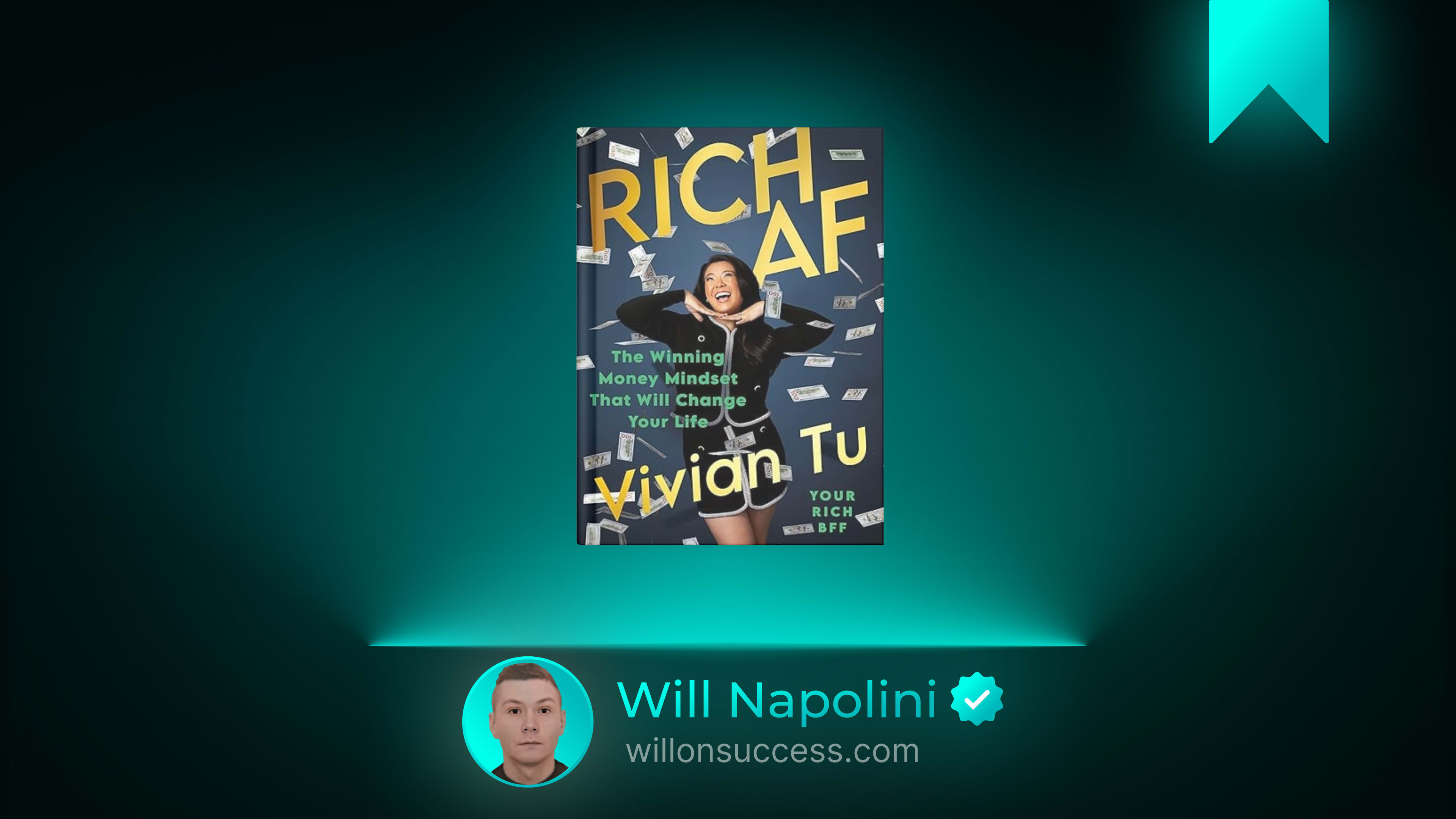
In her deeply empowering book Rich AF: The Winning Money Mindset That Will Change the Way You Think About Money Forever, former Wall Street trader Vivian Tu dismantles this exhausting mythology. Drawing from her years on the trading floor at J.P. Morgan, she reveals a profound and liberating truth: The rules of money are not actually complicated. They have been intentionally gatekept to keep everyday people paying high fees and living in quiet panic.
The central idea of this book is that true wealth is not about hoarding cash or depriving yourself of joy. True wealth is about buying back your autonomy. It is about understanding the mechanics of the game so you can stop playing defense and start building a life where money is a tool for freedom, rather than a source of fear.
The View from the Trading Floor
To understand why this shift in perspective matters, we have to look at where the confusion comes from.
Vivian Tu did not start her career as a financial influencer. She started it on the trading floor of one of the most prestigious investment banks in the world. Surrounded by some of the wealthiest people on the planet, she had a front-row seat to how the ultra-rich actually managed their money.
What she discovered was remarkably boring.
The wealthy were not sitting in front of six monitors, day-trading volatile stocks, or trying to time the market. They were not stressing over the price of groceries. They relied on systems. They automated their investments. They bought low-cost, diversified index funds and let the slow, quiet magic of compound interest do the heavy lifting. They focused on acquiring assets and optimizing their taxes.
But when Tu looked at what the financial industry was selling to everyday people—the middle class and young professionals—she saw a completely different playbook. Everyday consumers were sold high-fee mutual funds, complex insurance products they didn’t need, and a culture of shame-based budgeting. They were sold the illusion that investing was a high-stakes casino, when in reality, the wealthy were simply buying the casino itself.
She realized that Wall Street makes money look complicated because complexity is a highly profitable business model. If you feel overwhelmed, you will pay someone else to manage your money, often surrendering a percentage of your wealth in the process.
Tu’s mission became clear: Translate the language of the gatekeepers into the language of the living room. Strip away the jargon, remove the shame, and hand the tools of the wealthy back to the people who actually need them.
Shame Is the Most Expensive Emotion in Your Portfolio
The first and perhaps most crucial step in building wealth is performing what Tu calls a “Money Cleanse.” But unlike traditional budgets, which are often designed to make you feel guilty for being human, this cleanse is about clarity and values.
Most of us avoid looking at our finances because we associate money with moral judgment. If our bank account is low, we tell ourselves we are irresponsible. If we carry debt, we tell ourselves we are failures.
But shame is a paralyzing emotion. It makes you close the banking app. It makes you ignore the credit card bill. It keeps you in the dark.
If I were mentoring you through this, I would ask you to separate your net worth from your self-worth. Money is simply stored energy. It is a neutral resource. The number in your account is just data, and data has no moral weight.
The Money Cleanse involves looking at your spending without judgment and asking a simple question: Did this purchase align with my actual values, or was it a reaction to stress, societal pressure, or exhaustion?
You do not need to stop buying the daily latte if that latte genuinely brings you joy and helps you transition into your workday. But you do need to ruthlessly cut the subscriptions you forgot about, the clothes you bought to impress people you don’t even like, and the convenience fees you pay because you are too burned out to plan ahead.
Budgeting shouldn’t be a punishment for being human; it should be a blueprint for buying back your freedom. When you stop apologizing for what you spend and start intentionally directing your capital toward what you truly care about, you transition from a passive consumer to an active architect of your life.
The Gatekeepers Are Lying to You About Investing
There is a pervasive myth that to build wealth, you need to be a genius at picking stocks. We watch movies about Wall Street traders screaming into telephones, and we assume that investing requires constant vigilance, deep analytical skills, and a high tolerance for risk.
This is the exact illusion that keeps the middle class trapped in the Rat Race.
Tu breaks down investing into its most accessible, unglamorous, and effective form: the low-cost index fund.
Think of the stock market as a casino. The financial media wants you to believe that you can beat the house. They want you to pick the winning stock, to time the exact moment the market will dip, to find the next big tech startup before anyone else. But trying to pick individual stocks is like playing the slot machines. The odds are heavily skewed against you, and the emotional rollercoaster will exhaust you.
The wealthy do not play the slot machines. They own the building.
An index fund allows you to buy a tiny slice of hundreds or thousands of the most successful companies at once. You are not betting on a single horse; you are betting on the entire race. Historically, the broader market trends upward over the long term. By consistently investing in low-cost index funds, you remove the anxiety of daily market fluctuations. You stop checking the financial news every morning. You let time and compound growth do the heavy lifting.
Consistency will always outperform intensity. You do not need to find the perfect investment. You just need to start, stay consistent, and let time do its work.
Your Credit Score Is a Game, Not a Moral Report Card
One of the most liberating concepts in the book is the reframing of credit and debt.
We are taught to view a high credit score as a badge of honor and a low score as a mark of irresponsibility. We treat the FICO score like a financial GPA, assuming it measures our character.
It does not.
Your credit score is not a measure of your moral fiber. It is simply an algorithm designed to measure your profitability to a bank. It answers one question for lenders: If we lend this person money, how likely are they to pay it back with interest?
Once you understand that credit is just a game with very specific, documented rules, you stop fearing it and start hacking it.
You learn that keeping your credit utilization low (using only a small percentage of your available credit limit) matters more than carrying a balance. You learn that paying off a loan early might actually temporarily dip your score because it shortens your credit history. You realize that debt is not inherently evil; it is a tool. “Bad debt” buys liabilities that depreciate, like high-interest credit card balances for luxury goods. “Good debt” buys assets that appreciate or generate income, like a reasonable mortgage on a rental property or a low-interest loan to expand a business.
When you strip the moral judgment away from debt, you can use it strategically. You stop paying unnecessary interest, and you start leveraging the bank’s money to build your own asset column.
Automation Is the Ultimate Act of Self-Care
Perhaps the most practical takeaway from Tu’s philosophy is the absolute necessity of automation.
We often rely on willpower to manage our money. We tell ourselves that at the end of the month, we will take whatever is left in our checking account and transfer it to our savings or investment accounts.
But willpower is a finite resource. By the end of a long month of navigating work stress, relationship dynamics, and the general exhaustion of modern life, your willpower is depleted. There is never anything “left over.”
The solution is not to become more disciplined; the solution is to build a system that does not require discipline.
Imagine your income as water flowing into a reservoir. If you rely on willpower, you are trying to carry that water in buckets to your garden every single day. It is exhausting, and eventually, you will spill it. Automation is the process of laying down PVC pipes.
You set up your accounts so that the moment your paycheck hits, the water is automatically routed. A specific percentage goes to your checking account for daily living. A specific percentage goes to a high-yield savings account for emergencies. And a specific percentage is instantly routed to your investment accounts.
You pay yourself first, before you even have the chance to spend it. You remove the emotional friction from saving. You stop negotiating with yourself about whether you can “afford” to invest this month. The system does the work, and you get to live your life knowing your future is being quietly funded in the background.
Why This Matters Now More Than Ever
Why should you care about shifting your financial paradigm today? Because the cost of financial ignorance has never been higher.
We are living in an era of unprecedented economic shifts. Pensions are largely a relic of the past. The cost of housing and healthcare is outpacing wage growth. Relying on a single employer to secure your retirement is a gamble with stakes that are far too high.
But here is the hopeful truth: The tools to build wealth have never been more accessible. You no longer need a stockbroker to buy an index fund. You no longer need a massive minimum balance to open a high-yield savings account. The gatekeepers have lost their monopoly on information.
When you take responsibility for your financial education, you reclaim your agency. You realize that money is not just numbers on a screen; it is the physical manifestation of your choices.
When you have six months of living expenses in a high-yield savings account, you are not just earning interest. You are buying the ability to walk away from a toxic boss. You are buying the freedom to take a month off to care for a sick family member. You are buying the peace of mind to sleep through the night when the car breaks down.
You trade the fragile illusion of job security for the unshakeable reality of self-reliance.
Practical Application: Building Your Financial Architecture
Understanding the philosophy of wealth is valuable, but philosophy without execution is just entertainment. If you want to build a system that buys back your freedom, you must change your daily behaviors.
Schedule a Weekly “Money Date” Financial anxiety thrives in the dark. Once a week, set aside twenty minutes to sit down with your finances. Pour yourself a cup of tea or a glass of wine. Put on music you enjoy. Open your accounts. Review your spending from the past week. Check your credit card balances. Transfer funds where they need to go. By making this a consistent, pleasant ritual, you rewire your brain to associate financial management with self-care rather than punishment.
Implement the 24-Hour Rule for Impulse Purchases The modern economy is designed to separate you from your money as frictionlessly as possible. One-click checkout and saved credit card information bypass your prefrontal cortex and speak directly to your impulses. Whenever you feel the urge to buy something non-essential online, add it to your cart and close the laptop. Wait exactly 24 hours. In the vast majority of cases, the emotional urgency to purchase will fade, and you will realize you didn’t actually want the item; you just wanted the dopamine hit of acquiring it.
Build the “Buckets” System Open three distinct accounts if you haven’t already.
- A checking account for your daily bills and spending.
- A high-yield savings account (HYSA) for your emergency fund and short-term goals. Do not use a traditional bank that pays you 0.01% interest; your emergency fund should be working for you.
- A brokerage account for your long-term investments (index funds). Log into your payroll portal today and set up direct deposits so your money automatically splits into these buckets before it ever touches your daily checking account.
Who Needs to Read This Book
Rich AF is essential reading for the beginner who feels entirely paralyzed by the jargon of the financial world. It is for the millennial or Gen Z professional who is tired of being lectured about their spending habits and wants actionable, systemic strategies to build wealth. It is for anyone who has ever felt a knot of shame in their stomach when thinking about their credit score or retirement account.
However, it is important to be honest about what this book is not. If you are an advanced investor looking for complex tax-avoidance strategies, commercial real estate syndications, or deep-dive options trading, this book will feel too foundational for you. It is not a textbook for day traders.
But if you need a compassionate, highly accessible, and fiercely practical guide to demystify the rules of money and build a resilient financial foundation, this is exactly where you should start.
Your First Step Toward Financial Freedom
You do not need to overhaul your entire financial life by tomorrow morning. Change happens in the quiet, seemingly insignificant moments where you choose clarity over avoidance.
So here is what I want you to do today.
I want you to log into your primary bank account and find exactly one recurring subscription that you have not used in the last thirty days. It might be a streaming service you forgot about, a premium app you no longer open, or a monthly box of samples you never actually wanted.
Cancel it.
Then, take the exact amount of money that subscription was costing you each month, and set up an automatic, recurring transfer to a high-yield savings account or an investment account.
It might only be ten dollars. It might only be fifteen. But you have just taken a resource that was quietly draining your wealth and redirected it toward your freedom. You have proven to yourself that you are in control of the system, not the other way around.
The gatekeepers have kept the doors locked for far too long. But you finally have the key. Turn it, walk through, and start building the life you actually deserve.