The Courage to Hear 'No': How 100 Days of Rejection Can Set You Free
Think about the last time you were about to ask for something you truly wanted—a raise, a date, a favor from a neighbor, or an exception to a rule.
Remember the physical sensation right before you opened your mouth? The slight tightening in your chest. The sudden, irrational calculation of how awkward it would be if they said no. And then, remember what you did next. You likely swallowed the words, smiled, and accepted the status quo.
If I could sit across the table from you right now, I would tell you something that might sting just a little: The silent graveyard of human potential is not filled with failures. It is filled with the questions we were too afraid to ask.
We are biologically wired to fear rejection. Thousands of years ago, being exiled from the tribe meant certain death. Today, that same primal alarm system goes off when a barista gets our coffee order wrong and we are too intimidated to ask them to remake it. We treat the word “no” not as a simple data point, but as a devastating verdict on our inherent worth.
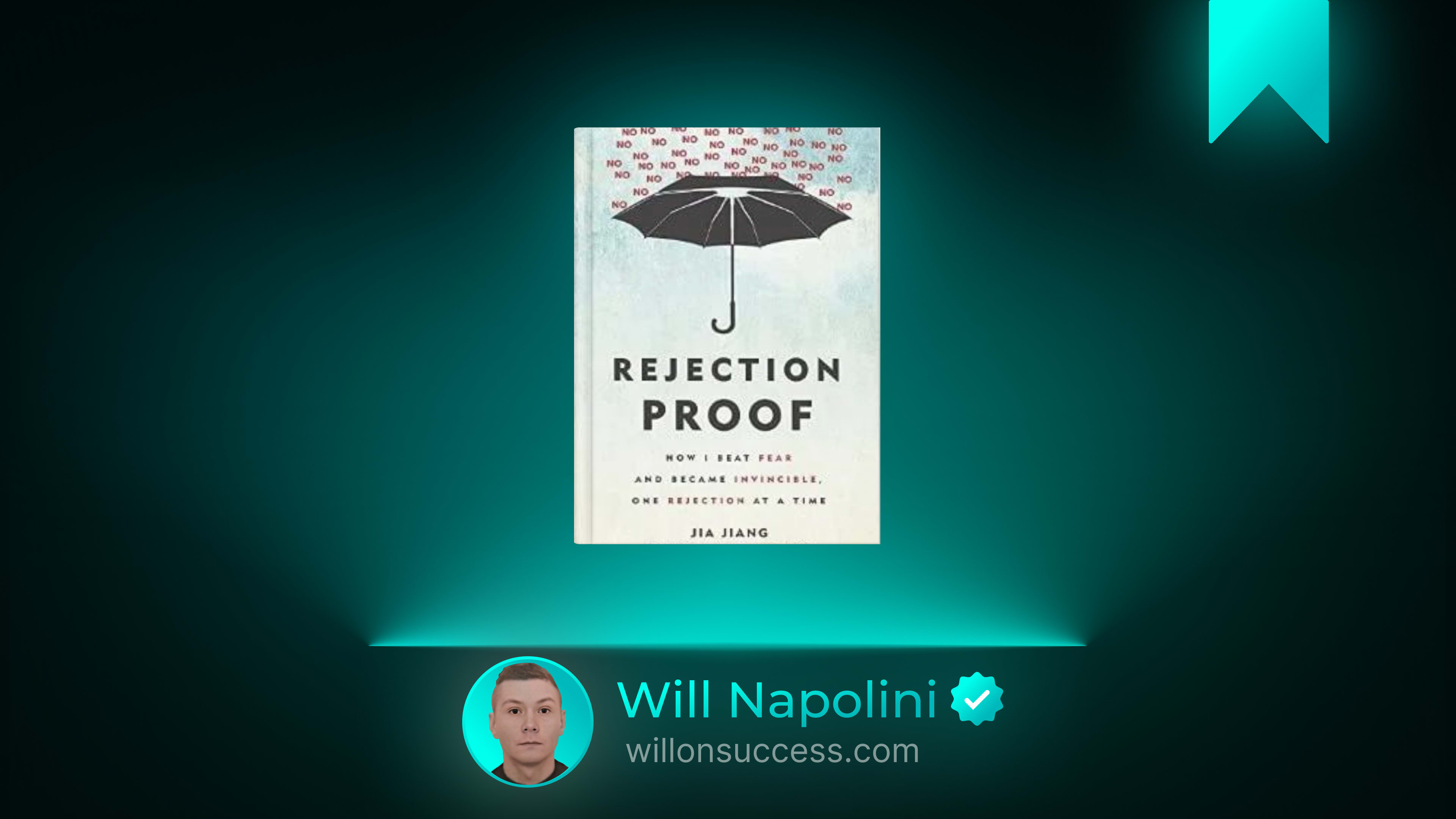
In his transformative book Rejection Proof: How to Beat Fear and Become More Resilient, entrepreneur and speaker Jia Jiang dismantles this paralyzing illusion. Through a radical, self-imposed experiment, he discovered a profound truth: The fear of rejection is far more destructive than the rejection itself. And the only way to conquer that fear is not to avoid it, but to run directly toward it.
The Anatomy of a Fear Response
To understand why this matters, we have to look at where this fear comes from.
Jia Jiang traces his own terror of rejection back to a childhood memory. At six years old, he participated in a classroom game where children were supposed to praise one another. One by one, his classmates received compliments. Jia waited. And waited. No one praised him. He was left standing alone, internalizing a silent, crushing belief: I am not worthy of being chosen.
Decades later, that childhood wound nearly destroyed his adult dreams. After leaving a secure corporate job to pursue his passion as an entrepreneur, Jia pitched his startup to a prominent investor. The investor rejected him. For most people, this is a standard business hurdle. For Jia, it was a catastrophic trigger. The childhood wound tore open. He felt entirely worthless and was ready to abandon his entrepreneurial dream altogether.
But instead of retreating into safety, Jia made a decision that sounds entirely irrational on paper. He decided to seek out rejection on purpose.
He discovered a concept called “Rejection Therapy” and committed to 100 Days of Rejection. His goal was simple: Ask strangers for absurd, unreasonable things every single day just to get rejected. He asked a stranger if he could borrow $100. He asked to be a greeter at Walmart. He asked a pilot if he could make an announcement over the airplane’s PA system.
He expected to build up a callous. What he actually built was a bridge to a completely different way of living.
The Magic on the Other Side of the Ask
The defining moment of Jia’s experiment—and perhaps the most beautiful illustration of his core thesis—happened at a Krispy Kreme donut shop.
On day three of his challenge, Jia walked up to the counter and asked the employee, Jackie, for a box of donuts shaped like the interlocking Olympic rings. It was an absurd request. He fully expected her to laugh at him, tell him no, and validate his belief that the world was a hostile, unaccommodating place.
But Jia didn’t just drop the request and run away. He stayed. He explained why he was doing this. He told her about his 100-day challenge and his deep fear of rejection.
Jackie didn’t reject him. She didn’t even say no. Instead, she grabbed a pen and paper, asked him to draw the symbol, took it into the back kitchen, and fifteen minutes later emerged with a freshly made, perfectly glazed box of Olympic ring donuts.
Jia didn’t get rejected. He got a miracle. And it went viral, changing the trajectory of his life.
Why did this happen? Because Jia stayed in the arena. He discovered that when you stop treating “no” as a lethal weapon, you give the people around you the space to surprise you. You stop managing their assumptions and start connecting with their humanity.
Rejection Is a Mismatch, Not a Verdict
One of the most liberating shifts you can make in your life is realizing that rejection is rarely about you.
When we hear the word “no,” our ego immediately translates it into a personal indictment. They don’t like me. My idea is stupid. I am not enough. But Jia’s experiment revealed that rejection is almost always a matter of mismatched circumstances, timing, or resources.
Think of a puzzle piece. If you try to force a piece into a spot where it doesn’t fit, it isn’t a “bad” piece. It simply belongs to a different part of the puzzle. The person rejecting your offer might be stressed, bound by corporate policy, lacking the budget, or simply not in a position to say yes.
When you separate your identity from the outcome of the ask, the sting of rejection vanishes. You begin to see “no” for what it actually is: a simple redirection. A “no” only becomes a wall if you turn around and walk away. If you stay, it often becomes a door.
The Power of the Follow-Up Question
Most of us treat the word “no” as a stop sign. Jia Jiang teaches us to treat it as a starting line.
During his 100 days, Jia went to a Walmart and asked the manager if he could stand at the door and greet customers. The manager said no. In the past, Jia would have felt the hot flush of shame, mumbled an apology, and fled the store.
Instead, he took a breath and asked a simple, non-confrontational question: “Why?”
The manager explained that it was a liability issue; if a customer slipped while Jia was greeting them, the store could be sued. Jia then asked, “What if I just stand here, keep my hands in my pockets, and don’t say a word?” The manager laughed and admitted that wouldn’t be a liability, but it also wouldn’t be much of a greeting. They ended up having a genuine conversation, and the manager allowed Jia to help out in a different capacity.
By asking “why,” Jia moved the interaction from a binary pass/fail judgment into a collaborative problem-solving session.
When you ask for something and get rejected, the most powerful tool in your arsenal is curiosity. “I understand. Just so I can learn for next time, what would it take to make this a yes?” or “Is there a different way we could structure this?”
You will be astonished by how often a “no” is actually just an unspoken “not exactly like this.” People want to help you, but you have to give them the roadmap to do it.
Vulnerability Is the Ultimate Disarmament
We often think that to succeed in business or life, we need to project an armor of unshakeable confidence. We believe that showing fear makes us weak.
Jia’s experiment proved the exact opposite. When he approached strangers and prefaced his absurd requests with, “I’m doing this because I’m terrified of rejection and I’m trying to get over my fear,” people dropped their defenses.
When you own your vulnerability, you signal to the other person that you are not a threat. You are a fellow human being trying to grow. The “Burger Refill” story perfectly illustrates this. Jia went to a fast-food drive-thru and asked for a “burger refill,” exactly like a soda refill. The request was ridiculous. The manager initially said no. But because Jia was honest about his awkward experiment and didn’t act entitled, the manager found it endearing and handed him the food anyway.
Authenticity disarms people. When you stop trying to look perfect and start being real, you invite others to meet you in that reality. You trade the exhausting performance of invulnerability for the quiet power of being known.
How to Reclaim Your Agency Today
Why should you care about shifting your relationship with rejection? Because the trajectory of avoiding “no” leads to a life of profound regret.
Imagine what changes in your daily life when you stop letting the fear of a two-letter word dictate your boundaries and your ambitions.
At work, you stop accepting the first salary offer because you are afraid to negotiate. You start pitching the bold ideas in the meeting, knowing that even if they are shot down, your willingness to speak up builds your reputation as a leader.
In your personal life, you stop waiting for others to read your mind. You start asking for the help you need, expressing the affection you feel, and setting the boundaries that protect your energy.
You realize that every great opportunity, every deep relationship, and every meaningful breakthrough in your life is sitting behind a door that requires you to knock. If you never knock, you guarantee a “no.” If you do knock, you at least give yourself a chance.
Understanding this is valuable, but understanding without action changes nothing. If you want to build the muscle of resilience, you must start small. You must prove to your nervous system that you can survive the word “no.”
Set a “No” Quota Instead of setting a goal to get three “yeses” this week, set a goal to collect three “nos.” Gamify the process. Ask a colleague for a favor you know they might decline. Ask a local business for a small discount. When you hear the word “no,” mentally check a box. You are retraining your brain to see rejection as a successful completion of a task, rather than a personal failure.
Use the Honest Preamble The next time you are nervous to make an ask, do not try to hide it. Say the quiet part out loud. “I’m a little nervous to ask this because I don’t want to overstep, but…” or “This might be a long shot, but…” Watch how the person across from you softens. You have just bypassed their skepticism and spoken directly to their empathy.
Practice the “Why” Pivot The next time you receive a mild rejection in a low-stakes environment, resist the urge to flee. Take one deep breath, smile, and ask, “I completely understand. Would you mind sharing what the main factor was?” You don’t have to argue with their reason. Just listen. You will begin to see the hidden architecture of human decision-making, and you will realize how rarely it has anything to do with your worth.
Who Needs to Read This Book
Rejection Proof is essential reading for the chronic over-thinker, the aspiring entrepreneur, the creative pitching a portfolio, and the people-pleaser who is exhausted by the effort of avoiding conflict. If you have ever abandoned a brilliant idea because you were terrified of looking foolish, this book will hand you the psychological armor you need to step into the arena. It is for anyone who realizes that their fear of judgment is costing them their dreams.
However, if you are someone who already struggles with being overly aggressive, or if you are looking for manipulative, high-pressure sales tactics to force people into submission, this book is not for you. Jia Jiang is not teaching you how to bully the world into giving you what you want. He is teaching you how to build the internal resilience required to ask for what you deserve, and the grace to accept the answer.
Your First Step Toward Being Brave
You do not need to ask for Olympic donuts or try to commandeer an airplane intercom to start changing your life. Change happens in the quiet, seemingly insignificant moments where you choose courage over comfort.
So here is what I want you to do today.
Go to a local coffee shop, a bakery, or a retail store. Order your item, and right before you tap your card to pay, take a breath and ask, “Is there any way I could get a 10% discount on this today?”
They will probably say no. They might look at you a little strangely. They might say, “Sorry, our system doesn’t allow it.”
When they say no, I want you to smile, say, “I completely understand, thank you anyway,” and pay full price.
As you walk out of that store, pay attention to your body. Notice that your heart is still beating. Notice that the sky has not fallen. Notice that you survived the exact thing you have spent your entire life avoiding.
You do not need to eliminate your fear to be brave. You just need to stop letting it drive the car. Take a breath, ask the question, and let the word “no” set you free.