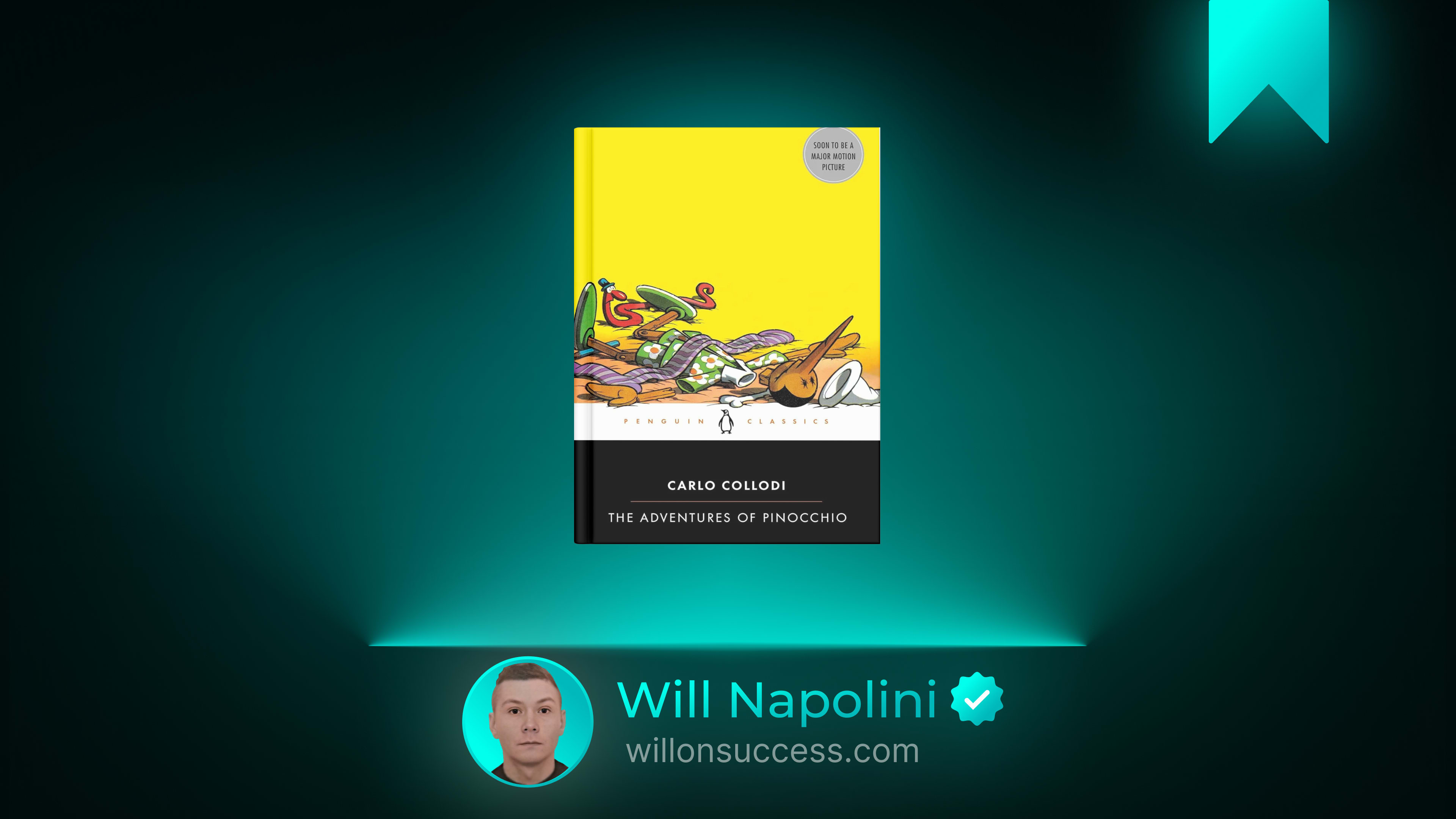
The Adventures of Pinocchio Summary: The Messy, Beautiful Process of Becoming Who You Are Meant to Be
I want to show you a dangerous illusion we all carry about personal growth.
It is the belief that transformation is a magical event. We think that if we just find the right mentor, read the right book, or have the right breakthrough, we will instantly become the mature, disciplined, successful person we want to be. We want the fairy godmother to wave a wand and turn our raw potential into solid reality.
But if I could sit across the table from you, I would gently tell you that this is not how human beings are made.
Growth is not a magical transformation. It is a grueling, messy, often painful process of chiseling away everything that is false, lazy, and selfish until only what is real remains.
Most of us only know the sanitized, musical version of Carlo Collodi’s The Adventures of Pinocchio. But the original 1881 novel is not a gentle children’s story. It is a gritty, dark, and profoundly brilliant manual on the agonizing process of human maturation. It is a story about what it actually takes to become a “real boy”—or in our terms, a fully realized, responsible, character-driven adult.
Here is what I have learned from Collodi’s masterpiece, and how you can use its hard-won wisdom to stop living as a puppet to your impulses and start taking ownership of your own life.
The Big Idea: You Are Not Born with Character; You Are Built
The central thesis of The Adventures of Pinocchio is that potential is not the same as character.
When the carpenter Geppetto carves Pinocchio out of a piece of magical talking wood, the puppet is given the shape of a boy, but he has none of the substance. He is impulsive, selfish, lazy, and entirely ruled by his immediate desires. He wants to be a “real boy,” but he has no idea what that actually requires.
Collodi’s underlying philosophy is that character is not an inheritance. It is an achievement. You do not become a person of integrity, discipline, and wisdom by accident, and you certainly do not become one by taking shortcuts. You become real through a long series of difficult choices, painful consequences, and the quiet, unglamorous commitment to doing the right thing when no one is watching.
The journey from wood to flesh is the journey from being controlled by your environment and your impulses to being governed by your own internal principles.
The Story on the Road: A Masterclass in Consequences
To understand the depth of this lesson, we have to look at the actual journey Collodi’s Pinocchio takes. It is a journey of spectacular, repeated failures.
Pinocchio is created with immense potential, but he immediately rebels. He is given a father who loves him and sacrifices for him, but Pinocchio repays that love by running away. He is visited by the Talking Cricket, who offers him wise, practical advice. Pinocchio’s response? He throws a hammer at the cricket and kills it.
From there, it is a downward spiral. He sells the spelling book his father bought for him—literally selling his father’s coat to buy it—just to get into a puppet theater. He falls for a get-rich-quick scheme from a Fox and a Cat, burying his gold coins in the “Field of Miracles” to grow a money tree, only to be robbed and nearly hanged. He ignores the warnings of the beautiful Blue Fairy. He runs away to the “Land of Toys,” a place where boys play all day and never study, only to wake up and find he has literally transformed into a donkey, sold to a circus, and worked to the brink of death.
It is only after hitting absolute rock bottom—after being humiliated, exhausted, and realizing the devastating cost of his own laziness and greed—that Pinocchio changes.
He commits to honest, daily labor. He studies late into the night. He cares for his ailing, impoverished father. He stops looking for magic beans and starts doing the hard, boring work of being a good son and a good student.
Only then, at the very end of the book, does he wake up as a real boy. The magic was not in the wood. The magic was in the work.
The Raw Material Is Not the Final Product
Potential vs. Character
One of the most important distinctions in this book is the difference between what you are given and what you build.
Pinocchio starts as a piece of wood. He has the capacity to become a boy, but the wood itself is just raw material. In your own life, your raw material is your genetics, your upbringing, your natural talents, and your initial circumstances.
Many of us spend our lives complaining about the quality of our wood. We blame our parents, our economy, our lack of formal education, or our natural dispositions. We say, “I am just built this way,” or “I didn’t have the right start.”
But Collodi reminds us that the raw material is just the beginning. Geppetto did the initial carving, but Pinocchio had to do the refining.
You may have been dealt a difficult hand. You may feel like your starting wood is knotted and flawed. But character is not about the quality of the wood you were given; it is about the discipline you apply to shape it. Growth before achievement. The goal is not merely to look like a successful person on the outside; it is to do the internal carving required to actually become one.
Ignoring the Quiet Voice Always Costs More Than Listening To It
The Tragedy of the Talking Cricket
Early in the story, the Talking Cricket appears to warn Pinocchio that a life of laziness and disobedience will lead to ruin. It is the voice of conscience. It is the voice of long-term wisdom.
Pinocchio finds this voice annoying. It disrupts his immediate fun. So, he silences it.
How often do we do the exact same thing?
You know you should save that money instead of buying the luxury item. You know you should have the difficult, honest conversation with your partner instead of avoiding it. You know you should put the phone away and do the deep work instead of scrolling for another hour.
That quiet, persistent voice inside you is your Talking Cricket. It is not there to ruin your fun; it is there to save your life. But when we find the truth inconvenient, we squash it. We rationalize. We distract ourselves.
But here is the hard truth: you can kill the cricket, but you cannot escape the consequences of ignoring it. Every time you silence your inner wisdom to serve a short-term impulse, you are walking one step closer to the Land of Toys. You are choosing the illusion of freedom over the reality of self-mastery.
The Trap of the “Field of Miracles”
Shortcuts vs. Substance
Perhaps the most cautionary tale in the book is Pinocchio’s encounter with the Fox and the Cat. They convince him that if he plants his gold coins in the Field of Miracles and waits twenty minutes, a tree will grow bearing thousands of gold coins.
Pinocchio is desperate for a shortcut. He wants the reward without the work. He wants the harvest without the planting.
We live in a world that is entirely obsessed with the Field of Miracles. We are sold diet pills instead of discipline. We are sold “get rich quick” schemes instead of decades of compounding skill. We are sold communication hacks instead of the hard work of building genuine empathy.
But principles do not bend for shortcuts. The Fox and the Cat are not just thieves in the story; they are the personification of the lie that you can bypass the process.
When you chase the Field of Miracles, you do not just fail to get rich or get fit. You actually lose what you already had. Pinocchio lost his gold. In your life, chasing shortcuts will cost you your time, your integrity, and your peace of mind. True substance is always built in the slow, unglamorous dirt of daily consistency, never in the magical soil of a quick fix.
You Become What You Indulge
The Donkey Transformation
The darkest and most brilliant metaphor in Collodi’s book is the Land of Toys. It is a place where there is no school, no rules, and no work. The boys just play, eat sweets, and stay up late. It sounds like paradise.
But after a few months of this pure indulgence, the boys begin to change. They grow donkey ears. They grow tails. Eventually, they turn entirely into donkeys, unable to speak, forced to pull carts and perform in circuses.
The moral here is stark and unforgiving: if you dedicate your life entirely to pleasure, avoidance of effort, and the indulgence of your base impulses, you will lose your humanity. You will become a beast of burden, a slave to your own appetites, pulled around by the whips of your own bad habits.
When you refuse to do the hard work of studying, of building a skill, of delaying gratification, you are not “freeing” yourself. You are slowly turning into a donkey. You are surrendering your agency.
Freedom is not the absence of rules. Freedom is the ability to govern yourself. When you master your impulses, you are a real boy. When you let your impulses master you, you are an animal pulling a cart.
Why This Matters on an Ordinary Tuesday
It is easy to read a fairy tale and think it belongs in a nursery. But the collision between the desire for shortcuts and the demand for character happens to you every single week.
When you embrace the lessons of Collodi’s original tale, your ordinary Tuesday changes.
When you are tempted to buy into a “Field of Miracles” scheme—whether it is a risky financial gamble or a fad diet that promises overnight results—you hear the quiet voice of the Cricket. You recognize it as a trap. You choose the boring, proven path of slow, consistent effort.
When you are exhausted and tempted to retreat to the “Land of Toys” by doomscrolling on your phone until 2:00 AM, you recognize the donkey ears growing on your head. You put the phone away. You choose the discomfort of rest or reading over the numbness of endless consumption.
When you fail, and you will fail, you do not blame the Fox, the Cat, or the Blue Fairy. You take responsibility. You do the hard work of repairing the damage.
You stop waiting for a magic wand to make you a “real” adult. You realize that becoming real is a daily choice.
Practical Application: Turning Concepts into Behavior
Understanding the metaphor of the wood and the carving is only the first step. Action before intention. Here is how you can apply this framework to your life starting today.
1. Identify Your “Field of Miracles”
Take a hard look at your current goals. Where are you looking for a shortcut? Are you trying to learn a language in a week? Are you trying to build a business without doing the foundational market research? Are you trying to fix a relationship with a single grand gesture instead of daily consistency? Identify one area where you are hoping for magic. Abandon the shortcut. Write down the slow, boring, unglamorous daily action that actually builds that skill or relationship. Commit to doing it for the next thirty days.
2. Resurrect the Cricket
For the next seven days, practice listening to your inner voice before you make a decision. When you are about to procrastinate, overeat, snap at a loved one, or buy something you cannot afford, pause for three seconds. Ask yourself: What is the quiet voice in my head telling me to do right now? Do not squash it. Acknowledge it. Even if you ultimately choose the wrong path, you must start by hearing the truth your own conscience is trying to tell you.
3. The Daily “Real Boy” Habit
Pinocchio only became real when he committed to daily, unglamorous responsibility. Choose one small, difficult task that you have been avoiding because it requires effort without immediate reward. It could be balancing your checkbook, doing a difficult workout, or having a necessary but uncomfortable conversation. Do it first thing in the morning. Do not negotiate with yourself. Treat it as the daily chisel stroke that is carving you into the person you want to be.
Who Should Read This Book
The Adventures of Pinocchio is essential reading for anyone who feels stuck in a cycle of starting and stopping, or anyone who is constantly looking for a “hack” to bypass the hard work of personal growth. It is a profound book for parents, as it strips away the sugar-coating of modern child-rearing and reminds us that children (and adults) require firm boundaries, natural consequences, and the demand for responsibility to truly mature.
Who might find it less useful? If you are looking for the gentle, musical, heartwarming story of the Disney film, you will be shocked by Collodi’s original text. It is strange, dark, sometimes violent, and deeply moralistic. It is not a light, breezy read. But if you are willing to look past the 19th-century fairy tale veneer, you will find one of the most accurate psychological portraits of human maturation ever written.
One Small Step
You do not need to overhaul your entire life today. You just need to make one choice that rejects the illusion of the shortcut.
Here is your one small step: Identify one thing you have been putting off today because it is difficult, boring, or uncomfortable. It is the opposite of the Land of Toys.
Do it right now. Do not wait for motivation. Do not wait for it to feel easy. Just pick up the chisel and strike the wood.
The Courage to Become Real
We spend so much of our lives wishing we were already finished. We wish the hard parts of growing up were behind us. We wish we could just skip to the end of the story where we are wise, successful, and at peace.
But the deepest lesson of The Adventures of Pinocchio is that the carving never really stops.
Becoming a “real boy” is not a destination you arrive at; it is a manner of traveling. It is the daily, courageous choice to reject the easy lie in favor of the hard truth. It is the willingness to let your selfish impulses be burned away in the fire of discipline, so that what remains is solid, enduring, and true.
You cannot buy the wood of character with the counterfeit coins of shortcuts. You have to carve it yourself, stroke by stroke, choice by choice.
The magic is not in the wand. The magic is in the work. Pick up your tools. The carving is waiting.