The Adventures of Huckleberry Finn Summary: How to Find Your True Moral Compass in a Noisy World
There is a quiet, agonizing moment in every person’s life when the rules you were taught suddenly clash with the truth you feel in your gut.
You are standing at a crossroads. On one side is the path of least resistance—the expectations of your family, the norms of your culture, the comfortable way things have “always been done.” On the other side is a quieter, narrower path that your own humanity is urging you to take, even though it makes you feel guilty, confused, or afraid of being judged.
If I could sit across the table from you, I would tell you that this internal friction is not a sign that you are broken. It is a sign that you are waking up.
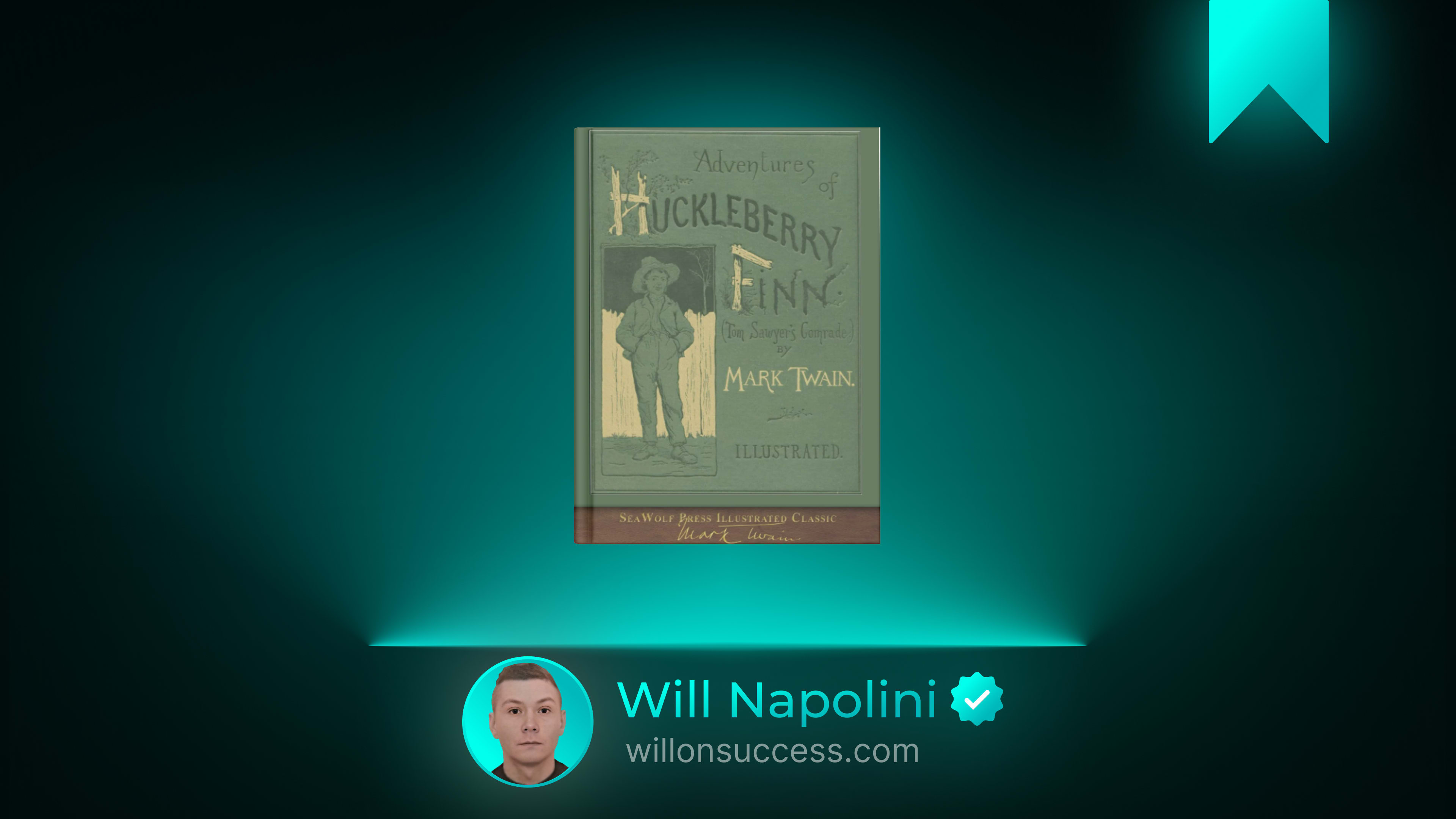
For over a century, readers have analyzed Mark Twain’s The Adventures of Huckleberry Finn as a great American novel, a satire of the antebellum South, or a masterpiece of dialect and humor. But beneath the adventure and the historical setting lies a profound, deeply personal blueprint for human development.
Twain himself described the core of this book in his explanatory note: it is a story where “a sound heart and a deformed conscience come into collision and conscience suffers defeat.”
Here is what I have learned from Huck’s journey down the Mississippi, and how you can use his hard-won wisdom to stop living by someone else’s flawed map and start navigating by your own true north.
The Big Idea: True Character Is Found in the Collision Between Society and the Soul
The central thesis of Huckleberry Finn is that society’s rules are often deeply flawed, and blindly following them will cost you your humanity.
When we hear the word “conscience,” we usually think of it as a flawless internal compass pointing toward good. But Twain introduces a radical, uncomfortable idea: what if your conscience has been deformed by a corrupt society? What if the very thing making you feel guilty is actually the right thing to do?
Huck Finn is an uneducated, marginalized boy who has been taught by his entire world that helping a runaway slave named Jim escape is a sin. His “deformed conscience” tells him he is wicked. But his “sound heart”—his innate, uncorrupted sense of human connection and empathy—tells him that Jim is his friend.
The ultimate victory of this novel is not surviving the river. The victory is Huck’s decision to trust his sound heart over his deformed conscience. He chooses his own innate humanity over the inherited dogma of his culture.
This is the ultimate personal development journey. Growth is not just about learning new skills; it is about having the courage to unlearn the false rules that keep you small, and the bravery to trust your own moral intuition when the crowd demands you conform.
The Story on the River: A Journey of Moral Awakening
To understand the power of this lesson, we have to look at the physical journey Huck and Jim take. They build a small raft and push off into the Mississippi River, trying to navigate toward the free states.
This physical journey is a brilliant metaphor for the internal journey of self-discovery.
On the raft, there is peace. There is honesty. There is a deep, quiet equality between a runaway boy and a runaway slave. The river represents the raw, unfiltered truth of human connection when you strip away the artificial structures of society.
But every time they go ashore, the illusion of a civilized world shatters. They encounter the absurd, violent feud between the Grangerfords and the Shepherdsons. They are manipulated by the “Duke” and the “Dauphin,” two con men who represent the greed and hypocrisy of the towns. They see a mob ready to lynch an innocent man.
The shore represents the crowd. It represents the institutions, the social norms, and the collective madness of a society that has lost its moral footing.
Twain is showing us a fundamental truth: you cannot find your true self while you are constantly surrounded by the noise, expectations, and corruptions of the crowd. Clarity requires distance. You have to get on the raft.
The Shore Will Always Try to Corrupt Your Compass
The Danger of Inherited Dogma
One of the most vital lessons in this book is the realization that just because a rule is universally accepted, does not mean it is right.
Huck grows up in a society that tells him Black people are property, that “sivilization” is a virtue, and that religion is about following strict, often hypocritical, doctrines. Because everyone around him believes these things, Huck internalizes them. He feels genuine guilt when he helps Jim.
How often do we do the exact same thing?
You may be working in a corporate culture that rewards cutting corners, and you feel like a failure for wanting to do things the right way. You may be in a family dynamic that demands you sacrifice your own mental health to keep the peace, and you feel selfish for setting a boundary. You may be navigating a social media landscape that demands you perform a certain identity, and you feel inadequate for just being yourself.
We often mistake conformity for character. We think that if we just follow the rules of the “shore,” we will be safe. But Twain warns us that the shore is often where the worst of human nature hides behind a veneer of politeness and tradition.
If your compass is calibrated by a corrupt society, it will always point you in the wrong direction. You have to be willing to look at the map you were handed and ask, “Who drew this, and where were they trying to lead me?”
A Guilty Conscience Is Sometimes Just a Well-Trained Mind
The Courage to Defy Your Own Guilt
The climax of Huck’s internal journey is one of the most famous moments in literature. Huck is alone on the raft. He thinks about Miss Watson, the woman who tried to “sivilize” him, and he feels a surge of guilt for helping Jim escape. He decides he must do the “right” thing and turn Jim in.
He sits down to write the letter. He thinks about how helping Jim will make him an outcast. He thinks about the rules he was taught. He says to himself, “It was a close place… I took it up, and held it in my hand. I was a-trembling, because I’d got to decide, forever, betwixt two things, and I knowed it.”
He tries to pray for forgiveness, but the words won’t come. He looks at Jim, who is sleeping, and hears Jim say, “Huck, you’s de bes’ fren’ Jim’s ever had; en you’s de only fren’ ole Huck has got now.”
Huck looks at the letter. He looks at Jim. And he makes his choice.
“I was a-trembling, because I’d got to decide, forever, betwixt two things, and I knowed it. I studied a minute, sort of holding my breath, and then says to myself: ‘All right, then, I’ll go to hell’—and tore it up.”
This is the essence of moral courage. Huck is willing to accept the ultimate punishment—eternal damnation, according to his deformed conscience—rather than betray his friend. He realizes that if doing the right thing means going to hell, then he would rather go to hell than do the wrong thing.
When you finally decide to trust your sound heart, the guilt you feel is not a sign that you are doing something wrong. It is just the friction of your old programming breaking apart.
Clarity Requires Distance from the Crowd
The Necessity of the “River”
You cannot hear your own thoughts when you are constantly reacting to the demands of the shore. Huck and Jim only find their deepest conversations, their truest selves, and their moral clarity when they are out on the water, drifting away from the towns.
In our modern lives, the “shore” is everywhere. It is the 24-hour news cycle. It is the endless notifications. It is the pressure to maintain an image. It is the opinions of people who do not actually have to live with the consequences of your choices.
If you want to know what you actually believe—if you want to separate your sound heart from your deformed conscience—you have to intentionally create distance. You have to build a raft.
This does not mean you have to run away to the woods. It means you must carve out sacred, uninterrupted space in your life where the voices of the shore cannot reach you. It is in the silence, away from the performative demands of the crowd, that your true moral compass finally settles and points true north.
Why This Matters on an Ordinary Tuesday
It is easy to read a 19th-century adventure novel and think it has nothing to do with your modern life. But the collision between the sound heart and the deformed conscience happens to you every single week.
When you embrace the lessons of the river, your ordinary Tuesday changes.
When a colleague takes credit for your work, and your “deformed conscience” (trained by a culture of corporate politeness) tells you to stay quiet and keep the peace, your “sound heart” reminds you of your own dignity. You choose to speak up, calmly and professionally.
When you are exhausted and need to say no to a social obligation, and your “deformed conscience” tells you that you are being a bad friend, your “sound heart” reminds you that you cannot pour from an empty cup. You choose to stay home and rest.
When you stop trying to calibrate your life to the expectations of the shore, you stop living in a state of quiet desperation. You replace the anxiety of people-pleasing with the deep, grounded peace of personal integrity.
Practical Application: Turning Concepts into Behavior
Understanding the metaphor of the river and the shore is only the beginning. Action before intention. Here is how you can apply Huck’s journey to your own life starting today.
1. The “Shore” Audit
Take a piece of paper and draw a line down the middle. On the left side, write “The Shore.” List three expectations, rules, or habits you currently follow simply because “that’s what you’re supposed to do” or because you are afraid of disappointing others. On the right side, write “The River.” For each item on the left, write down what your actual, uncorrupted humanity tells you to do instead. Look at the right side. Choose one of those truths to act on this week.
2. Build Your Weekly Raft
You cannot navigate your life if you never leave the dock. Schedule one hour this week where you are completely disconnected from the “shore.” Turn off your phone. Close your laptop. Go for a walk, sit in a quiet room, or drive without the radio on. During this hour, ask yourself one question: What is something I am doing right now just to meet an external expectation? Do not force an answer. Just let the question sit in the quiet. Clarity will follow.
3. The “Sound Heart” Pause
The next time you face a decision and feel a wave of guilt or anxiety, pause before you react. Ask yourself: Is this guilt coming from my sound heart, telling me I am about to do something truly harmful? Or is it coming from my deformed conscience, telling me I am about to break a rule that doesn’t actually matter? Learn to tell the difference between the voice of integrity and the voice of indoctrination.
Who Should Read This Book
The Adventures of Huckleberry Finn is essential reading for anyone who feels trapped by the expectations of their family, their culture, or their industry. It is a profound book for anyone who has ever felt like an outsider, or who is struggling to reconcile their own innate goodness with the flawed systems they live inside. It teaches the vital skill of critical thinking and moral courage.
Who might find it less useful? It is important to be honest about the reading experience. This is a 19th-century novel. It contains outdated, offensive racial slurs and depicts the brutal realities of a deeply flawed historical era. It is not a light, easy read, and it requires the reader to grapple with heavy, uncomfortable themes. If you are looking for a straightforward, purely uplifting self-help book, this is not it. But if you are willing to wrestle with deep moral questions and extract the timeless wisdom from a complex narrative, it will change the way you view your own conscience.
One Small Step
You do not need to tear up a literal letter or run away on a raft today. You just need to acknowledge the voice of your own humanity.
Here is your one small step: Think of one small, everyday situation where you recently compromised your own truth just to keep the peace or meet an expectation.
Write it down. Next to it, write: “Next time, I will listen to my sound heart.”
You do not have to fix the whole situation today. Just make the decision that, in the future, you will no longer let the shore dictate your direction.
The Courage to Navigate Your Own Waters
We spend so much of our lives trying to build the perfect house on the shore. We try to arrange the furniture of our lives exactly the way society tells us to. We paint the walls the approved colors. We invite the approved guests. And yet, we sit in the parlor feeling a quiet, unexplainable emptiness.
But the deepest lesson of The Adventures of Huckleberry Finn is that you were not built to live on the shore. You were built to navigate the river.
Your moral compass is not found in the applause of the crowd, and it is not found in the rigid rules of a corrupt system. It is found in the quiet, courageous space where you choose to listen to your own sound heart, even when it terrifies you.
The shore will always try to pull you in. The current will always be strong. But you have the power to push off, to trust your own navigation, and to drift toward the person you were actually meant to be.
Untie the rope. The river is waiting.