The Very Hungry Caterpillar: What Eric Carle's Timeless Story Teaches Us About Growth, Self-Control, and Transformation
Have you ever noticed how the simplest stories often carry the deepest truths?
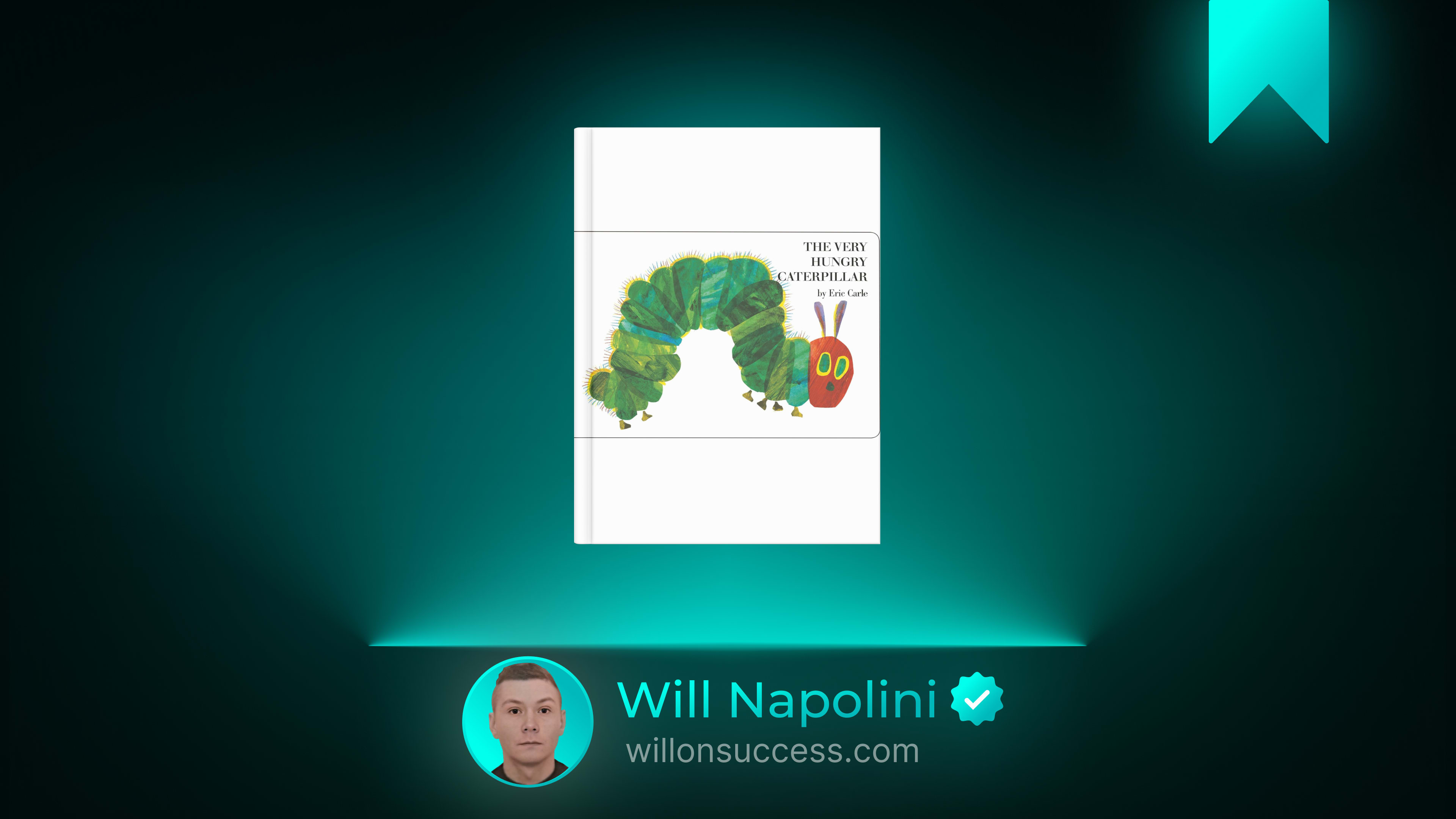
I want to tell you about a book that has sold more than 55 million copies and been translated into over 70 languages. It is a children’s picture book with colorful collage illustrations and pages with little holes where a hungry caterpillar has eaten his way through. On the surface, it is a story about a caterpillar who eats a lot of food and becomes a butterfly.
But if you look closer, The Very Hungry Caterpillar by Eric Carle is really about something far more profound: the messy, necessary process of becoming who you are meant to be.
The Big Idea: Transformation Requires Both Indulgence and Discipline
Here is what I have learned from this deceptively simple story: Growth is not a straight line. It is a journey that includes experimentation, mistakes, course correction, and ultimately, transformation.
The caterpillar does not emerge from his egg knowing exactly what to eat or how to behave. He is hungry—very hungry—and he follows that hunger wherever it leads him. Some choices nourish him. Others give him a stomach ache. But every choice, even the poor ones, is part of his journey toward becoming a butterfly.
What I discovered was that this story speaks to something universal: we all start small. We all feel hungry—for knowledge, for experience, for meaning. And we all must navigate the tension between what feels good in the moment and what serves our long-term growth.
The Story: A Week of Eating and Becoming
Let me walk you through what happens in this story, because the details matter.
On a Sunday morning, a tiny and very hungry caterpillar hatches from his egg. He is small, and he is searching. For the next five days, he eats through an increasing quantity of fruit: one apple on Monday, two pears on Tuesday, three plums on Wednesday, four strawberries on Thursday, and five oranges on Friday.
But here is the truth: the caterpillar is still hungry.
So on Saturday, he feasts on an assortment of food: chocolate cake, an ice-cream cone, a pickle, Swiss cheese, salami, a lollipop, cherry pie, a sausage, a cupcake, and a slice of watermelon. That night, he gets a stomach ache from overeating.
On Sunday, the caterpillar makes a different choice. He eats a nice green leaf, and he feels much better. Now a big, fat caterpillar, he builds a cocoon around himself. After two weeks, he nibbles a hole and pushes his way out, emerging as a beautiful, multicolored butterfly.
That is the story. Simple, yes? But let me tell you what I see beneath the surface.
The Major Principles
Growth Is Not Linear—It Is Experimental
The caterpillar does not get it right the first time. He tries fruit. He tries junk food. He overeats. He gets sick. He course-corrects by eating a leaf.
This is how growth actually works in real life.
We experiment. We make mistakes. We learn. We adjust.
I have seen people beat themselves up for not having their life figured out immediately. They compare their chapter one to someone else’s chapter twenty. But the caterpillar teaches us something different: it is okay to be hungry. It is okay to try things. It is okay to overindulge and feel the consequences. What matters is that you keep moving, keep learning, and keep growing.
A small decision becomes a direction, and a direction repeated long enough becomes a life. The caterpillar’s journey from tiny and hungry to beautiful and flying is not a straight line—it is a series of choices, some wise and some not, that all contribute to his transformation.
Self-Control Is Learned Through Experience, Not Lecture
Here is something important: no one tells the caterpillar what to eat. No one warns him about the consequences of eating too much junk food. He has to discover this for himself.
This is the difference between being told something and learning it through experience.
The caterpillar eats the chocolate cake and the lollipop and the cherry pie because he is hungry and they are there. It is only after he gets a stomach ache that he realizes something needs to change. The next day, he chooses a nice green leaf, and it makes him feel better.
This is how self-control is actually developed. It is not imposed from the outside. It is cultivated from within through the natural consequences of our choices.
I have learned that freedom of choice does not mean freedom from consequences. The caterpillar could eat whatever he wanted, but when he ate too much junk food, he felt bad. That discomfort taught him something that no lecture ever could.
What you repeat in private eventually becomes visible in your life. The caterpillar’s private choices—what he ate each day—directly shaped his ability to transform into a butterfly.
Transformation Requires Both Nourishment and Rest
Notice the pattern in this story: the caterpillar eats for six days. On the seventh day, after eating the leaf, he becomes a big, fat caterpillar and builds a cocoon. He rests inside that cocoon for two weeks before emerging as a butterfly.
This is the rhythm of growth: action, then rest. Effort, then integration.
We live in a culture that glorifies constant productivity. But the caterpillar teaches us that transformation happens in the resting, in the cocoon, in the quiet space where we cannot see what is happening but something profound is taking place.
You do not need more motivation. You need a system that honors both effort and rest. The caterpillar did not become a butterfly by eating and eating and eating. He became a butterfly by eating, then resting, then allowing the natural process of metamorphosis to unfold in its own time.
Your Hunger Is Not Your Enemy
The caterpillar is described as “very hungry” from the moment he hatches. That hunger drives everything he does. It is not something to be ashamed of or suppressed. It is the engine of his growth.
I want you to consider this: what if your hunger—for more meaning, more connection, more purpose—is not a problem to be solved but a compass pointing you toward your potential?
The caterpillar could have ignored his hunger. He could have stayed small and safe inside his egg. But he hatched. He searched. He ate. He grew. And eventually, he flew.
Your hunger is your birthright. It is what propels you forward. The question is not whether you are hungry. The question is what you feed that hunger.
Why This Matters in Your Daily Life
You may be wondering what a children’s book about a caterpillar has to do with your life as an adult. Let me show you.
In Your Health: The caterpillar’s journey mirrors our own relationship with food and self-care. We all have days when we eat the fruit and days when we eat the cake. The question is not perfection. The question is whether you can feel the consequences of your choices and course-correct with compassion rather than shame.
In Your Career: You do not start as a butterfly. You start as a tiny, hungry beginner. You try different things. Some work. Some do not. You overcommit and burn out. You learn to set boundaries. You build your cocoon—those quiet periods of skill development and reflection—before you emerge with new capabilities.
In Your Relationships: Growth is messy. You will make mistakes. You will overindulge in the wrong things—people-pleasing, avoidance, control. You will get a stomach ache from these choices. The leaf—the simple, nourishing choice—is often honesty, vulnerability, and presence.
In Your Personal Development: The caterpillar does not become a butterfly overnight. It takes time. It takes patience. It takes trust in a process you cannot fully see or control. Your transformation is no different.
Practical Application: Turning the Story into Action
Here is what I want you to do. These are not grand gestures. They are small, observable actions you can take starting today.
1. The Hunger Inventory
Take ten minutes this week to write down the answer to this question: “What am I truly hungry for right now?”
Not what you think you should want. Not what others expect. What do you actually hunger for? Rest? Creativity? Connection? Adventure? Once you name it, you can begin to feed it wisely.
2. The Leaf Experiment
Tomorrow, identify one “leaf” in your life—one simple, nourishing choice that will make you feel better. It might be a healthy meal. It might be saying no to something that drains you. It might be ten minutes of quiet. Make that choice consciously, and notice how it feels.
3. Honor Your Cocoon
Look at your calendar for the next two weeks. Where is your cocoon time? Where is the space for rest, integration, and unseen growth? If there is none, create it. Block out one hour this week where you do nothing but rest and reflect. Transformation requires this space.
4. Practice Compassionate Course-Correction
The next time you overindulge or make a choice that gives you a “stomach ache”—whether literal or metaphorical—do not shame yourself. Instead, ask: “What did this teach me? What do I need to do differently next time?” Then choose your leaf.
Who Should Read This Book
The Very Hungry Caterpillar is officially a children’s book, and it is wonderful to read aloud to young ones. It teaches them about the days of the week, counting, and the life cycle of a butterfly. But I believe adults should read it too, with fresh eyes.
This book is for you if:
- You are in a season of growth and transformation
- You struggle with self-control and moderation
- You feel impatient with your own progress
- You need permission to experiment and make mistakes
- You are supporting a child through their own growth
This book may be less useful if you are looking for a complex narrative or a step-by-step self-help program. It is a simple story. But simplicity does not mean shallow. Sometimes the simplest stories carry the deepest wisdom.
Eric Carle himself said the book is “a book of hope—that you, an insignificant, ugly little caterpillar can grow up and eventually unfold your talent, and fly into the world.” That message is for all of us, no matter our age.
One Small Step
Do not wait for Monday. Do not wait for the perfect moment. Start where you are.
Here is your one small step: Today, notice your hunger.
When you feel the urge to eat, to scroll, to work, to distract yourself—pause. Ask yourself: “What am I truly hungry for?” Then make one conscious choice to feed that hunger in a way that serves your growth.
You start small. You stay consistent. You let time do its work.
The caterpillar did not know he would become a butterfly when he hatched from that egg. He just followed his hunger, learned from his choices, and trusted the process. You can do the same.
Your cocoon is waiting. Your wings are forming. And the world needs what only you can become.